

Short Answer
If you're years into a relationship and desire no longer arrives on its own the way it did at the start, you haven't fallen out of love or "broken" — you've likely shifted toward responsive desire, where interest builds in response to closeness and context rather than showing up spontaneously. This is one of the most common and normal patterns in long-term relationships, especially after 35, and it's not a downgrade — it's simply a different on-ramp. The catch is that responsive desire needs the right conditions: a body that isn't fried by stress and exhaustion, and unpressured intimacy that gives desire room to build. That's why "just try harder" backfires, and why the real levers are often sleep, stress, and shared mental load rather than novelty or effort. This article explains why the shift happens, why chasing spontaneous desire is the wrong strategy, how the physical conditions matter (and how to see them in your own data), and when a persistent change is worth extra support.
Cohort Context: the "brakes" get busier with age
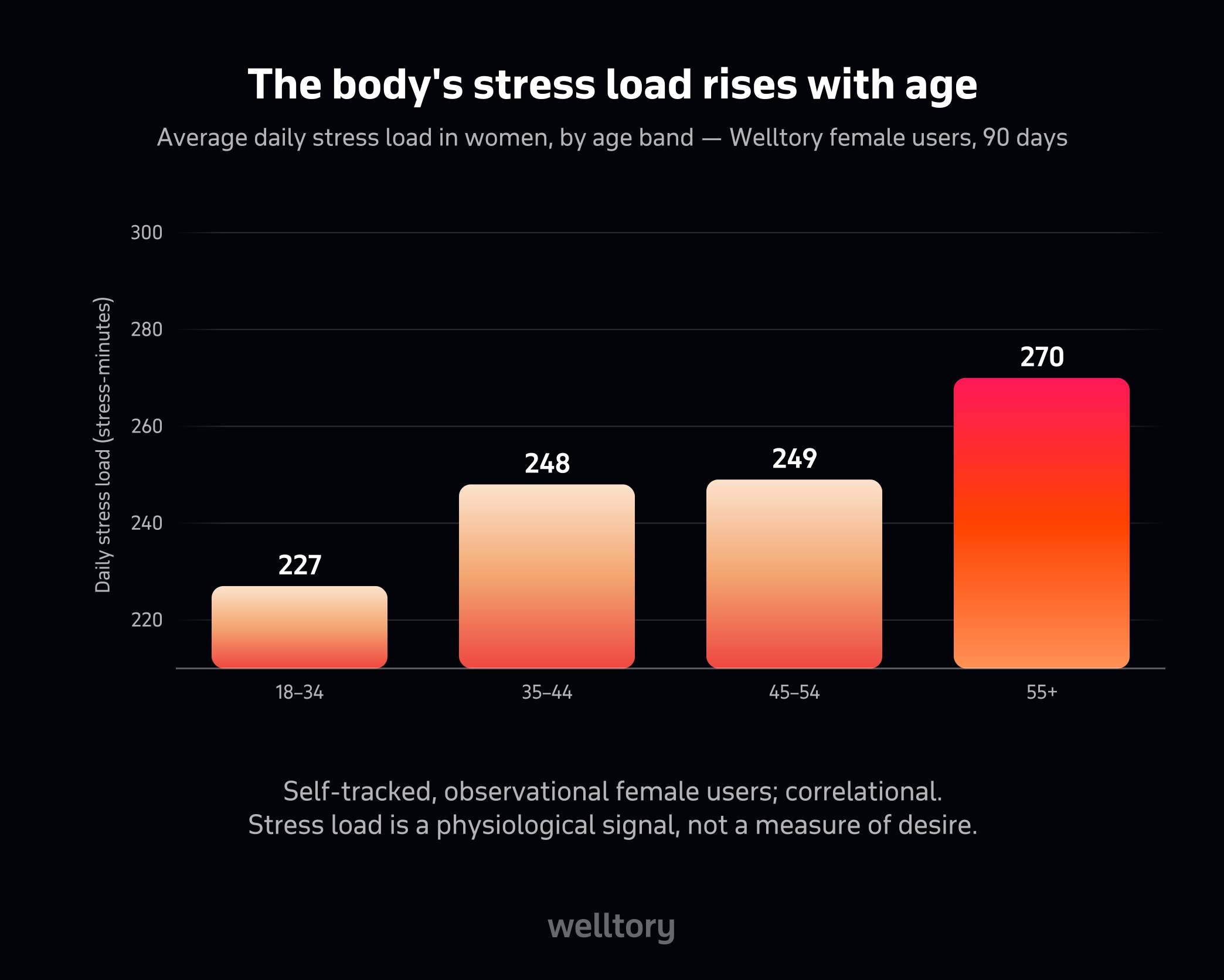
Welltory doesn't measure desire — but it measures the physical state desire depends on, and that state gets busier with age. In our data, women's average daily stress load rose across age groups — from about 227 stress-minutes in the youngest group to about 270 in the 55+ group — while morning energy drifted down. Responsive desire is especially sensitive to that background load: the more the body is running on "busy," the more it needs genuine downshift and unpressured closeness to let desire surface. These are general users, not a measure of anyone's sex life — but they show why "just relax and it'll happen" gets physically harder over the years, and why it isn't laziness.
Spontaneous vs. responsive desire
Early in a relationship, novelty and newness fuel spontaneous desire — the out-of-nowhere urge that makes those first months feel effortless. Over time, for many people (and disproportionately women), desire becomes responsive: it emerges once pleasurable touch, connection, or the right mood gets things going, a pattern researcher Rosemary Basson described as a normal model of sexual response, not a disorder. (tandfonline.com) If you've thought "I'm rarely in the mood beforehand, but I enjoy it once we start," that's responsive desire — and recognizing it removes a huge amount of unnecessary worry. It also completely changes the strategy: instead of waiting for a spark that no longer arrives unprompted, you deliberately create the conditions that let desire build.
Why chasing spontaneous desire backfires
A helpful frame is the dual control model: desire has an "accelerator" (what turns you on) and a "brake" (everything giving your brain a reason not to — stress, fatigue, resentment, the to-do list, feeling watched). (sciencedirect.com) In long relationships, low desire is usually a brakes problem, not a broken accelerator. That's why piling on accelerators — fancy lingerie, pressure to want it more, a "we should have more sex" talk — so often fails: if the brakes are on, the car won't move no matter how hard you press the gas. Worse, the pressure itself becomes another brake. The productive move is to lower the brakes — the stress, the exhaustion, the mental load — and then create unpressured conditions that let responsive desire do its thing.
The physical floor: rest, stress, and connection
Responsive desire doesn't run on willpower — it runs on a nervous system that can downshift. Arousal is a "rest-and-digest" (parasympathetic) state, so when you're chronically under-slept or stressed, your body is stuck in the wrong gear and desire simply has less room to appear. This is where the everyday realities of midlife — careers, kids, aging parents, broken sleep — quietly erode intimacy, not because anything is wrong with the relationship, but because the physical floor desire stands on has been worn thin. It's also why the same couple can feel more connected after a genuinely restful weekend than after an expensive "romantic" night when both partners are exhausted. Protecting rest and real downshift isn't unromantic; it's foundational.
Three neighbouring pieces: what stress and sleep do to women's libido, how cortisol freezes desire in midlife, and performance anxiety, when trying harder makes it worse.
How Welltory helps you see the conditions
You can't put "desire" on a dashboard, and Welltory doesn't try. What it can show you is the physical state responsive desire depends on: your sleep, your stress load, your HRV and recovery — whether your body is actually getting to stand down, or running on "busy" week after week. That visibility is quietly useful for a relationship: it reframes "we never feel like it anymore" from a verdict about the relationship into a question about capacity — are we both chronically depleted? It helps you notice that the stretches when intimacy feels easier tend to line up with better sleep and lower stress, and it makes the case for protecting those conditions instead of scheduling guilt. Data can't fix a relationship, but it can reveal when the real issue is a fried nervous system rather than lost attraction.
How to work with responsive desire
The shift is practical, not romantic-mythical. Give desire a runway: unpressured closeness — touch, affection, time — without the expectation that it must lead somewhere, so interest has room to emerge. Protect the conditions: enough sleep and real downshift from stress, because a depleted nervous system keeps the brakes on. Share the mental load, since invisible labor (the planning, the worrying, the "default parent" tax) is one of the biggest and least-discussed desire-killers in long partnerships — and genuinely handing off pieces, not just delegating tasks while keeping the worry, is what actually lightens it. And drop the scoreboard — comparing to the early, spontaneous days measures the wrong thing. Desire that builds is still desire.
When it's worth extra support
Sometimes a persistent change points to something addressable beyond stress and habit: hormonal shifts around perimenopause, thyroid or mood issues, medications (including some antidepressants and hormonal contraception), pain with sex, or relationship distress that's grown quietly. If low desire is distressing you or straining the relationship, a clinician or a qualified sex or relationship therapist can genuinely help — and reaching out is a strength, not a last resort. The goal isn't to force desire back to its 25-year-old form; it's to remove what's in the way and give the responsive version the conditions it needs.


Discounts for blog readers: up to 36% off
See what affects your energy, stress, sleep, and daily state with Welltory
This article is for educational purposes only and is not medical advice. If a change in desire distresses you or your relationship, a clinician or a qualified sex or relationship therapist can help. Welltory measures physiological signals like heart rate, HRV, sleep, activity, and stress; it does not measure desire or relationship quality.
Was this helpful?
Ask AI for a summary of page


Written by Jane Smorodnikova

The founder and CEO of Welltory. A recognized tech leader with two Master's degrees and experience at MIT, she has scaled Welltory to over 17 million users.
Written by Tatsiana Yashyna

Deputy COO at Welltory. With a background in medicine and years of working with health data, she translates research and real physiological signals — sleep, stress, heart rate, and hormones — into clear, evidence-based explanations that help people understand what their bodies are telling them.
Reviewed by Anna Elitzur
-2.jpg)
With her medical degree, Anna reviews Welltory's health content for medical accuracy and alignment with current clinical guidelines and research.
References
- Basson R. The female sexual response: a different model (responsive desire). Journal of Sex & Marital Therapy. https://www.tandfonline.com/doi/pdf/10.1080/009262300278641
- Dual control model of sexual response (accelerators and brakes). Journal of Sexual Medicine / Kinsey Institute. https://www.sciencedirect.com/science/article/abs/pii/S1743609515310250
- Welltory women's cohort context (stress load by age band). Reproducible script: `persona_lab/scripts/midlife_age_bands.py`.
- Conceptualizing women's sexual function: linear versus circular models of sexual response (empirical comparison of the Basson circular model against linear models). PMID 19686428. https://pubmed.ncbi.nlm.nih.gov/19686428/
- Basson R. Women's sexual desire — disordered or misunderstood? PMID 11898699. https://pubmed.ncbi.nlm.nih.gov/11898699/