

Short answer
Yes, stress can lower libido. Stress hormones such as cortisol can turn down the reproductive system, but in daily life the bigger effect is on attention: a mind busy with worry has little room for desire. In men, short sleep and chronic strain also drag on testosterone and erections. Usually desire isn't gone. It's crowded out.
If your sex drive has gone quiet during a hard stretch, it's not a verdict on your relationship, and it's not something you should be able to think your way out of. Studies link stressed moments with lower desire, and that's physiology, not a character flaw.
For many people the 40s stack several loads at once: work at its most demanding, children, ageing parents, money worries, and for many women the start of perimenopause. This article explains what cortisol actually does to desire (it's less simple than "cortisol kills libido"), how stress affects men and women differently, why midlife feels heavier, and what helps desire come back.
Can stress cause low libido?
The link is real in both women and men, and it shows up in everyday life, not only in the lab.
In a 2025 study, 63 young adults in heterosexual relationships rated their stress, desire and arousal six times a day for two weeks and gave six saliva samples a day to measure cortisol. At moments of higher stress, desire and arousal were lower. Higher cortisol went with lower same-moment desire more strongly in women than in men. (doi.org) It was a small study of people in their 20s, and it measured associations, not cause — but it caught the connection in real life, moment by moment.
The kind of stress matters. In a Swiss study of couples, everyday stress from inside the relationship — conflict, tension, worry about the partner — was more strongly linked to low desire in both women and men than stress from outside, like work. (doi.org)
In men, work strain shows up too. Among 2,112 men in three European countries, those with the most difficulties at work had about 1.8 times the odds of a sexual problem in the past year. The link ran through anxiety and depression, and feeling emotionally close to a partner was protective. (doi.org) In a study of young doctors, personal burnout was linked to erectile dysfunction in men, and job stress to lubrication and orgasm problems in women. (doi.org)
Mood sits in the middle of all this. Depression raises the risk of later sexual problems by about 70%, and sexual problems roughly triple the odds of later depression — each can feed the other. (doi.org)
What does cortisol actually do to your sex drive?
Cortisol is the main hormone of the stress response, released by the adrenal glands under the direction of the brain's HPA axis (hypothalamus, pituitary, adrenals). The reproductive system runs on a parallel chain, the HPG axis (hypothalamus, pituitary, gonads), which controls estrogen and testosterone.
When stress hormones run high, they can turn the reproductive chain down at every level. In the brain, they reduce GnRH, the signal that starts the chain. At the pituitary, they reduce LH and FSH, the hormones that tell the ovaries and testes to work. And at the ovaries and testes themselves, they change how sex hormones are made. (PMC) From an evolutionary point of view this makes sense: a body under threat postpones reproduction.
In men, this can happen fast. When researchers raised cortisol sharply — with a hydrocortisone dose or a medical stress test — testosterone fell soon afterwards, apparently through a direct effect on the testes. (doi.org)
But everyday life is less dramatic than a lab dose. In 45 healthy young men at rest, cortisol and testosterone levels weren't correlated at all; a clear inverse link appeared only after intense exercise. The authors called the relationship "small to moderate at best." (PMC) So "high cortisol means low testosterone" is too simple. Stress is one input, alongside sleep, weight, illness and age.
In women, the cortisol story is also about direction. In a lab study of 30 women watching an erotic film, cortisol fell in 20 of them and rose in 9. The women whose cortisol rose reported lower desire, arousal and satisfaction in their everyday sex lives, though their genital response in the lab wasn't different. (doi.org) The researchers suggested that worry about sex itself may be what drove cortisol up.
Is arousal the opposite of stress? Not quite
You'll often read that arousal needs a calm, "rest-and-digest" body and that fight-or-flight is its opposite. That's half right.
In men, erections do depend on a relaxation signal: nitric oxide relaxes the smooth muscle in the penis so blood can flow in, while strong sympathetic "alarm" output keeps the penis flaccid and ends erections. (doi.org) That's one reason anxiety about performance can make erections harder — more on that in sexual performance anxiety.
In women, the picture is surprising. Some activation actually helps. In 52 women, genital arousal was highest at a moderate level of sympathetic activation and lower when activation was very low or very high. (doi.org) A short workout before erotic stimuli can boost women's physical arousal for the same reason. (doi.org)
So what goes wrong under chronic stress? Mostly attention. Women living with high chronic stress showed lower genital arousal, higher cortisol and more distraction than women with average stress — and when all three were considered together, distraction was the only one that still predicted lower arousal. (doi.org)
The practical meaning: the problem isn't that your body is "switched on." It's that your mind is somewhere else — on the inbox, the school run, the bills. Desire needs your attention to be available, and chronic stress keeps it occupied.
Stress and libido in men: cortisol, testosterone and erections
For men, stress usually hits through three routes at once.
Sleep. Stress steals sleep, and sleep holds up testosterone. In a lab study of 10 healthy men in their 20s, one week of sleeping about five hours a night lowered daytime testosterone by 10–15%. Cortisol didn't change, so this wasn't a cortisol effect — it was the lost sleep itself. For comparison, the authors note that normal ageing lowers testosterone by about 1–2% a year. (doi.org)
Anxiety and mood. In the European study above, the link between job strain and sexual problems ran through anxiety and depression. (doi.org) Once a man has had a few difficult nights, worry about the next one can become a stressor of its own.
Habits under pressure. Stressful stretches often come with less exercise, more alcohol and weight gain, all of which work against erections. Exercise is one of the best-tested counterweights: across seven trials in men with erectile dysfunction, regular exercise improved erectile scores by about four points on a 30-point scale, most with moderate-to-vigorous aerobic training. (doi.org) We cover the lifestyle side in detail in what really drives male libido and erections, and the testosterone side in testosterone myths worth dropping after 40.
Why does sex drive drop in your 40s?
Here's a finding that surprises people: surveys of 340,847 Americans show that everyday stress is actually highest in the early 20s and falls with age. But worry stays high right through middle age before it drops. (doi.org) Midlife isn't the most acute stage of life — it's the most loaded one, full of open loops you carry around.
And midlife has become heavier than it used to be. Compared with the 1990s, middle-aged Americans in the 2010s reported stressors on 19% more days and felt 61% more risk to their finances and 52% more risk to their future plans. (doi.org)
For women, the menopausal transition adds a sleep problem on top. In the SWAN study of 12,603 women aged 40 to 55, 38% reported trouble sleeping, rising to about 45% in late perimenopause — and the menopausal stage, not age itself, was linked to it. (doi.org) If you're not sure whether you're dealing with stress or perimenopause, see stress or perimenopause?
What doesn't happen is a sudden cortisol spike at 40. Across adulthood, average cortisol drifts up slowly — by roughly 20–50% between age 20 and 80 — and its daily rhythm flattens, but there's no jump in any particular decade. (doi.org) The 40s feel different because of what you're carrying, not because a hormone switch flipped. For the broader age picture, see why desire changes with age.
What our data shows: stress load is higher from 35 on
Welltory's stress load is built from heart rate and heart rate variability: it counts how many minutes a day your nervous system spends in a stressed state. It isn't cortisol; it reflects how much your nervous system is under load, which is one part of the stress response. We looked at 5,056 Welltory adults over a 90-day window, by age.
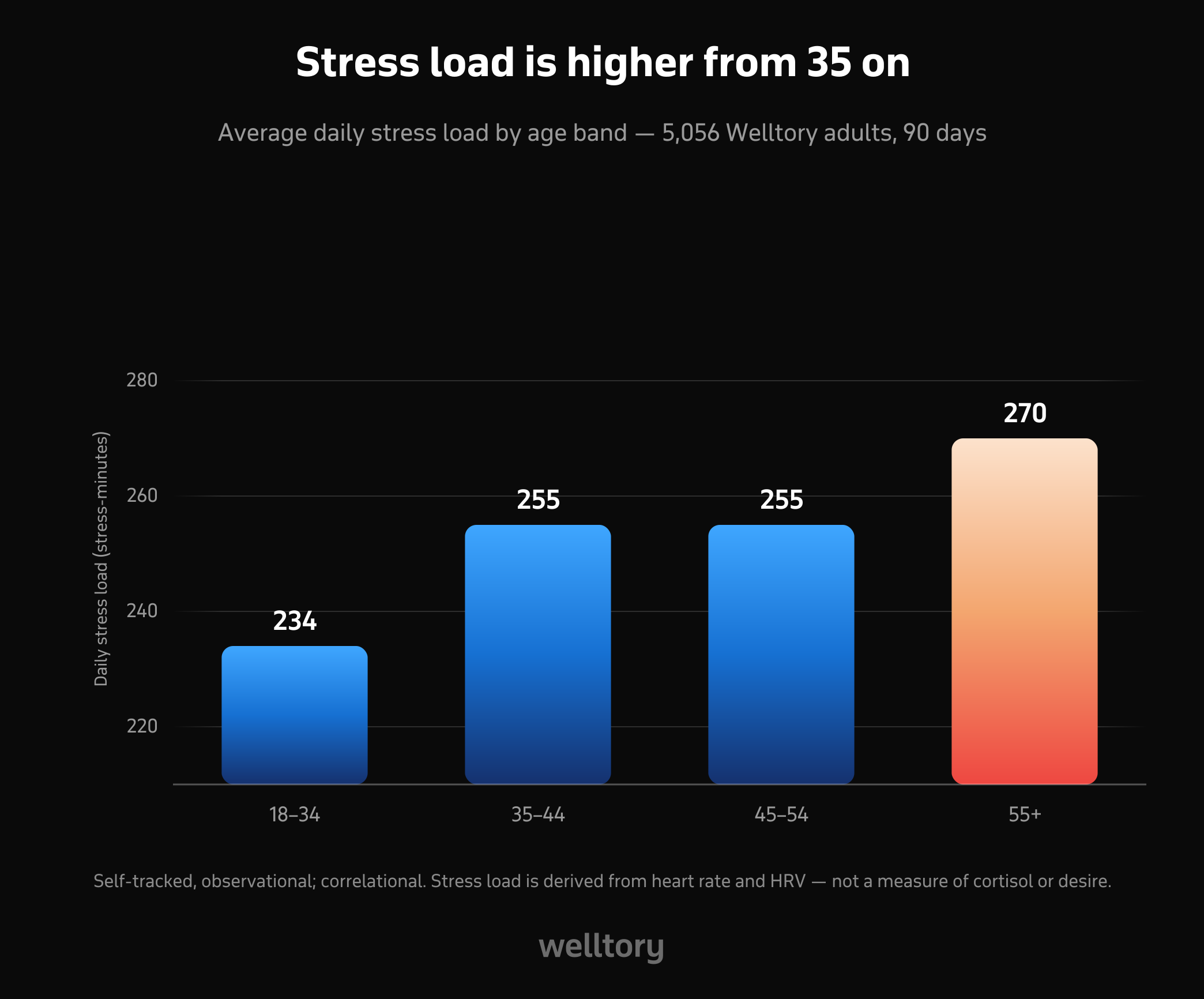
The youngest group, 18 to 34, averaged 234 stress-minutes a day. From 35 the number was higher — 255 in both the 35–44 and 45–54 groups — and highest at 55 and over, 270. So in our data the step up comes at midlife and rises again after 55, rather than peaking in the 40s.
The step was steeper for women. Women aged 18 to 34 averaged 227 stress-minutes a day, and women aged 35 to 44 averaged 249 — about 10% more. Men started higher (252) and rose less (267). That fits the heavier midlife load many women describe, with work, children, family care and, later, perimenopause landing in the same years.
Welltory adults with a known age, per-user averages over a 90-day window (18–34: 217 users; 35–44: 762; 45–54: 1,444; 55+: 2,633). Observational and aggregated. Stress load is derived from heart rate and HRV; it is not a measure of cortisol or desire.
How to lower the load and thaw desire
You don't restart desire by pressing the accelerator harder. You take your foot off the brake. These are the levers with evidence behind them.
Sleep. In a diary study of young university women, each extra hour of sleep went with more desire the next day and 14% higher odds of partnered sex the next day. (doi.org) In young men, a week of short sleep lowered testosterone. (doi.org) If stress is wrecking your sleep, that's the first thing to fix.
Movement. Regular aerobic exercise improves erectile function in men, (doi.org) and in women exercise supports sexual function through mood, body image and a more flexible nervous system. (doi.org)
Mindfulness. In a randomized trial of 148 women with low desire and arousal (average age about 39), eight weekly group sessions of mindfulness-based therapy improved desire and arousal substantially — and supportive sex education worked about as well for desire. (doi.org) Mindfulness also lowered perceived stress, and in that group, a bigger drop in stress went with a bigger rise in desire. (doi.org)
Touch without pressure. In a randomized study, women who got a 10-minute neck-and-shoulder massage from their partner before a stressful test had smaller cortisol and heart-rate spikes; talking support alone didn't have that effect. (doi.org) In couples tracked in daily life, more sexual activity was linked to lower cortisol. (doi.org) Affection that isn't a demand is a way back in, not a chore.
Deal with the stress that lives inside the relationship. Since conflict and tension between partners are more closely tied to low desire than work stress, (doi.org) talking it through — or with a couples therapist — is a direct lever. Interestingly, outside stress doesn't always pull couples apart: in 316 Swiss couples, stressed partners actually exchanged more affection. (doi.org)
Share the load, not just the tasks. Handing someone a task while you still have to remember, check and chase it doesn't lower your load. Handing off whole areas of responsibility does.
When low libido isn't just stress
Stress is common, but it's not the only cause, and a few others are easy to test for or change:
Medications. Many common antidepressants cause sexual side effects in roughly a quarter to most users, depending on the drug; some, such as bupropion and mirtazapine, don't differ from placebo. (doi.org) Switching is a decision for your prescriber.
Depression. Low desire and depression often go together, and each raises the risk of the other. (doi.org)
Thyroid. In one study, about 4 in 5 men with an over- or underactive thyroid had erectile problems, versus 1 in 3 without, and function improved after treatment. (doi.org)
Low testosterone in men, which needs proper testing (below).
Perimenopause in women: hot flashes, night sweats, changing periods and vaginal dryness.
See a doctor sooner if the drop is sudden, if sex is painful, if you have new erection problems along with breathlessness on exertion, or if low mood is part of the picture. Seek emergency care for chest pain or pressure, especially at rest or lasting more than a few minutes. For a women-focused list of causes, see low libido in women; for symptoms of genuinely high cortisol, which is a different medical problem from everyday stress, see high cortisol symptoms.
How to bring this up with your doctor — and what to ask for
Bring the timeline and the load, not just the symptom. When desire changed, what else changed around then, and whether it comes and goes with stressful periods or stays flat. Low desire is one of the least specific symptoms in medicine; the context is what makes it make sense.
For men, ask for the right testosterone test. Guidelines say low testosterone should be diagnosed only when there are symptoms and a fasting morning total testosterone is low on two separate tests. (doi.org) A single afternoon test after a bad week doesn't tell you much.
For women, know that a testosterone level won't diagnose it. International guidelines say a blood testosterone level should not be used to diagnose low desire in women. (doi.org) A conversation about perimenopause, mood, pain and medications is more useful.
Ask these specifically. Could any of my medications be doing this? Should my thyroid be checked? Could this be depression or anxiety? Is there a stress or sleep problem here we should treat first? Would a sex therapist, couples therapist or mindfulness program make sense?
If you are dismissed. "I know stress is common, but this has lasted months and it's affecting my life. Can we note it and look at possible causes?" A documented concern is more likely to be followed up.
How Welltory helps
A wearable can't measure cortisol or desire, and Welltory doesn't pretend to. What it can show is the load underneath: how many minutes a day your nervous system spends in a stressed state, whether your heart rate variability and resting heart rate show you're recovering overnight, and how much sleep you're really getting — all against your own baseline.
That makes the invisible load visible. When "I just don't feel like it" lines up with a month of high stress load, short nights and flat recovery, you're looking at a pattern you can work on, not proof that something is wrong with you or your relationship. With My Patterns, you can add notes like "low desire", "argument" or "day off" and see, over a few weeks, which days tend to come before the flat ones and which come before better ones. If the stress in your body feels stuck even when life calms down, why your body won't relax after stress goes deeper.
How we made it
The clinical content rests on published research and guidelines: daily-life studies of stress, cortisol and sex (Mües et al. 2025; Schneider et al. 2026), couples and everyday stress (Bodenmann et al. 2006; Landolt et al. 2024; Ditzen et al. 2007), stress and the reproductive axis (Whirledge & Cidlowski 2010; Cumming et al. 1983; Brownlee et al. 2005), cortisol and arousal in women (Hamilton, Rellini & Meston 2008; Hamilton & Meston 2013; Lorenz et al. 2012; Stanton et al. 2018), erection physiology (Dean & Lue 2005), sleep and testosterone (Leproult & Van Cauter 2011), sleep and desire (Kalmbach et al. 2015), work strain and burnout (Štulhofer et al. 2013; Papaefstathiou et al. 2020), depression (Atlantis & Sullivan 2012), stress across the lifespan (Stone et al. 2010; Almeida et al. 2020), midlife sleep in SWAN (Kravitz et al. 2003), cortisol and age (Van Cauter et al. 1996), exercise (Silva et al. 2017), mindfulness trials (Brotto et al. 2021, 2024), antidepressants (Serretti & Chiesa 2009), thyroid and erectile function (Krassas et al. 2008), and guidelines on testosterone testing in men and women (Bhasin et al. 2018; Parish et al. 2021).
The Welltory figures come from an aggregated, de-identified dataset of 5,056 adults with a known age: per-user average daily stress load over a 90-day window, by age band and by sex. Welltory does not collect data on cortisol, hormones, desire or sexual activity.


Discounts for blog readers: up to 36% off
See what affects your energy, stress, sleep, and daily state with Welltory
This article is for educational purposes only and is not medical advice. A persistent, distressing drop in desire can stem from hormones, thyroid, mood, medications, or relationship factors and is worth discussing with a doctor. Welltory measures physiological signals like heart rate, HRV, sleep, activity, and stress; it does not measure hormones or desire.
Was this helpful?
Ask AI for a summary of page


Written by Jane Smorodnikova

The founder and CEO of Welltory. A recognized tech leader with two Master's degrees and experience at MIT, she has scaled Welltory to over 17 million users.
Written by Tatsiana Yashyna

Deputy COO at Welltory. With a background in medicine and years of working with health data, she translates research and real physiological signals — sleep, stress, heart rate, and hormones — into clear, evidence-based explanations that help people understand what their bodies are telling them.
Reviewed by Anna Elitzur
-2.jpg)
With her medical degree, Anna reviews Welltory's health content for medical accuracy and alignment with current clinical guidelines and research.
References
- Mües HM, Markert C, Feneberg AC, Nater UM. Too stressed for sex? Associations between stress and sex in daily life. Psychoneuroendocrinology 2025;181:107583. https://doi.org/10.1016/j.psyneuen.2025.107583
- Bodenmann G, Ledermann T, Blattner D, Galluzzo C. Associations among everyday stress, critical life events, and sexual problems. Journal of Nervous and Mental Disease 2006;194(7):494-501. https://doi.org/10.1097/01.nmd.0000228504.15569.b6
- Štulhofer A, Træen B, Carvalheira A. Job-related strain and sexual health difficulties among heterosexual men from three European countries: the role of culture and emotional support. Journal of Sexual Medicine 2013;10(3):747-756. https://doi.org/10.1111/j.1743-6109.2012.02967.x
- Papaefstathiou E, et al. The impact of burnout and occupational stress on sexual function in both male and female individuals: a cross-sectional study. International Journal of Impotence Research 2020;32(5):510-519. https://doi.org/10.1038/s41443-019-0170-7
- Atlantis E, Sullivan T. Bidirectional association between depression and sexual dysfunction: a systematic review and meta-analysis. Journal of Sexual Medicine 2012;9(6):1497-1507. https://doi.org/10.1111/j.1743-6109.2012.02709.x
- Whirledge S, Cidlowski JA. Glucocorticoids, stress, and fertility. Minerva Endocrinologica 2010;35(2):109-125. https://pmc.ncbi.nlm.nih.gov/articles/PMC3547681/
- Cumming DC, Quigley ME, Yen SS. Acute suppression of circulating testosterone levels by cortisol in men. Journal of Clinical Endocrinology & Metabolism 1983;57(3):671-673. https://doi.org/10.1210/jcem-57-3-671
- Brownlee KK, Moore AW, Hackney AC. Relationship between circulating cortisol and testosterone: influence of physical exercise. Journal of Sports Science & Medicine 2005;4(1):76-83. https://pmc.ncbi.nlm.nih.gov/articles/PMC3880087/
- Hamilton LD, Rellini AH, Meston CM. Cortisol, sexual arousal, and affect in response to sexual stimuli. Journal of Sexual Medicine 2008;5(9):2111-2118. https://doi.org/10.1111/j.1743-6109.2008.00922.x
- Dean RC, Lue TF. Physiology of penile erection and pathophysiology of erectile dysfunction. Urologic Clinics of North America 2005;32(4):379-395. https://doi.org/10.1016/j.ucl.2005.08.007
- Lorenz TA, Harte CB, Hamilton LD, Meston CM. Evidence for a curvilinear relationship between sympathetic nervous system activation and women's physiological sexual arousal. Psychophysiology 2012;49(1):111-117. https://doi.org/10.1111/j.1469-8986.2011.01285.x
- Stanton AM, Handy AB, Meston CM. The effects of exercise on sexual function in women. Sexual Medicine Reviews 2018;6(4):548-557. https://doi.org/10.1016/j.sxmr.2018.02.004
- Hamilton LD, Meston CM. Chronic stress and sexual function in women. Journal of Sexual Medicine 2013;10(10):2443-2454. https://doi.org/10.1111/jsm.12249
- Leproult R, Van Cauter E. Effect of 1 week of sleep restriction on testosterone levels in young healthy men. JAMA 2011;305(21):2173-2174. https://doi.org/10.1001/jama.2011.710
- Silva AB, Sousa N, Azevedo LF, Martins C. Physical activity and exercise for erectile dysfunction: systematic review and meta-analysis. British Journal of Sports Medicine 2017;51(19):1419-1424. https://doi.org/10.1136/bjsports-2016-096418
- Stone AA, Schwartz JE, Broderick JE, Deaton A. A snapshot of the age distribution of psychological well-being in the United States. PNAS 2010;107(22):9985-9990. https://doi.org/10.1073/pnas.1003744107
- Almeida DM, Charles ST, Mogle J, et al. Charting adult development through (historically changing) daily stress processes. American Psychologist 2020;75(4):511-524. https://doi.org/10.1037/amp0000597
- Kravitz HM, Ganz PA, Bromberger J, et al. Sleep difficulty in women at midlife: a community survey of sleep and the menopausal transition. Menopause 2003;10(1):19-28. https://doi.org/10.1097/00042192-200310010-00005
- Van Cauter E, Leproult R, Kupfer DJ. Effects of gender and age on the levels and circadian rhythmicity of plasma cortisol. Journal of Clinical Endocrinology & Metabolism 1996;81(7):2468-2473. https://doi.org/10.1210/jcem.81.7.8675562
- Kalmbach DA, Arnedt JT, Pillai V, Ciesla JA. The impact of sleep on female sexual response and behavior: a pilot study. Journal of Sexual Medicine 2015;12(5):1221-1232. https://doi.org/10.1111/jsm.12858
- Brotto LA, Zdaniuk B, Chivers ML, et al. A randomized trial comparing group mindfulness-based cognitive therapy with group supportive sex education and therapy for the treatment of female sexual interest/arousal disorder. Journal of Consulting and Clinical Psychology 2021;89(7):626-639. https://doi.org/10.1037/ccp0000661
- Brotto LA, Basson R, Grabovac A, et al. Impact of mindfulness versus supportive sex education on stress in women with sexual interest/arousal disorder. Journal of Behavioral Medicine 2024;47(4):721-733. https://doi.org/10.1007/s10865-024-00491-5
- Ditzen B, Neumann ID, Bodenmann G, et al. Effects of different kinds of couple interaction on cortisol and heart rate responses to stress in women. Psychoneuroendocrinology 2007;32(5):565-574. https://doi.org/10.1016/j.psyneuen.2007.03.011
- Schneider E, Hernández C, Brock R, et al. Intranasal oxytocin and physical intimacy for dermatological wound healing and neuroendocrine stress: a randomized clinical trial. JAMA Psychiatry 2026;83(2):118-127. https://doi.org/10.1001/jamapsychiatry.2025.3705
- Landolt SA, Impett EA, Weitkamp K, et al. Extradyadic stress as a barrier to sexual activity in couples? A dyadic response surface analysis. Journal of Social and Personal Relationships 2024;41(10):2959-2982. https://doi.org/10.1177/02654075241255910
- Serretti A, Chiesa A. Treatment-emergent sexual dysfunction related to antidepressants: a meta-analysis. Journal of Clinical Psychopharmacology 2009;29(3):259-266. https://doi.org/10.1097/JCP.0b013e3181a5233f
- Krassas GE, Tziomalos K, Papadopoulou F, et al. Erectile dysfunction in patients with hyper- and hypothyroidism: how common and should we treat? Journal of Clinical Endocrinology & Metabolism 2008;93(5):1815-1819. https://doi.org/10.1210/jc.2007-2259
- Bhasin S, Brito JP, Cunningham GR, et al. Testosterone therapy in men with hypogonadism: an Endocrine Society clinical practice guideline. Journal of Clinical Endocrinology & Metabolism 2018;103(5):1715-1744. https://doi.org/10.1210/jc.2018-00229
- Parish SJ, Simon JA, Davis SR, et al. International Society for the Study of Women's Sexual Health clinical practice guideline for the use of systemic testosterone for hypoactive sexual desire disorder in women. Journal of Sexual Medicine 2021;18(5):849-867. https://doi.org/10.1016/j.jsxm.2020.10.009
- Welltory adult cohort (daily stress load by age band and sex, 5,056 users, 90 days). Reproducible script: `persona_lab/scripts/midlife_age_bands.py`.