

Short answer
Sex drive does change with age, but differently for women and men. In a British national survey, women's lack of interest in sex rose from 25% in their late teens and early 20s to about 38% by their 40s to early 60s. Men's interest stayed fairly steady; what rose was erection trouble. There's no single "sexual peak."
If desire feels different now than it did at 25, you're not broken, and it's not only in your head. Desire rests on a physical foundation — hormones, blood vessels, sleep and a nervous system that can switch off — and that foundation genuinely shifts over the decades. But the shift is gradual, it varies a lot between people, and much of it is driven by things you can influence: health, weight, sleep, stress, a partner's health and the relationship itself.
This article goes decade by decade with real population numbers for women and men, explains what happens around menopause and to testosterone, busts the "men peak at 18, women at 35" myth, and covers what keeps desire healthier as you get older.
Does libido decrease with age?
On average, yes — but less dramatically than people fear, and in different ways for women and men.
The best population data come from Natsal-3, a national probability survey of over 15,000 people aged 16 to 74 in Britain. Among sexually active people, the share of women who had lacked interest in sex for at least three months in the past year rose from 24.8% at 16 to 24 to 31.9% at 25 to 34, then leveled off around 37–39% from 35 to 64, and was 34.2% at 65 to 74. (doi.org)
For men, lack of interest stayed between 11.5% and 17.2% at every age, with no significant age trend. What rose steeply was erection trouble: about 8% in the 20s and 30s, 13.4% at 45 to 54, 23.5% at 55 to 64 and 30% at 65 to 74.
The same survey found that problems are common but distress is not. About 42% of sexually active men and 51% of women reported at least one lasting sexual difficulty, yet only about 1 in 10 were distressed about their sex life.
In the US, a national study of adults aged 57 to 85 found that most people in their late 50s and early 60s are sexually active — 84% of men and 62% of women aged 57 to 64. At 75 to 85, the figures were 39% of men and 17% of women. Among those still active at 75 to 85, 54% had sex at least two to three times a month. (doi.org)
Sex drive by age: a decade-by-decade picture
These numbers come from large surveys that compare different age groups at one point in time, so they mix ageing with generation effects. They describe averages, not what will happen to you.
| Age | Women | Men |
|---|---|---|
| 16–24 | 24.8% lacked interest for 3+ months | 11.5% lacked interest; coming too quickly was the most common problem |
| 25–34 | 31.9% lacked interest | 14.5% lacked interest |
| 35–44 | 37.0% lacked interest | 17.2% lacked interest; 7.9% had erection trouble |
| 45–54 | 37.9% lacked interest | 15.3% lacked interest; 13.4% had erection trouble |
| 55–64 | 38.8% lacked interest; 26.9% had an uncomfortably dry vagina | 16.0% lacked interest; 23.5% had erection trouble |
| 65–74 | 34.2% lacked interest | 13.6% lacked interest; 30.0% had erection trouble |
| 75–85 (US) | 16.7% sexually active; about half of them reported lack of interest | 38.5% sexually active; 43.5% of them had erectile difficulty |
Ages 16–74: sexually active people in Britain, Natsal-3. (doi.org) Ages 75–85: US adults, NSHAP. (doi.org)
In your 20s and early 30s. In a US national survey, the share of people who'd had vaginal sex in the past year peaked among women aged 20 to 29 and men aged 25 to 39, then declined with each older group. (doi.org) Anxiety during sex is also most common now: 8.2% of women aged 16 to 24 in Britain, versus 2% at 65 to 74.
In your 30s and 40s. For women, reported lack of interest climbs through the late 20s and early 30s, then levels off. This is also when work, young children and sleep deprivation pile up — the load we cover in cortisol and "frozen" libido in your 40s. For men, interest holds steady and erections are mostly unchanged until the mid-40s.
In your 50s and early 60s. For women, the menopausal transition brings the biggest single change (below). For men, erection trouble roughly triples between the early 40s and the early 60s. Distressing sexual problems in US women peak in this window: 14.8% of women aged 45 to 64 had a sexual problem that distressed them, compared with 10.8% of younger and 8.9% of older women. (doi.org)
In your late 60s and beyond. Sexual activity becomes less common, but largely for practical reasons. At 75 to 85, 78% of men but only 40% of women had a spouse or partner, and among people without one, just 22% of men and 4% of women were sexually active. The most common reason couples stopped was the man's physical health. (doi.org) In England, 54% of men and 31% of women over 70 were still sexually active. (doi.org)
When do women peak sexually — and when do men?
You've probably heard that men peak at 18 and women at 35. The idea goes back to Alfred Kinsey's reports in the late 1940s and 1950s, and modern researchers say the scientific evidence for a later female peak is lacking. (doi.org)
In the largest direct test, 8,150 people aged 15 to 80 rated their desire. Women's desire for a partner rose into the mid-20s, stayed on a plateau until the mid-40s, and then declined. Men's desire rose until the late 30s or around 40, and then declined. Neither sex had a sharp peak age. Men reported higher desire on average. The sample was mostly young adults, so the picture after 60 is less certain.
One study of 827 women found that those aged 27 to 45 reported more sexual thoughts and fantasies than younger or older women. (doi.org) It's often quoted as proof of the "women peak at 35" idea, but it included no men and grouped a very wide age range, so it can't show a peak at any single age.
The honest summary: there is no single sexual peak. For both sexes, desire is broadly stable from the mid-20s into the 40s. After that, women more often report losing interest, and men more often report erection problems — which is not the same as losing desire.
What happens to desire at menopause?
For many women, the menopausal transition is the biggest single change. The SWAN study followed 1,390 US women for up to 14.5 years. Their sexual function held steady until about 20 months before the final period, then declined for roughly two and a half years, and kept declining more slowly for at least five years afterwards. (doi.org)
An earlier SWAN analysis of 3,302 women found that by late perimenopause, desire fell and pain during sex rose. But the transition itself didn't independently change arousal, pleasure, emotional satisfaction or how often women had sex; health, mood, the relationship and vaginal dryness mattered for all of these. (doi.org)
Vaginal dryness is a big part of the story. In SWAN, it rose from about 1 in 5 women in their 40s and early 50s (19.4%) to 1 in 3 by their late 50s and 60s (34.0%), and dryness predicted later pain during sex. (doi.org) Genitourinary syndrome of menopause — dryness, irritation, pain with sex and urinary symptoms — affects an estimated 27% to 84% of postmenopausal women, and it is underdiagnosed and very treatable. (doi.org) Pain and low desire often go together, and treating the pain can help interest return.
A common myth: women's testosterone does not drop at natural menopause. In 1,423 Australian women, testosterone declined gradually from the 20s onward, and natural menopause had no independent effect. Surgical removal of both ovaries did lower it. (doi.org) It's estrogen that falls sharply around the final period. For more on the transition itself, see perimenopause symptoms and sleep and hormones in midlife.
Men's sex drive by age: testosterone, erections and interest
Testosterone does fall with age, but more slowly and less inevitably than the "1% a year from 30" line suggests. In the Massachusetts Male Aging Study, which re-tested the same men aged 40 to 70 after 7 to 10 years, total testosterone fell about 1.6% a year, and free and bioavailable testosterone about 2–3% a year. (doi.org) In the Baltimore Longitudinal Study, testosterone in the low (hypogonadal) range reached about 20% of men over 60, 30% over 70 and 50% over 80. (doi.org)
Health matters as much as the birthday. In the Massachusetts study, men without chronic illness, obesity, regular prescription drugs or heavy drinking had 10–15% higher androgen levels. (doi.org) In men over 40 who reported very good health, testosterone didn't fall with age at all. (doi.org) Weight is one of the biggest levers: obese men had about 5 nmol/L lower testosterone than lean men, (doi.org) and over four years, losing weight raised testosterone while gaining weight lowered it. (doi.org)
When testosterone is genuinely low, it shows up mostly as sexual symptoms: fewer morning erections, low desire and erectile dysfunction. (doi.org)
Erections change more than interest. In the Massachusetts study, 52% of men aged 40 to 70 had some degree of erectile dysfunction, and complete ED tripled from 5% at 40 to 15% at 70. (doi.org) New erection problems in midlife can be an early sign of heart disease — see is erectile dysfunction a sign of heart disease? — and the lifestyle levers are covered in what really drives male libido and erections. The testosterone myths get their own piece in testosterone after 40.
Lower desire isn't the same as a problem
As people age, low desire becomes more common, but being bothered by it doesn't rise in step. In Australian women aged 65 to 79, 88% scored as having low desire on a standard questionnaire — a cutoff designed for younger women, which inflates the figure — but only 13.6% were distressed about it. (doi.org) Among European men aged 40 to 79 with erectile dysfunction, only 38% were concerned about it, and concern peaked in their 50s. (doi.org)
Doctors diagnose a desire disorder only when low desire lasts at least six months and causes personal distress. (doi.org) Lower desire that doesn't bother you — or your partner — is a normal variation, not a condition to fix.
Relationship length plays a role too. Many women in long-term relationships notice that desire tends to show up after closeness or touch begins rather than beforehand — what researchers call responsive desire. (doi.org) It's a normal pattern, not a decline. We cover it in responsive desire in a long relationship.
What our data shows: the foundation shifts gently with age
Welltory can't see desire, but it can see the physical foundation desire rests on. We looked at sleep and morning energy in 5,056 Welltory adults over a 90-day window, by age.
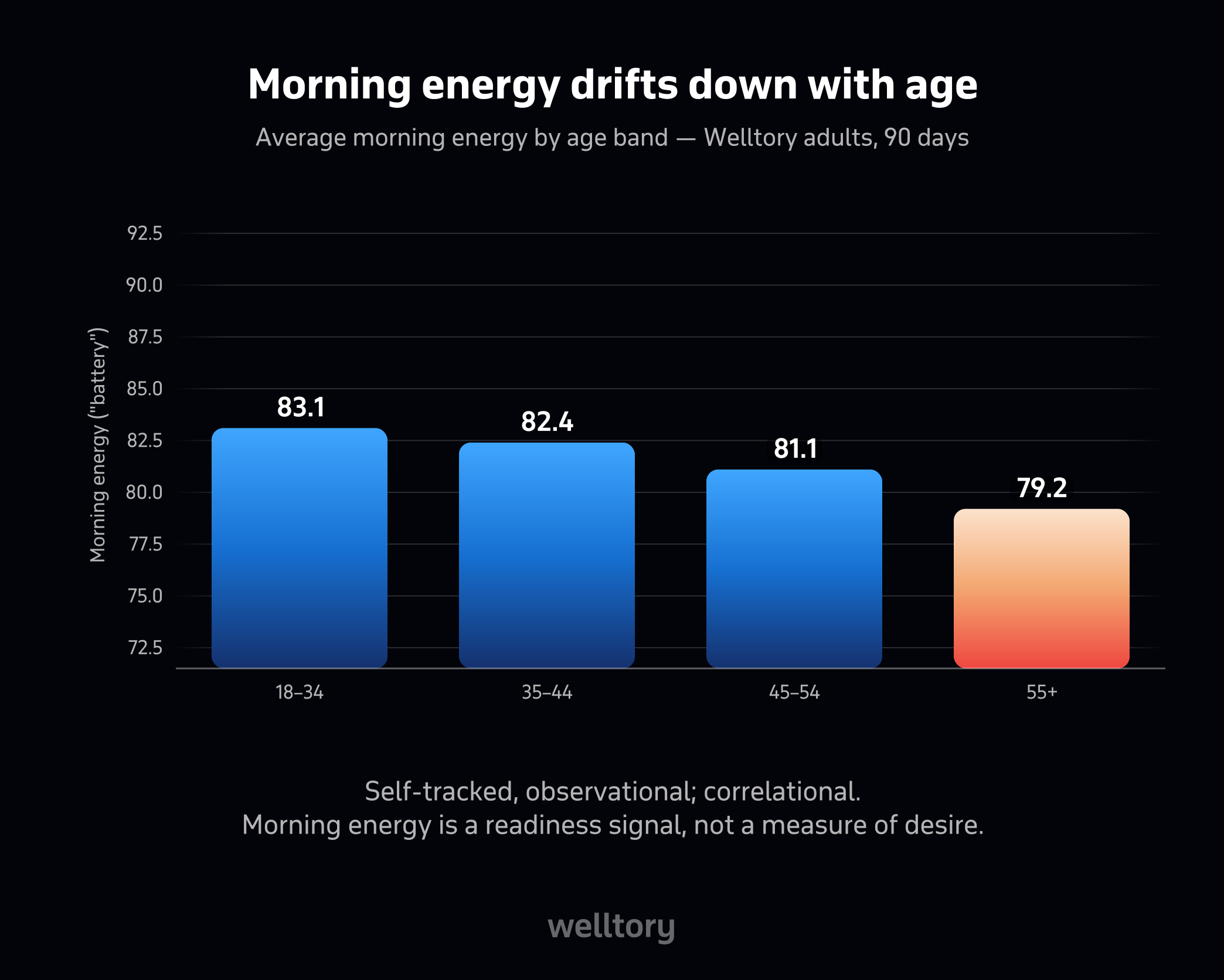
Morning energy — Welltory's measure of how recovered you are when you wake up — dipped only slightly with age: from 83.1 out of 100 in adults aged 18 to 34 to 79.2 in those 55 and over. REM sleep, the dream stage of sleep, fell more clearly: from about 89 minutes a night at 18 to 34 to about 80 minutes at 55 and over. The drop was similar in women (92 to 86 minutes) and men (80 to 73 minutes). Average sleep length barely changed — about 7.2 to 7.5 hours in every group.
The takeaway fits the survey data: the physical base shifts gradually, not off a cliff. In our data, the gaps between habit groups are far bigger than the gaps between age groups. Adults who were among the most active, slept seven hours or more and had below-average stress (692 people) woke with an average energy of 88; the least active, shortest-sleeping, most stressed group (232 people) averaged 59. Part of that gap may simply reflect the sleep and stress used to define the groups.
Welltory adults with a known age, per-user averages over a 90-day window (18–34: 217 users; 35–44: 762; 45–54: 1,444; 55+: 2,633). Observational and aggregated. Morning energy and sleep stages are physiological signals, not measures of desire.
What keeps desire healthier as you age?
The levers don't change with age — they matter more.
Stay healthy overall. In the US study of older adults, people in fair or poor health were about half as likely to be sexually active. (doi.org) Depression roughly quadrupled the odds of low sexual function in Britain, for both sexes. (doi.org)
Move. In a two-year trial, obese men with erectile dysfunction who lost weight and raised their exercise to about 195 minutes a week were about six times more likely to regain normal erectile function than controls — 17 of 55 versus 3 of 55. (doi.org) A review of intervention studies suggests about 160 minutes a week of moderate-to-vigorous aerobic exercise for six months. (doi.org)
Protect sleep. In young men, a week of five-hour nights cut daytime testosterone by about 10–15%, (doi.org) and in young women, each extra hour of sleep went with 14% higher odds of partnered sex the next day. (doi.org) These were small studies in young adults, but the direction is consistent. Loud snoring or unrefreshing sleep is worth checking for sleep apnea: see could I have sleep apnea?
Treat pain and dryness. Lubricants and vaginal moisturizers help mild symptoms; low-dose vaginal estrogen, vaginal DHEA or ospemifene treat moderate to severe ones. Safety data for vaginal estrogen beyond a year are limited, and breast cancer survivors should decide with their oncologist. (doi.org)
Talk — to your partner and your doctor. Finding it hard to talk about sex with a partner more than doubled the odds of low sexual function. (doi.org) Yet only 22% of women and 38% of men aged 57 to 85 had discussed sex with a doctor since turning 50. (doi.org)
When is a change in desire worth checking?
A gradual shift that doesn't bother you is usually normal. These deserve a doctor:
a sudden or steep drop rather than a slow drift;
new erection problems, especially with breathlessness on exertion, or diabetes or high blood pressure (chest pain or pressure, especially at rest or lasting more than a few minutes, needs emergency care);
pain during sex, dryness that lubricant doesn't fix, or bleeding after menopause;
hot flashes, night sweats or period changes alongside the drop;
tiredness with feeling cold or weight change (thyroid), or low mood and loss of interest in other things (depression);
a drop that started with a new medication — some antidepressants and blood pressure drugs are common culprits.
How to bring this up with your doctor — and what to ask for
Say it plainly, with a timeline. "My desire has dropped a lot over the past year, and it bothers me," or "My erections have changed since about last spring." Doctors often won't ask, especially as you get older, so open the door yourself.
Ask for the checks that fit your situation. For men with erection changes: blood pressure, cholesterol, blood sugar or HbA1c, and, if symptoms suggest it, a fasting morning testosterone repeated on a second day. For women around menopause: whether your symptoms fit perimenopause or genitourinary syndrome of menopause, and what treatment options suit you. For anyone: thyroid function, a mood screen, and a medication review.
Ask these specifically. Is this likely age, or something treatable? Could any of my medications be doing this? Would treating dryness or pain help? Would a referral to a sex therapist or pelvic floor physiotherapist make sense?
If you are dismissed. "I understand it's common at my age, but it's affecting my life. Can we look at possible causes?" "It's your age" is not a diagnosis.
How Welltory helps
Welltory doesn't measure desire and doesn't try. What it does measure is the foundation desire rests on: your sleep and its stages, your stress load through the day, your heart rate variability and resting heart rate, and your morning energy — all against your own baseline, which matters more with age than any population average.
Over weeks, that turns a vague sense of "I'm just getting older" into something you can act on. You can see whether a flat stretch lines up with poor sleep or a heavy month, and whether protecting sleep or adding exercise moves your recovery. With My Patterns, you can add notes like "low desire", "hot flashes" or "new medication" and see what tends to come before the difficult weeks. For how the nervous system itself ages, see why HRV declines with age.
How we made it
The population figures come from national probability surveys: Natsal-3 in Britain (Mitchell et al. 2013), NSHAP in the US (Lindau et al. 2007), the National Survey of Sexual Health and Behavior (Herbenick et al. 2010), PRESIDE (Shifren et al. 2008), and the English Longitudinal Study of Ageing (Lee et al. 2016). Menopause findings come from SWAN (Avis et al. 2009, 2017; Waetjen et al. 2018), the Menopause Society's 2020 position statement on genitourinary syndrome of menopause, and a study of androgens in women (Davison et al. 2005). Men's testosterone and erection figures come from the Massachusetts Male Aging Study (Feldman et al. 1994, 2002), the Baltimore Longitudinal Study of Aging (Harman et al. 2001), the European Male Ageing Study (Wu et al. 2008, 2010; Camacho et al. 2013; Corona et al. 2010), and the Healthy Man Study (Sartorius et al. 2012). The "sexual peak" section draws on Wieczorek et al. 2022 and Easton et al. 2010; low desire and distress in older women on Zeleke et al. 2017; responsive desire on Basson 2000; and lifestyle evidence on Esposito et al. 2004, Gerbild et al. 2018, Leproult & Van Cauter 2011, and Kalmbach et al. 2015.
The Welltory figures come from an aggregated, de-identified dataset of 5,056 adults with a known age: per-user average sleep, REM sleep and morning energy over a 90-day window, by age band and by sex. Welltory does not collect data on desire or sexual activity.


Discounts for blog readers: up to 36% off
See what affects your energy, stress, sleep, and daily state with Welltory
This article is for educational purposes only and is not medical advice, diagnosis, or treatment. Changes in desire are normal, but a persistent, distressing change can also stem from hormones, thyroid or heart issues, mood, relationship factors, or medications, so it's worth discussing with a doctor. Welltory measures physiological signals like heart rate, HRV, sleep, activity, and stress; it does not measure or diagnose desire or sexual function.
Was this helpful?
Ask AI for a summary of page


Written by Jane Smorodnikova

The founder and CEO of Welltory. A recognized tech leader with two Master's degrees and experience at MIT, she has scaled Welltory to over 17 million users.
Written by Tatsiana Yashyna

Deputy COO at Welltory. With a background in medicine and years of working with health data, she translates research and real physiological signals — sleep, stress, heart rate, and hormones — into clear, evidence-based explanations that help people understand what their bodies are telling them.
Reviewed by Anna Elitzur
-2.jpg)
With her medical degree, Anna reviews Welltory's health content for medical accuracy and alignment with current clinical guidelines and research.
References
- Mitchell KR, Mercer CH, Ploubidis GB, et al. Sexual function in Britain: findings from the third National Survey of Sexual Attitudes and Lifestyles (Natsal-3). The Lancet 2013;382(9907):1817-1829. https://doi.org/10.1016/S0140-6736%2813%2962366-1
- Lindau ST, Schumm LP, Laumann EO, et al. A study of sexuality and health among older adults in the United States. New England Journal of Medicine 2007;357(8):762-774. https://doi.org/10.1056/NEJMoa067423
- Herbenick D, Reece M, Schick V, et al. Sexual behavior in the United States: results from a national probability sample of men and women ages 14–94. Journal of Sexual Medicine 2010;7(Suppl 5):255-265. https://doi.org/10.1111/j.1743-6109.2010.02012.x
- Shifren JL, Monz BU, Russo PA, Segreti A, Johannes CB. Sexual problems and distress in United States women: prevalence and correlates. Obstetrics & Gynecology 2008;112(5):970-978. https://doi.org/10.1097/AOG.0b013e3181898cdb
- Lee DM, Nazroo J, O'Connor DB, Blake M, Pendleton N. Sexual health and well-being among older men and women in England: findings from the English Longitudinal Study of Ageing. Archives of Sexual Behavior 2016;45(1):133-144. https://doi.org/10.1007/s10508-014-0465-1
- Wieczorek LL, Chivers M, Koehn MA, DeBruine LM, Jones BC. Age effects on women's and men's dyadic and solitary sexual desire. Archives of Sexual Behavior 2022;51(8):3765-3789. https://doi.org/10.1007/s10508-022-02375-8
- Easton JA, Confer JC, Goetz CD, Buss DM. Reproduction expediting: sexual motivations, fantasies, and the ticking biological clock. Personality and Individual Differences 2010;49(5):516-520. https://doi.org/10.1016/j.paid.2010.05.018
- Avis NE, Colvin A, Karlamangla AS, et al. Change in sexual functioning over the menopausal transition: results from the Study of Women's Health Across the Nation. Menopause 2017;24(4):379-390. https://doi.org/10.1097/GME.0000000000000770
- Avis NE, Brockwell S, Randolph JF Jr, et al. Longitudinal changes in sexual functioning as women transition through menopause: results from the Study of Women's Health Across the Nation. Menopause 2009;16(3):442-452. https://doi.org/10.1097/gme.0b013e3181948dd0
- Waetjen LE, Crawford SL, Chang PY, et al. Factors associated with developing vaginal dryness symptoms in women transitioning through menopause: a longitudinal study. Menopause 2018;25(10):1094-1104. https://doi.org/10.1097/GME.0000000000001130
- The NAMS 2020 GSM Position Statement Editorial Panel. The 2020 genitourinary syndrome of menopause position statement of The North American Menopause Society. Menopause 2020;27(9):976-992. https://doi.org/10.1097/GME.0000000000001609
- Davison SL, Bell R, Donath S, Montalto JG, Davis SR. Androgen levels in adult females: changes with age, menopause, and oophorectomy. Journal of Clinical Endocrinology & Metabolism 2005;90(7):3847-3853. https://doi.org/10.1210/jc.2005-0212
- Feldman HA, Longcope C, Derby CA, et al. Age trends in the level of serum testosterone and other hormones in middle-aged men: longitudinal results from the Massachusetts Male Aging Study. Journal of Clinical Endocrinology & Metabolism 2002;87(2):589-598. https://doi.org/10.1210/jcem.87.2.8201
- Harman SM, Metter EJ, Tobin JD, Pearson J, Blackman MR. Longitudinal effects of aging on serum total and free testosterone levels in healthy men. Journal of Clinical Endocrinology & Metabolism 2001;86(2):724-731. https://doi.org/10.1210/jcem.86.2.7219
- Sartorius G, Spasevska S, Idan A, et al. Serum testosterone, dihydrotestosterone and estradiol concentrations in older men self-reporting very good health: the Healthy Man Study. Clinical Endocrinology 2012;77(5):755-763. https://doi.org/10.1111/j.1365-2265.2012.04432.x
- Wu FC, Tajar A, Pye SR, et al. Hypothalamic-pituitary-testicular axis disruptions in older men are differentially linked to age and modifiable risk factors: the European Male Aging Study. Journal of Clinical Endocrinology & Metabolism 2008;93(7):2737-2745. https://doi.org/10.1210/jc.2007-1972
- Camacho EM, Huhtaniemi IT, O'Neill TW, et al. Age-associated changes in hypothalamic–pituitary–testicular function in middle-aged and older men are modified by weight change and lifestyle factors: longitudinal results from the European Male Ageing Study. European Journal of Endocrinology 2013;168(3):445-455. https://doi.org/10.1530/EJE-12-0890
- Wu FC, Tajar A, Beynon JM, et al. Identification of late-onset hypogonadism in middle-aged and elderly men. New England Journal of Medicine 2010;363(2):123-135. https://doi.org/10.1056/NEJMoa0911101
- Feldman HA, Goldstein I, Hatzichristou DG, Krane RJ, McKinlay JB. Impotence and its medical and psychosocial correlates: results of the Massachusetts Male Aging Study. Journal of Urology 1994;151(1):54-61. https://doi.org/10.1016/S0022-5347%2817%2934871-1
- Zeleke BM, Bell RJ, Billah B, Davis SR. Hypoactive sexual desire dysfunction in community-dwelling older women. Menopause 2017;24(4):391-399. https://doi.org/10.1097/GME.0000000000000767
- Corona G, Lee DM, Forti G, et al. Age-related changes in general and sexual health in middle-aged and older men: results from the European Male Ageing Study (EMAS). Journal of Sexual Medicine 2010;7(4):1362-1380. https://doi.org/10.1111/j.1743-6109.2009.01601.x
- Basson R. The female sexual response: a different model. Journal of Sex & Marital Therapy 2000;26(1):51-65. https://doi.org/10.1080/009262300278641
- Esposito K, Giugliano F, Di Palo C, et al. Effect of lifestyle changes on erectile dysfunction in obese men: a randomized controlled trial. JAMA 2004;291(24):2978-2984. https://doi.org/10.1001/jama.291.24.2978
- Gerbild H, Larsen CM, Graugaard C, Areskoug Josefsson K. Physical activity to improve erectile function: a systematic review of intervention studies. Sexual Medicine 2018;6(2):75-89. https://doi.org/10.1016/j.esxm.2018.02.001
- Leproult R, Van Cauter E. Effect of 1 week of sleep restriction on testosterone levels in young healthy men. JAMA 2011;305(21):2173-2174. https://doi.org/10.1001/jama.2011.710
- Kalmbach DA, Arnedt JT, Pillai V, Ciesla JA. The impact of sleep on female sexual response and behavior: a pilot study. Journal of Sexual Medicine 2015;12(5):1221-1232. https://doi.org/10.1111/jsm.12858
- Welltory adult cohort (sleep, REM sleep and morning energy by age band and sex, 5,056 users, 90 days). Reproducible script: `persona_lab/scripts/midlife_age_bands.py`.