

Short Answer
Testosterone does decline with age — but slower and less dramatically than the ads for "boosters" suggest, and far less than most men fear. On average, men lose about 1% per year after 30, so by 50 you might be down roughly 20% from your peak, and most men stay within a healthy range. The bigger story: a lot of what men blame on "low T" — low energy, poor sleep, low drive, weight gain, brain fog — is often driven by the very things that also suppress testosterone: bad sleep, chronic stress, inactivity, and excess weight. That's good news, because those are modifiable, and a single week of short sleep alone can cut testosterone 10–15%. It also matters because genuine testosterone deficiency is a specific clinical diagnosis — symptoms plus two low morning blood tests — not a vibe, a symptom quiz, or a number off a home kit. This article separates the real, gradual decline from the marketing myths, explains how sleep, weight, stress, and activity move the needle, shows what a proper diagnosis actually requires, and covers what testosterone therapy can and can't do.
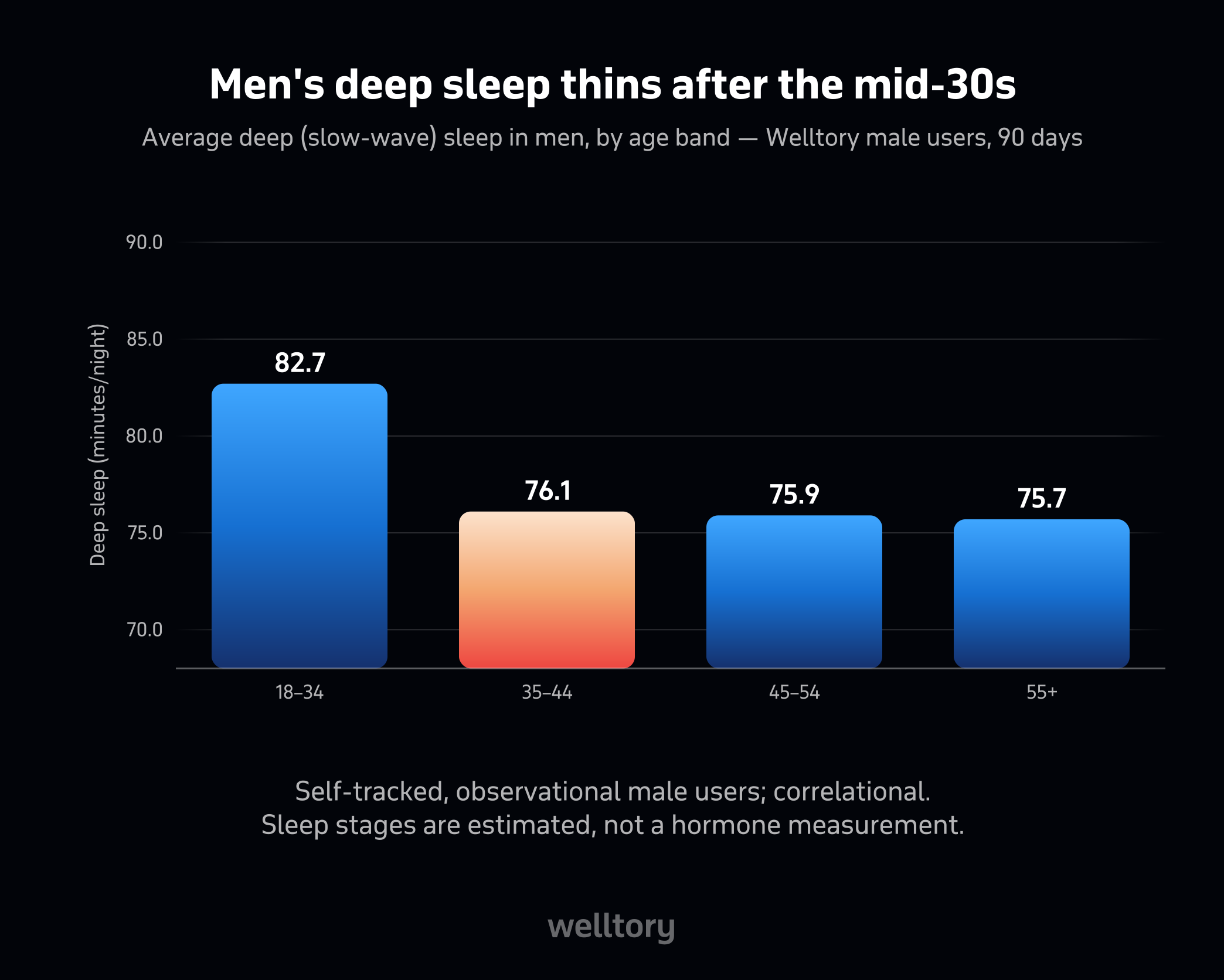
A note on the data: Welltory doesn't measure hormones, but it measures sleep — one of testosterone's biggest levers. In our data, men's deep (slow-wave) sleep drops notably after the mid-30s, from about 83 minutes a night in the youngest group to roughly 76 in older groups, and stays lower from there. Deep sleep is when much of the body's overnight hormonal restoration happens — a concrete, trackable reason "just push through on less sleep" quietly costs you.
The real decline: about 1% a year
Testosterone peaks in early adulthood and begins a slow decline around age 30, dropping on average about 1% per year. (health.clevelandclinic.org) This is normal aging, not disease, and there's wide individual variation — some men stay near their peak for decades, others decline faster. Crucially, it's a gentle slope, not a cliff, which is exactly why lifestyle has room to matter across the entire midlife stretch: small, consistent changes compound over the same years the natural decline is happening. A 45-year-old's "I feel off" is far more often about sleep, weight, and stress than about the couple of percent his testosterone has drifted since 40.
What our data shows: men's deep sleep thins with age
Because sleep is one of testosterone's largest levers, it's worth seeing how it moves. Across Welltory's men, deep (slow-wave) sleep steps down after the mid-30s and stays lower — and deep sleep is precisely when a large share of the body's overnight hormonal restoration, testosterone included, takes place. So part of the "midlife slump" men attribute to hormones is really a sleep-architecture change they can partly influence: protect the conditions for deep sleep and you protect one of the inputs that keeps testosterone where it should be. It's not a hormone reading — Welltory can't give you that — but it's a real, trackable piece of the same puzzle.
The myth: blaming everything on "low T"
Here's what the supplement market doesn't tell you: many symptoms pinned on low testosterone — fatigue, low libido, brain fog, weight gain, poor sleep, low mood — overlap heavily with the effects of poor sleep, chronic stress, and inactivity. Those lifestyle factors don't just mimic low T; they actively lower it, creating a loop where feeling bad and having lower testosterone reinforce each other. So "low T" is frequently over-blamed and under-investigated. Before assuming your hormones are the problem — and certainly before reaching for a "booster" — it's worth looking hard at the inputs that shape them, because that's usually where the real fix lives. Most over-the-counter "testosterone boosters," it's worth adding, have little quality evidence behind them.
Sleep is the biggest lever you control
If you change one thing for your testosterone, make it sleep. In a controlled study, one week of about five-hour nights lowered young men's testosterone by 10–15% — an effect the researchers likened to aging 10 to 15 years. (sciencedaily.com) Much of testosterone's daily production is tied to sleep, especially the deep and REM stages that thin with age and get shredded by late nights, screens, and alcohol. Protecting 7–9 hours of regular sleep is the highest-leverage, cheapest "booster" there is. And because untreated sleep apnea — common and often undiagnosed in midlife men — repeatedly fragments deep sleep and is independently linked to low testosterone, loud snoring or waking unrefreshed is worth a real medical check, not a shrug.
Weight, activity, and stress
The rest of the levers reinforce each other. Excess weight lowers testosterone — fat tissue converts it to estrogen and drives inflammation — and losing weight can raise it, which is one reason the biggest gains often come from the waistline, not a pill. Regular activity, especially resistance training plus generally staying non-sedentary, supports healthy levels, while a chair-bound pattern erodes them. Chronic stress keeps cortisol elevated, and cortisol works directly against testosterone, so a relentless, wired baseline quietly taxes your hormones even if you're doing everything else right. None of these is a quick fix, but together they move the needle more reliably than almost any supplement — and, importantly, they improve the symptoms men actually care about (energy, drive, mood, body composition), whether or not your number changes much.
How low testosterone is actually diagnosed
This is where a lot of men (and clinics selling TRT) get it wrong. Genuine testosterone deficiency isn't diagnosed from a symptom checklist or a single reading. Medical guidelines are specific: you need both consistent symptoms and unequivocally low blood testosterone, confirmed on two separate morning tests. Total testosterone should be measured fasting, between 7 and 11 a.m., when levels peak, and a low result should be repeated before any diagnosis — because a single value can be misleadingly low after a bad night, a big meal, or an illness. (pubmed.ncbi.nlm.nih.gov) The symptoms that actually warrant testing are things like low libido, erectile difficulty, loss of morning erections, unexplained fatigue, and loss of muscle — not simply "feeling older." A good workup also checks the conditions that hide behind "low T": thyroid disease, sleep apnea, depression, and diabetes. If a provider offers to diagnose and treat you off one number or a questionnaire, that's a red flag.
What testosterone therapy can — and can't — do
Testosterone replacement therapy (TRT) is a legitimate treatment for men with genuinely, consistently low levels and symptoms — and for them it can improve libido, energy, mood, and body composition. But it is not an anti-aging supplement, and the guidelines are deliberately cautious, especially with age: for men 65 and older with low testosterone, expert bodies advise against routine prescribing, offering it only case-by-case after an explicit discussion of risks and benefits. (pubmed.ncbi.nlm.nih.gov) TRT also carries real trade-offs: it typically suppresses fertility (it shrinks sperm production), can thicken the blood, and needs ongoing monitoring — so it's a medical relationship, not a subscription you self-manage. For most men in their 40s and 50s with a slightly lower number and fixable lifestyle inputs, the sleep-weight-stress route improves how they feel without any of that. TRT is the right tool for real deficiency — and the wrong tool for normal aging.
Two pieces alongside this: what lifestyle actually does to libido and erections, and the 75 days before conception.
How Welltory helps you see the inputs
You can't measure testosterone with a wearable — and Welltory doesn't pretend to. What it can do is make visible the inputs that most strongly shape it: your sleep duration and deep-sleep quality, your stress load (a proxy for the cortisol pressure working against testosterone), your activity and recovery balance, and your resting heart rate and HRV as markers of overall metabolic health. That matters because the "low T" symptoms — fatigue, low drive, foggy days — are vague and easy to misattribute. Tracking lets you check the obvious culprits first: is your deep sleep collapsing, is your stress running hot for weeks, are you barely moving? Watching those trends turns "maybe it's my hormones" into a concrete action list — and gives you and your doctor a real-world picture of the lifestyle side before, or alongside, proper blood work.


Discounts for blog readers: up to 36% off
See what affects your energy, stress, sleep, and daily state with Welltory
This article is for educational purposes only and is not medical advice, diagnosis, or treatment. If you have symptoms of low testosterone, only a doctor can diagnose it (with blood tests) and advise on treatment; do not start testosterone therapy on your own. Welltory measures physiological signals like heart rate, HRV, sleep, activity, and stress; it does not measure hormones.
Was this helpful?
Ask AI for a summary of page


Written by Jane Smorodnikova

The founder and CEO of Welltory. A recognized tech leader with two Master's degrees and experience at MIT, she has scaled Welltory to over 17 million users.
Written by Tatsiana Yashyna

Deputy COO at Welltory. With a background in medicine and years of working with health data, she translates research and real physiological signals — sleep, stress, heart rate, and hormones — into clear, evidence-based explanations that help people understand what their bodies are telling them.
Reviewed by Anna Elitzur
-2.jpg)
With her medical degree, Anna reviews Welltory's health content for medical accuracy and alignment with current clinical guidelines and research.
References
- Declining testosterone levels with age (~1%/year after 30). Cleveland Clinic. https://health.clevelandclinic.org/declining-testosterone-levels
- Leproult R, Van Cauter E. Effect of 1 week of sleep restriction on testosterone levels in young healthy men. JAMA. 2011;305(21):2173-2174. PMID 21632481. Full text: https://pmc.ncbi.nlm.nih.gov/articles/PMC4445839/
- Bhasin S, et al. Testosterone Therapy in Men With Hypogonadism: An Endocrine Society Clinical Practice Guideline (diagnosis: symptoms + two low morning tests; cautious TRT with age). JCEM 2018. https://pubmed.ncbi.nlm.nih.gov/29562364/
- Mulhall JP, et al. Evaluation and Management of Testosterone Deficiency: AUA Guideline. Journal of Urology 2018. https://pubmed.ncbi.nlm.nih.gov/29601923/
- Welltory men's cohort context (deep sleep by age band). Reproducible script: `persona_lab/scripts/midlife_age_bands.py`.