

Short answer
Lifestyle changes can improve erectile dysfunction, especially when ED is linked to weight, inactivity, smoking, sleep or stress. Across seven trials, exercise raised erectile function scores by about 4 points, and in obese men, weight loss plus exercise restored normal erections in 31% versus 5% of controls. The best-supported steps: aerobic exercise, weight loss and quitting smoking, plus attention to sleep, stress and drinking.
If your erections or sex drive aren't what they used to be, you're not alone, and it's not a character flaw or "just in your head." About half of men aged 40 to 70 have some degree of erectile dysfunction. (doi.org) An erection is a blood-flow event that depends on healthy vessels, nerves, hormones and a mind that isn't in alarm mode — which is exactly why everyday habits move it.
This article goes through the questions men actually search — does exercise help, does weight loss help, does smoking or alcohol cause ED, can lack of sleep or stress cause it, can it be reversed — with the real numbers behind each answer, plus what to ask your doctor.
How common is erectile dysfunction?
Very. In the Massachusetts Male Aging Study, a random sample of men aged 40 to 70, 52% had some degree of erectile dysfunction, and complete ED tripled from 5% at age 40 to 15% at age 70. ED was more common in men with heart disease, high blood pressure and diabetes, and in those with depression or high anger scores. (doi.org) In a US study of nearly 32,000 male health professionals over 50, one in three (33%) had ED in the previous three months. (doi.org)
Most ED in midlife has a physical side — blood vessels, weight, blood sugar, hormones, medications — often mixed with a psychological side like stress or performance worry. That mix is good news: it means there are several levers, and many of them are in your hands.
Does exercise help erectile dysfunction?
Yes — it's the best-tested lifestyle change. Across seven randomized trials of 478 men with ED, exercise programs improved erectile function scores by about 4 points on the IIEF, the standard 30-point erectile function scale. The benefit was strongest for moderate-to-vigorous aerobic exercise. (doi.org)
How much? A systematic review of intervention studies concluded that about 40 minutes of moderate-to-vigorous aerobic exercise, four times a week — around 160 minutes weekly — for six months helps reduce erectile problems caused by inactivity, obesity, high blood pressure, metabolic syndrome or heart disease. (doi.org) Moderate-to-vigorous means brisk enough that talking takes effort: fast walking uphill, cycling, jogging, swimming.
It's not too late to start. In the Massachusetts study, men who stayed sedentary had the highest risk of developing ED, while men who stayed active — or started exercising in midlife — had the lowest. (doi.org) Among men over 50, the most active had about 30% lower risk of ED than the least active. (doi.org)
Pelvic floor exercises can help too. In a UK trial of 55 men with ED, pelvic floor training with biofeedback improved erections within three months compared with advice alone. After six months, when all men had received the training, 40% had normal function and another 35% had improved — though that later phase had no comparison group. (PMC) A physiotherapist can teach the technique.
Does weight loss help erectile dysfunction?
Often, yes. In the best-known trial, 110 obese Italian men with ED (aged 35 to 55, without diabetes or high blood pressure) were randomly assigned to a two-year program to lose weight by eating less and moving more, or to general advice. In the program group, body mass index fell from about 37 to 31 and weekly exercise rose from 48 to 195 minutes. 31% of them (17 of 55) regained normal erectile function, versus 5% (3 of 55) of controls. (doi.org)
Across six randomized trials of 740 men, lifestyle changes combined with treatment of heart risk factors improved erectile scores by about 2.7 points on a 25-point version of the scale. (doi.org) In older men with type 2 diabetes, losing about 10% of body weight over a year mainly kept erections from getting worse: 8% worsened, versus 20% in the comparison group. (doi.org)
Diet quality seems to matter, not just calories. In one Italian analysis of 65 men with metabolic syndrome and ED, 37% of those who followed a Mediterranean-style diet — vegetables, fruit, nuts, whole grains, legumes, olive oil, fish — reached normal erectile function after two years, versus 7% on a control diet. (doi.org) It's one small study, so treat it as encouraging rather than proven.
Weight also affects testosterone, which plays a role in libido. Across 24 studies, weight loss raised total testosterone by about 2.9 nmol/L with a low-calorie diet and 8.7 nmol/L after bariatric surgery, and the more weight men lost, the bigger the rise. (doi.org)
Does smoking cause erectile dysfunction?
Smoking is strongly linked to it. Current smokers have about 1.5 times the odds of ED compared with never-smokers, and former smokers about 1.3 times. (doi.org) The risk grows with dose: about 14% higher odds for every 10 cigarettes a day, and 15% for every 10 years of smoking. (doi.org)
Quitting helps. In a one-year study of 281 smokers with ED, erections improved in at least 25% of the men who quit — and in none of those who kept smoking. Younger men with milder ED improved most. (doi.org) In lab tests, men who stayed off cigarettes for four weeks had stronger erectile responses than men who relapsed. (doi.org) Interestingly, in the same quit-smoking program, cutting down was linked to changes in heart rate variability that went along with better erections — a hint that the benefit runs partly through the nervous system and circulation. (doi.org)
Does alcohol affect erection?
In the short term, yes. In a lab study of 16 men, even low and moderate doses of alcohol slightly reduced erectile response, and a high dose reduced it substantially. (doi.org) In other words, alcohol's effect on erections is real and grows with the dose.
Heavy, long-term drinking is linked to lasting sexual problems. Among 100 men treated for alcohol dependence, 72% had at least one sexual dysfunction — most often premature ejaculation, low desire and ED — and the more they drank, the higher the risk. (doi.org)
The honest nuance: large population surveys haven't found that light-to-moderate drinking raises ED risk. Some even show lower odds among moderate drinkers — about 0.71 times for under 21 drinks a week. (doi.org) (doi.org) But these are snapshot surveys, and part of the effect is likely that men with health problems drink less or stop. It's not a reason to start drinking. If you notice erections are worse on nights you drink, or you're drinking most days, cutting back is a direct experiment worth running — and it also improves sleep. (More on what alcohol does overnight in alcohol and your next-day HRV.)
Can lack of sleep cause erectile dysfunction?
It can contribute, through hormones and through sleep disorders.
Short sleep lowers testosterone. In a lab study of 10 healthy men in their 20s, one week of sleeping about five hours a night lowered daytime testosterone by 10–15%. The authors note that for comparison, normal ageing lowers testosterone by about 1–2% a year. (doi.org) It was a tiny study in young men.
Insomnia and shift work. In US insurance data on over 500,000 men, those diagnosed with insomnia were about 60% more likely to be diagnosed with ED over the next three years than age-matched men without insomnia, though the insomnia group also had more other health problems. (doi.org) In an andrology clinic, men with shift work sleep disorder scored 2.8 points lower on erectile function, and night-shift workers 7.6 points lower than day workers. (doi.org)
Sleep apnea. Obstructive sleep apnea — repeated pauses in breathing during sleep, usually with loud snoring — is linked to ED: across 10 studies, men without sleep apnea had roughly half the odds of ED of men with it. (doi.org) Treating it with CPAP gave a small average improvement in erectile function across seven studies — about one point on the 25-point scale. (doi.org) The bigger reason to treat apnea is your heart and daytime energy; better erections are a bonus. If you snore loudly and wake unrefreshed, see could I have sleep apnea? and sleep apnea treatment options.
Can stress cause erectile dysfunction?
Yes, as a contributor. An erection needs the smooth muscle in the penis and its blood vessels to relax. Noradrenaline — the fast-acting stress chemical of the fight-or-flight system — does the opposite and contracts them. (doi.org) That's why a man can have normal morning erections and still struggle when he's anxious.
Sexual performance anxiety affects an estimated 9–25% of men and feeds both psychogenic ED and premature ejaculation. (doi.org) One difficult night becomes a worry about the next, and the worry itself becomes the brake. We cover that cycle in sexual performance anxiety.
Mood matters in both directions. Depression is linked to about 40% higher odds of ED, and ED to nearly three times the odds of depression. (doi.org) Talking therapy can help: in a Cochrane review, group psychotherapy reduced persistent ED compared with no treatment, and adding it to sildenafil worked better than the pill alone. (doi.org) US urology guidelines recommend considering a referral to a mental health professional to reduce performance anxiety. (doi.org) For how chronic stress and cortisol affect desire itself, see cortisol and "frozen" libido.
ED and your heart: the one-paragraph version
Erections depend on the same artery lining as your heart, and the penile arteries are smaller, so they often show trouble first. Across 14 studies of 92,757 men, men with ED had about 44% more cardiovascular events and 25% higher risk of death from any cause, and the link was strongest in younger men. (doi.org) In men with coronary disease and ED, ED came first in two-thirds, on average about three years earlier. (doi.org) That's why persistent ED deserves a heart check, not just a prescription. The full picture is in is erectile dysfunction a sign of heart disease?
What about male libido and testosterone?
Libido and erections are related but different. Low sexual desire, fewer morning erections and ED are the three symptoms most closely tied to genuinely low testosterone in men aged 40 to 79. (doi.org) But low libido alone doesn't prove low testosterone — stress, depression, relationship issues, sleep and medications are other common causes.
Guidelines say low testosterone should be diagnosed only when there are symptoms and a fasting morning total testosterone is low on two separate tests. (doi.org) The same guideline advises against starting testosterone in men with untreated severe sleep apnea or who are trying to conceive soon (more on that in the 75 days before conception, from the male side). Weight loss is the lifestyle lever with the clearest evidence for raising testosterone, and short sleep lowers it. For the myths, see testosterone after 40; for how desire shifts with age, see sex drive by age.
Can erectile dysfunction be reversed?
Sometimes — and earlier is better. In the Massachusetts study, about one in three men with ED (35%) went into remission over roughly nine years without any specific treatment, while about a third of men with mild or moderate ED got worse. Lower weight favored remission; smoking and poor health favored getting worse. (doi.org)
Lifestyle programs normalize erections in a meaningful minority, not everyone: about 31% of obese men in the best-known trial. (doi.org) Men who were obese at the start kept a higher risk even after later weight loss, (doi.org) and older men with more severe ED improved less after quitting smoking. So the best time to change habits is as soon as you notice a change. Even when erections don't fully return, the same changes still protect your heart.
What our data shows: active men run calmer
Welltory can't see erections, but it can see the cardiovascular and stress signals that sit underneath them. In 1,971 Welltory men over a 90-day window, we compared the most active third (about 9,100 or more steps a day, 670 men) with the least active third (about 6,300 steps or fewer, 651 men).
The active men had a resting heart rate about 3 beats per minute lower (59.6 versus 62.5) and a much lighter daily stress load — 235 versus 309 stress-minutes a day, about 74 minutes less time in a stressed state. Their morning energy was the same (76 in both groups), so the difference isn't simply that active men feel better when they wake.
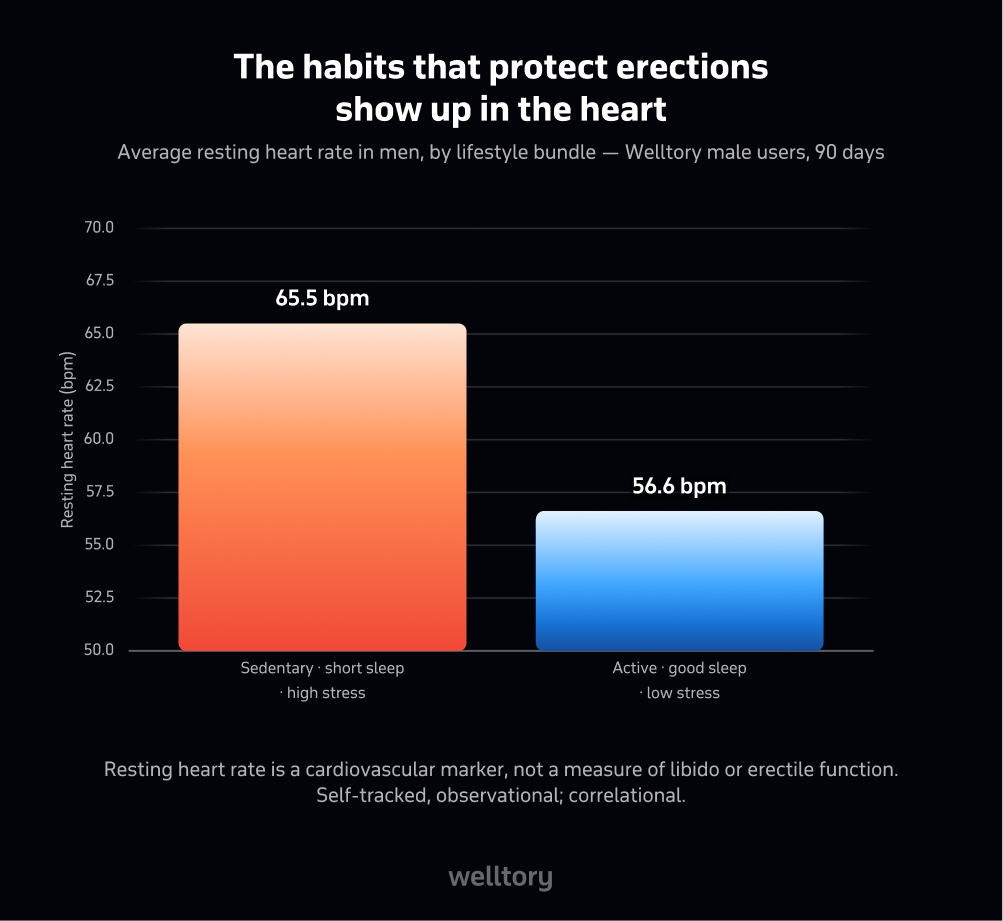
When we combined habits, the gap widened. Men who were active, slept seven hours or more and had below-average stress (215 men) averaged a resting heart rate of 56.6; men who were inactive, slept under six and a half hours and had above-average stress (128 men) averaged 65.5 — about 9 beats higher — and woke with far less energy (58 versus 85 out of 100).
Exercise and weight loss have trial evidence for erections; sleep and stress have observational links. Our data can't say anything about sexual function, but these habits are linked to measurably different heart-rate and stress numbers.
Welltory male users, per-user averages over a 90-day window. Observational and aggregated. Resting heart rate and stress load are cardiovascular and nervous-system signals, not measures of sexual function.
A practical plan
Move most days, and push some of it. Build toward about 160 minutes a week of moderate-to-vigorous aerobic exercise — for example 40 minutes, four times a week. Brisk walking counts if it's brisk.
Lose weight if you carry extra, especially around the middle. Losing weight can improve erections and raise testosterone; in trials, the benefit grew with the amount lost.
Stop smoking. Ask your doctor about nicotine replacement or other quit-smoking medication. In the study above, only men who quit saw their erections improve.
Cut back on alcohol, especially before sex and on weeknights.
Protect seven or more hours of sleep, and get checked for sleep apnea if you snore loudly or wake unrefreshed.
Lower the pressure. If worry about performance is part of it, a few sessions with a sex therapist or psychologist can break the cycle.
Get checked (below) — so you're not treating a symptom while missing a cause.
Give it time. In the trials, benefits built up over months, not days.
When to see a doctor
Occasional trouble is normal, especially when you're tired, stressed or have been drinking. See a doctor if erection problems last more than a few months, are getting worse, or come with low desire. Go sooner if you're under about 60, have diabetes, high blood pressure or high cholesterol, or notice chest discomfort or breathlessness on exertion. Seek emergency care for chest pain, for an erection lasting more than four hours, or for sudden vision or hearing loss after taking an ED pill. (DailyMed)
How to bring this up with your doctor — and what to ask for
Say it plainly, with a timeline. "My erections have been weaker for about six months" is a complete, useful sentence. ED is one of the most common things doctors treat.
Ask for the right checks. Urology guidelines say men with ED should be told it's a risk marker for heart disease, and recommend a morning total testosterone test. (doi.org) Ask for blood pressure, a fasting cholesterol panel, fasting glucose or HbA1c, and a heart risk estimate. If testosterone comes back low, ask for a repeat fasting morning test before any treatment decision.
Ask about your medications. Some blood pressure drugs, antidepressants and other medicines can affect erections or desire. Ask whether there's an alternative — don't stop anything on your own.
Mention the whole picture. Snoring, low mood, heavy drinking, smoking, stress at work, relationship strain. Each can change the plan.
Know the safety rule. ED pills must never be combined with nitrates in any form, including nitroglycerin for chest pain and "poppers," or with riociguat, because blood pressure can drop dangerously. (DailyMed) The label also says not to use them if sex is inadvisable for your heart. Avoid pills and "natural boosters" bought online without a prescription.
If you are dismissed. "I'd like to understand the cause, not just get a prescription. Can we check my heart risk and testosterone?" That's standard care.
How Welltory helps
Welltory doesn't measure erections or libido. What it does track is the machinery underneath: your resting heart rate, heart rate variability, sleep, activity and daily stress load, compared with your own baseline.
That turns a lifestyle plan into something you can see working. As you add exercise, cut alcohol, sleep more or quit smoking, you can watch whether your resting heart rate drifts down and your stress load eases over weeks. With My Patterns, you can add notes like "ED", "drinks" or "workout" and see which habits tend to come before better days. It won't diagnose anything, but it gives you and your doctor a concrete record instead of a vague impression. For the women's side of the same question, see low libido in women.
How we made it
The clinical content rests on published research and guidelines: the Massachusetts Male Aging Study (Feldman et al. 1994; Derby et al. 2000; Travison et al. 2007), the Health Professionals Follow-up Study (Bacon et al. 2003), exercise meta-analyses and reviews (Silva et al. 2017; Gerbild et al. 2018), a pelvic floor trial (Dorey et al. 2004), weight loss and diet trials (Esposito et al. 2004, 2006; Gupta et al. 2011; Wing et al. 2010; Corona et al. 2013), smoking studies (Cao et al. 2013, 2014; Pourmand et al. 2004; Harte & Meston 2012; Harte 2013), alcohol studies (Rubin & Henson 1976; Cheng et al. 2007; Wang et al. 2018; Arackal & Benegal 2007), sleep studies (Leproult & Van Cauter 2011; Belladelli et al. 2024; Rodriguez et al. 2020; Kellesarian et al. 2018; Yang et al. 2021), stress and mood (Andersson 2011; Pyke 2020; Liu et al. 2018; Melnik et al. 2007), testosterone (Wu et al. 2010; Bhasin et al. 2018), ED and cardiovascular risk (Vlachopoulos et al. 2013; Montorsi et al. 2003), the AUA erectile dysfunction guideline (Burnett et al. 2018), and the sildenafil prescribing information.
The Welltory figures come from an aggregated, de-identified dataset of 1,971 male users: per-user average steps, resting heart rate, stress load, sleep and morning energy over a 90-day window, compared by activity level and by combined habits. Welltory does not collect data on sexual function.


Discounts for blog readers: up to 36% off
See what affects your energy, stress, sleep, and daily state with Welltory
This article is for educational purposes only and is not medical advice, diagnosis, or treatment. Erectile dysfunction and low libido are common and treatable — and because erection problems can be an early sign of heart disease, diabetes, low testosterone, depression, or a medication side effect, persistent symptoms are worth discussing with a doctor. Welltory measures physiological signals like heart rate, HRV, sleep, activity, and stress; it does not measure or diagnose sexual function.
Was this helpful?
Ask AI for a summary of page


Written by Jane Smorodnikova

The founder and CEO of Welltory. A recognized tech leader with two Master's degrees and experience at MIT, she has scaled Welltory to over 17 million users.
Written by Tatsiana Yashyna

Deputy COO at Welltory. With a background in medicine and years of working with health data, she translates research and real physiological signals — sleep, stress, heart rate, and hormones — into clear, evidence-based explanations that help people understand what their bodies are telling them.
Reviewed by Anna Elitzur
-2.jpg)
With her medical degree, Anna reviews Welltory's health content for medical accuracy and alignment with current clinical guidelines and research.
References
- Feldman HA, Goldstein I, Hatzichristou DG, Krane RJ, McKinlay JB. Impotence and its medical and psychosocial correlates: results of the Massachusetts Male Aging Study. Journal of Urology 1994;151(1):54-61. https://doi.org/10.1016/s0022-5347%2817%2934871-1
- Bacon CG, Mittleman MA, Kawachi I, et al. Sexual function in men older than 50 years of age: results from the Health Professionals Follow-up Study. Annals of Internal Medicine 2003;139(3):161-168. https://doi.org/10.7326/0003-4819-139-3-200308050-00005
- Silva AB, Sousa N, Azevedo LF, Martins C. Physical activity and exercise for erectile dysfunction: systematic review and meta-analysis. British Journal of Sports Medicine 2017;51(19):1419-1424. https://doi.org/10.1136/bjsports-2016-096418
- Gerbild H, Larsen CM, Graugaard C, Areskoug Josefsson K. Physical activity to improve erectile function: a systematic review of intervention studies. Sexual Medicine 2018;6(2):75-89. https://doi.org/10.1016/j.esxm.2018.02.001
- Derby CA, Mohr BA, Goldstein I, et al. Modifiable risk factors and erectile dysfunction: can lifestyle changes modify risk? Urology 2000;56(2):302-306. https://doi.org/10.1016/s0090-4295%2800%2900614-2
- Dorey G, Speakman M, Feneley R, et al. Randomised controlled trial of pelvic floor muscle exercises and manometric biofeedback for erectile dysfunction. British Journal of General Practice 2004;54(508):819-825. https://pmc.ncbi.nlm.nih.gov/articles/PMC1324914/
- Esposito K, Giugliano F, Di Palo C, et al. Effect of lifestyle changes on erectile dysfunction in obese men: a randomized controlled trial. JAMA 2004;291(24):2978-2984. https://doi.org/10.1001/jama.291.24.2978
- Gupta BP, Murad MH, Clifton MM, et al. The effect of lifestyle modification and cardiovascular risk factor reduction on erectile dysfunction: a systematic review and meta-analysis. Archives of Internal Medicine 2011;171(20):1797-1803. https://doi.org/10.1001/archinternmed.2011.440
- Wing RR, Rosen RC, Fava JL, et al. Effects of weight loss intervention on erectile function in older men with type 2 diabetes in the Look AHEAD trial. Journal of Sexual Medicine 2010;7(1):156-165. https://doi.org/10.1111/j.1743-6109.2009.01458.x
- Esposito K, Ciotola M, Giugliano F, et al. Mediterranean diet improves erectile function in subjects with the metabolic syndrome. International Journal of Impotence Research 2006;18(4):405-410. https://doi.org/10.1038/sj.ijir.3901447
- Corona G, Rastrelli G, Monami M, et al. Body weight loss reverts obesity-associated hypogonadotropic hypogonadism: a systematic review and meta-analysis. European Journal of Endocrinology 2013;168(6):829-843. https://doi.org/10.1530/EJE-12-0955
- Cao S, Yin X, Wang Y, et al. Smoking and risk of erectile dysfunction: systematic review of observational studies with meta-analysis. PLOS ONE 2013;8(4):e60443. https://doi.org/10.1371/journal.pone.0060443
- Cao S, Gan Y, Dong X, Liu J, Lu Z. Association of quantity and duration of smoking with erectile dysfunction: a dose-response meta-analysis. Journal of Sexual Medicine 2014;11(10):2376-2384. https://doi.org/10.1111/jsm.12641
- Pourmand G, Alidaee MR, Rasuli S, et al. Do cigarette smokers with erectile dysfunction benefit from stopping?: a prospective study. BJU International 2004;94(9):1310-1313. https://doi.org/10.1111/j.1464-410X.2004.05162.x
- Harte CB, Meston CM. Association between smoking cessation and sexual health in men. BJU International 2012;109(6):888-896. https://doi.org/10.1111/j.1464-410X.2011.10503.x
- Harte CB. Association between cigarette smoking and erectile tumescence: the mediating role of heart rate variability. International Journal of Impotence Research 2013;25(4):155-159. https://doi.org/10.1038/ijir.2012.43
- Rubin HB, Henson DE. Effects of alcohol on male sexual responding. Psychopharmacologia 1976;47(2):123-134. https://doi.org/10.1007/BF00735810
- Arackal BS, Benegal V. Prevalence of sexual dysfunction in male subjects with alcohol dependence. Indian Journal of Psychiatry 2007;49(2):109-112. https://doi.org/10.4103/0019-5545.33257
- Wang XM, Bai YJ, Yang YB, et al. Alcohol intake and risk of erectile dysfunction: a dose-response meta-analysis of observational studies. International Journal of Impotence Research 2018;30(6):342-351. https://doi.org/10.1038/s41443-018-0022-x
- Cheng JYW, Ng EML, Chen RYL, Ko JSN. Alcohol consumption and erectile dysfunction: meta-analysis of population-based studies. International Journal of Impotence Research 2007;19(4):343-352. https://doi.org/10.1038/sj.ijir.3901556
- Leproult R, Van Cauter E. Effect of 1 week of sleep restriction on testosterone levels in young healthy men. JAMA 2011;305(21):2173-2174. https://doi.org/10.1001/jama.2011.710
- Belladelli F, Li S, Zhang CA, et al. The association between insomnia, insomnia medications, and erectile dysfunction. European Urology Focus 2024;10(1):139-145. https://doi.org/10.1016/j.euf.2023.08.005
- Rodriguez KM, Kohn TP, Kohn JR, et al. Shift work sleep disorder and night shift work significantly impair erectile function. Journal of Sexual Medicine 2020;17(9):1687-1693. https://doi.org/10.1016/j.jsxm.2020.06.009
- Kellesarian SV, Malignaggi VR, Feng C, Javed F. Association between obstructive sleep apnea and erectile dysfunction: a systematic review and meta-analysis. International Journal of Impotence Research 2018;30(3):129-140. https://doi.org/10.1038/s41443-018-0017-7
- Yang Z, Du G, Ma L, et al. Continuous positive airway pressure therapy in obstructive sleep apnoea patients with erectile dysfunction: a meta-analysis. Clinical Respiratory Journal 2021;15(2):163-168. https://doi.org/10.1111/crj.13280
- Andersson KE. Mechanisms of penile erection and basis for pharmacological treatment of erectile dysfunction. Pharmacological Reviews 2011;63(4):811-859. https://doi.org/10.1124/pr.111.004515
- Pyke RE. Sexual performance anxiety. Sexual Medicine Reviews 2020;8(2):183-190. https://doi.org/10.1016/j.sxmr.2019.07.001
- Liu Q, Zhang Y, Wang J, et al. Erectile dysfunction and depression: a systematic review and meta-analysis. Journal of Sexual Medicine 2018;15(8):1073-1082. https://doi.org/10.1016/j.jsxm.2018.05.016
- Melnik T, Soares BG, Nasselo AG. Psychosocial interventions for erectile dysfunction. Cochrane Database of Systematic Reviews 2007;(3):CD004825. https://doi.org/10.1002/14651858.CD004825.pub2
- Vlachopoulos CV, Terentes-Printzios DG, Ioakeimidis NK, et al. Prediction of cardiovascular events and all-cause mortality with erectile dysfunction: a systematic review and meta-analysis of cohort studies. Circulation: Cardiovascular Quality and Outcomes 2013;6(1):99-109. https://doi.org/10.1161/CIRCOUTCOMES.112.966903
- Montorsi F, Briganti A, Salonia A, et al. Erectile dysfunction prevalence, time of onset and association with risk factors in 300 consecutive patients with acute chest pain and angiographically documented coronary artery disease. European Urology 2003;44(3):360-364. https://doi.org/10.1016/s0302-2838%2803%2900305-1
- Travison TG, Shabsigh R, Araujo AB, et al. The natural progression and remission of erectile dysfunction: results from the Massachusetts Male Aging Study. Journal of Urology 2007;177(1):241-246. https://doi.org/10.1016/j.juro.2006.08.108
- Wu FCW, Tajar A, Beynon JM, et al. Identification of late-onset hypogonadism in middle-aged and elderly men. New England Journal of Medicine 2010;363(2):123-135. https://doi.org/10.1056/NEJMoa0911101
- Bhasin S, Brito JP, Cunningham GR, et al. Testosterone therapy in men with hypogonadism: an Endocrine Society clinical practice guideline. Journal of Clinical Endocrinology & Metabolism 2018;103(5):1715-1744. https://doi.org/10.1210/jc.2018-00229
- Burnett AL, Nehra A, Breau RH, et al. Erectile dysfunction: AUA guideline. Journal of Urology 2018;200(3):633-641. https://doi.org/10.1016/j.juro.2018.05.004
- U.S. Food and Drug Administration. VIAGRA (sildenafil citrate) prescribing information. DailyMed. https://dailymed.nlm.nih.gov/dailymed/drugInfo.cfm?setid=0b0be196-0c62-461c-94f4-9a35339b4501
- Welltory men's cohort (activity, resting heart rate, stress load and lifestyle bundle, 1,971 male users, 90 days). Reproducible script: `persona_lab/scripts/libido_lifestyle_men_context.py`.

