

Short answer
Yes, erectile dysfunction can be an early sign of heart disease. Across 14 studies of about 93,000 men, men with ED had about 44% more cardiovascular events and 62% more heart attacks. In men who develop coronary disease, erection problems often start first, usually 2 to 5 years earlier — a window to act.
If you've noticed erection changes, bringing them up is not vanity or oversharing, and it's not "just age." An erection depends on healthy blood vessels, and the arteries that supply the penis are narrower than the ones that feed the heart. When the lining of your arteries starts to struggle, they are often the first place it shows.
That doesn't mean every man with ED has heart disease — many causes are psychological, hormonal, medication-related or temporary. It means that persistent ED, especially in a man in his 40s or 50s or a man with diabetes, is a good reason to have your heart risk checked. This article explains why ED can come first, how big the risk really is, who it matters for most, what your doctor should check, and whether women have an equivalent.
Why can erection problems show up before heart problems?
An erection is a blood-flow event. When you're aroused, the inner lining of the penile arteries — the endothelium — releases nitric oxide, which relaxes the artery walls so blood can flow in. The same lining runs through every artery in your body, including the ones that feed your heart. High blood pressure, high LDL cholesterol, diabetes, smoking and inactivity damage it everywhere at once. (doi.org)
Size is the other half of the explanation. The arteries that supply the penis are only about 1 to 2 millimeters wide, compared with about 3 to 4 millimeters for the main coronary arteries. So the same amount of plaque or vessel stiffening that barely affects the heart can already cut blood flow to the penis enough to notice. Doctors call this the artery size hypothesis. (doi.org) That's why erection changes can be an early clue about the circulation as a whole.
How many years before heart disease does ED appear?
The best data come from men who already have coronary artery disease and were asked when their erection problems began.
In 300 Italian men with chest pain and blocked coronary arteries, about half had ED. Of those, 67% said it started before any heart symptoms — on average 38.8 months, or a little over three years, earlier. (doi.org)
In a second Italian study of men with stable coronary disease and ED, ED came first in 93% of them, typically about two years (24 months) before the heart diagnosis. (doi.org)
A UK study of men in cardiac rehabilitation found ED in 66% of them versus 37% of similar men without heart disease, and concluded ED may precede a heart event by as much as five years. (doi.org)
The European Society of Cardiology sums it up: ED usually appears 2 to 5 years (about 3 on average) before coronary disease, stroke or blocked leg arteries. (doi.org)
Two caveats matter. These figures rely on men remembering when ED began, and they describe the time to heart symptoms or diagnosis — mostly chest pain — not specifically to a heart attack. They don't mean every man with ED will have a heart event within a few years. What they do mean is that ED often opens a window of a few years to act.
How much does ED raise heart disease risk?
Less than the "double the risk" line you'll often read, but enough to take seriously.
A large pooled analysis combined 14 long-term studies of 92,757 men, followed for about six years on average. Compared with men without ED, men with ED had 44% more cardiovascular events, 62% more heart attacks, 39% more strokes and 25% higher death from any cause. The link with cardiovascular death specifically wasn't statistically clear. (doi.org) A second analysis of 12 cohort studies found almost the same numbers — about 48% higher risk of cardiovascular disease — even after accounting for the usual risk factors. (doi.org)
In a US trial of 9,457 men aged 55 and over, having ED went with a 45% higher risk of later heart events. The researchers noted that this was in the same range as the extra risk from current smoking or a family history of heart attack. In everyday numbers, that was about 2.4 heart events per 100 men a year with ED, versus 1.5 without. (doi.org)
Severity matters. In the 45 and Up Study of 95,038 Australian men aged 45 and over, among those with no known heart disease, men with severe ED had 60% higher risk of ischaemic heart disease and about twice the risk of death from any cause during follow-up, compared with men without ED, even after adjusting for smoking, weight, diabetes and blood pressure treatment. The risk rose step by step with ED severity. (doi.org)
Who should take ED most seriously as a heart signal?
Younger men. ED predicts heart risk more strongly in younger men than in older ones. (doi.org) In a 10-year study in Minnesota, men in their 40s with ED developed coronary disease at about 49 per 1,000 a year, compared with about 1 per 1,000 a year among men without ED. Only 2% of men that age had ED, so the numbers are small and uncertain, but the authors concluded that ED in younger men deserves particular attention. The gap shrank with age and disappeared after 70, when ED is common for many reasons. (doi.org)
Men with diabetes. In a review of studies covering 22,586 men with diabetes, the long-term cohort studies found that ED went with about 74% higher odds of heart events. (doi.org) Diabetes can hide heart disease, because it can blunt chest pain. In diabetic men whose coronary disease caused no symptoms at all, ED was far more common than in diabetic men without it — 34% versus 5% (doi.org) — and over about four years it went with roughly double the rate of major heart events. (doi.org)
Men with ED that is persistent, worsening or severe, and men who also have high blood pressure, high cholesterol, prediabetes, a smoking history, excess weight around the middle, or a family history of early heart disease.
Less so: ED that comes and goes with stress, alcohol, a new relationship or tiredness, and ED where morning and solo erections are still normal, is more likely to have a psychological or situational cause. That's still worth addressing — see sexual performance anxiety — but it's a different conversation.
What guidelines say your doctor should check
Heart and urology societies now agree that ED should prompt a cardiovascular check.
The American Urological Association says men with ED should be told that it is a risk marker for underlying cardiovascular disease and other conditions that may need evaluation. (doi.org)
The European Society of Cardiology recommends that assessment of cardiovascular risk should be considered in men with ED. (doi.org)
The Princeton IV expert panel (2024) goes further: men with ED should be treated as being at risk for cardiac events until proven otherwise, and ED should count as a risk-enhancing factor. (doi.org)
In practice, a first check usually includes blood pressure, a fasting cholesterol panel, fasting glucose or HbA1c, kidney function and a morning testosterone level, (doi.org) plus a 10-year cardiovascular risk estimate. For some men at low-to-intermediate risk, doctors may add a coronary artery calcium (CAC) scan, a quick CT that shows calcified plaque. (doi.org) The European guideline notes that CAC scanning in this situation is suggested but not yet proven. Men with chest symptoms, breathlessness on exertion or high overall risk should be referred to cardiology. (doi.org)
If the terms are new, here's what they mean in plain words. A 10-year risk estimate is a calculator your doctor fills in with your age, blood pressure, cholesterol, smoking status and diabetes; it gives the chance, in percent, of a heart attack or stroke over the next ten years, and it decides how hard to push on prevention. ED doesn't enter most of these calculators directly, which is exactly why the Princeton panel suggests treating it as a factor that nudges your risk up. A CAC score counts calcium in the walls of your heart arteries: zero is reassuring, while a higher score means plaque is already there, even if you have no symptoms. Either result is useful, because it tells you whether to act on blood pressure, cholesterol or blood sugar now or simply keep up healthy habits.
One safety point every man should know: ED pills such as sildenafil and tadalafil must never be taken with nitrate medicines like nitroglycerin, or with riociguat, because the combination can drop blood pressure dangerously; the Princeton panel advises no short-acting pill within 24 hours of a nitrate and no tadalafil within 48 hours. The label also says not to use them if sex is inadvisable for your heart. (FDA) Avoid ED pills or "herbal" boosters bought online without a prescription. And some heart and blood pressure drugs — thiazide diuretics, some beta-blockers, aldosterone antagonists — can themselves cause ED, (doi.org) so ask your doctor about alternatives rather than stopping them.
ED is a warning sign, not the cause
ED and heart disease share roots — damaged vessel lining, plaque, high blood pressure, diabetes — so ED works like a smoke alarm, not like a fire. That has one important consequence: treating the erection alone doesn't treat the arteries. No randomized trial has shown that ED pills lower heart risk; the lower heart event rates seen in some men taking them come only from looking back at records. (doi.org)
What does help both is working on the shared roots. In a two-year randomized trial of obese men with ED, those who lost weight and increased exercise from 48 to 195 minutes a week regained normal erections in about 1 in 3 cases, versus about 1 in 20 in the control group, and their inflammation markers fell. (doi.org) The full lifestyle picture — exercise, sleep, alcohol, smoking, weight — is in what really drives male libido and erections. If blood pressure is part of your picture, see what causes high blood pressure and how to measure blood pressure at home.
What our data shows: healthy habits show up in a calmer heart
Welltory can't see erections, but it can see one everyday readout of cardiovascular fitness: resting heart rate. We compared two groups of Welltory adults over a 90-day window. The first (692 people) was among the most active, slept seven hours or more and had below-average stress. The second (232 people) was among the least active, slept under six and a half hours and had above-average stress.
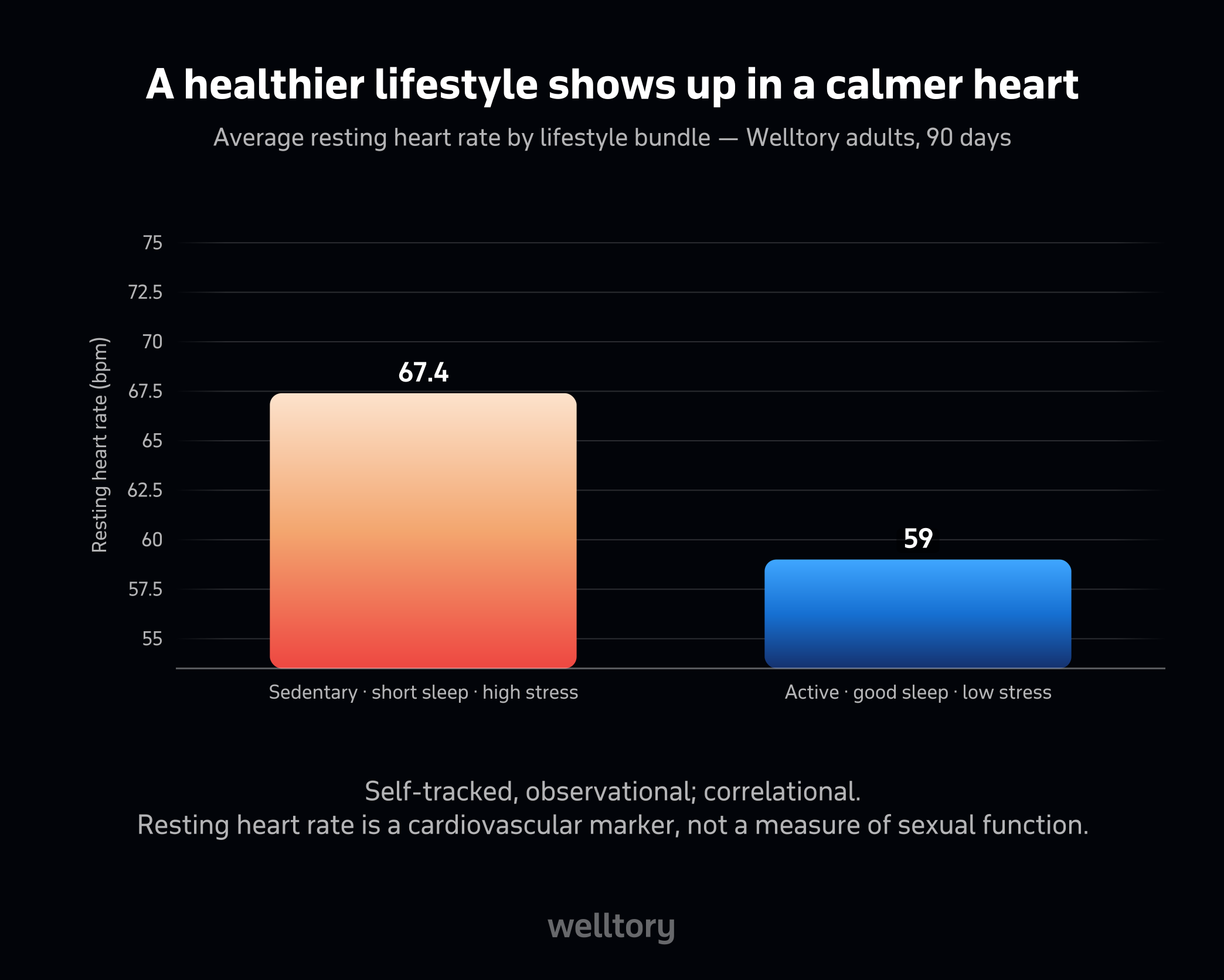
The healthier group averaged a resting heart rate of 59 beats per minute; the less healthy group averaged 67 — about 8 beats per minute higher at rest. The healthier group also woke with far more energy (88 versus 59 out of 100).
Exercise and weight loss, two of these habits, improved erections and inflammation markers in the trial above. Our data can't show anything about erections, but these habits are linked to measurably different numbers you can track.
Welltory adults with complete activity, sleep and stress data, per-user averages over a 90-day window. "Healthier": top third for steps, 7+ hours of sleep, stress at or below the median. "Less healthy": bottom third for steps, under 6.5 hours of sleep, stress at or above the median. Observational and aggregated; resting heart rate is not a measure of sexual function or a diagnosis of heart disease.
Is there a female equivalent of ED as a heart warning?
Not an established one. Women with cardiovascular disease are more likely to have sexual difficulties: in a review of 54 studies covering about 149,000 people, women with heart or blood vessel disease had about 1.5 times the odds of sexual dysfunction, and about twice the odds after a heart attack. (doi.org) But that runs in the other direction — heart disease leading to sexual problems. No study so far has shown that women's sexual problems predict future heart events the way ED does in men, and experts describe the evidence for a female counterpart as emerging but immature. (doi.org)
There are hints linking women's sexual function to the nervous system rather than the arteries. In a small study of 72 young women, those with below-average resting heart rate variability were more likely to report arousal difficulties. (doi.org) That's a signal about stress physiology, not heart disease. For what usually drives low desire in women, see low libido in women.
When should ED send you to a doctor?
See a doctor if erection problems have lasted a few months, are getting worse, or came on without an obvious reason — even if you feel healthy otherwise. Go sooner if:
you're under about 60, or you have diabetes, high blood pressure or high cholesterol;
you also notice chest discomfort, pressure or breathlessness when you exert yourself, or calf pain when walking that eases with rest;
you smoke, carry extra weight around your middle, or have a family history of early heart disease;
you snore loudly and wake unrefreshed — sleep apnea is linked to both ED and heart disease (see could I have sleep apnea?);
ED started after a new medication.
Seek emergency care for chest pain, pressure or severe breathlessness, including during sex.
How to bring this up with your doctor — and what to ask for
Say it plainly, and say when it started. "My erections have been weaker for about eight months, and I'd like to check whether it's related to my heart." That sentence moves the appointment from embarrassment to cardiovascular prevention, which is exactly where guidelines want it.
Ask for the cardiovascular workup, not only a prescription. Blood pressure, a fasting cholesterol panel, fasting glucose or HbA1c, kidney function, and a 10-year heart risk estimate. Ask whether a coronary artery calcium scan makes sense for you.
Ask about the rest of the picture. A morning testosterone level if you also have low desire or fewer morning erections, and a review of your medications. Mention snoring, low mood, heavy drinking or smoking — each changes the plan.
Bring your numbers. Home blood pressure readings and a few weeks of resting heart rate, sleep and activity trends give your doctor more than a single clinic reading. (See also: white coat and masked hypertension.)
If you are dismissed. "Guidelines say ED is a risk marker for heart disease. Can we check my cardiovascular risk properly?" You're asking for standard care, not a favor.
How Welltory helps
Welltory doesn't measure erections or diagnose heart disease. What it does track is the everyday cardiovascular picture: your resting heart rate, your heart rate variability, your sleep, your activity and your stress load, each compared with your own baseline.
That's useful in two ways. First, it shows whether the changes you make for your arteries — more exercise, less alcohol, better sleep, quitting smoking — are moving your resting heart rate and recovery in the right direction over weeks. Second, it gives you a concrete record to bring to your doctor. With My Patterns, you can add notes like "ED", "alcohol" or "workout" and see what tends to come before the better and worse days. For a sense of where your numbers sit, see what is a normal resting heart rate.
How we made it
The clinical content rests on published research and guidelines: studies of ED onset in men with coronary disease (Montorsi et al. 2003, 2006; Hodges et al. 2007), the artery size hypothesis (Montorsi et al. 2005), a systematic review of the ED–cardiovascular link (Gandaglia et al. 2014), meta-analyses of cohort studies (Vlachopoulos et al. 2013; Dong et al. 2011; Yamada et al. 2012), large cohorts (Thompson et al. 2005; Inman et al. 2009; Banks et al. 2013), studies in men with diabetes (Gazzaruso et al. 2004, 2008), guidelines from the American Urological Association (Burnett et al. 2018), the European Society of Cardiology (Visseren et al. 2021) and the Princeton consensus panel (Köhler et al. 2024; Miner et al. 2014), the sildenafil prescribing information (FDA), a lifestyle trial (Esposito et al. 2004), and research on women's sexual function and cardiovascular disease (Dilixiati et al. 2024; Priviero et al. 2026; Stanton et al. 2015).
The Welltory figures come from an aggregated, de-identified dataset of adults with complete activity, sleep and stress data: per-user average resting heart rate and morning energy over a 90-day window, compared between a healthier-habits group (692 users) and a less-healthy-habits group (232 users). Welltory does not collect data on sexual function.


Discounts for blog readers: up to 36% off
See what affects your energy, stress, sleep, and daily state with Welltory
This article is for educational purposes only and is not medical advice, diagnosis, or treatment. Persistent changes in libido or erectile function can signal treatable underlying conditions — including heart disease, diabetes, hormonal, or mood issues — so they're worth discussing with a doctor. Welltory measures physiological signals like heart rate, HRV, sleep, activity, and stress; it does not measure or diagnose sexual function.
Was this helpful?
Ask AI for a summary of page


Written by Jane Smorodnikova

The founder and CEO of Welltory. A recognized tech leader with two Master's degrees and experience at MIT, she has scaled Welltory to over 17 million users.
Written by Tatsiana Yashyna

Deputy COO at Welltory. With a background in medicine and years of working with health data, she translates research and real physiological signals — sleep, stress, heart rate, and hormones — into clear, evidence-based explanations that help people understand what their bodies are telling them.
Reviewed by Anna Elitzur
-2.jpg)
With her medical degree, Anna reviews Welltory's health content for medical accuracy and alignment with current clinical guidelines and research.
References
- Montorsi F, Briganti A, Salonia A, et al. Erectile dysfunction prevalence, time of onset and association with risk factors in 300 consecutive patients with acute chest pain and angiographically documented coronary artery disease. European Urology 2003;44(3):360-364. https://doi.org/10.1016/s0302-2838%2803%2900305-1
- Montorsi P, Ravagnani PM, Galli S, et al. Association between erectile dysfunction and coronary artery disease. Role of coronary clinical presentation and extent of coronary vessels involvement: the COBRA trial. European Heart Journal 2006;27(22):2632-2639. https://doi.org/10.1093/eurheartj/ehl142
- Hodges LD, Kirby M, Solanki J, et al. The temporal relationship between erectile dysfunction and cardiovascular disease. International Journal of Clinical Practice 2007;61(12):2019-2025. https://doi.org/10.1111/j.1742-1241.2007.01629.x
- Montorsi P, Ravagnani PM, Galli S, et al. The artery size hypothesis: a macrovascular link between erectile dysfunction and coronary artery disease. American Journal of Cardiology 2005;96(12B):19M-23M. https://doi.org/10.1016/j.amjcard.2005.07.006
- Gandaglia G, Briganti A, Jackson G, et al. A systematic review of the association between erectile dysfunction and cardiovascular disease. European Urology 2014;65(5):968-978. https://doi.org/10.1016/j.eururo.2013.08.023
- Vlachopoulos CV, Terentes-Printzios DG, Ioakeimidis NK, et al. Prediction of cardiovascular events and all-cause mortality with erectile dysfunction: a systematic review and meta-analysis of cohort studies. Circulation: Cardiovascular Quality and Outcomes 2013;6(1):99-109. https://doi.org/10.1161/CIRCOUTCOMES.112.966903
- Dong JY, Zhang YH, Qin LQ. Erectile dysfunction and risk of cardiovascular disease: meta-analysis of prospective cohort studies. Journal of the American College of Cardiology 2011;58(13):1378-1385. https://doi.org/10.1016/j.jacc.2011.06.024
- Thompson IM, Tangen CM, Goodman PJ, et al. Erectile dysfunction and subsequent cardiovascular disease. JAMA 2005;294(23):2996-3002. https://doi.org/10.1001/jama.294.23.2996
- Banks E, Joshy G, Abhayaratna WP, et al. Erectile dysfunction severity as a risk marker for cardiovascular disease hospitalisation and all-cause mortality: a prospective cohort study. PLOS Medicine 2013;10(1):e1001372. https://doi.org/10.1371/journal.pmed.1001372
- Inman BA, St Sauver JL, Jacobson DJ, et al. A population-based, longitudinal study of erectile dysfunction and future coronary artery disease. Mayo Clinic Proceedings 2009;84(2):108-113. https://doi.org/10.4065/84.2.108
- Yamada T, Hara K, Umematsu H, et al. Erectile dysfunction and cardiovascular events in diabetic men: a meta-analysis of observational studies. PLOS ONE 2012;7(9):e43673. https://doi.org/10.1371/journal.pone.0043673
- Gazzaruso C, Giordanetti S, De Amici E, et al. Relationship between erectile dysfunction and silent myocardial ischemia in apparently uncomplicated type 2 diabetic patients. Circulation 2004;110(1):22-26. https://doi.org/10.1161/01.CIR.0000133278.81226.C9
- Gazzaruso C, Solerte SB, Pujia A, et al. Erectile dysfunction as a predictor of cardiovascular events and death in diabetic patients with angiographically proven asymptomatic coronary artery disease. Journal of the American College of Cardiology 2008;51(21):2040-2044. https://doi.org/10.1016/j.jacc.2007.10.069
- Burnett AL, Nehra A, Breau RH, et al. Erectile dysfunction: AUA guideline. Journal of Urology 2018;200(3):633-641. https://doi.org/10.1016/j.juro.2018.05.004
- Visseren FLJ, Mach F, Smulders YM, et al. 2021 ESC Guidelines on cardiovascular disease prevention in clinical practice. European Heart Journal 2021;42(34):3227-3337. https://doi.org/10.1093/eurheartj/ehab484
- Köhler TS, Kloner RA, Rosen RC, et al. The Princeton IV consensus recommendations for the management of erectile dysfunction and cardiovascular disease. Mayo Clinic Proceedings 2024;99(9):1500-1517. https://doi.org/10.1016/j.mayocp.2024.06.002
- Miner M, Nehra A, Jackson G, et al. All men with vasculogenic erectile dysfunction require a cardiovascular workup. American Journal of Medicine 2014;127(3):174-182. https://doi.org/10.1016/j.amjmed.2013.10.013
- U.S. Food and Drug Administration. VIAGRA (sildenafil citrate) prescribing information, revised 12/2017. https://www.accessdata.fda.gov/drugsatfda_docs/label/2017/020895s048lbl.pdf
- Esposito K, Giugliano F, Di Palo C, et al. Effect of lifestyle changes on erectile dysfunction in obese men: a randomized controlled trial. JAMA 2004;291(24):2978-2984. https://doi.org/10.1001/jama.291.24.2978
- Dilixiati D, Cao R, Mao Y, et al. Association between cardiovascular disease and risk of female sexual dysfunction: a systematic review and meta-analysis. European Journal of Preventive Cardiology 2024;31(7):782-800. https://doi.org/10.1093/eurjpc/zwae042
- Priviero F, Hollis F, Wood SK, et al. Erectile and clitoral dysfunction as harbingers of cardiovascular disease: a perspective. Medicina 2026;62(2):416. https://doi.org/10.3390/medicina62020416
- Stanton AM, Lorenz TA, Pulverman CS, Meston CM. Heart rate variability: a risk factor for female sexual dysfunction. Applied Psychophysiology and Biofeedback 2015;40(3):229-237. https://doi.org/10.1007/s10484-015-9286-9
- Welltory adult cohort (resting heart rate and morning energy by lifestyle bundle, 924 users, 90 days). Reproducible script: `persona_lab/scripts/midlife_age_bands.py`.