

Short answer
Low libido in women is common: about 4 in 10 women report low desire, though only about 1 in 10 women have low desire that distresses them. The usual causes are everyday ones — stress, short or poor sleep, the menstrual cycle, some medications, pain, low mood, and a new baby. Desire that shows up only after closeness begins is normal, not low.
If your sex drive has dropped, you're not broken, and you're not imagining it. Desire is not a fixed personality trait. It is a response, and it depends on the state your body and your life are in. For many women it doesn't arrive out of nowhere; it builds once touch or closeness has already started. Researchers call this responsive desire, and it is a normal way for desire to work.
What pushes desire down is usually not a missing spark but a pile of brakes: a stressful stretch, weeks of short nights, the second half of your cycle, an antidepressant, sex that hurts, or simply being exhausted. This article walks through each of them in plain language, what the research actually shows, what helps, and when a drop is worth taking to a doctor.
How common is low libido in women?
Much more common than most women think. In PRESIDE, a survey of over 31,000 US women, 38.7% reported low sexual desire. But only about 10% had low desire and felt distressed about it. (doi.org) (doi.org) The same survey found that distressing sexual problems of any kind peak in midlife: 14.8% of women aged 45 to 64, compared with 10.8% of younger and 8.9% of older women.
Britain's national sex survey, Natsal-3, found the same gap between having a difficulty and being bothered by it. About half of sexually active women (51.2%) reported at least one sexual difficulty in the past year, but only about 11% said they were distressed about their sex life. More than a quarter (27.4%) said they and their partner wanted sex at different levels. (doi.org)
Two things follow from this. First, lower desire on its own is not a diagnosis; it is part of the normal range. Second, if it does bother you, you are far from alone, and it is a legitimate thing to bring to a doctor.
Is my desire actually low — or is it responsive?
The older textbook picture of desire went like this: first you feel an urge, then you get aroused, then you have sex. For many women, that is not the order. In 2000, the physician and researcher Rosemary Basson described a different, very common pattern: a woman starts from a neutral place, and desire emerges once touch, closeness, or the right context gets things going. (doi.org)
Basson's paper was a model, not a survey, but later data back it up. In a survey of 3,687 women, among those who became aroused easily, about 31% said they typically or always feel desire only once arousal has already started, while only 15.5% said they have sex only if they feel desire first. Starting sex without desire at the outset was almost twice as common for women in long-term relationships as in short ones — 42% versus 22.4%. (doi.org)
So "I never want it until we've started" is not a sign that something is wrong. It is one of the most common ways desire works, especially years into a relationship. Doctors consider a disorder only when desire has been low or absent for six months or more and this causes personal distress; desire that shows up once things get started is not, on its own, a sign of a disorder. (doi.org) If desire does show up once you are in the right situation, the question is less "what's wrong with me" and more "how often do I get to be in that situation." We go deeper into this in responsive desire in a long relationship.
Brakes and accelerators: why "just try harder" backfires
A useful way to think about it comes from the dual control model, developed at the Kinsey Institute. Your sexual response depends on a balance between two systems: an "accelerator" that responds to things that turn you on, and a "brake" that responds to reasons not to — stress, worry, fatigue, feeling watched, fear of pain, an unfinished to-do list. People differ in how sensitive each system is, and some braking is healthy. (doi.org)
In a study of 540 women, the brake side predicted sexual problems more strongly than anything else the researchers measured — more than age, marital status, health or the accelerator side. The strongest predictors were needing conditions to be "just right" and worrying about how sex would go. (doi.org)
This is why pressing harder on the accelerator — new lingerie, pressure to "want it more," forcing it on a tired evening — often does nothing. If the brakes are on, the car doesn't move. The more useful question is: what is pressing my brake right now? The rest of this article is essentially a list of the most common answers.
How does stress affect a woman sexually?
Stress is one of the most common brakes, and it now has decent everyday data behind it. In a 2025 study, 63 people in heterosexual relationships rated their stress, desire and arousal six times a day for two weeks and gave six saliva samples a day for cortisol, the main stress hormone. At moments of higher stress, desire and arousal were lower. Higher cortisol went with lower same-moment desire more strongly in women than in men. (doi.org)
Two details from the same study are worth knowing. The links showed up at the same moments: stressed moments were lower-desire moments. That fits the idea of stress crowding desire out while it's happening, though a study like this can't prove which came first. And having sex was followed by lower cortisol levels.
Lab studies point to how that crowding-out works. Women living with high chronic stress showed lower genital arousal to an erotic film, higher cortisol and more distraction than women with average stress — and distraction was the strongest factor of the three. (doi.org) In another study, women whose cortisol rose rather than fell during sexual stimuli reported lower desire, arousal and satisfaction in their everyday sex lives. (doi.org)
In plain words: a mind that is still running the day's list has less room for desire. That is not a lack of attraction or love. It is attention going where it has been trained to go. For the deeper mechanism — how the stress system talks to the sex hormones, and why the load often gets heavier in midlife — see cortisol and "frozen" libido.
Does lack of sleep affect female libido?
Yes — and it is one of the most fixable causes on this list. In a two-week diary study of 171 university women, longer sleep was followed by more desire the next day, and each extra hour of sleep went with 14% higher odds of partnered sex the next day. These links held after accounting for daytime mood and fatigue. (doi.org) It was a small pilot study in young women, so the exact number shouldn't be stretched to everyone, but the direction fits other research.
The same study had one twist: women who usually slept longer had better genital arousal, but on a given night, a longer sleep was actually followed by slightly poorer genital arousal the next day. Regular, sufficient sleep seems to matter more than one catch-up night.
In older women, sleep quality stands out. Among 2,487 sexually active women with an average age of 53, poor sleep quality was linked to about 1.5 times higher odds of sexual dysfunction, even after adjusting for other factors. (doi.org) Night sweats, a partner's snoring, a baby waking every two hours, or 3 a.m. worry all count here.
When in your cycle is libido highest?
For many women, desire is not flat across the month. Daily hormone studies show a typical pattern: desire tends to peak in the middle of the cycle, around ovulation, and fall in the second half — the luteal phase, after ovulation and before your period. Desire rose with estradiol (the main estrogen) and fell with progesterone. (doi.org) A larger study of 375 young women found the same link with progesterone. (doi.org)
One popular claim doesn't hold up: in both studies, testosterone did not explain the day-to-day changes in desire. And not every woman feels a clear mid-cycle rise — that is normal too.
The cycle also shows up in your body's basic signals. Across 37 studies, heart rate variability (HRV), a marker of how much your nervous system is in "rest-and-digest" mode, was lower in the second half of the cycle than in the first. (doi.org) In a wrist-sensor study of 91 women, pulse during sleep was about 2 beats per minute higher around ovulation and about 4 beats higher in the middle of the luteal phase than during the period. (doi.org)
These patterns vary a lot between women, so your HRV or heart rate can't reliably tell you which phase you're in. Still, this is useful for two reasons. It means the week you feel flat may simply be your luteal phase, not a problem. And it means you can see your own rhythm in your data rather than guessing. We cover what changes phase by phase in what your body does across the menstrual cycle and the four menstrual cycle phases. If the week before your period brings heavy low mood or irritability, not just lower desire, read about PMDD.
What else causes low libido in women?
Stress, sleep and the cycle are the everyday brakes. These are the other common causes doctors look for.
Antidepressants. In a meta-analysis, sexual dysfunction affected between about 26% and 80% of patients depending on the drug, with SSRIs like sertraline, paroxetine, fluoxetine and escitalopram among them. Bupropion and mirtazapine were no different from placebo. (doi.org) If this sounds familiar, talk to your prescriber: switching or adjusting is their call, and stopping suddenly is not safe.
Hormonal contraception. The evidence is more mixed than its reputation. In a placebo-controlled trial of 340 women, a common levonorgestrel pill didn't change overall sexual function but slightly lowered desire, arousal and pleasure scores. (doi.org) Reviews find most women notice no change, while a minority notice a drop — and a few an increase. (doi.org) If your desire fell soon after starting a method, it's reasonable to ask about alternatives.
A new baby. Among first-time mothers, 83% reported sexual problems in the first three months after birth and 64% at six months, compared with 38% before pregnancy. Painful sex at six months was linked to breastfeeding, which lowers estrogen and dries vaginal tissue. Only 15% had raised it with a professional. (doi.org) More on the recovery side in postpartum recovery after 35.
Pain during sex. About 1 in 13 sexually active women (7.5%) have had painful sex for three months or more in the past year, and it is strongly linked to vaginal dryness and anxiety about sex. (doi.org) Pain and low desire often travel together, and pain is treatable and always worth mentioning.
Low mood and anxiety. In Natsal-3, depression was one of the strongest factors linked to low sexual function in women, with about four times the odds. (doi.org) Losing interest in things you used to enjoy, including sex, is a classic sign of depression.
Thyroid problems. In a meta-analysis of women with thyroid disorders, more than 4 in 10 (44.8%) reported sexual dysfunction. (doi.org) See signs of thyroid problems in women.
Perimenopause and menopause. Falling estrogen can bring vaginal dryness, hot flashes and broken sleep, all of which press the brakes. We cover this separately in why desire changes with age and perimenopause symptoms.
The relationship. In Natsal-3, an unhappy relationship and difficulty talking about sex were each linked to about three to four times the odds of low sexual function. (doi.org) Resentment, an unequal share of the household load, or sex that is routinely unsatisfying are real causes, not excuses.
What our data shows: short nights leave less in the tank
Welltory can't see desire, but it can see the rested, recovered body that desire depends on. In a Welltory dataset of 3,089 women tracked over a 90-day window, we compared those whose nights averaged under six hours (357 women) with those who averaged seven to nine hours (1,842 women).
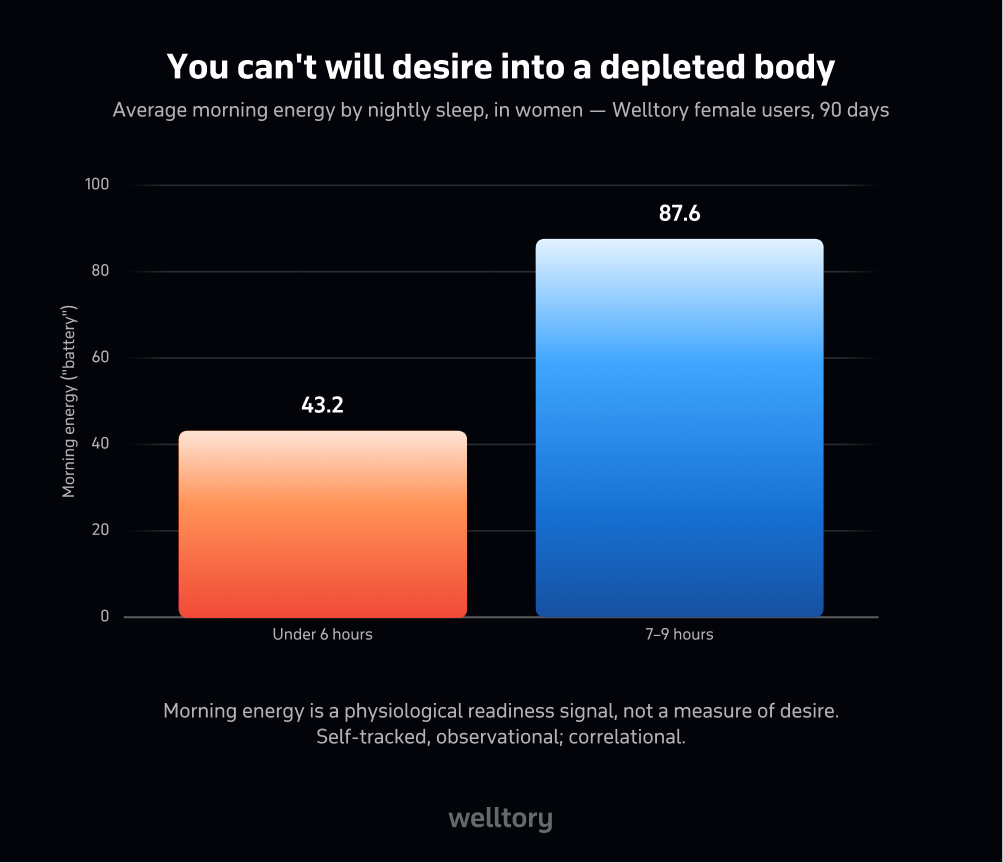
Women sleeping under six hours woke with an average morning energy score of 43, while women sleeping seven to nine hours averaged 88 — roughly half the reserve. Their daytime stress load was about the same (256 versus 265 stress-minutes a day), so the gap doesn't appear to come from more daytime stress. The short sleepers simply started each day with less in the tank.
The studies above link shorter sleep with lower next-day desire; our data only shows that short sleepers start the day with less energy.
Welltory female users over a 90-day window; average nightly sleep and average morning energy ("battery") per user. Observational and aggregated. Morning energy is a readiness signal, not a measure of desire.
What actually helps with low libido in women?
Guidelines for low desire start in the same place: explain what's normal, then deal with what's pressing the brakes, before anything else. (doi.org) In practice:
Protect your sleep first. In daily-diary research, longer sleep went with more desire the next day. (doi.org) If sleep is broken by night sweats, snoring or a baby, address that problem rather than just going to bed earlier.
Lower the load, not just the stress. Short, genuine breaks from being "on" help more than an occasional big escape. Handing off real responsibility — not just tasks you still have to track — reduces the background hum that crowds desire out.
Give responsive desire a runway. Unpressured touch and time together, without the expectation that it must lead to sex, lets desire build the way it naturally does for many women.
Use your cycle as information. If the second half of your cycle is predictably flat, that's your pattern, not a failure. Plan around it instead of fighting it.
Treat pain and dryness. Lubricants, vaginal moisturizers and, after menopause, vaginal estrogen prescribed by a doctor can change the whole picture. If you've had breast cancer, decide on vaginal estrogen together with your oncologist.
Review your medications with your doctor. Especially antidepressants and hormonal contraception, which have alternatives.
Consider sex therapy or mindfulness-based therapy. In a randomized trial of 148 women with low desire and arousal, eight weekly group sessions of either mindfulness-based therapy or supportive sex education produced large improvements in desire and arousal that lasted at least 12 months; the trial had no untreated comparison group. (doi.org)
There are also prescription options for diagnosed low-desire disorder, with modest benefits. Two drugs are approved in the US for premenopausal women: flibanserin and bremelanotide. In a meta-analysis, flibanserin added about half a satisfying sexual event per month on average, with more dizziness, sleepiness and nausea. (doi.org) (doi.org) For postmenopausal women diagnosed after a full assessment, international societies agree testosterone has a moderate benefit — and they also say a blood testosterone level should not be used to diagnose low desire. (doi.org) These are decisions to make with a doctor, not supplements to try on your own.
When is low sex drive a medical problem?
Low desire becomes a medical diagnosis — hypoactive sexual desire disorder (HSDD), or female sexual interest/arousal disorder in the US psychiatric manual — only when desire is low or absent for at least six months and it causes you distress. (doi.org) The newest international classification, ICD-11, no longer files sexual problems under mental disorders; it puts them in a separate chapter on sexual health. (doi.org)
Some situations deserve a doctor sooner:
desire dropped suddenly or steeply, not gradually;
sex has become painful, or you have new bleeding or discharge;
the drop started with a new medication or contraceptive;
it comes with low mood or loss of interest in other things (if you have thoughts of harming yourself, contact a crisis line or emergency services right away);
it comes with other body changes — tiredness with weight change or feeling cold, hot flashes, irregular or missed periods, or milky nipple discharge;
it followed childbirth and isn't lifting, or it's causing real strain in your relationship.
How to bring this up with your doctor — and what to ask for
Say it plainly, and say what bothers you. "My sex drive has been much lower for about eight months, and it's bothering me" is a complete, useful sentence. Doctors often won't ask, so it helps to open the door yourself.
Bring the context, not just the symptom. When it started, what changed around then — a new job, a baby, a new pill, poor sleep, a hard year — and whether it's constant or comes and goes with your cycle. A few weeks of notes on sleep, stress and cycle days turns a vague complaint into a pattern.
Ask these specifically. Could any of my medications be doing this, and is there an alternative? Could this be my thyroid, perimenopause, or low mood — and how would we check? Is the pain or dryness I'm having treatable? Would a referral to a sex therapist or a pelvic floor physiotherapist make sense?
Know what doesn't help. A testosterone blood test alone doesn't diagnose low libido in women, and international guidelines advise against using it that way. (doi.org)
If you are dismissed. "I understand this is common, but it's affecting my life. Can we note it in my record and look at possible causes?" A documented concern is far more likely to be followed up.
How Welltory helps
Welltory doesn't measure libido and doesn't try to. What it does measure is the body desire runs on: your sleep, your stress load across the day, your heart rate variability and resting heart rate, and your morning energy — each against your own baseline rather than a population average.
That makes the invisible brakes visible. You can see whether a flat month lines up with weeks of short sleep or a stretch of high stress, and whether your resting heart rate and HRV shift across your cycle the way the research describes. With My Patterns, you can add notes like "low desire", "period day 1" or "new pill", and over a few weeks see what tends to come before the flat days and what comes before the good ones. It won't diagnose anything, but it gives you and your doctor a timeline instead of a vague feeling. For the men's side of the same question, see what really drives male libido and erections; if you're planning a pregnancy, see the 90 days before conception.
How we made it
The clinical content rests on published research and guidelines: the PRESIDE survey of US women (Shifren et al. 2008), Natsal-3 in Britain (Mitchell et al. 2013, 2017), the ISSWSH process of care for hypoactive sexual desire disorder (Clayton et al. 2018), ICD-11 classification (Reed et al. 2016), Basson's model of responsive desire (2000) and survey data on it (Carvalheira et al. 2010), the dual control model (Bancroft et al. 2009; Sanders et al. 2008), stress and cortisol studies (Mües et al. 2025; Hamilton & Meston 2013; Hamilton, Rellini & Meston 2008), sleep and sexual function (Kalmbach et al. 2015; Kling et al. 2021), hormones and desire across the cycle (Roney & Simmons 2013; Jones et al. 2018), HRV and pulse across the cycle (Schmalenberger et al. 2019; Shilaih et al. 2017), antidepressants (Serretti & Chiesa 2009), hormonal contraception (Zethraeus et al. 2016; Burrows et al. 2012), sex after childbirth (Barrett et al. 2000), thyroid disorders (Salari et al. 2024), therapy and medication trials (Brotto et al. 2021; Jaspers et al. 2016; Kingsberg et al. 2019), and the global consensus on testosterone for women (Davis et al. 2019).
The Welltory figures come from an aggregated, de-identified dataset of 3,089 female users over a 90-day window: average nightly sleep and average morning energy per user, compared between women averaging under six hours (357) and seven to nine hours (1,842). Welltory does not collect data on desire or sexual activity.


Discounts for blog readers: up to 36% off
See what affects your energy, stress, sleep, and daily state with Welltory
This article is for educational purposes only and is not medical advice, diagnosis, or treatment. Changes in desire are common and normal — but persistent low desire that distresses you can also stem from hormones, thyroid issues, depression or anxiety, relationship factors, pain, or medications (including some antidepressants and hormonal contraception), so it's worth discussing with a doctor. Welltory measures physiological signals like heart rate, HRV, sleep, activity, and stress; it does not measure or diagnose sexual desire or function.
Was this helpful?
Ask AI for a summary of page


Written by Jane Smorodnikova

The founder and CEO of Welltory. A recognized tech leader with two Master's degrees and experience at MIT, she has scaled Welltory to over 17 million users.
Written by Tatsiana Yashyna

Deputy COO at Welltory. With a background in medicine and years of working with health data, she translates research and real physiological signals — sleep, stress, heart rate, and hormones — into clear, evidence-based explanations that help people understand what their bodies are telling them.
Reviewed by Anna Elitzur
-2.jpg)
With her medical degree, Anna reviews Welltory's health content for medical accuracy and alignment with current clinical guidelines and research.
References
- Shifren JL, Monz BU, Russo PA, Segreti A, Johannes CB. Sexual problems and distress in United States women: prevalence and correlates. Obstetrics & Gynecology 2008;112(5):970-978. https://doi.org/10.1097/AOG.0b013e3181898cdb
- Mitchell KR, Mercer CH, Ploubidis GB, et al. Sexual function in Britain: findings from the third National Survey of Sexual Attitudes and Lifestyles (Natsal-3). The Lancet 2013;382(9907):1817-1829. https://doi.org/10.1016/S0140-6736%2813%2962366-1
- Clayton AH, Goldstein I, Kim NN, et al. The International Society for the Study of Women's Sexual Health process of care for management of hypoactive sexual desire disorder in women. Mayo Clinic Proceedings 2018;93(4):467-487. https://doi.org/10.1016/j.mayocp.2017.11.002
- Basson R. The female sexual response: a different model. Journal of Sex & Marital Therapy 2000;26(1):51-65. https://doi.org/10.1080/009262300278641
- Carvalheira AA, Brotto LA, Leal I. Women's motivations for sex: exploring the DSM-IV-TR criteria for hypoactive sexual desire and female sexual arousal disorders. Journal of Sexual Medicine 2010;7(4):1454-1463. https://doi.org/10.1111/j.1743-6109.2009.01693.x
- Bancroft J, Graham CA, Janssen E, Sanders SA. The dual control model: current status and future directions. Journal of Sex Research 2009;46(2-3):121-142. https://doi.org/10.1080/00224490902747222
- Sanders SA, Graham CA, Milhausen RR. Predicting sexual problems in women: the relevance of sexual excitation and sexual inhibition. Archives of Sexual Behavior 2008;37(2):241-251. https://doi.org/10.1007/s10508-007-9235-7
- Mües HM, Markert C, Feneberg AC, Nater UM. Too stressed for sex? Associations between stress and sex in daily life. Psychoneuroendocrinology 2025;181:107583. https://doi.org/10.1016/j.psyneuen.2025.107583
- Hamilton LD, Meston CM. Chronic stress and sexual function in women. Journal of Sexual Medicine 2013;10(10):2443-2454. https://doi.org/10.1111/jsm.12249
- Hamilton LD, Rellini AH, Meston CM. Cortisol, sexual arousal, and affect in response to sexual stimuli. Journal of Sexual Medicine 2008;5(9):2111-2118. https://doi.org/10.1111/j.1743-6109.2008.00922.x
- Kalmbach DA, Arnedt JT, Pillai V, Ciesla JA. The impact of sleep on female sexual response and behavior: a pilot study. Journal of Sexual Medicine 2015;12(5):1221-1232. https://doi.org/10.1111/jsm.12858
- Kling JM, Kapoor E, Mara K, Faubion SS. Associations of sleep and female sexual function: good sleep quality matters. Menopause 2021;28(6):619-625. https://doi.org/10.1097/GME.0000000000001744
- Roney JR, Simmons ZL. Hormonal predictors of sexual motivation in natural menstrual cycles. Hormones and Behavior 2013;63(4):636-645. https://doi.org/10.1016/j.yhbeh.2013.02.013
- Jones BC, Hahn AC, Fisher CI, et al. General sexual desire, but not desire for uncommitted sexual relationships, tracks changes in women's hormonal status. Psychoneuroendocrinology 2018;88:153-157. https://doi.org/10.1016/j.psyneuen.2017.12.015
- Schmalenberger KM, Eisenlohr-Moul TA, Würth L, et al. A systematic review and meta-analysis of within-person changes in cardiac vagal activity across the menstrual cycle. Journal of Clinical Medicine 2019;8(11):1946. https://doi.org/10.3390/jcm8111946
- Shilaih M, Clerck V, Falco L, Kübler F, Leeners B. Pulse rate measurement during sleep using wearable sensors, and its correlation with the menstrual cycle phases, a prospective observational study. Scientific Reports 2017;7:1294. https://doi.org/10.1038/s41598-017-01433-9
- Serretti A, Chiesa A. Treatment-emergent sexual dysfunction related to antidepressants: a meta-analysis. Journal of Clinical Psychopharmacology 2009;29(3):259-266. https://doi.org/10.1097/JCP.0b013e3181a5233f
- Zethraeus N, Dreber A, Ranehill E, et al. Combined oral contraceptives and sexual function in women — a double-blind, randomized, placebo-controlled trial. Journal of Clinical Endocrinology & Metabolism 2016;101(11):4046-4053. https://doi.org/10.1210/jc.2016-2032
- Burrows LJ, Basha M, Goldstein AT. The effects of hormonal contraceptives on female sexuality: a review. Journal of Sexual Medicine 2012;9(9):2213-2223. https://doi.org/10.1111/j.1743-6109.2012.02848.x
- Barrett G, Pendry E, Peacock J, et al. Women's sexual health after childbirth. BJOG 2000;107(2):186-195. https://doi.org/10.1111/j.1471-0528.2000.tb11689.x
- Mitchell KR, Geary R, Graham CA, et al. Painful sex (dyspareunia) in women: prevalence and associated factors in a British population probability survey. BJOG 2017;124(11):1689-1697. https://doi.org/10.1111/1471-0528.14518
- Salari N, et al. The sexual dysfunction in women with thyroid disorders: a meta-analysis. BMC Endocrine Disorders 2024;24:279. https://doi.org/10.1186/s12902-024-01817-9
- Brotto LA, Zdaniuk B, Chivers ML, et al. A randomized trial comparing group mindfulness-based cognitive therapy with group supportive sex education and therapy for the treatment of female sexual interest/arousal disorder. Journal of Consulting and Clinical Psychology 2021;89(7):626-639. https://doi.org/10.1037/ccp0000661
- Jaspers L, Feys F, Bramer WM, et al. Efficacy and safety of flibanserin for the treatment of hypoactive sexual desire disorder in women: a systematic review and meta-analysis. JAMA Internal Medicine 2016;176(4):453-462. https://doi.org/10.1001/jamainternmed.2015.8565
- Kingsberg SA, Clayton AH, Portman D, et al. Bremelanotide for the treatment of hypoactive sexual desire disorder: two randomized phase 3 trials. Obstetrics & Gynecology 2019;134(5):899-908. https://doi.org/10.1097/AOG.0000000000003500
- Davis SR, Baber R, Panay N, et al. Global consensus position statement on the use of testosterone therapy for women. Journal of Clinical Endocrinology & Metabolism 2019;104(10):4660-4666. https://doi.org/10.1210/jc.2019-01603
- Reed GM, Drescher J, Krueger RB, et al. Disorders related to sexuality and gender identity in the ICD-11. World Psychiatry 2016;15(3):205-221. https://doi.org/10.1002/wps.20354
- Welltory women's cohort (sleep and morning energy, 3,089 female users, 90 days). Reproducible script: `persona_lab/scripts/libido_women_context.py`.
