

Short answer
A realistic postpartum recovery timeline after 35 runs in stages. The first 6 weeks bring the most visible healing, but sleep, pelvic floor strength, iron stores, and mood often need 6 to 12 months or longer. Sleep usually hits its lowest point in the first 3 months. Age matters less than sleep, support, and birth complications.
If you're months past the birth and still running on empty, you're not imagining it, and it's not weakness. The "six-week checkup, then back to normal" idea was never how bodies work. Tissue heals on one schedule, hormones on another, sleep on a third, and your nervous system follows whichever one is lagging. Feeling unfinished at three or six months is common, and it usually has reasons you can name.
This article walks through what the research says about each stage of recovery, whether pregnancy after 35 really makes recovery harder, why postpartum sleep deprivation hits so hard, what "postpartum depletion" does and doesn't mean, how to tell ordinary exhaustion from postpartum anxiety or depression, why your HRV may look low, the tips that actually have evidence behind them, and the warning signs that mean you should call someone today.
How long does postpartum recovery take?
There is no single finish line. Official guidelines have moved away from the idea of one checkup at six weeks. The American College of Obstetricians and Gynecologists (ACOG) calls the weeks after birth the "fourth trimester" and recommends that every woman have contact with her obstetric care provider within the first 3 weeks, followed by ongoing care as needed and a comprehensive postpartum visit no later than 12 weeks after birth. That visit is meant to cover mood, sleep and fatigue, physical recovery, infant feeding, sexuality and contraception, and any chronic conditions. (doi.org)
The World Health Organization's 2022 postnatal guideline recommends at least 24 hours of care after a facility birth and at least three more checkups in the first six weeks: between 48 and 72 hours, between 7 and 14 days, and during week six. It also recommends screening every woman for postnatal depression and anxiety. (who.int)
Here is a rough postpartum recovery timeline, based on the studies cited in this article. Your own may be faster or slower.
Weeks 0–6: acute healing. Bleeding settles, the uterus shrinks, and stitches or a cesarean incision heal. This is also when fatigue is most intense. In a study of 716 employed mothers in Minnesota interviewed five weeks after birth, women reported six postpartum symptoms on average; the most common were fatigue (64%), breast discomfort (60%), and lower desire for sex (52%). Women who had a cesarean had worse physical function and less energy than those who gave birth vaginally. (doi.org) The risk of some serious complications, including postpartum preeclampsia, is highest in these weeks (see the warning-signs section below).
Weeks 6–12: the "should be better by now" stretch. Many women feel pressure to be back to normal here, but the data say otherwise. Night-time sleep is still badly broken, and sleep satisfaction and duration reach their low point in the first three months after birth. (doi.org) Leaking urine is common in this window: about 1 in 3 women (33%) report some urinary incontinence in the first three months. (doi.org) This is also when ACOG's comprehensive visit should take place.
Months 3–6: slow rebuilding. Sleep gradually becomes less fragmented, and many women start to feel more like themselves. But this is also when problems that started quietly can surface. Postpartum thyroiditis often shows up in the first year, and postpartum depression can begin or become more noticeable after the first few months; one large review saw a trend toward higher rates of depression beyond six months after birth. (doi.org)
Months 6–12: the long tail. The abdominal wall is still healing for many women: in a Norwegian study of 300 first-time mothers, a separation of the abdominal muscles (diastasis recti) was found in 60% at six weeks, 45% at six months, and 33% at twelve months. (doi.org) Periods may return, stop, and start again, especially while breastfeeding, and your body's signals shift with them (see the four menstrual cycle phases).
Beyond a year. In a German study that followed 2,541 women over years, sleep satisfaction and sleep duration did not fully return to pre-pregnancy levels for up to six years after a first child. (doi.org) That doesn't mean you'll feel unwell for six years. It means that "recovered" often looks like a new normal rather than a return to exactly how things were.
Is postpartum recovery harder after 35?
This is one of the most common worries, and the honest answer is: somewhat, in specific ways, but less than the phrase "advanced maternal age" suggests.
Some birth complications are more common after 35 and especially after 40. In a UK study of 215,344 births, women aged 40 or older were 1.83 times more likely to have a cesarean delivery than women aged 20 to 29, even after adjusting for parity, ethnicity, deprivation, and body mass index. (doi.org) A cesarean is major abdominal surgery, and it tends to mean a slower early recovery. In a US study of 828,269 births in Washington State, the odds of severe maternal complications were about 20% higher among women aged 35 to 39 than among those aged 25 to 29 before adjustment, and the risk rose steeply after 39. After adjusting for other factors, the extra absolute risk was still small: 0.9 percentage points for mothers aged 40 to 44. (doi.org)
Pelvic floor injury is linked to older age at a first vaginal birth. In an MRI study of 160 first-time mothers (half of whom had new stress incontinence) scanned 9 to 12 months after their first vaginal delivery, women with injury to the levator ani (the main pelvic floor muscle) were on average 3.5 years older. Forceps delivery, a tear of the anal sphincter, and episiotomy were even stronger risk factors. (doi.org)
Postpartum preeclampsia is more common with older maternal age. A review in the American Journal of Obstetrics and Gynecology lists older maternal age, along with obesity and cesarean delivery, among the factors associated with a higher risk of new high blood pressure after birth. (doi.org)
But sleep and mood are not simply "worse with age." In the German sleep study, parental age was unrelated, or only very weakly related, to how much sleep recovered after birth. (doi.org) In a Norwegian cohort of 19,291 first-time mothers, women aged 32 and older had only slightly higher psychological distress scores from pregnancy to 18 months after birth than women aged 25 to 31, and the youngest mothers had the highest scores of all. Among women with no history of depression, older mothers were not at higher risk. (doi.org)
So recovery after 35 is not a different process. It is the same process, with somewhat higher odds of a harder start (a cesarean, a difficult vaginal birth, blood pressure problems) that can stretch the timeline. Some things that are common after 35 also matter, even though studies rarely measure them: a demanding job to return to, parents who are older and less able to help, or a pregnancy that followed fertility treatment. If you're planning a pregnancy after 35, the months before conception are a good time to work on sleep, iron, thyroid, and blood pressure; we cover that in the 90 days before conception.
Why does postpartum sleep deprivation hit so hard?
Because it isn't just short sleep. It's broken sleep, night after night, with no end date.
The best early data come from a study that fitted about 50 new mothers with wrist activity monitors from week 2 to week 16 after birth. Surprisingly, their total night-time sleep averaged 7.2 hours and didn't change much over those months. What changed was the quality: at week 2, only about 80% of the time in bed was spent asleep, with frequent interruptions. By week 16, sleep efficiency had improved to about 90% and fragmentation had dropped by about 40%. The researchers noted that early postpartum sleep was as fragmented as sleep in people with sleep disorders. (doi.org)
This is why "but I'm technically getting seven hours" doesn't match how you feel. Seven hours in four pieces is not the same as seven hours in one. Deep sleep and REM sleep happen in cycles, and every waking resets part of the process. If you're still recovering from weeks of this, the ideas in can you catch up on sleep debt are worth a read.
Surveys that ask women about their sleep show the bigger picture. In the German study of 2,541 women, sleep satisfaction fell by 1.81 points on a 0-to-10 scale in the first three months after birth, and sleep duration fell by 62 minutes a night compared with before pregnancy. Men's sleep fell by only 13 minutes. (doi.org) Postpartum sleep deprivation, in other words, falls mostly on mothers.
Broken sleep also affects the stress system. In a small lab study of young men, a single night of partial sleep loss raised cortisol, the main stress hormone, by 37% the following evening and delayed its normal night-time drop. (doi.org) That study wasn't done in new mothers, but it helps explain why sleep loss can leave you feeling wired and tired at the same time.
Sleep is also closely linked to mood after birth. In a study of 112 couples followed from late pregnancy, mothers who slept less than 4 hours between midnight and 6 a.m., and mothers who napped less than 60 minutes a day, had a higher risk of depression at three months after birth. This held regardless of how "difficult" the baby's temperament was. (doi.org) Daytime naps are not a luxury here; see how long a nap should be for how to make short ones count.
What about breastfeeding? Many women are told formula will help them sleep. The evidence is mixed. In one study that measured sleep objectively, there were no differences in sleep time, sleep quality, or daytime sleepiness between women who breastfed exclusively, formula-fed, or did both. (doi.org) In the large German survey, breastfeeding was linked to only a slight drop in sleep, about 14 minutes a night. (doi.org) What seems to matter more is who does the night feeds and whether you get one longer protected stretch of sleep.
What our data shows: short nights, less morning energy
Welltory can't tell who among its users has just had a baby. But broken and often short sleep is a defining feature of the early postpartum months, and our data show how closely short sleep and low morning energy go together.
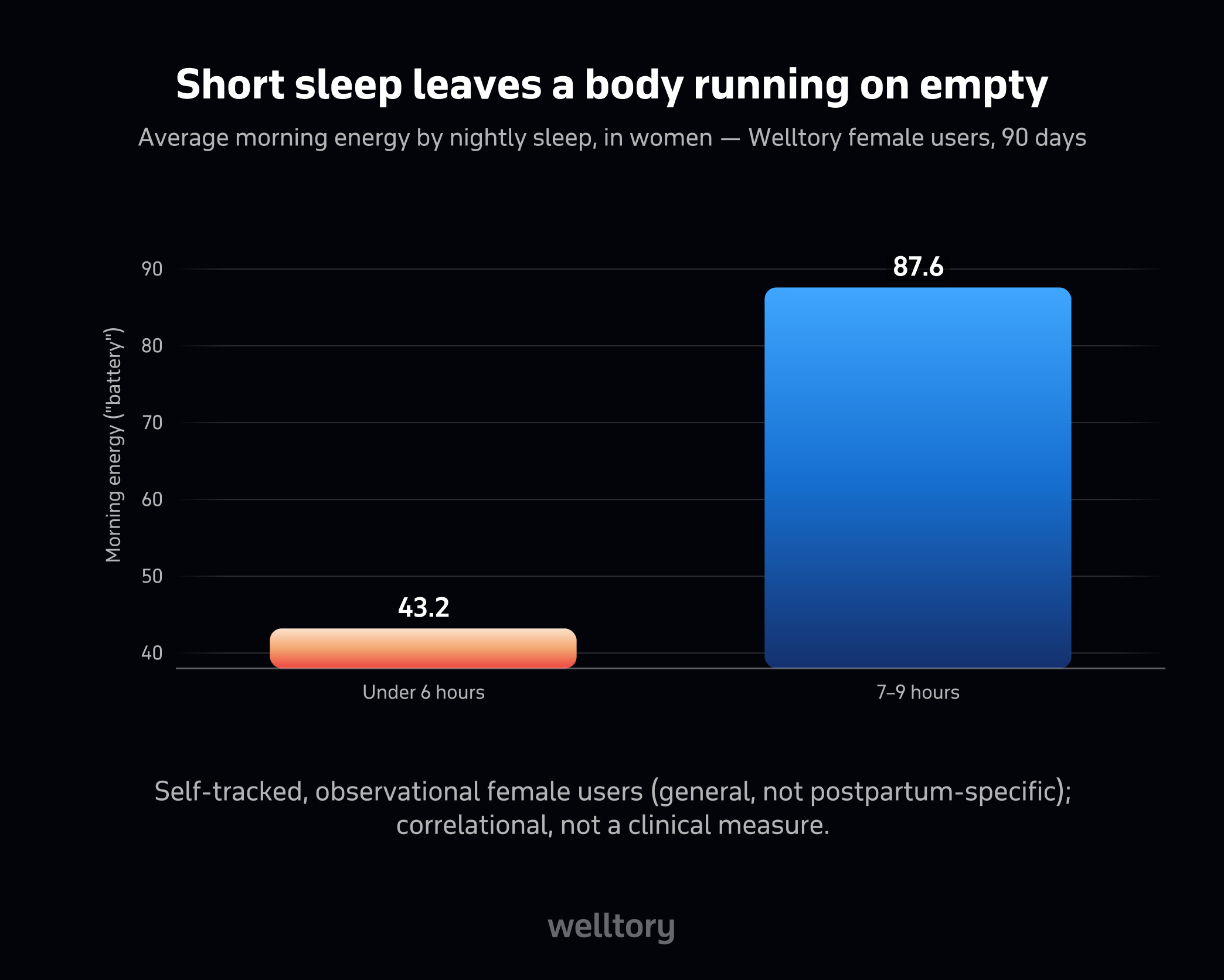
We looked at per-user 90-day averages from a Welltory dataset of 5,061 users with both sleep and morning-energy data (December 15, 2025, to March 14, 2026). Among women, those whose nights averaged under 6 hours (357 women) started the day with an average morning energy score of 43.2. Women who averaged 7 to 9 hours (1,842 women) started at 87.6. That's roughly half the morning reserve for the short sleepers.
These women were not selected as postpartum; they were female Welltory users in general. And morning energy is a readiness score based on heart rate variability and other signals, not a measure of hormones, healing, or mood. But the gap helps put a number on something new mothers often hear dismissed: women who sleep less tend to start the day with far less in the tank. Feeling depleted after months of broken sleep is not a character flaw.
A note on the data: these are self-tracked, aggregated, observational figures from female Welltory users; they show a link between sleep length and morning energy, not cause and effect, and they are not specific to the postpartum period. All other figures in this article come from the cited studies.
What is postpartum exhaustion, and is "postpartum depletion" real?
Postpartum exhaustion is the deep, persistent tiredness many women feel in the months after birth. Some of it is simply the workload: night feeds, healing, and a brain that stays on alert. But some of it has medical causes that are easy to miss, because everyone expects a new mother to be tired.
You may have seen the term postpartum depletion. It's a popular term, not a medical diagnosis. It was coined to describe a cluster of exhaustion, brain fog, low mood, and feeling "drained" that can last for months or years after birth. There's no agreed definition and no test for it, and supplement protocols sold under this name have not been studied in clinical trials. But several of the things it points to are real, measurable, and treatable. These are the ones worth asking about.
Iron deficiency and anemia. Blood loss at birth, on top of iron used during pregnancy, leaves many women low. In healthy women after a normal birth, about 14% of those who took iron in pregnancy and 24% of those who didn't were anemic one week after delivery. Postpartum anemia is linked to poorer quality of life, reduced concentration, emotional instability, and depression. (doi.org) In a small study of new mothers, those with lower hemoglobin (the oxygen-carrying protein in red blood cells) a week after birth had more depressive symptoms at four weeks. (doi.org) And in a small randomized trial of 81 mothers in South Africa, iron treatment in women with iron-deficiency anemia improved depression and stress scores by 25%, while a placebo did not. (doi.org) These studies were small, but together they are a good reason to have your iron checked, not just guessed. The WHO postnatal guideline also includes iron and folic acid supplements after birth in places where anemia is common. (who.int) Ask your doctor before starting iron, since the right amount depends on your blood results.
Postpartum thyroiditis. This is inflammation of the thyroid that starts in the first year after birth. It affects about 5.4% of women. Only about 22% of cases follow the classic pattern of an overactive phase followed by an underactive one; about half of women have only an underactive (hypothyroid) phase, with fatigue, dry skin, and memory problems that look exactly like "new-mom tiredness." Up to half of women who test positive for thyroid antibodies early in pregnancy develop it, and 20% to 40% of women who have it go on to permanent hypothyroidism. (doi.org) A simple blood test can check. For the symptoms to watch for, see signs of thyroid problems in women, and for what a TSH result means, Hashimoto's, TSH, and hypothyroidism.
Sleep loss itself. As above, broken sleep drives fatigue, stress hormones, and mood, and it can keep you depleted even when bloodwork is normal.
Nutrition and recovery load. Healing, making milk, and running on little sleep all demand energy. Skipped meals and "I'll eat later" days are common in the early months. There's no magic protocol here, but regular meals with protein and iron-rich foods, fluids, and asking your clinician whether to keep taking a prenatal vitamin while breastfeeding are sensible, low-risk steps.
Low mood and anxiety. Exhaustion is also a symptom of postpartum depression and anxiety, which the next section covers.
Is it postpartum anxiety, depression, or just exhaustion?
Sometimes it's hard to tell, even from the inside, and they often overlap. Here is what the research says about how common each one is, and how to tell when tiredness has become something more.
Postpartum anxiety is common, and often overlooked. A meta-analysis of 102 studies with nearly 222,000 women found that 15.0% had anxiety symptoms in the first 24 weeks after birth, and 9.9% met criteria for an anxiety disorder. (doi.org) Postpartum anxiety can look like constant worry about the baby's breathing or feeding, being unable to sleep even when the baby sleeps, a racing heart, tight chest, irritability, or a sense of dread. For the full list, see anxiety symptoms.
Postpartum depression is also common. In a review of 58 studies with 37,294 healthy mothers who had no history of depression, 17% had postpartum depression. (doi.org) Signs include persistent sadness or emptiness, loss of interest or pleasure, feeling like a bad mother, guilt, hopelessness, and pulling away from people. It is different from the "baby blues," which are short-lived mood swings in the first days after birth that usually pass within a couple of weeks.
Intrusive thoughts are common, and usually not dangerous. Many new mothers are frightened by sudden, unwanted images of something bad happening to the baby. In a study of 100 women followed from pregnancy, unwanted thoughts of accidental harm to the infant were universal at 4 and 12 weeks after birth, and close to half had unwanted thoughts of intentionally harming the baby. These thoughts were not linked to harmful parenting, and they were more common with high stress and low support. (doi.org) Thoughts that feel unwanted and upsetting are typical of anxiety rather than intent, but only a clinician can assess this. They are still worth telling a clinician about, because they are treatable and they can be exhausting.
When it's an emergency. Postpartum psychosis is rare, affecting roughly 1 to 3 women per 1,000 births (doi.org), but it is a medical emergency. Signs include confusion, seeing or hearing things others don't, strange beliefs, severe agitation, or not sleeping at all even when you can. If you or someone close to you notices these, or if you have thoughts of harming yourself or your baby that feel like something you might act on, call 988 in the US (call or text), the National Maternal Mental Health Hotline at 1-833-TLC-MAMA (1-833-852-6262), or local emergency services right away.
Screening is recommended, so ask for it. The US Preventive Services Task Force (USPSTF) recommends screening adults, including pregnant and postpartum people, for depression and (in adults 64 and younger) for anxiety disorders. (doi.org) (doi.org) It also found convincing evidence that counseling, such as cognitive behavioral therapy and interpersonal therapy, helps prevent perinatal depression in women at higher risk, which includes those with a history of depression or current symptoms. (doi.org) The most widely used screening tool is the Edinburgh Postnatal Depression Scale, a 10-question form that takes a few minutes. (doi.org) If nobody offers it, you can ask. For how depression is assessed more generally, see how depression is diagnosed.
A simple rule of thumb: if the tiredness lifts after a good stretch of sleep, it's probably mostly exhaustion. If you get good sleep and still feel hopeless, flat, panicky, or unable to enjoy anything for most days over two weeks, or if you can't sleep even when you have the chance, it's time to talk to someone.
Why is my HRV low after having a baby?
Heart rate variability (HRV) is the small, natural variation in the time between heartbeats. Higher HRV generally reflects more activity of the "rest-and-digest" side of your nervous system; lower HRV often reflects stress, poor sleep, illness, or a body working hard to recover. Resting heart rate often moves in the opposite direction.
Pregnancy itself changes these numbers a lot. In a study of 18 active women who wore a WHOOP strap from before conception through pregnancy and after birth, HRV fell steadily and resting heart rate rose through most of pregnancy. Then, about 49 days before birth, both reversed: HRV began rising and resting heart rate began falling, a trend that continued into the postpartum period. (doi.org) In a Finnish study of 58 women who wore smartwatches through pregnancy and three months after birth, heart rate rose and HRV fell as pregnancy went on, then returned toward normal after delivery. But one HRV measure (normalized RMSSD) dropped in the postpartum months, and a measure associated with a more stress-dominant balance rose. The study also found that a woman's age was significantly linked to her HRV. (doi.org)
So low HRV in the months after birth is common, and there are usually several reasons at once:
Broken sleep. In a study where 15 adults slept only 3 hours a night for three nights, RMSSD (a key HRV measure) dropped, and signs of stress activation rose. (doi.org) Postpartum nights are not the same as a lab experiment, but the direction is the same.
Healing and pain. A body repairing tissue after a vaginal birth or cesarean is under physical load.
Anemia. Low iron makes the heart work harder to deliver oxygen.
Stress and anxiety. A nervous system on constant alert for a baby's cries doesn't fully switch off.
Age. HRV naturally declines with age, so a 38-year-old's normal range is lower than a 28-year-old's to begin with.
The most useful way to read postpartum HRV is against your own baseline, over weeks, not against a chart or a friend's number. A single low morning doesn't mean anything on its own; HRV naturally moves from day to day, as we explain in why HRV fluctuates day to day. What's worth watching is the trend: whether your numbers are slowly steadying as sleep improves, and whether a sudden drop lines up with a fever, a hard week, or not feeling well. A wearable can't tell you why your HRV is low. If it's low alongside worrying symptoms, the symptoms are what matter, and they belong with your doctor.
How your body heals: pelvic floor, abdominal wall, and moving again
Pelvic floor. The pelvic floor is the hammock of muscles that supports the bladder, uterus, and bowel. Pregnancy and birth stretch it, and many women notice leaking when they cough, sneeze, laugh, or lift. In the first three months after birth, about a third of women report some urinary incontinence, though weekly leaking is less common (about 12%) and daily leaking rarer still (about 3%). It is about twice as common after a vaginal birth (31%) as after a cesarean (15%). (doi.org)
Pelvic floor muscle training, often called Kegel exercises, is widely recommended. A Cochrane review of 46 trials with 10,832 women found that training during pregnancy lowered the risk of leaking three to six months after birth. For training started after birth, the benefit was less certain, partly because the trials were small and varied. (doi.org) That doesn't mean it's useless; it means that if leaking, heaviness, or pain persist beyond the first few months, a referral to a pelvic floor physical therapist is more useful than doing exercises alone and hoping.
Abdominal separation (diastasis recti). As the belly grows, the two long muscles down the front of the abdomen are pushed apart. In the Norwegian study of 300 first-time mothers, this separation was found in 60% at six weeks after birth, 45% at six months, and 33% at a year. Women who lifted heavy loads 20 or more times a week were about twice as likely to have it. Notably, women with and without the separation reported the same amount of lower back and pelvic pain a year after birth. (doi.org) So a gap is common and often not a problem in itself, but it is a reason to rebuild core strength gradually rather than jumping straight into crunches or heavy lifting.
Moving again. ACOG encourages women to continue or start exercise as part of good health and notes that women who were active before pregnancy can keep up those activities during pregnancy and after birth, adjusting as needed. It also says physical activity can help prevent postpartum depression. (doi.org) The WHO physical activity guidelines recommend that postpartum women without contraindications aim for at least 150 minutes of moderate aerobic activity a week, such as brisk walking, building up gradually. (doi.org) A meta-analysis of 12 studies found that exercise programs in pregnancy and after birth reduced postpartum depressive symptoms, with a larger effect in women who already had symptoms. (doi.org)
In practice, that means starting with walking and gentle core and pelvic floor work, adding intensity over weeks, and checking with your clinician before high-impact exercise, running, or heavy lifting, especially after a cesarean, a significant tear, or if you have leaking, heaviness, or pain. "Getting your body back" is a marketing phrase, not a medical goal. The goal is a body that works well and doesn't hurt.
Sex and intimacy. Lower desire and pain with sex are very common in the first months after birth, especially while breastfeeding, which lowers estrogen. We cover this in how stress, sleep, and your cycle shape women's libido.
Postpartum recovery tips that are actually backed by evidence
Most postpartum recovery tips online are either obvious ("rest!") or unhelpful ("sleep when the baby sleeps" to someone with a toddler too). These are the ones with research behind them, adapted for real life.
Protect one longer stretch of sleep. Early postpartum sleep is highly fragmented even when total hours look normal. (doi.org) If a partner or helper can take one feed, so you get a single block of 4 or more hours, that block may be worth more than an extra hour scattered through the night. Mothers who got less than 4 hours between midnight and 6 a.m. had a higher risk of depression. (doi.org)
Nap without guilt. In the same study, napping less than an hour a day was linked to a higher risk of depression. (doi.org) In that study, mothers who napped at least an hour a day in total fared better, and several short naps can add up.
Get your blood checked, not just your stitches. Ask for a full blood count, ferritin (your iron stores), and thyroid tests if you're very tired, foggy, low, or breathless. Anemia and thyroiditis are common and treatable. (doi.org) (doi.org)
Move a little, early and often. Walking and gentle strength work, built up gradually, support both physical recovery and mood. (doi.org)
See a pelvic floor physical therapist if symptoms persist. Leaking, heaviness, or pain beyond the first few months are common but not something you have to accept.
Screen your mood on purpose. Ask for the Edinburgh scale or another screening tool at your visits, and answer honestly. (doi.org)
Build support deliberately. High parenting stress and low social support were linked to more distressing intrusive thoughts. (doi.org) After 35, family help may be less available, so name specific tasks and ask for them.
Keep your blood pressure in view. If you had high blood pressure in pregnancy, follow your provider's plan for checking it at home in the first weeks after birth, and know the warning signs below.
Eat something real, regularly. Regular meals with protein and iron-rich foods, plenty of fluids, and asking whether to continue a prenatal vitamin while breastfeeding.
Measure progress in months, not weeks. Sleep, strength, and energy have their own timelines. Comparing yourself at eight weeks to how you were before pregnancy sets you up to feel like you're failing when you're not.
When is it urgent? Warning signs in the year after birth
Many serious problems after pregnancy happen after you've gone home. In US data on pregnancy-related deaths from 2011 to 2015, 21.4% happened between 1 and 6 weeks after birth and another 11.7% between 6 weeks and a year after birth. The leading causes included heart and blood vessel conditions, infection, and bleeding, and about three in five deaths were judged preventable. (doi.org)
Postpartum preeclampsia, a dangerous rise in blood pressure, can develop even if your blood pressure was normal during pregnancy. It is generally defined as new high blood pressure that appears between 48 hours and 6 weeks after birth, and most women with the late-onset form develop it in the first 7 to 10 days, most often with a headache. (doi.org)
The CDC's Hear Her campaign lists these urgent maternal warning signs for the year after birth. If you have any of them, seek medical care immediately and tell the staff you recently had a baby: (cdc.gov)
a headache that won't go away or gets worse over time, especially with blurred vision or dizziness;
dizziness or fainting;
changes in vision, such as flashing lights, blind spots, or blurry or double vision;
a fever of 100.4°F (38°C) or higher;
extreme swelling of your hands or face;
thoughts about harming yourself or your baby;
trouble breathing, including trouble breathing when lying flat;
chest pain, or a fast or pounding heartbeat;
severe nausea and vomiting;
severe belly pain that doesn't go away;
heavy bleeding (soaking one or more pads in an hour), passing clots bigger than an egg, or bad-smelling discharge;
swelling, redness, or pain in one leg or arm;
overwhelming tiredness that comes on suddenly and doesn't improve with sleep.
Also contact your provider soon, not at your next routine visit, if you have a wound that is red, hot, or oozing; burning when you urinate; a painful, red, hot area on your breast with fever; or low mood, anxiety, or intrusive thoughts that are getting worse. None of these are things to wait out or track with a wearable.
How to bring this up with your doctor — and what to ask for
Say it plainly. "I'm five months postpartum, and I'm more exhausted than I think I should be, even on nights when I get decent sleep" is clear and useful. So is "I'm having scary thoughts I can't shake" or "I'm leaking when I run, and it's not getting better." You don't need to prove you've earned the appointment.
Bring context, not just the symptom. How your birth went (cesarean, forceps, heavy blood loss, high blood pressure), how you're feeding, how broken your nights really are, and for how long. Doctors often assume unbroken sleep unless told otherwise. A few weeks of notes on sleep, mood, and energy turn "I'm tired" into a pattern someone can act on.
Ask these specifically. Could I be anemic, and can we check my full blood count and ferritin? Should my thyroid be tested, given how I feel? Can I do a depression and anxiety screen today? Is my blood pressure where it should be, and should I keep checking it at home? Would a pelvic floor physical therapist help with what I'm noticing? When is it safe for me to return to running or lifting?
If you are dismissed. "I understand being tired is normal with a baby, but this feels like more than that, and it's affecting how I function. Can we rule out anemia and thyroid problems, and note my concerns in my record?" A documented concern is much more likely to be followed up. If you're still not heard, it's reasonable to ask for a referral or a second opinion.
How Welltory helps
Welltory can't examine a wound, check your iron, or diagnose postpartum depression, and it shouldn't try. What it can do is make the invisible parts of recovery visible, so you're not relying on memory and willpower on four hours of sleep.
Welltory tracks your sleep, your stress load through the day, your HRV and resting heart rate, and your morning energy, the body battery score that reflects how much reserve you start the day with. You can measure with a compatible wearable or with your phone camera, and each reading is compared with your own baseline, not a population average. That matters after birth, when your "normal" has shifted and old numbers no longer apply.
In practice, that can look like:
Seeing the trend, not the bad day. Is your HRV slowly steadying and your resting heart rate slowly coming down as the weeks pass? That's a quiet, encouraging signal on days when you don't feel any progress.
Linking cause and effect. With My Patterns, you can tag things like "partner did night feed," "walked 30 minutes," "started iron," "period returned," or "bad night," and after a few weeks see what tends to come before your better and worse mornings.
Making your case for help. "My morning energy has been flat for three weeks, and it jumps on the nights I get a four-hour stretch" is a concrete, persuasive thing to show a partner or a doctor.
Noticing when something changes. A sudden change in your usual numbers alongside feeling unwell is a reason to pay attention to your symptoms. Welltory won't tell you what's wrong, but it can help you notice that something has shifted.
What it can't do: diagnose anemia, thyroid disease, infection, preeclampsia, depression, or anxiety, or replace your postpartum visits. If you have warning signs, call your provider or emergency services, not an app. Used alongside your care team, Welltory gives you a timeline of your own recovery instead of a vague feeling that you "should be better by now."
How we made it
The clinical content rests on official guidelines and published research: ACOG committee opinions on postpartum care (2018) and on physical activity (2020), WHO's postnatal care recommendations (2022) and physical activity guidelines (Bull et al. 2020), USPSTF recommendations on perinatal depression (2019) and on depression and anxiety screening (2023), and the CDC Hear Her list of urgent maternal warning signs. Studies on postpartum sleep (Montgomery-Downs et al. 2010a, 2010b; Richter et al. 2019; Goyal et al. 2009; Leproult et al. 1997), postpartum symptoms (McGovern et al. 2006), maternal age and outcomes (Kenny et al. 2013; Lisonkova et al. 2017; Aasheim et al. 2012; Kearney et al. 2006), mental health (Dennis et al. 2017; Shorey et al. 2018; Fairbrother & Woody 2008; VanderKruik et al. 2017; Cox et al. 1987), iron and thyroid (Milman 2011; Corwin et al. 2003; Beard et al. 2005; Stagnaro-Green 2012), pelvic floor and abdominal wall (Thom & Rortveit 2010; Woodley et al. 2020; Sperstad et al. 2016), exercise and mood (Poyatos-León et al. 2017), HRV in pregnancy and after birth (Rowan et al. 2022; Sarhaddi et al. 2022; Bourdillon et al. 2021), and pregnancy-related deaths and postpartum preeclampsia (Petersen et al. 2019; Hauspurg & Jeyabalan 2022).
The Welltory figures come from a de-identified dataset of 5,061 users with sleep and morning-energy data, using per-user 90-day averages from December 15, 2025, to March 14, 2026. We compared women averaging under 6 hours of sleep (357) with women averaging 7 to 9 hours (1,842). Welltory does not know which users are postpartum, so these are general female users, and the comparison is observational.


Discounts for blog readers: up to 36% off
See what affects your energy, stress, sleep, and daily state with Welltory
This article is for educational purposes only and is not medical advice. Postpartum recovery is medical — follow your OB/midwife's guidance, and seek help promptly for heavy bleeding, severe pain, fever, or any signs of postpartum depression or anxiety (persistent sadness, hopelessness, intrusive thoughts). Welltory measures physiological signals like heart rate, HRV, sleep, activity, and stress; it does not diagnose anything.
Was this helpful?
Ask AI for a summary of page


Written by Jane Smorodnikova

The founder and CEO of Welltory. A recognized tech leader with two Master's degrees and experience at MIT, she has scaled Welltory to over 17 million users.
Written by Tatsiana Yashyna

Deputy COO at Welltory. With a background in medicine and years of working with health data, she translates research and real physiological signals — sleep, stress, heart rate, and hormones — into clear, evidence-based explanations that help people understand what their bodies are telling them.
Reviewed by Anna Elitzur
-2.jpg)
With her medical degree, Anna reviews Welltory's health content for medical accuracy and alignment with current clinical guidelines and research.
References
- American College of Obstetricians and Gynecologists. ACOG Committee Opinion No. 736: Optimizing postpartum care. Obstetrics & Gynecology 2018;131(5):e140-e150. https://doi.org/10.1097/AOG.0000000000002633
- World Health Organization. WHO recommendations on maternal and newborn care for a positive postnatal experience. Geneva: WHO; 2022. ISBN 978-92-4-004598-9. https://www.who.int/publications/i/item/9789240045989
- McGovern P, Dowd B, Gjerdingen D, et al. Postpartum health of employed mothers 5 weeks after childbirth. Annals of Family Medicine 2006;4(2):159-167. https://doi.org/10.1370/afm.519
- Richter D, Krämer MD, Tang NKY, Montgomery-Downs HE, Lemola S. Long-term effects of pregnancy and childbirth on sleep satisfaction and duration of first-time and experienced mothers and fathers. Sleep 2019;42(4):zsz015. https://doi.org/10.1093/sleep/zsz015
- Thom DH, Rortveit G. Prevalence of postpartum urinary incontinence: a systematic review. Acta Obstetricia et Gynecologica Scandinavica 2010;89(12):1511-1522. https://doi.org/10.3109/00016349.2010.526188
- Shorey S, Chee CYI, Ng ED, Chan YH, Tam WWS, Chong YS. Prevalence and incidence of postpartum depression among healthy mothers: a systematic review and meta-analysis. Journal of Psychiatric Research 2018;104:235-248. https://doi.org/10.1016/j.jpsychires.2018.08.001
- Sperstad JB, Tennfjord MK, Hilde G, Ellström-Engh M, Bø K. Diastasis recti abdominis during pregnancy and 12 months after childbirth: prevalence, risk factors and report of lumbopelvic pain. British Journal of Sports Medicine 2016;50(17):1092-1096. https://doi.org/10.1136/bjsports-2016-096065
- Kenny LC, Lavender T, McNamee R, O'Neill SM, Mills T, Khashan AS. Advanced maternal age and adverse pregnancy outcome: evidence from a large contemporary cohort. PLoS ONE 2013;8(2):e56583. https://doi.org/10.1371/journal.pone.0056583
- Lisonkova S, Potts J, Muraca GM, et al. Maternal age and severe maternal morbidity: a population-based retrospective cohort study. PLoS Medicine 2017;14(5):e1002307. https://doi.org/10.1371/journal.pmed.1002307
- Kearney R, Miller JM, Ashton-Miller JA, DeLancey JOL. Obstetric factors associated with levator ani muscle injury after vaginal birth. Obstetrics & Gynecology 2006;107(1):144-149. https://doi.org/10.1097/01.AOG.0000194063.63206.1c
- Hauspurg A, Jeyabalan A. Postpartum preeclampsia or eclampsia: defining its place and management among the hypertensive disorders of pregnancy. American Journal of Obstetrics and Gynecology 2022;226(2S):S1211-S1221. https://doi.org/10.1016/j.ajog.2020.10.027
- Aasheim V, Waldenström U, Hjelmstedt A, Rasmussen S, Pettersson H, Schytt E. Associations between advanced maternal age and psychological distress in primiparous women, from early pregnancy to 18 months postpartum. BJOG 2012;119(9):1108-1116. https://doi.org/10.1111/j.1471-0528.2012.03411.x
- Montgomery-Downs HE, Insana SP, Clegg-Kraynok MM, Mancini LM. Normative longitudinal maternal sleep: the first 4 postpartum months. American Journal of Obstetrics and Gynecology 2010;203(5):465.e1-465.e7. https://doi.org/10.1016/j.ajog.2010.06.057
- Leproult R, Copinschi G, Buxton O, Van Cauter E. Sleep loss results in an elevation of cortisol levels the next evening. Sleep 1997;20(10):865-870. https://doi.org/10.1093/sleep/20.10.865
- Goyal D, Gay C, Lee K. Fragmented maternal sleep is more strongly correlated with depressive symptoms than infant temperament at three months postpartum. Archives of Women's Mental Health 2009;12(4):229-237. https://doi.org/10.1007/s00737-009-0070-9
- Montgomery-Downs HE, Clawges HM, Santy EE. Infant feeding methods and maternal sleep and daytime functioning. Pediatrics 2010;126(6):e1562-e1568. https://doi.org/10.1542/peds.2010-1269
- Milman N. Postpartum anemia I: definition, prevalence, causes, and consequences. Annals of Hematology 2011;90(11):1247-1253. https://doi.org/10.1007/s00277-011-1279-z
- Corwin EJ, Murray-Kolb LE, Beard JL. Low hemoglobin level is a risk factor for postpartum depression. Journal of Nutrition 2003;133(12):4139-4142. https://doi.org/10.1093/jn/133.12.4139
- Beard JL, Hendricks MK, Perez EM, et al. Maternal iron deficiency anemia affects postpartum emotions and cognition. Journal of Nutrition 2005;135(2):267-272. https://doi.org/10.1093/jn/135.2.267
- Stagnaro-Green A. Approach to the patient with postpartum thyroiditis. Journal of Clinical Endocrinology & Metabolism 2012;97(2):334-342. https://doi.org/10.1210/jc.2011-2576
- Dennis CL, Falah-Hassani K, Shiri R. Prevalence of antenatal and postnatal anxiety: systematic review and meta-analysis. British Journal of Psychiatry 2017;210(5):315-323. https://doi.org/10.1192/bjp.bp.116.187179
- Fairbrother N, Woody SR. New mothers' thoughts of harm related to the newborn. Archives of Women's Mental Health 2008;11(3):221-229. https://doi.org/10.1007/s00737-008-0016-7
- VanderKruik R, Barreix M, Chou D, et al. The global prevalence of postpartum psychosis: a systematic review. BMC Psychiatry 2017;17:272. https://doi.org/10.1186/s12888-017-1427-7
- US Preventive Services Task Force; Barry MJ, Nicholson WK, Silverstein M, et al. Screening for depression and suicide risk in adults: US Preventive Services Task Force recommendation statement. JAMA 2023;329(23):2057-2067. https://doi.org/10.1001/jama.2023.9297
- US Preventive Services Task Force; Barry MJ, Nicholson WK, Silverstein M, et al. Screening for anxiety disorders in adults: US Preventive Services Task Force recommendation statement. JAMA 2023;329(24):2163-2170. https://doi.org/10.1001/jama.2023.9301
- US Preventive Services Task Force; Curry SJ, Krist AH, Owens DK, et al. Interventions to prevent perinatal depression: US Preventive Services Task Force recommendation statement. JAMA 2019;321(6):580-587. https://doi.org/10.1001/jama.2019.0007
- Cox JL, Holden JM, Sagovsky R. Detection of postnatal depression: development of the 10-item Edinburgh Postnatal Depression Scale. British Journal of Psychiatry 1987;150(6):782-786. https://doi.org/10.1192/bjp.150.6.782
- Rowan SP, Lilly CL, Claydon EA, Wallace J, Merryman K. Monitoring one heart to help two: heart rate variability and resting heart rate using wearable technology in active women across the perinatal period. BMC Pregnancy and Childbirth 2022;22:887. https://doi.org/10.1186/s12884-022-05183-z
- Sarhaddi F, Azimi I, Axelin A, Niela-Vilen H, Liljeberg P, Rahmani AM. Trends in heart rate and heart rate variability during pregnancy and the 3-month postpartum period: continuous monitoring in a free-living context. JMIR mHealth and uHealth 2022;10(6):e33458. https://doi.org/10.2196/33458
- Bourdillon N, Jeanneret F, Nilchian M, Albertoni P, Ha P, Millet GP. Sleep deprivation deteriorates heart rate variability and photoplethysmography. Frontiers in Neuroscience 2021;15:642548. https://doi.org/10.3389/fnins.2021.642548
- Woodley SJ, Lawrenson P, Boyle R, et al. Pelvic floor muscle training for preventing and treating urinary and faecal incontinence in antenatal and postnatal women. Cochrane Database of Systematic Reviews 2020;5:CD007471. https://doi.org/10.1002/14651858.CD007471.pub4
- American College of Obstetricians and Gynecologists. Physical activity and exercise during pregnancy and the postpartum period: ACOG Committee Opinion No. 804. Obstetrics & Gynecology 2020;135(4):e178-e188. https://doi.org/10.1097/AOG.0000000000003772
- Bull FC, Al-Ansari SS, Biddle S, et al. World Health Organization 2020 guidelines on physical activity and sedentary behaviour. British Journal of Sports Medicine 2020;54(24):1451-1462. https://doi.org/10.1136/bjsports-2020-102955
- Poyatos-León R, García-Hermoso A, Sanabria-Martínez G, Álvarez-Bueno C, Cavero-Redondo I, Martínez-Vizcaíno V. Effects of exercise-based interventions on postpartum depression: a meta-analysis of randomized controlled trials. Birth 2017;44(3):200-208. https://doi.org/10.1111/birt.12294
- Petersen EE, Davis NL, Goodman D, et al. Vital signs: pregnancy-related deaths, United States, 2011–2015, and strategies for prevention, 13 states, 2013–2017. MMWR Morbidity and Mortality Weekly Report 2019;68(18):423-429. https://doi.org/10.15585/mmwr.mm6818e1
- Centers for Disease Control and Prevention. Urgent maternal warning signs and symptoms. HEAR HER campaign. Updated May 15, 2024. https://www.cdc.gov/hearher/maternal-warning-signs/index.html
- Welltory. Sleep duration and morning energy by gender, per-user 90-day averages (15 Dec 2025 – 14 Mar 2026); women <6 h n = 357, 7–9 h n = 1,842; men <6 h n = 362, 7–9 h n = 981. Internal observational dataset.