
From scattered moments to My Patterns: the feature that tells you why some days wreck you
Inside Welltory’s latest product update, built to turn everyday stress and recovery signals into something you can actually understand.

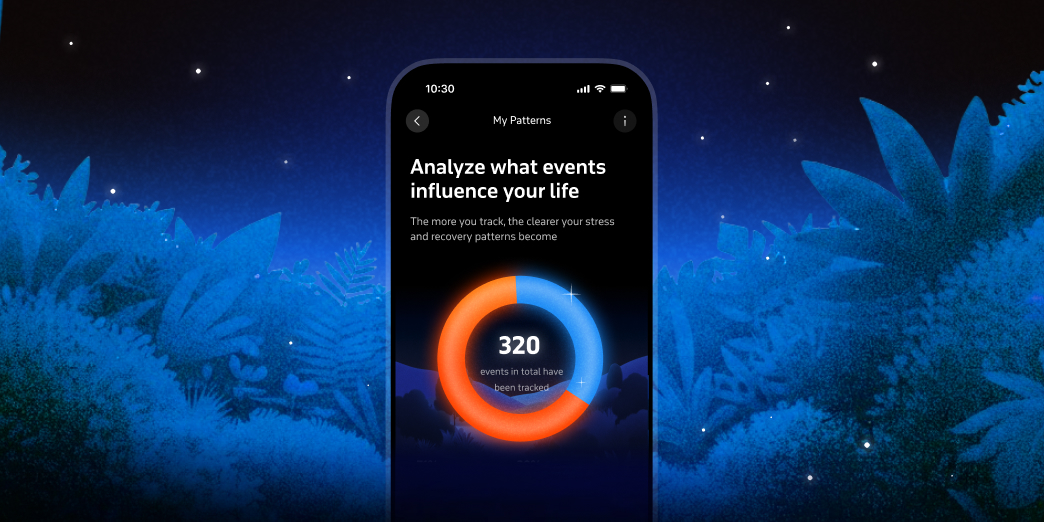
Hi, I'm Kate, and this is the update I've always wanted to ship.
Here's the thing about stress: it rarely announces itself. Your heart races in a meeting, and by the time you notice, you've already forgotten what triggered it. You feel calm after a walk and assume it's random. A bad night gets blamed on "just one of those days." Your body is keeping a very precise record of what's happening to it — and now, you have the unique way to read it.
What My Patterns actually is
Welltory already knows when your body moves through a stress or recovery episode. By reading your heart rate and physiological signals in real time, it can identify with precision when your body is under strain and when it is genuinely recovering. My Patterns takes that understanding one step further by connecting each physiological response to the real-life moment behind it — turning a signal on a graph into something personal, understandable, and useful.
Every time you tell Welltory what was happening during an episode, that moment is saved as a tag in My Patterns. One tag may not reveal much. But as they accumulate over days and weeks, they begin to form a living map of your life: what repeatedly appears alongside stress, what reliably helps you recover, and which moments may deserve more attention than you have been giving them.
How it works
It's built to take you seconds, not minutes:
- When Welltory detects a stress or rest episode on your Today screen, it asks a simple question — "What happened?" or "What helped you rest?"
- You answer however is easiest: tap a suggested tag, type a few words, or just talk. Say "argument with my manager" or "coffee with a friend," and Welltory automatically pulls out the tags — deadline, coffee, walk, argument, good news.
- There's no dropdown to search through. You describe your day in your own words, and the system figures out what matters. If it gets something wrong, you correct it before it's saved.
- Tags only come from real episodes your body actually went through — not from journal entries typed in isolation. That's what keeps the picture honest.
Think of it as a jar you keep filling
On their own, tags are just fragments: a deadline, an argument, a coffee, a walk, five quiet minutes outside. Each one feels like nothing.
But every time Welltory catches a stress or recovery episode and you tell it what was happening, another piece drops into the jar. Give it a few weeks, and the fragments stop being random. They start forming a living map of your life — what reliably helps you unwind, which situations keep showing up right before you spike, which rare events your body reacts to far more strongly than you'd expect, and how all of it shifts over time.
It's not a score. It's not a generic tip. It's built entirely from your body and your days.
What's inside
Open the My Patterns widget on your Today screen and you'll see a ring — orange for stress episodes, blue for recovery — with your total tag count in the center. Tap in, and here's what's waiting:
- Stress and recovery breakdown — the overall split between the two, plus how this month compares to last. A more balanced ring means you're actually managing to offset stress with recovery, not just absorbing it.
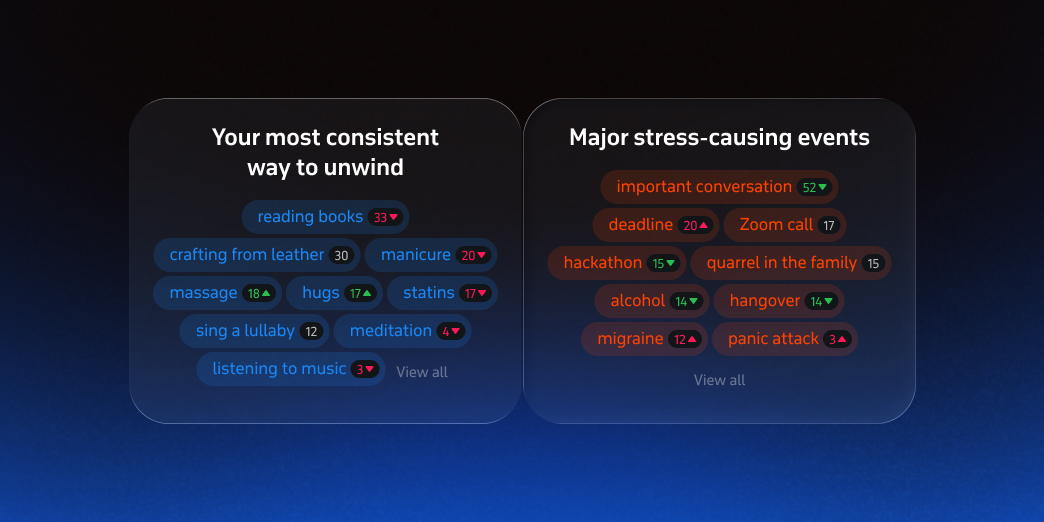
- Your most consistent way to unwind — the tags that show up most in your recovery episodes. The walk, the specific playlist, the ten minutes with your dog — the things that actually work, made visible instead of half-remembered.
- Major stress-causing events — the tags behind your stress episodes. Some you can change. Some you can't. Either way, you can finally see them clearly instead of just feeling their weight.
- Worth paying attention to — this is the one that surprises people. It surfaces tags that don't happen often but hit your body hard when they do. Rare doesn't mean unimportant — if it's showing up here, your body is telling you to notice it.
- Stress & recovery timeline — a visual history of when stress tends to build and when your body actually gets the chance to recover.
Tap into any single tag and you get the full picture: how often it appears and how that's trending, which days of the week it tends to hit, your heart rate during those exact episodes, and a complete list of every time it happened.
The moment it clicks
This is the part users tell us about unprompted: the moment a pattern shows them something they'd never have connected on their own.
"I thought coffee was my biggest problem — but it's actually late meetings."
That's the whole point. Stress feels random until you can see it laid out. Once you can, it stops being a mood and starts being information.
Insights that come to you
You don't have to go digging. As your My Patterns fills up, Welltory starts surfacing insights directly in your Today feed — one at a time, mixed in with the rest of your daily insights, so you get a nudge exactly when there's something real to say. These need real data to be reliable: typically at least 7 tagged occurrences in the current month, with some history from the month before to compare against. That's usually about two to three weeks of noting what's happening — not a long wait for something this useful.
Why I think this actually matters
For years, health apps have helped people measure stress, recovery, and heart rate variability. Those numbers are valuable, but My Patterns makes them more personal by connecting them to the moments, habits, and experiences behind them — using the context only you can provide.
With a little consistent tagging, the picture starts to change. You may uncover a stressor you had never considered, notice that something simple is helping more than you realized, or see a pattern your memory alone would have missed.
That is the real value of My Patterns. It does not just give you more data. It helps you turn your own daily life into a clearer understanding of what affects you, what restores you, and what you may want to do differently.
— Kate


Discounts for blog readers: up to 36% off
See what affects your energy, stress, sleep, and daily state with Welltory
Was this helpful?
Ask AI for a summary of page


