
What is a normal resting heart rate? The real range, by age and fitness — and how to read your own
A normal resting heart rate is 60–100 bpm — but lower usually means fitter, and your own baseline matters more than any population number. The real range by age and sex, when to worry, and how to read your own.

Short Answer
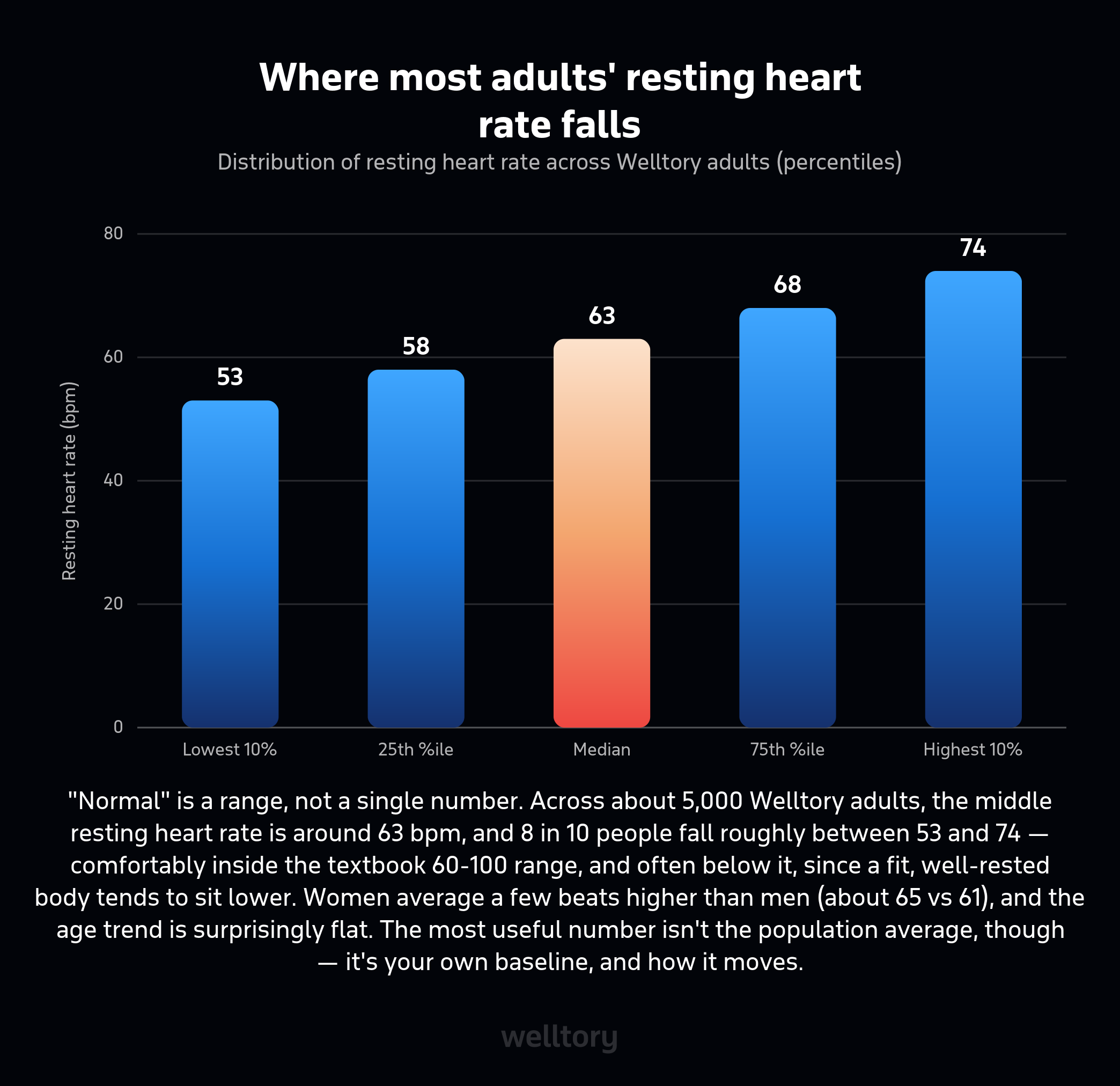
For most healthy adults, a normal resting heart rate is between 60 and 100 beats per minute (bpm) — that's the range the American Heart Association uses. But two things matter more than the textbook band. First, lower (within reason) usually means fitter: well-conditioned athletes often sit at 40–60 bpm, and across the population a lower resting heart rate is linked to better cardiovascular fitness and longevity — a large meta-analysis of over a million people found each 10-bpm increase in resting heart rate was associated with about a 9% higher risk of dying from any cause. Second, your own baseline beats any population number: what's "normal" for you is your steady average when rested, and the useful signal is when it drifts up or down from that. In Welltory's own data across about 5,000 adults, the middle resting heart rate is around 63 bpm and most people fall between about 53 and 74 — often at or below the lower end of the classic range, because a fit, well-recovered body runs slower. This article explains the real range by age and sex, what "good" looks like, when high or low is worth a doctor, and how to read your own number.
A note on the data: the distribution below is aggregated, de-identified Welltory data — per-user average resting heart rate across roughly 5,000 adults. It shows where real people actually sit (median ~63 bpm; women a few beats higher than men; a strikingly flat age trend), which is a more grounded picture than a single "normal" number.
What our data shows: where most adults actually sit
"Normal" is a range, not a magic number — and the spread is the point. Across Welltory adults, the middle resting heart rate is about 63 bpm, with roughly 8 in 10 people falling between 53 and 74. That sits comfortably inside — and often below — the textbook 60–100 band, because everyday fit, well-rested people tend to run on the lower side. Women average a few beats higher than men (about 65 vs 61 bpm), which is normal physiology, and the age trend is surprisingly flat: resting heart rate doesn't climb much with age on its own (a rising resting heart rate is usually about fitness, stress, sleep, or health, not birthdays). The takeaway: a wide band of numbers is perfectly normal, and where you land inside it matters less than whether your own number is stable.
The standard range — and why lower tends to be better
The clinical reference is simple: 60–100 bpm is considered normal for adults at rest. Below 60 is technically "bradycardia" and above 100 is "tachycardia," but those labels need context — a runner at 48 isn't sick, and someone at 101 right after coffee isn't either.
What the research keeps showing is that, within healthy limits, a lower resting heart rate is a good sign. It reflects a strong, efficient heart that pumps more blood per beat, so it doesn't have to beat as often. Endurance athletes commonly sit in the 40s–50s. And epidemiologically, a lower resting rate tracks with lower cardiovascular risk and longer life, while a persistently high resting rate flags higher risk — in that meta-analysis of more than a million people, each extra 10 bpm carried roughly a 9% higher risk of all-cause death and a similar bump in cardiovascular death. (cmaj.ca) This is exactly why resting heart rate is such a useful thing to track: it's a cheap, daily readout of cardiovascular and recovery status that you can influence.
Normal by age and sex
Two nuances round out the picture. Sex: women's resting heart rate runs a few beats higher than men's on average — partly because a smaller average heart pumps less blood per beat and so beats a little more often — so a woman at 68 and a man at 62 can be equally healthy. In women it also shifts across the menstrual cycle, tending to sit a touch higher in the luteal (premenstrual) phase, and it rises meaningfully in pregnancy, when blood volume climbs and the heart works harder — often by 10–20 bpm by the third trimester, which is normal.
Age: contrary to intuition, resting heart rate doesn't reliably rise with age in healthy adults; our data is nearly flat across the decades. What changes with age is usually fitness, weight, medications, and health, not the heart rate itself — so a resting rate that has climbed over the years is a nudge to look at lifestyle, not an inevitable part of getting older. At the other end of life, children and teenagers run faster — a newborn's resting rate can top 100–160 bpm — and it settles gradually toward the adult range by the late teens. The practical upshot of all this is the same theme: "normal" depends on who and when, so your own steady baseline is a better reference than a one-size chart.
How resting heart rate is measured — and why the method matters
Your resting heart rate is only meaningful if it's captured at genuine rest, and how you measure changes the number more than most people realize. The cleanest reading is first thing in the morning, before you get up — that's your truest baseline, taken before caffeine, movement, food, or the day's first stresses nudge it upward. Measured later in the day, even sitting quietly for a few minutes, it usually reads several beats higher, which is why comparing a morning number one day to an afternoon number the next tells you little.
Method matters too. A chest strap or an ECG reads the heart's electrical signal directly and is the most accurate. A wrist or finger optical sensor — the kind in most smartwatches and in phone-camera apps — estimates each beat from tiny blood-flow changes under the skin; it's excellent for tracking your own trend but can wobble with movement, cold hands, tattoos, or a loose band. None of that makes wearables useless; it just means the right way to use them is to pick one consistent method and time, and read the trend rather than any single reading. A one-off number after coffee and a rushed morning isn't your resting heart rate — it's a snapshot of that particular moment.
It's also worth separating two related numbers: your resting heart rate (awake but at rest) and your sleeping or overnight heart rate, which usually dips to its lowest in the deepest part of the night. Many trackers report the overnight low, which tends to run a few beats below the daytime resting figure. Both are useful; the key is to compare like with like over time.
What raises your resting heart rate day to day
Plenty of ordinary things lift your resting heart rate temporarily, which is exactly why a single high reading rarely means anything is wrong. Caffeine and nicotine are stimulants that raise it for hours. Alcohol pushes it up, especially overnight and the next morning — a classic reason your resting rate looks elevated after a few drinks. Short or broken sleep and a stressful, wired day keep the sympathetic "fight-or-flight" system switched on, so the heart runs faster even at rest. Heat and dehydration force the heart to work harder to circulate blood and cool you, which is why resting rates often creep up in summer. Illness or a fever raises it — frequently one of the earliest signs you're coming down with something, sometimes before you feel sick. Overtraining — hard training without enough recovery — leaves the next morning's resting rate elevated. And large meals, dehydration, pain, some medications, and even anxiety in the moment can all move it.
The point of knowing this list is perspective: these are normal, passing bumps. The signal that actually matters is different — it's when your resting heart rate sits several beats above your own baseline for days without one of these obvious explanations. That sustained drift is the informative pattern; the daily noise is just noise.
When a high or low number is worth a doctor
Context decides. A single high reading after coffee, stress, heat, a poor night, alcohol, or illness is normal and passes. What deserves attention is a persistent shift or one paired with symptoms.
See a doctor if your resting heart rate is consistently over ~100 bpm without an obvious cause, if it's under ~50 with symptoms like dizziness, fatigue, fainting, or breathlessness (in a non-athlete), or if a fast or slow rate comes with palpitations, chest discomfort, shortness of breath, or fainting — those can signal an arrhythmia or another issue worth checking.
Two pieces of context help you tell benign from concerning. A low rate is usually good news: a trained runner resting in the 40s is fine, and the number only matters if it comes with symptoms of too little blood flow (lightheadedness, unusual fatigue, near-fainting). A high rate is more often a passing response to caffeine, stress, heat, illness, or a poor night than a heart problem — but a fast resting rate that persists, or that spikes suddenly into a pounding, irregular rhythm, deserves a look, since it can point to thyroid overactivity, anemia, dehydration, or an arrhythmia like atrial fibrillation.
A particularly useful early warning is subtler than either extreme: a resting heart rate that has crept up several beats above your own baseline and stayed there for a week or more without an obvious reason. That sustained drift can be the first quiet sign of brewing illness, overtraining, dehydration, thyroid changes, poor sleep, or mounting stress — often before you feel anything. We dig into each direction in our companion pieces on a high resting heart rate and a low resting heart rate, and cover the racing, irregular kind in our guides to heart palpitations and arrhythmias.
How to lower your resting heart rate — what actually works
Because a lower resting heart rate reflects a fitter, calmer, better-recovered body, the ways to lower it are simply the ways to become one — and they're well evidenced, not gimmicks.
Regular aerobic exercise is the biggest lever. Consistent cardio — brisk walking, running, cycling, swimming — strengthens the heart so it pumps more blood per beat, and over weeks to months your resting rate drifts down. This is the single most reliable way to lower it, and it's why endurance athletes sit so low.
Protect and regularize your sleep. Short or fragmented sleep keeps the heart running faster, so getting enough sleep on a consistent schedule brings the baseline down. A resting rate that's stuck high often traces straight back to a run of poor nights.
Lower chronic stress. A nervous system stuck in "go" holds the heart rate up; slow, paced breathing and genuine daily downtime nudge the body toward "rest-and-digest," which is reflected directly in a lower resting rate over time.
Go easy on alcohol and excess caffeine, and stay hydrated. All three otherwise keep your resting rate elevated, especially overnight — cutting back is one of the faster-acting changes you'll notice.
Trim excess weight if it's relevant, since carrying less reduces the heart's workload at rest.
None of this moves the number overnight — resting heart rate responds over weeks, not days — but together these habits lower it dependably, and watching your own trend is the clearest way to see the effort pay off. The important caveat: if your resting heart rate stays high despite doing all of this, that's a reason to see a doctor and look for an underlying cause, not to simply push harder.
How to read your own resting heart rate with Welltory
Here's where a tracker earns its place, because the single most useful number isn't the population median — it's your baseline and its movement. Resting heart rate is best measured when you're truly at rest, ideally on waking before you get up, and read as a trend rather than a one-off. With Welltory you can watch your resting heart rate over weeks alongside your HRV, sleep, and stress, and that's where the insight lives: you'll see it settle as your fitness and sleep improve, and tick up when you're under-recovered, ill, stressed, drinking, or sleeping badly — often a day or two before you consciously feel it. That turns a vague "is my heart rate okay?" into something concrete: not "am I inside 60–100?" but "is my own number steady, and does it come back down when I take care of myself?" Two honest caveats: wrist optical readings are estimates and single mornings are noisy, so read the weekly trend; and a tracker can't diagnose — a genuinely abnormal or symptomatic rate belongs with a doctor. But as a daily mirror for cardiovascular and recovery status, resting heart rate is one of the most useful things it shows you. (For the flip side of the same coin, see our guide to what your HRV measures.)


Discounts for blog readers: up to 36% off
See what affects your energy, stress, sleep, and daily state with Welltory
This article is for educational purposes only and is not medical advice. A resting heart rate outside the typical range, or new symptoms like palpitations, dizziness, or breathlessness, deserve a doctor's assessment. Welltory measures physiological signals like heart rate, HRV, sleep, activity, and stress; it does not diagnose anything.
Was this helpful?
Ask AI for a summary of page


Written by Jane Smorodnikova

The founder and CEO of Welltory. A recognized tech leader with two Master's degrees and experience at MIT, she has scaled Welltory to over 17 million users.
Written by Tatsiana Yashyna

Deputy COO at Welltory. With a background in medicine and years of working with health data, she translates research and real physiological signals — sleep, stress, heart rate, and hormones — into clear, evidence-based explanations that help people understand what their bodies are telling them.
Reviewed by Anna Elitzur
-2.jpg)
With her medical degree, Anna reviews Welltory's health content for medical accuracy and alignment with current clinical guidelines and research.
References
- Target heart rates and normal resting heart rate (60–100 bpm; athlete lows). American Heart Association. https://www.heart.org/en/healthy-living/exercise-and-physical-activity/fitness-basics/target-heart-rates
- Heart rate: what's normal? (resting heart rate range; lower with fitness). Mayo Clinic. https://www.mayoclinic.org/healthy-lifestyle/fitness/expert-answers/heart-rate/faq-20057979
- Heart rate: normal rates and what to know. Cleveland Clinic. https://my.clevelandclinic.org/health/diagnostics/heart-rate
- Zhang D, et al. Resting heart rate and all-cause and cardiovascular mortality in the general population: a meta-analysis (46 studies, >1.2M people; ~9% higher mortality per 10 bpm). CMAJ 2016. https://www.cmaj.ca/content/188/3/E53
- Welltory adult cohort distribution (resting heart rate percentiles, by sex and age). Reproducible script: `persona_lab/scripts/resting_hr_normal.py`.


