

Short Answer
A low resting heart rate — below 60 beats per minute, which doctors call bradycardia — is usually a good sign, not a bad one. In a fit, healthy person it reflects a strong, efficient heart that pumps more blood per beat, so it doesn't have to beat as often; well-trained athletes commonly rest in the 40s and 50s and are perfectly healthy. The single question that decides whether a low number is fine or a problem is simple: are there symptoms? A low resting rate with no symptoms is almost always benign, especially if you're active. A low resting rate with dizziness, lightheadedness, fainting, unusual fatigue, weakness, or breathlessness is different — that can mean your heart isn't pumping enough blood, and it needs a doctor. Beyond fitness, a genuinely slow heart can also come from medications (like beta-blockers), an underactive thyroid, or an electrical problem in the heart. In Welltory's data the fitness link is clear — the most active adults sit about 5 beats lower than the least active. This article explains the difference between an athlete's low heart rate and a concerning one, what causes each, and when to see a doctor. (For the full range, start with our guide to a normal resting heart rate.)
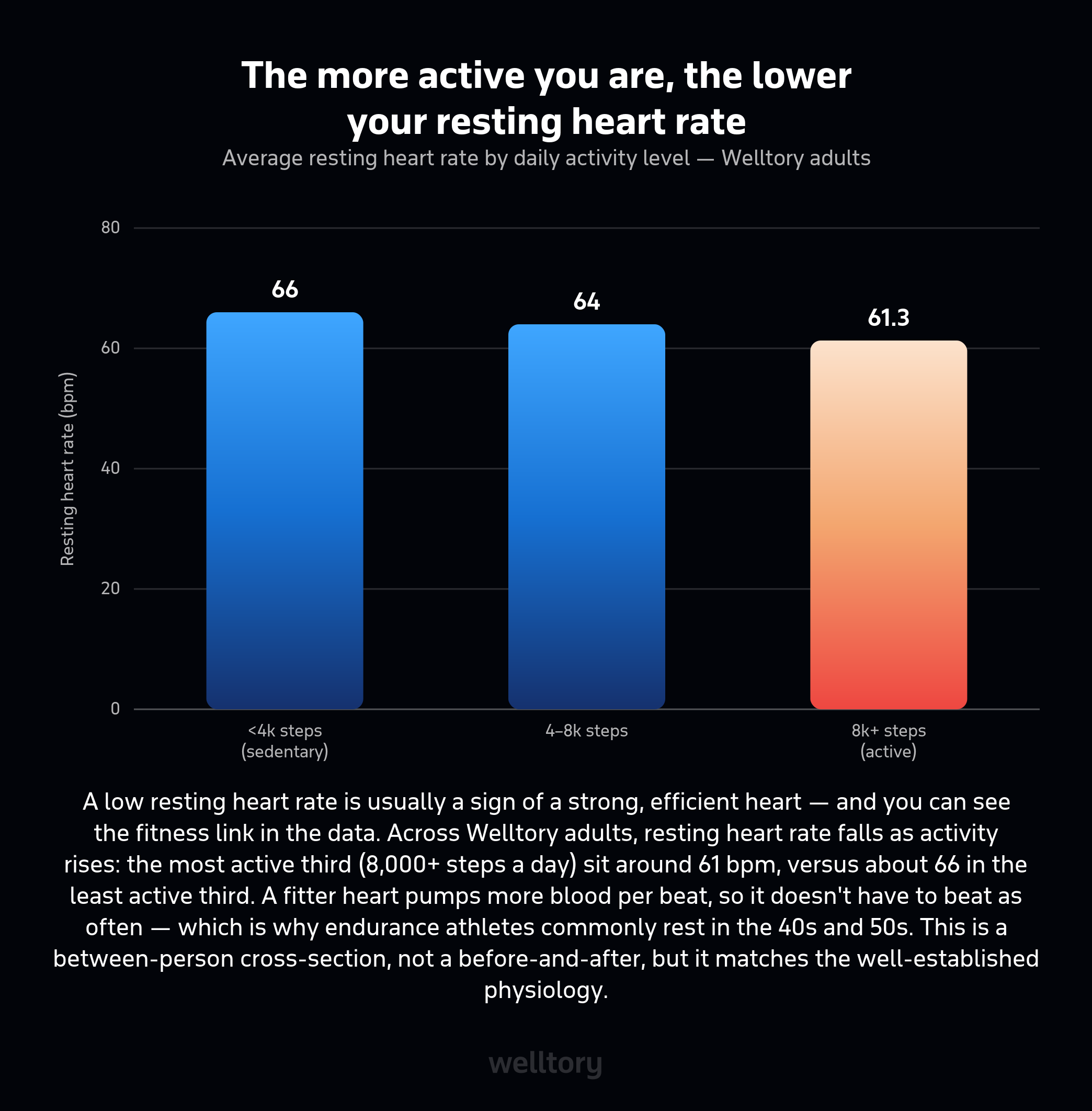
A note on the data: the chart below is aggregated, de-identified Welltory data — average resting heart rate across roughly 5,000 adults by how active they are. It shows the fitness link directly: more movement, lower resting heart rate.
What our data shows: the more you move, the lower it sits
The reason "low usually means fit" isn't just a saying — you can see it in the numbers. Across Welltory adults, resting heart rate falls steadily with activity: the least active third (under ~4,000 steps a day) average about 66 bpm, while the most active third (8,000+ steps) sit around 61 — and that's before you get to serious endurance athletes, who often rest far lower still. The mechanism is straightforward: regular aerobic training makes the heart a stronger pump, so it moves the same blood in fewer beats. This is exactly why a low resting heart rate, in an active person with no symptoms, is a marker of good cardiovascular fitness rather than a red flag. The number going down as you get fitter is one of the most satisfying things to watch in your own data.
What counts as "low"?
Technically, a resting heart rate under 60 bpm is bradycardia. But that label alone tells you almost nothing, because the same number can be a sign of elite fitness or of a heart that's struggling — the context is everything. A conditioned runner resting at 48 and feeling great is not the same as a sedentary person who suddenly drops to 48 and feels faint, even though the number is identical. So the useful way to read a low resting rate is not against the 60-bpm line but against two things: your own history (is this normal for you, or a new change?) and your symptoms (do you feel fine, or lightheaded and tired?). Athletes and very fit people can have resting rates in the 40s that are completely healthy; the moment a low rate comes with symptoms of too little blood flow, the story changes.
The good kind: an athlete's heart
For most people with a low resting heart rate, the explanation is simply fitness. Endurance and regular aerobic training remodel the heart to pump more efficiently and shift the nervous system toward stronger "rest-and-digest" (vagal) tone at rest, both of which slow the resting rate. Athletes with resting heart rates of 40–60 bpm are common and, in the absence of symptoms, this is a normal, healthy adaptation. (medicalnewstoday.com) It's the same efficiency that lets a fit heart handle hard efforts and recover quickly. If your resting rate has drifted down over months as your training improved, and you feel good, that's the athlete's-heart pattern — a sign your work is paying off, not a problem.
It's worth adding that resting heart rate normally dips even lower during sleep, when the body is deepest in recovery, so a very low number seen overnight on a tracker is usually expected. Judge the daytime resting figure and how you feel, not the sleeping low in isolation.
A common worry is whether an athlete's very low heart rate is somehow "straining" the heart. For a genuinely fit person, the opposite is true: the low rate is a sign the heart is doing its job with less effort, not more. Large studies of endurance athletes find their slow resting rates are, in the vast majority, a benign training adaptation rather than a disease — the rare exceptions are picked up not by the number alone but by symptoms, family history, or findings on an ECG. So an athlete who feels well and performs well has little reason to fear a resting rate in the 40s or low 50s; it's the body's stamp of approval, and it will drift back up if training eases off.
When a low resting heart rate is fine — and when it isn't
Here's the practical dividing line. A low resting heart rate is fine when it's stable, longstanding or clearly tied to your fitness, and — crucially — causes no symptoms. You feel normal, you exercise well, you're not dizzy or wiped out. In that case a number in the 50s, or even 40s for an athlete, needs no action.
A low resting heart rate is worth checking when it's new or falling without a fitness explanation, or when it comes with symptoms that suggest your organs aren't getting enough blood: lightheadedness, dizziness, fainting or near-fainting, unusual fatigue, weakness, confusion, shortness of breath, or chest discomfort. (my.clevelandclinic.org) Those symptoms are the signal, regardless of the exact number — a heart that's beating too slowly to meet the body's needs is a medical issue, and it can occasionally be serious.
The causes of a genuinely slow heart
When a low resting rate isn't about fitness, several things can slow the heart, and they're worth knowing because most are treatable.
Medications. This is one of the most common non-athletic causes. Beta-blockers (for blood pressure, arrhythmias, or anxiety) deliberately slow the heart, and other drugs — some calcium-channel blockers, digoxin, amiodarone — do too. If your resting rate dropped after starting a new medication, that's very likely the reason; discuss it with your prescriber rather than stopping on your own. (my.clevelandclinic.org)
An underactive thyroid (hypothyroidism). Too little thyroid hormone slows the whole metabolism, including the heart, so a low resting rate alongside fatigue, weight gain, cold intolerance, dry skin, or constipation can point to hypothyroidism — diagnosed with a simple thyroid blood test and very treatable. (We cover this in our guide to an underactive thyroid.)
Electrical problems in the heart. The heart's own pacemaker or wiring can slow with age or disease — conditions like sick sinus syndrome or heart block — which can cause a slow rate that does produce symptoms and sometimes needs treatment, including a pacemaker. This is exactly why a low rate with dizziness or fainting deserves an ECG.
Other causes include certain electrolyte imbalances, some infections (like myocarditis), and, temporarily, deep relaxation or the moment of a strong vagal reflex. A slow rate that's persistent, new, or symptomatic is the one to investigate.
How low is too low? Athlete's low versus a warning
People often ask what the floor is — how low a resting heart rate can safely go. The honest answer is that there's no universal cutoff, because the same number means different things in different bodies. A conditioned endurance athlete can sit in the low 40s, even the high 30s at rest, with a perfectly healthy heart; for them, that's the ceiling of fitness, not a warning. The same reading in an untrained person who suddenly developed it, and who feels faint on standing, is a problem. So "too low" is defined by symptoms and change, not by a line on a chart.
There's one athletic nuance worth flagging, though: a resting heart rate that keeps drifting down while your performance and mood get worse, not better, can be a sign of overtraining rather than improving fitness — a fatigued, under-recovered nervous system, often alongside falling HRV, poor sleep, and heavy legs. In that case the low number isn't the win it looks like; it's a cue to back off and recover. (This is the flip side of an elevated morning heart rate after hard training, which we cover in our guide to overtraining and recovery.) The way to tell healthy-low from overtrained-low is the rest of the picture: are you performing and feeling well, or dragging?
Low resting heart rate and age
Age adds a wrinkle worth knowing. On one hand, staying active into later life keeps the resting heart rate pleasantly low and is entirely healthy. On the other, the heart's own electrical system — the natural pacemaker and its wiring — can slow or become unreliable with age, so a newly low or increasingly slow resting rate in an older adult is more likely than in a young athlete to reflect a conduction problem such as sick sinus syndrome or heart block. The distinguishing features are the same as always: a stable, longstanding, symptom-free low rate in an active older person is usually fine, whereas a new drop, or one paired with dizziness, fainting spells, breathlessness, or unusual fatigue, is a reason to get an ECG rather than to assume it's just fitness. If you're older and your tracker shows your resting rate falling without more exercise — especially with any of those symptoms — it's worth a conversation with your doctor.
When to see a doctor
Keep it simple: a low resting heart rate without symptoms, especially if you're fit, is almost always fine and needs nothing. See a doctor if a slow rate comes with dizziness, fainting or near-fainting, unusual fatigue, weakness, confusion, breathlessness, or chest discomfort; if your resting rate has dropped noticeably and you're not an athlete; or if it fell after starting a new medication. Seek urgent care for fainting or chest pain with a slow pulse. A doctor can check your thyroid, review your medications, and run an ECG to see whether your heart's electrical system is the cause — and in the great majority of cases, reassure you that your low number is simply a fit, healthy heart.
How to build a healthy low resting heart rate
If your goal is the good kind of low resting heart rate — the fitness kind — the route is the same as for cardiovascular health generally, and it's earned rather than forced. Regular aerobic exercise is the engine: consistent cardio over weeks and months strengthens the heart so it pumps more per beat and settles lower at rest. Alongside it, good, consistent sleep and lower chronic stress strengthen the "rest-and-digest" (vagal) tone that slows the heart in a healthy way, and staying hydrated and easing off alcohol removes the things that otherwise keep it elevated. Done this way, a lower resting rate arrives gradually as a byproduct of a fitter, calmer body — which is exactly why it's a good sign.
What you should not do is chase a low number for its own sake, or read a medication-induced low rate as a fitness achievement — a beta-blocker slowing your heart isn't the same as training slowing it, even though the number looks similar. And if your resting rate is already low and healthy, there's nothing to "fix": a stable, symptom-free low rate is a finish line, not a problem to solve. The only low rate worth acting on is one that's new, unexplained, or symptomatic — and that action is a doctor's visit, not more training.
How Welltory helps you read a low resting heart rate
A low number is most meaningful in context — your trend and how you feel — and that's what a tracker is good for. With Welltory you can watch your resting heart rate over time alongside your HRV, sleep, and activity, which helps you tell the reassuring story from the one that needs a look. If your resting rate has drifted down over months as your training improved, and your HRV is healthy and you feel good, that's the athlete's-heart pattern — your fitness showing up in the data. If instead your resting rate dropped suddenly without more training, or dropped around a new medication, or is paired with low energy and dizziness, that's context worth bringing to a doctor. The point isn't for the app to judge your number — a low rate can be excellent or concerning — but to give you the trend and the surrounding signals so you (and your clinician) can tell which it is. Two honest caveats: wrist optical sensors are estimates and can occasionally misread a slow or irregular pulse, and a tracker can't diagnose bradycardia or its cause — symptoms plus an ECG do that. But for knowing whether your low number is fitness or a change worth checking, the trend is genuinely useful. (For the opposite pattern, see our guide to a high resting heart rate, and for the recovery side of your heart data, what your HRV measures.)


Discounts for blog readers: up to 36% off
See what affects your energy, stress, sleep, and daily state with Welltory
This article is for educational purposes only and is not medical advice. A low heart rate that comes with dizziness, fainting, unusual fatigue, or breathlessness needs prompt medical attention. Welltory measures physiological signals like heart rate, HRV, sleep, activity, and stress; it does not diagnose anything.
Was this helpful?
Ask AI for a summary of page


Written by Jane Smorodnikova

The founder and CEO of Welltory. A recognized tech leader with two Master's degrees and experience at MIT, she has scaled Welltory to over 17 million users.
Written by Tatsiana Yashyna

Deputy COO at Welltory. With a background in medicine and years of working with health data, she translates research and real physiological signals — sleep, stress, heart rate, and hormones — into clear, evidence-based explanations that help people understand what their bodies are telling them.
Reviewed by Anna Elitzur
-2.jpg)
With her medical degree, Anna reviews Welltory's health content for medical accuracy and alignment with current clinical guidelines and research.
References
- Bradycardia: symptoms, causes and treatment (below 60 bpm; athlete vs concerning; medications, hypothyroidism, heart block). Cleveland Clinic. https://my.clevelandclinic.org/health/diseases/17841-bradycardia
- Low resting heart rates in athletes: is it safe? (athletes 40–60 bpm; concern only with symptoms). Medical News Today. https://www.medicalnewstoday.com/articles/athletes-heart-rate
- Bradycardia: slow heart rate (when a slow rate needs attention). American Heart Association. https://www.heart.org/en/health-topics/arrhythmia/about-arrhythmia/bradycardia--slow-heart-rate
- When to worry about a slow heart rate (symptoms that make bradycardia concerning). Kelsey-Seybold Clinic. https://www.kelsey-seybold.com/your-health-resources/blog/when-to-worry-about-a-slow-heart-rate
- Welltory adult cohort (resting heart rate by activity level). Reproducible script: `persona_lab/scripts/activity_sedentary_vs_active.py`.


