
Overtraining: when your HRV drops even though you're training hard — and your body is asking for rest
Training builds fitness only when recovery keeps up. When load outruns recovery, HRV falls below your baseline and resting heart rate rises above it — the paradox of working harder for worse numbers.

Short Answer
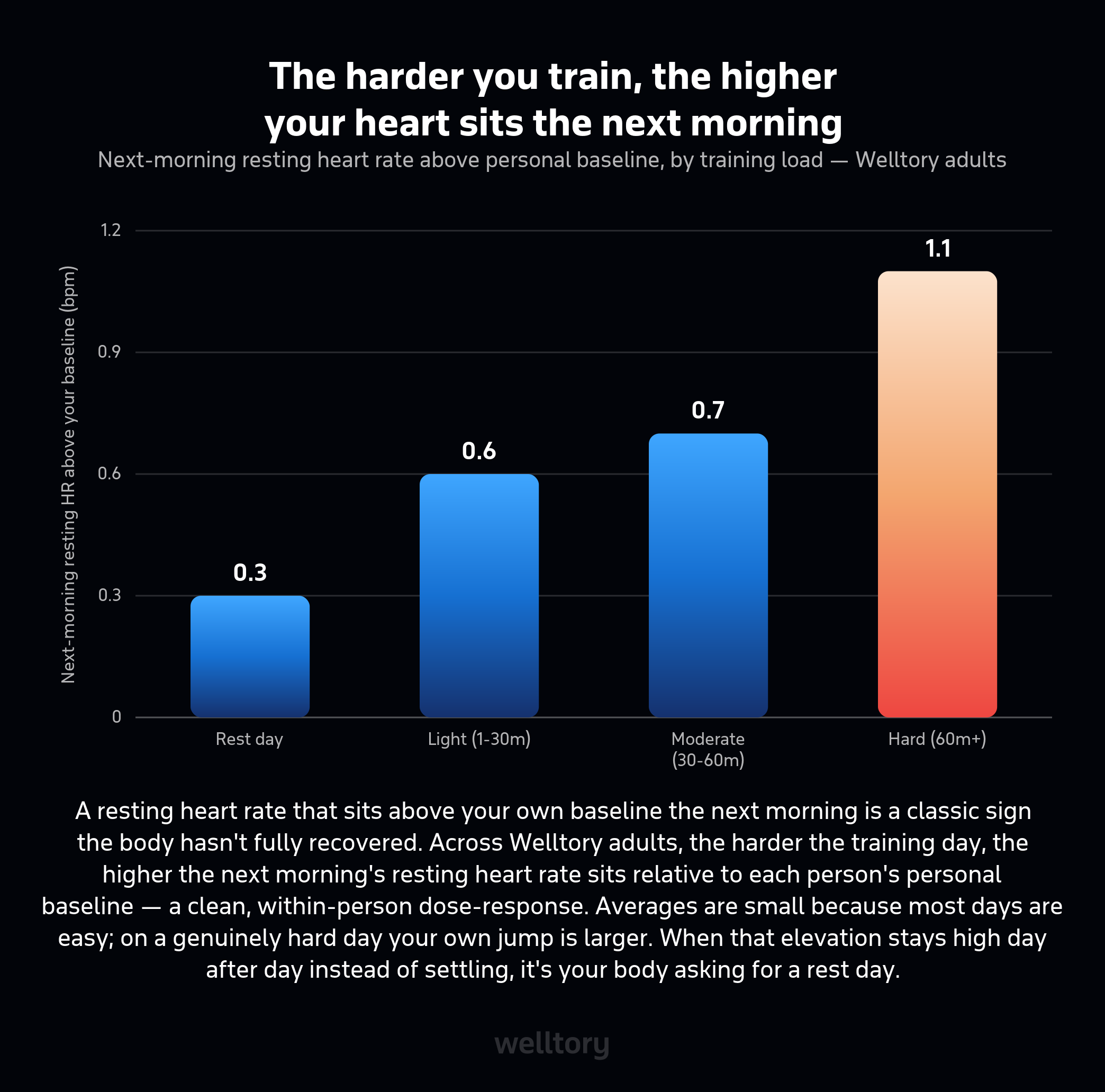
Training is supposed to make your body stronger and your recovery numbers better — so it's genuinely confusing when you're working harder and your heart rate variability (HRV) is dropping, your resting heart rate is creeping up, and your performance is stalling. That paradox is the signature of overtraining (more precisely, nonfunctional overreaching sliding toward overtraining syndrome): training load has outrun recovery, and the body has tipped from "adapting" into "depleting." Fitness isn't built during workouts — it's built during recovery between them. When you don't leave enough room to recover, the nervous system shifts toward chronic sympathetic "fight-or-flight" dominance, and the classic red flags appear: HRV trending below your personal baseline and resting heart rate sitting above it, alongside fatigue, poor sleep, low mood, and flat performance. In Welltory data you can see the seed of this: the harder people train on a given day, the higher their resting heart rate sits above their own baseline the next morning. The fix isn't more discipline — it's rest. This article explains the signs, the physiology, and how to catch it early.
Cohort Context: hard training raises your next-morning heart rate
Overtraining is fundamentally a within-person problem — it's about your load versus your recovery, not how you compare to anyone else. That's exactly what our data captures. Grouping days by that day's training load and looking at the next morning's resting heart rate relative to each person's own baseline, the pattern is clean and stepwise: rest days barely move it, while hard sessions (60+ minutes) leave the next morning's resting heart rate meaningfully elevated above baseline. The averages are small because most days are easy — but the direction is the whole point: harder training pushes your next-morning heart rate up relative to your own normal, a direct read on incomplete recovery. When that elevation shows up once, it's just training. When it stays high day after day and your HRV keeps sliding, that's your body signaling it needs a break.
The paradox: harder work, worse numbers
Here's the counterintuitive truth at the heart of overtraining. In a well-balanced program, hard training followed by adequate recovery makes you fitter — resting heart rate drifts down, HRV drifts up. But push the load too high without enough recovery and it flips: you cross from functional overreaching (a normal, temporary dip that leads to adaptation) into nonfunctional overreaching (performance stalls for days or weeks) and, if it continues, overtraining syndrome (a months-long slump with systemic symptoms). (ovid.com) The tell is that effort and results decouple: you train more and get slower, more tired, and more run-down. If working harder is making everything worse, that's not a reason to work harder still — it's the signal to back off.
What the body is doing
Underneath, overtraining is an autonomic-nervous-system problem. Chronic, under-recovered training load tips the balance away from the parasympathetic "rest-and-digest" side toward sustained sympathetic activation — the same imbalance chronic stress produces. That shows up as reduced HRV: research using Poincaré-plot analysis found HRV decreases with overtraining, reflecting this loss of parasympathetic tone. (pubmed.ncbi.nlm.nih.gov) Systematic reviews confirm HRV works as a practical, non-invasive marker of recovery status and overtraining risk. (pmc.ncbi.nlm.nih.gov) Alongside it, resting heart rate rises above baseline (an elevation of more than about 5 bpm over your personal norm is a recognized warning sign), sleep degrades, mood dips, immunity weakens, and performance falls. Your body isn't being weak — it's overdrawn, and these signals are it asking for repayment in the form of rest.
When "discipline" tips into compulsion
There's a harder edge worth naming gently. For some people, the drive to train stops being a choice and starts feeling compulsory — an inability to take rest days, guilt or anxiety when skipping a session, and exercising through fatigue, illness, or injury. That pattern, sometimes called exercise addiction or compulsive exercise, is different from ordinary dedication because it persists despite clear harm, and it can be entangled with disordered eating. This isn't about willpower or vanity; it's a real mental-health pattern that deserves compassion and support, not judgment. If rest genuinely feels impossible, or if exercise is bound up with restricting food, please treat that as important — reaching out to a professional (or the National Alliance for Eating Disorders helpline) is a strong, healthy step. Rest is not the opposite of fitness; it's part of it.
How to recover and prevent it
The remedy for overtraining is almost boringly simple, and it's the opposite of what a driven person wants to hear: do less, recover more. Take genuine rest and easy days, and build a deload week (reduced volume/intensity) into your training every few weeks. Protect sleep — it's where adaptation actually happens. Fuel and hydrate adequately; underfueling accelerates overtraining. Manage life stress, because your body doesn't distinguish training stress from work stress — they draw on the same recovery budget. And use objective signals rather than ego to decide when to push: if your HRV is down and your resting heart rate is up relative to your baseline, that's a rest day, not a hero day. If symptoms are severe or persistent, see a doctor to rule out other causes like anemia, thyroid issues, or illness. (See also: the signs of overtraining.)
How Welltory helps you train by your recovery, not your ego
This is one of the most practical uses of a tracker for anyone who trains. Because overtraining is a within-person problem, the key is watching your HRV and resting heart rate against your own baseline — not chasing someone else's numbers. Welltory flags when your HRV is trending down or your resting heart rate is sitting above your personal norm, which are exactly the early markers of accumulated load. Use it to make the call the disciplined brain resists: on a low-HRV, elevated-heart-rate morning, take the easy day or the rest day, and you'll come back stronger than if you'd gritted through. Watch your sleep, stress, and recovery trends too, since life stress spends the same recovery budget as training. Two honest caveats: HRV is individual and noisy day to day, so read your multi-day trend rather than reacting to a single reading, and a tracker can't diagnose overtraining syndrome — persistent symptoms need a doctor. But for the everyday question of "should I push today or recover?", training by your data instead of your ego is exactly how you avoid digging the hole in the first place.


Discounts for blog readers: up to 36% off
See what affects your energy, stress, sleep, and daily state with Welltory
This article is for educational purposes only and is not medical advice. If you have persistent fatigue, an unusually high or low resting heart rate, or performance and mood decline, see a doctor to rule out other causes. If exercise feels compulsive or is tied to restricting food, please reach out for support — you can contact the National Alliance for Eating Disorders helpline. Welltory measures physiological signals like heart rate, HRV, sleep, activity, and stress; it does not diagnose anything.
Was this helpful?
Ask AI for a summary of page


Written by Jane Smorodnikova

The founder and CEO of Welltory. A recognized tech leader with two Master's degrees and experience at MIT, she has scaled Welltory to over 17 million users.
Written by Tatsiana Yashyna

Deputy COO at Welltory. With a background in medicine and years of working with health data, she translates research and real physiological signals — sleep, stress, heart rate, and hormones — into clear, evidence-based explanations that help people understand what their bodies are telling them.
Reviewed by Anna Elitzur
-2.jpg)
With her medical degree, Anna reviews Welltory's health content for medical accuracy and alignment with current clinical guidelines and research.
References
- Mourot L et al. Decrease in heart rate variability with overtraining: assessment by the Poincaré plot analysis. Clinical Physiology and Functional Imaging (PubMed). 2004. https://pubmed.ncbi.nlm.nih.gov/14717743/
- Heart rate variability as a marker for overtraining and recovery status — systematic review. PMC. https://pmc.ncbi.nlm.nih.gov/articles/PMC12098969/
- Overreaching/Overtraining: more is not always better (functional → nonfunctional overreaching → overtraining syndrome). ACSM's Health & Fitness Journal. https://www.ovid.com/jnls/acsm-healthfitness/fulltext/10.1249/fit.0000000000000100~overreachingovertraining-more-is-not-always-better
- Welltory adult cohort context (next-morning resting heart rate above personal baseline, by training load). Reproducible script: `persona_lab/scripts/overtraining_load_recovery.py`.

