

Short Answer
If your resting heart rate looks higher than you'd like, the most common reasons are ordinary and reversible: stress and anxiety, too much caffeine, alcohol or nicotine, dehydration, heat, poor sleep, and being out of shape. All of these keep the body's "fight-or-flight" system engaged or make the heart work harder, so it beats faster even at rest. Less often, a high resting rate points to something medical worth ruling out — anemia, an overactive thyroid, a fever or infection, certain medications, or an arrhythmia. The context that matters most is your own baseline: a single high reading after coffee or a rough night means little, but a resting rate that has crept up several beats above your normal and stayed there, or one that sits persistently above about 100 bpm, deserves attention. In Welltory's own data the link is clear — the more daily stress people carry, the higher their resting heart rate sits, by around 6 beats between the calmest and most-stressed groups. This article walks through the everyday causes, the medical ones to rule out, when to see a doctor, and how to bring a high resting heart rate back down. (For the full picture of what's normal, start with our guide to a normal resting heart rate.)
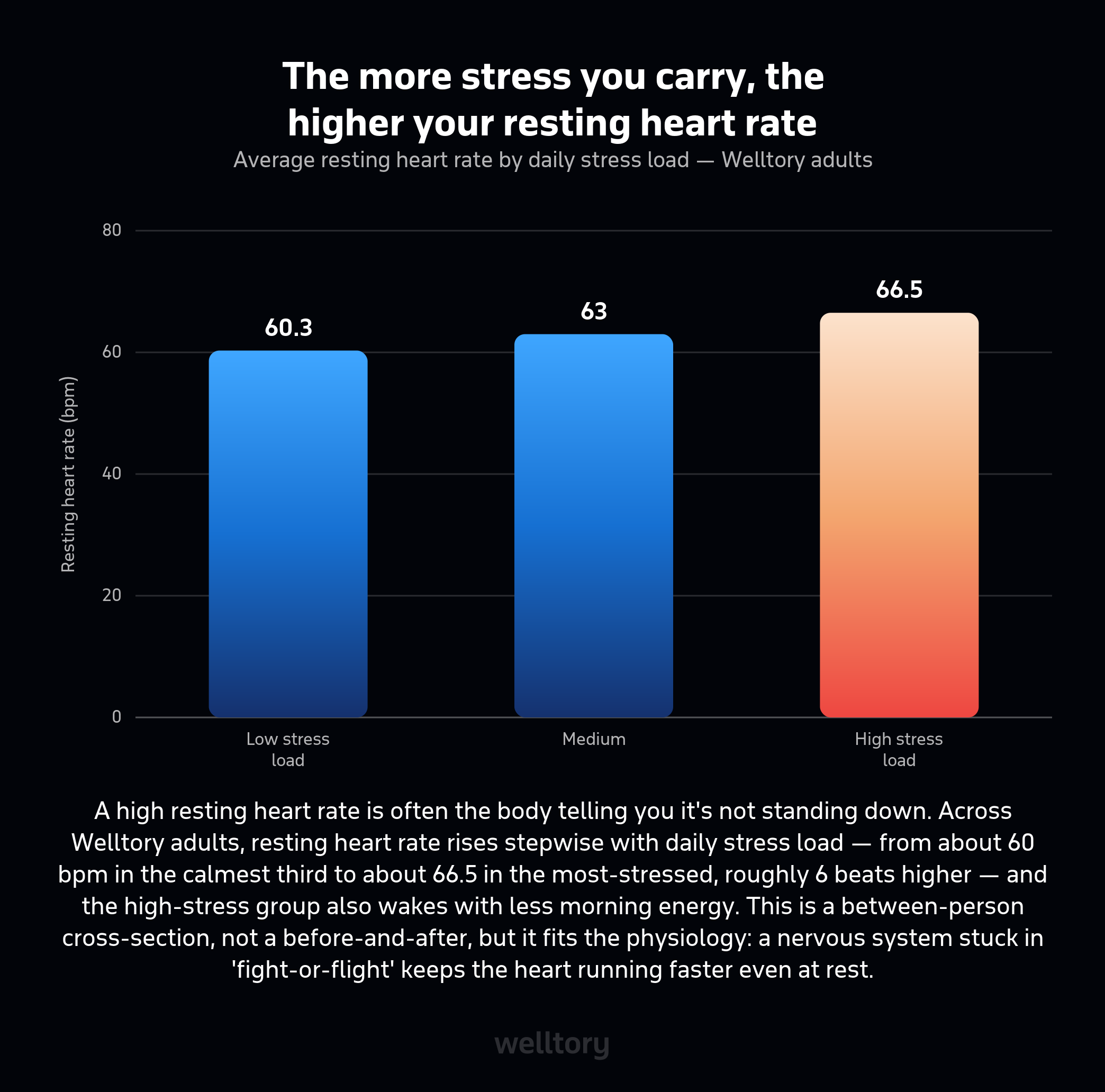
A note on the data: the chart below is aggregated, de-identified Welltory data — average resting heart rate across roughly 5,000 adults, grouped by how much daily stress they carry. It's a cross-section, not a before-and-after, but it lines up with the physiology: stress and a high resting heart rate travel together.
What our data shows: stress and resting heart rate rise together
The single most common driver of a nagging high resting heart rate is a nervous system that never fully stands down — and you can see it in the numbers. Across Welltory adults, resting heart rate climbs stepwise with daily stress load: the calmest third sit around 60 bpm, the middle around 63, and the most-stressed third around 66.5 — roughly 6 beats higher — while that high-stress group also wakes with noticeably less morning energy. Six beats may not sound dramatic, but it's the difference between a body that's recovering and one that's running warm around the clock, and it compounds: a heart that beats even a little faster all day, every day, is doing meaningfully more work over a year. The takeaway is hopeful, though — because so much of a high resting rate is driven by stress, sleep, and lifestyle, it's one of the more movable numbers in your body.
What counts as "high"?
Clinically, a resting heart rate over 100 bpm is called tachycardia, and below 100 is considered within the normal band. But that cutoff hides the more useful signal. A resting rate that sits in the high-normal range — say, consistently in the 80s or low 90s when it used to be in the 60s — can be worth looking at even though it's technically "normal," because the change from your baseline is what's informative. A single high number after caffeine, stress, heat, alcohol, illness, or a poor night is normal and passes. What matters is a sustained elevation: a resting rate that has climbed several beats above your usual and stayed there for a week or more, or one that's persistently above 100 without an obvious cause. In other words, judge it against your own steady baseline, not just the 100-bpm line.
The everyday causes — usually the answer
Most of the time, a high resting heart rate traces back to lifestyle, and these are the first things to check.
Stress and anxiety. This is the big one. Chronic stress and anxiety keep the sympathetic "fight-or-flight" system partly switched on all day, so the heart runs faster even when you're sitting still — exactly the pattern our data shows. A wired, always-on baseline is one of the most common reasons a resting rate sits high. (my.clevelandclinic.org)
Caffeine, alcohol, and nicotine. All three are stimulants to the cardiovascular system. Caffeine and nicotine directly speed the heart; alcohol raises it too, especially overnight and the morning after, which is why your resting rate often looks elevated after a few drinks. Some medications — including decongestants with pseudoephedrine and certain asthma and thyroid drugs — do the same. (goodrx.com)
Dehydration and heat. When you're low on fluids, blood volume drops, so the heart beats faster to keep circulation going. Heat adds to the load as the body works to cool itself — which is why resting heart rates often drift up in summer or after a sauna. Simply drinking enough water can bring a mildly high resting rate down.
Poor or short sleep. A run of bad nights keeps the nervous system activated and the resting heart rate up; it's one of the most common and most fixable causes. If your resting rate is stuck high, look at your recent sleep first.
Being out of shape (deconditioning). A less-fit heart pumps less blood per beat, so it has to beat more often to do the same job — the mirror image of why athletes run low. The good news is this reverses with regular aerobic exercise over weeks to months.
Recent big meals, pain, a full bladder, and simply having just moved. All can nudge a reading up temporarily — another reason to measure at true rest and read the trend, not a single number.
The medical causes worth ruling out
Less commonly, a persistently high resting heart rate is a sign of something that deserves a doctor's attention — and these are worth knowing because they're treatable.
Anemia. With fewer red blood cells to carry oxygen, the heart speeds up to compensate, so a high resting rate plus fatigue, paleness, or breathlessness can point to iron-deficiency or other anemia — checked with a simple blood count.
An overactive thyroid (hyperthyroidism). Too much thyroid hormone revs the heart's own pacemaker, so a fast resting rate — often with weight loss, heat intolerance, tremor, or anxiety — is a classic sign. It's diagnosed with a thyroid blood test, and it's very treatable. (We cover this in our guides to an overactive thyroid and how your thyroid shows up in your heart rate.)
Fever and infection. Illness raises resting heart rate — often one of the earliest signs you're coming down with something, sometimes a day before you feel sick. A short-lived rise with a cold or fever is expected and passes.
Arrhythmias. Conditions like atrial fibrillation or another abnormal rhythm can push the resting rate up, especially if it's fast and irregular or comes with palpitations, dizziness, or breathlessness — a reason to get an ECG. (See our guide to heart palpitations and arrhythmias.)
Overtraining. Ironically, too much hard training without enough recovery leaves the next morning's resting rate elevated — a useful early warning that you need a rest day rather than another hard session.
When to see a doctor
Use this simple rule: passing bumps are normal, sustained or symptomatic ones aren't. See a doctor if your resting heart rate is consistently over ~100 bpm without an obvious cause; if it's climbed well above your own baseline and stayed there for a week or more; or if a fast rate comes with palpitations, chest discomfort, shortness of breath, dizziness, or fainting. Also worth a check: a high resting rate alongside symptoms that suggest a treatable cause — unexplained fatigue and breathlessness (anemia), or weight loss, tremor, and heat intolerance (thyroid). None of this is cause for panic — most high resting rates are stress, sleep, and lifestyle — but a persistent or symptomatic one is exactly what a quick appointment is for.
How to bring a high resting heart rate down
The fixes follow directly from the causes, and most work over weeks rather than overnight.
Address stress first, since it's the most common driver: slow, paced breathing, genuine daily downtime, and anything that shifts you out of "go" mode lowers the resting rate that stress holds up. Even a few minutes of real downshift daily beats one big weekend reset.
Protect and regularize sleep — a run of good, consistent nights is one of the faster ways to see your resting rate come back down.
Cut back on caffeine, alcohol, and nicotine, especially later in the day, and stay well hydrated — these are among the quickest-acting levers.
Build aerobic fitness. Consistent cardio — brisk walking, running, cycling, swimming — strengthens the heart so it pumps more blood per beat and therefore beats less often at rest; this is the most durable way to lower your resting rate over the long run, and it's why fit people sit so low. You don't need punishing sessions, just regular ones. If you carry excess weight, losing some also reduces the heart's workload at rest and helps the number drift down.
Keep cool and rested in the heat, and treat a resting rate that jumps after hard training as a signal to take a recovery day.
And crucially: if your resting heart rate stays high despite all of this, don't just push harder — see a doctor to check for anemia, thyroid, or a rhythm issue. A number that won't come down with the usual fixes is itself useful information.
Is a high resting heart rate dangerous? The long-term picture
A single elevated reading isn't dangerous, and most high resting rates are benign, lifestyle-driven, and reversible. But the reason it's worth taking a persistently high resting rate seriously is what the long-term research shows. Across large populations, a higher resting heart rate is independently associated with higher risk over the years: in a meta-analysis of more than a million people, each 10-bpm-higher resting heart rate carried roughly a 9% higher risk of dying from any cause, with a similar bump in cardiovascular death. (cmaj.ca) That doesn't mean a resting rate of 80 is a diagnosis — it isn't — but it does mean the number is a genuine marker of cardiovascular and metabolic status, not a vanity metric. The encouraging flip side is that the same lower-it levers (fitness, sleep, less stress, less alcohol) are exactly the ones that improve that long-term picture. So bringing a high resting rate down isn't about hitting a target on a screen; it's a visible proxy for a heart that's under less strain.
A high resting heart rate at night or on waking
Two moments confuse people the most. First, on waking: if your very first reading of the day is high, the usual culprits are last night's alcohol, a poor or short sleep, late caffeine, a warm room, or brewing illness — the morning number is sensitive to all of them, which is also what makes it such a good early-warning signal. Second, your overnight or sleeping heart rate: many trackers report the low point reached in deep sleep, which normally sits a few beats below your daytime resting figure. If that overnight low is unusually high, or your heart rate stays elevated through the night instead of dipping, it often reflects alcohol, a late heavy meal, stress, a hot room, or a fever — and, less commonly, sleep-disordered breathing like sleep apnea, which repeatedly jolts the heart rate up in the night. A consistently high sleeping heart rate that you can't explain by the obvious causes is worth mentioning to a doctor, especially alongside loud snoring or unrefreshing sleep.
How Welltory helps you catch — and lower — a high resting heart rate
This is where tracking earns its place, because a high resting heart rate is most meaningful as a change from your own baseline, and that's exactly what a wearable is built to show. With Welltory you can watch your resting heart rate over weeks alongside your HRV, sleep, and stress, and the pattern tells the story: you'll see your resting rate tick up during stressful stretches, after drinking, on poor sleep, when you're getting sick, or when you're overtraining — often a day or two before you consciously feel run-down. Just as importantly, you can watch it come back down as you fix the cause: settle after a calmer week, drop as your fitness improves, ease when you protect your sleep. That turns a vague "why is my heart rate high?" into a concrete feedback loop — you can see which lever actually moves your number. Two honest caveats: wrist optical readings are estimates and single mornings are noisy, so read the weekly trend rather than reacting to one number, and a tracker can't diagnose — a persistently high or symptomatic rate belongs with a doctor. But for catching the drift early and confirming that your fixes are working, it's one of the most useful things it shows you. (For the opposite pattern — a very low number — see our guide to a low resting heart rate, and for the recovery side of the same coin, what your HRV measures.)


Discounts for blog readers: up to 36% off
See what affects your energy, stress, sleep, and daily state with Welltory
This article is for educational purposes only and is not medical advice. A resting heart rate that is persistently high, or one that comes with palpitations, chest pain, breathlessness, or fainting, needs a doctor's assessment. Welltory measures physiological signals like heart rate, HRV, sleep, activity, and stress; it does not diagnose anything.
Was this helpful?
Ask AI for a summary of page


Written by Jane Smorodnikova

The founder and CEO of Welltory. A recognized tech leader with two Master's degrees and experience at MIT, she has scaled Welltory to over 17 million users.
Written by Tatsiana Yashyna

Deputy COO at Welltory. With a background in medicine and years of working with health data, she translates research and real physiological signals — sleep, stress, heart rate, and hormones — into clear, evidence-based explanations that help people understand what their bodies are telling them.
Reviewed by Anna Elitzur
-2.jpg)
With her medical degree, Anna reviews Welltory's health content for medical accuracy and alignment with current clinical guidelines and research.
References
- Heart rate: normal rates and what raises it. Cleveland Clinic. https://my.clevelandclinic.org/health/diagnostics/heart-rate
- Reasons your resting heart rate is high (stress, caffeine, dehydration, anemia, thyroid, medications). GoodRx Health. https://www.goodrx.com/health-topic/heart/high-resting-heart-rate
- Heart rate: what's normal? (tachycardia; when a fast rate needs attention). Mayo Clinic. https://www.mayoclinic.org/healthy-lifestyle/fitness/expert-answers/heart-rate/faq-20057979
- Zhang D, et al. Resting heart rate and all-cause and cardiovascular mortality: a meta-analysis. CMAJ 2016. https://www.cmaj.ca/content/188/3/E53
- Welltory adult cohort (resting heart rate by daily stress load). Reproducible script: `persona_lab/scripts/rhr_by_stress.py`.

