

Short Answer
When couples think about preparing for pregnancy, the attention usually lands on the woman — but the biology says otherwise. Male factors are involved in about half of infertility cases, and a man's sperm takes roughly 75 days to be made, which means the sleep, stress, drinking, and habits of the next two-and-a-half months are quietly shaping the sperm that could father a pregnancy. The evidence is blunt: a single week of short sleep can drop testosterone by 10–15%, smoking and heavy drinking measurably damage sperm, and chronic stress works against the same hormones. None of this is about blame — it's about a window men actually control. This article covers what the science says, why fatherhood preparation matters as much as motherhood, and how tracking your own sleep and stress can help you use the 75 days. The medical steps — a semen analysis, a checkup — stay with your clinician.
Cohort Context: the levers are real, and they move
We don't know which Welltory users are planning a pregnancy, and nothing here is a fertility claim. But the habits guidelines flag for men — sleep and stress — are exactly what Welltory measures, and in men in our data they're strikingly visible:
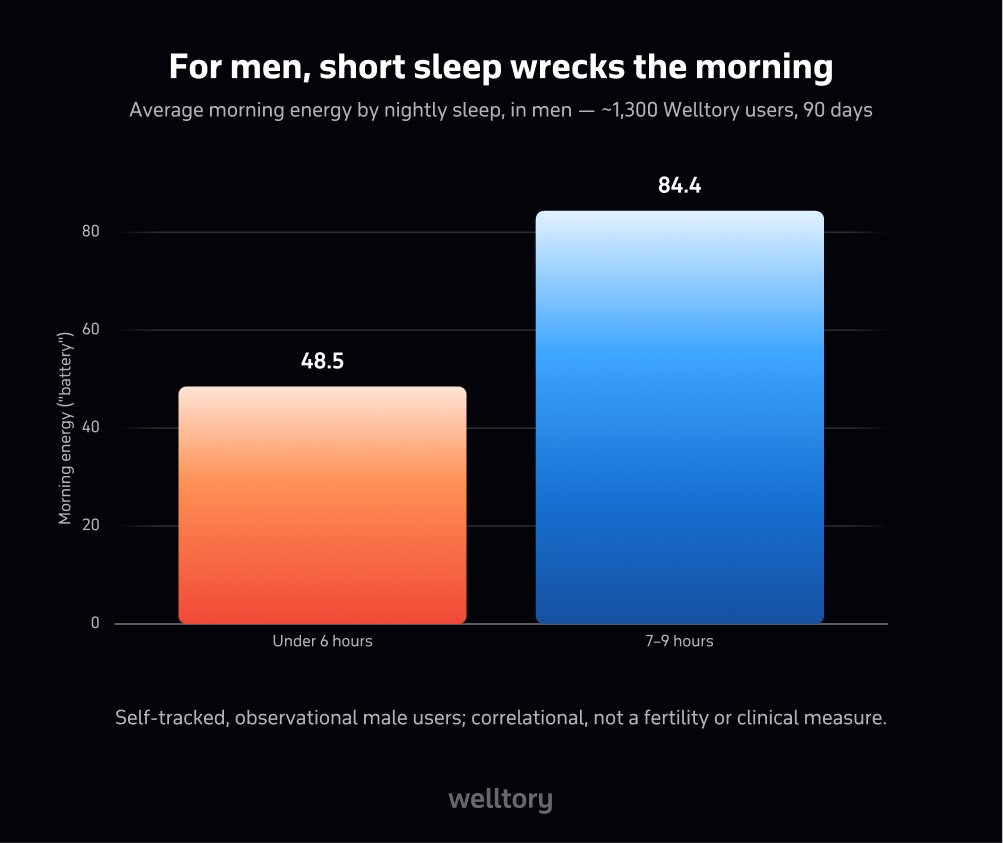
Short sleep tracked with a wrecked morning. Men who averaged under 6 hours of sleep had far lower morning energy than men sleeping 7–9 hours — roughly 49 vs 84 on Welltory's morning "battery" — and higher daily stress load (about 289 vs 268 stress-minutes). Sleep isn't a soft factor; it shows up hard in the data.
Stress load moved with practice. Men who regularly did a short calm/breathing measurement saw their stress load ease over three months, more than men who rarely did (about −13 vs −7 stress-minutes; roughly 221 vs 275 by the end).
These are general, self-tracked male users, not a preconception group, and the patterns are correlational — but they make the point: the levers guidelines name for men are measurable, and 75–90 days is enough to move them.
Why 75 days?
Sperm isn't sitting around waiting — it's constantly being manufactured, and the assembly line is long. Spermatogenesis takes about 74 days in the testes, followed by roughly two more weeks of maturation, so the full journey from "start" to ejaculation is close to 90 days. (pmc.ncbi.nlm.nih.gov) The practical consequence is simple and a little humbling: the lifestyle choices you make today won't show up in your sperm for two to three months. That's why "start now" beats "start when we're trying" — the sperm involved in a conception this autumn is being built this summer. Seventy-five days is the floor; three months is better. Either way, it's a real, controllable runway.
It takes two: fatherhood prep matters as much as motherhood
Here's the part the culture keeps getting wrong. Male factors contribute to roughly half of all infertility cases — yet preconception advice, testing, and lifestyle pressure still fall disproportionately on women. (academic.oup.com) A man's contribution isn't just "showing up"; sperm carries half the genetic material and is highly sensitive to lifestyle and oxidative stress during that final maturation window. Preparing as a father-to-be — sleeping better, drinking less, managing stress, getting a semen analysis if you're struggling — isn't optional support work. It's half the biology. Reframing preconception as a two-person project is one of the most useful things a couple can do.
Sleep: your testosterone runs on it
If you change one thing, make it sleep. In a controlled study, one week of sleeping about five hours a night lowered young men's daytime testosterone by 10–15% — an effect the researchers compared to aging 10 to 15 years. (sciencedaily.com) And it isn't only hormones: men reporting poor sleep quality have shown lower sperm concentration and reduced motility than good sleepers. (pmc.ncbi.nlm.nih.gov) Our own data echoes how physical this is — the men averaging under six hours ran dramatically lower morning energy and higher stress than those in the 7–9 hour range. The target isn't heroic; it's enough and regular: a consistent bedtime, 7–9 hours, and a wake time that doesn't lurch around on weekends.
Alcohol and smoking: how a "nightcap" breaks the wave
Two of the biggest, most modifiable hits are the ones men most normalize. Alcohol breaks the back half of your night. A drink may help you fall asleep, but as it clears, it suppresses REM sleep — the stage you get most of in the second half of the night — so you wake unrefreshed even after "enough" hours. (sleepfoundation.org) On top of that, heavy drinking hits sperm directly: chronic intake above roughly 50–60 g/day is consistently linked to reduced semen volume, concentration, motility, and morphology. (academic.oup.com)
Smoking is worse. In a systematic review, smokers were about 12 times more likely to have a low sperm count, and tobacco reduces semen volume, concentration, vitality, motility, and morphology — with passive smoke implicated too. (pmc.ncbi.nlm.nih.gov) Cutting back on both is the highest-leverage move of the 75 days: better sleep and better sperm from the same change.
Stress: the quiet drag on your hormones
Stress works against the same system. Chronically elevated stress and cortisol are associated with lower testosterone and poorer semen parameters, which is one reason a relentless, wired baseline is worth taking seriously in this window. (link.springer.com) The useful news is that stress is measurable and movable — and, as the research on breathing keeps showing, it's a skill of repetition, not a one-time reset. In our men's data, the ones who practiced a short calming routine regularly saw their stress load ease more than those who did it occasionally. You don't need a monastery; you need a few steady minutes most days — and if stress feels heavy or persistent, that's worth raising with a clinician too.
Movement: strong, not scorched
Regular moderate activity supports the hormones, weight, and metabolic health that underpin sperm production — the same roughly 150-minutes-a-week target that shows up across adult health guidance. The nuance for men in this window is avoiding the extremes that backfire: constant over-training without recovery adds physiological stress, and prolonged heat on the testes (very hot baths, saunas, a laptop parked on your lap) is worth easing off. Aim for consistent, strong, recovered — not maximal.
Track your baseline: make the 75 days legible
You can't manage what you can't see. Over a few weeks, learn your normal resting heart rate, HRV range, sleep duration, and how "wrecked" a bad week actually leaves you — then watch whether the 75-day window is moving in the right direction: sleep getting longer and steadier, stress load trending down, alcohol nights getting rarer. A wearable can't measure sperm or fertility, and it shouldn't pretend to — but it can show you whether the lifestyle levers the evidence points to are actually improving, which is exactly the part men usually fly blind on. Pair it with a semen analysis and your clinician's advice, and you've turned "get healthier" into something concrete.
A 75-day plan a guy will actually follow
Keep it blunt and repeatable. First, book the basics — if you're trying, a semen analysis is the real test, so get it on the calendar. Then pick the two levers with the most room, which for most men are sleep and drinking: protect a consistent 7–9 hours, and cut the weeknight alcohol that's quietly shredding your REM. Add a few minutes of a calming routine most days, keep movement regular but not punishing, and ease off the heat. Don't aim for a perfect week — aim for a steadier trend across the full 75–90 days, because that's the timeline your body is actually working on. Missed a day? It doesn't reset the clock. Direction beats perfection.
How to read your own preconception pattern
Watch trends, not single readings. Is your sleep getting longer and more regular? Is your morning energy climbing as the drinking drops? Is your stress load drifting down as a calming habit sticks? A tracker can't tell you anything about fertility — that's what a semen analysis and a clinician are for — but it can show whether the habits the evidence links to healthier sperm are genuinely improving across your window. That feedback is often the difference between "I'll get around to it" and actually doing it.


Discounts for blog readers: up to 36% off
See what affects your energy, stress, sleep, and daily state with Welltory
Two pieces alongside this: the testosterone myths worth dropping after 40, and the 90 days before conception, from the other side.
This article is for educational purposes only and is not medical advice, a fertility treatment, or a substitute for care from your doctor. If you're planning a pregnancy, a semen analysis and a preconception visit (GP, urologist, or fertility specialist) are the medical steps — talk to a clinician about testing, medications, and any health conditions. Welltory measures physiological signals like heart rate, HRV, sleep, and activity; it does not assess fertility or diagnose anything.
Was this helpful?
Ask AI for a summary of page


Written by Jane Smorodnikova

The founder and CEO of Welltory. A recognized tech leader with two Master's degrees and experience at MIT, she has scaled Welltory to over 17 million users.
Written by Tatsiana Yashyna

Deputy COO at Welltory. With a background in medicine and years of working with health data, she translates research and real physiological signals — sleep, stress, heart rate, and hormones — into clear, evidence-based explanations that help people understand what their bodies are telling them.
Reviewed by Anna Elitzur
-2.jpg)
With her medical degree, Anna reviews Welltory's health content for medical accuracy and alignment with current clinical guidelines and research.
References
- Spermatogenesis: The Commitment to Meiosis (duration ~74 days). PMC/NIH. https://pmc.ncbi.nlm.nih.gov/articles/PMC4698398/
- Tobacco and alcohol as factors for male infertility — a public health approach (male factor ~half; alcohol dose-effects). Journal of Public Health. https://academic.oup.com/jpubhealth/article/45/2/e241/6575627
- Leproult R, Van Cauter E. Effect of 1 week of sleep restriction on testosterone levels in young healthy men. JAMA. 2011;305(21):2173-2174. PMID 21632481. Full text: https://pmc.ncbi.nlm.nih.gov/articles/PMC4445839/
- Association of male sleep quality with semen parameters. PMC. https://www.ncbi.nlm.nih.gov/pmc/articles/PMC12487260/
- Alcohol and Sleep (REM suppression, second half of night). Sleep Foundation. https://www.sleepfoundation.org/nutrition/alcohol-and-sleep
- Tobacco smoking and semen quality: systematic review and meta-analysis (~12× oligozoospermia). PMC. https://www.ncbi.nlm.nih.gov/pmc/articles/PMC6325781/
- Biomarkers of Stress and Male Fertility (cortisol, testosterone, semen). Reproductive Sciences. https://link.springer.com/article/10.1007/s43032-022-00853-x
- Welltory men's cohort context (sleep duration, stress over 90 days). Reproducible script: `persona_lab/scripts/preconception_men_context.py`.

