

Short answer
Hormones and sleep form a two-way loop, and midlife strains both sides. Shifting estrogen and progesterone bring night sweats and 3 a.m. waking, while short sleep raises evening cortisol and can lower testosterone. In one survey, 56.6% of perimenopausal women reported insomnia symptoms lasting 6 months or more, and in a lab study a week of 5-hour nights cut young men's testosterone by 10–15%.
If your sleep fell apart somewhere in your 40s, you're not imagining it, and it's not a character flaw. Deep sleep genuinely thins with age, and for women the hormonal swings of perimenopause add hot flashes, night sweats and early waking on top. The same effort at bedtime simply buys less recovery than it did ten years ago. That is a change in the machinery, not in your discipline.
This article explains, in plain language, what each of the big midlife hormones — estrogen, progesterone, cortisol and testosterone — does to your sleep, and what sleep does back to them. It covers why perimenopause and menopause insomnia happen, what the research says actually helps (from CBT for insomnia to hormone therapy), when to see a doctor, and what our own data shows about short sleep and morning energy in women and men.
Does sleep affect hormones?
Yes, a lot. Many hormones are timed to your sleep, not just to the clock. Two examples matter most in midlife.
Testosterone rises during sleep. In men, testosterone levels peak during sleep and hit their low point in the late afternoon. That nightly rise depends on sleep itself rather than on the time of day, and it needs at least about 3 hours of sleep with normal structure. (doi.org)
Cortisol is switched down by sleep and switched up by waking. Cortisol is your main stress hormone. Its daily rhythm is set mainly by your body clock: low around bedtime, rising in the early morning to help you get up. Sleep adds its own layer on top. Falling asleep suppresses cortisol release, while waking up — including waking in the middle of the night — is followed by a cortisol pulse. (doi.org) So broken nights don't just leave you tired. They also nudge your stress system on at the wrong time.
Deep sleep and growth hormone go together. In a study of 149 healthy men, the amount of growth hormone released was tied to the amount of deep (slow-wave) sleep, independent of age. (doi.org)
The traffic runs the other way, too. Falling estrogen triggers hot flashes that wake you up, progesterone has a calming effect on the brain, and a stress system that's stuck "on" makes it harder to fall and stay asleep. That's why "is it my hormones or my sleep?" is often the wrong question. In midlife, they are usually the same loop.
Why is my sleep getting worse in my 40s?
Part of it is simple biology that happens to everyone. A meta-analysis of 65 studies covering 3,577 healthy people aged 5 to 102 found that in adults, total sleep time, sleep efficiency (the share of time in bed actually spent asleep), deep sleep and REM sleep all decrease with age, while time awake after first falling asleep increases. (doi.org)
The steepest drop in deep sleep happens earlier than most people expect. In the study of 149 healthy men, deep slow-wave sleep made up 18.9% of the night in men aged 16 to 25, but only 3.4% in men aged 36 to 50. It was replaced by lighter sleep. (doi.org) The same study found that evening cortisol creeps up with age — by about 19.3 nmol/L per decade — becoming noticeable after 50, around the same time sleep becomes more broken and REM sleep shrinks.
In other words, the same eight hours in bed now deliver less of the deep, restorative sleep your hormones depend on. You can't fully turn that clock back. You can stop making it worse and protect the quality you still have, which is where most of the practical wins are. We go deeper into this in how deep and REM sleep change after 40.
What causes perimenopause insomnia?
Perimenopause is the transition before your final period, usually starting in your 40s, when ovarian hormones swing up and down rather than falling smoothly. It is one of the most common times in a woman's life for sleep to fall apart.
In SWAN (the Study of Women's Health Across the Nation), a survey of 12,603 women aged 40 to 55, 38% reported difficulty sleeping in the past two weeks. The rate was highest in the late perimenopause (45.4%) and after surgical menopause (47.6%). Menopausal stage was linked to sleep difficulty independent of age and other factors. (doi.org) In a separate survey of 982 women aged 35 to 65, chronic insomnia was reported by 36.5% of premenopausal women, 56.6% of perimenopausal women and 50.7% of postmenopausal women. (doi.org)
The typical pattern is not trouble falling asleep but trouble staying asleep — waking at 2 or 3 a.m. and lying there. Night sweats and hot flashes are a key driver. (doi.org)
Timing within the cycle matters too. A SWAN daily-hormone study followed 630 women aged 43 to 53 across one menstrual cycle. Early perimenopausal women had 29% higher odds of reporting trouble sleeping than premenopausal women, and trouble sleeping was most common at the beginning and end of the cycle — around the period, when ovarian hormones are lowest. (doi.org) Hormone levels explained only part of it (in perimenopausal women, higher levels of a progesterone breakdown product were actually linked to more trouble sleeping), and mood and hot flashes were the strongest and most consistent contributors.
That is the key idea behind perimenopause sleep problems. It's not one number on a blood test. It's the swings, the heat, and the mood changes that come with them. Perimenopause also overlaps with a stressful stage of life — teenagers, ageing parents, peak work load — so it can be hard to tell hormones and stress apart. We look at that question directly in stress or perimenopause: what your HRV and sleep can tell you, and at the full symptom list in perimenopause: symptoms, stages and what's happening.
How does estrogen affect sleep?
The clearest way estrogen affects sleep in midlife is through hot flashes. As estrogen falls and fluctuates, many women start getting sudden waves of heat, sweating and a racing heart. When they happen at night, they're called night sweats.
They wake you up more often than you might think. In a sleep-lab study of 34 perimenopausal women (average age 50), women had an average of 3.5 measurable hot flashes per night. About 7 in 10 of them (69.4%) came with an awakening, and hot-flash-related waking added up to an average of 16.6 minutes a night — about 27% of all the time women spent awake. (doi.org) The women who found their hot flashes more bothersome also felt they were awake more.
This isn't a short phase for most women. In SWAN, among 1,449 women with frequent hot flashes or night sweats, the median total duration was 7.4 years, and they continued for a median of 4.5 years after the final period. Women whose symptoms started early, while still having regular or only slightly irregular periods, had the longest duration, more than 11.8 years. (doi.org)
Estrogen may matter for sleep in other ways too, although it is hard to separate from hot flashes. A 2023 review of reproductive hormones and sleep concluded that both the body's own estrogen and estrogen given as therapy, as well as progesterone, are linked to better sleep during the menopausal transition, and that hormone therapy markedly improves sleep complaints in this stage — though the authors note that part of this may come from fewer hot flashes and better mood. (doi.org) Night sweats can also feel a lot like a night-time anxiety attack. If you're not sure which one you're having, read night sweats: anxiety, hormones or heat?
Progesterone and sleep: the calming hormone that fades
Progesterone is often described as the "calming" hormone, and there is real biology behind that. When the body breaks progesterone down, one of its products acts on GABA receptors, the same brain system targeted by many sleeping pills and anti-anxiety drugs. In lab experiments on brain tissue, this metabolite behaved like a barbiturate-style calming agent at the GABA receptor. (doi.org)
That helps explain a familiar pattern. Across the menstrual cycle, sleep is most disrupted in the late luteal phase — the days before your period — when progesterone falls steeply. (doi.org)
A few small trials have tested progesterone as a sleep aid after menopause:
In a randomized, double-blind crossover study of 10 healthy postmenopausal women aged 54 to 70, a nightly dose of oral micronized progesterone for 21 days reduced time spent awake during the night, without affecting daytime thinking. (doi.org)
In a placebo-controlled trial of 8 healthy postmenopausal women aged 48 to 74 without sleep complaints or hot flashes, nightly progesterone for three weeks made no difference on an undisturbed night. But on a night disturbed by blood sampling, time awake after falling asleep was 53% lower and deep sleep almost 50% higher than on placebo. (doi.org) The authors suggested progesterone acts more like a "physiological regulator" that restores disturbed sleep than like a sleeping pill.
These studies are tiny, so treat them as promising, not proven. Progesterone is not an approved insomnia treatment on its own. In practice it usually comes up as part of hormone therapy: if you still have a uterus, estrogen therapy is paired with a progestogen to protect the uterine lining, and micronized progesterone is one option to discuss. (doi.org) This is a decision to make with your doctor, not a supplement to try on your own.
Menopause and sleep: what changes after your final period
Menopause is officially one year after your last period. For many women, hot flashes and broken sleep carry on well past that point — in the survey above, half of postmenopausal women (50.7%) reported chronic insomnia, and more than 80% of perimenopausal and postmenopausal women with severe hot flashes had insomnia symptoms. (doi.org)
A new problem also appears: sleep apnea. This is a condition where the airway repeatedly narrows or closes during sleep, causing breathing pauses, drops in oxygen and brief awakenings you may not remember. In the Wisconsin Sleep Cohort Study of 589 women, postmenopausal women had 3.5 times the odds of moderate-or-worse sleep apnea compared with premenopausal women, even after adjusting for age, body size and smoking. Perimenopause alone did not raise the odds significantly. (doi.org)
Put in everyday numbers, moderate-to-severe sleep apnea is estimated to affect about 3% of women aged 30 to 49 but 9% of women aged 50 to 70 — and 10% and 17% of men in the same age groups. (doi.org) In women it often looks less like the classic picture of loud snoring and daytime sleepiness and more like insomnia, and women with sleep apnea are more often underdiagnosed than men. (doi.org) That makes it easy to blame on "just menopause." If your nights are broken and you wake up unrefreshed, read could I have sleep apnea? the signs to know. For the broader picture of this stage, see our guide to menopause.
Cortisol and sleep: how does the stress hormone keep you up?
Cortisol and sleep push on each other in both directions.
Short sleep raises cortisol in the evening. In an early lab study, young men who had a night of partial or total sleep deprivation had 37% and 45% higher cortisol levels the following evening, and their cortisol took at least an hour longer to settle into its night-time low. (doi.org) In a classic study, 11 young men who spent six nights with only 4 hours in bed had higher evening cortisol, more activity in the "fight-or-flight" nervous system, and poorer blood sugar control than after recovery sleep. The authors noted the changes looked like those seen in normal ageing. (doi.org)
A more recent study tested just two nights of 4 hours in bed versus 10 hours in 13 healthy men. After short sleep, evening total cortisol rose by 30% and free cortisol in saliva by 200%, and the normal daily drop in cortisol was blunted by 21%. The men didn't feel more stressed — but they were hungrier, and the rise in appetite tracked the rise in cortisol. (doi.org)
High arousal keeps you awake. Chronic insomnia isn't only about losing sleep; it's also about a nervous system that won't switch off. In a sleep-lab study, 11 young adults with chronic insomnia had higher 24-hour ACTH and a trend toward higher cortisol than 13 good sleepers, with the biggest difference in the evening and the first half of the night. Those with the most broken sleep released the most cortisol. The authors described insomnia as a disorder of round-the-clock hyperarousal. (doi.org)
That is the "tired but wired" feeling many people know: exhausted all day, alert the moment the head hits the pillow. Remember too that every night-time awakening is followed by a cortisol pulse. (doi.org) So a night broken by hot flashes, a snoring partner or a full bladder is also a night of repeated small stress signals. We walk through how that plays out the next morning in night wakings and next-day stress.
One honest caveat: cortisol is not the villain of every bad night. In the week-long testosterone study below, daytime cortisol didn't change after sleep restriction. (doi.org) The effects of short sleep on cortisol show up mainly in the evening, and they are modest. They matter because they repeat night after night, not because a single bad night floods your body with stress hormones.
Does poor sleep lower testosterone?
It can, and midlife is when it matters most. The best-known study came from the University of Chicago. Ten healthy young men (average age 24) spent three nights with 10 hours in bed, then eight nights with 5 hours in bed in the lab. Their actual sleep fell from about 8 hours 55 minutes to 4 hours 48 minutes a night. After a week of this, their daytime testosterone was 10–15% lower, and their sense of vigor fell steadily. (doi.org) For comparison, the authors noted that normal ageing lowers testosterone by about 1–2% a year.
The picture from the wider research is more mixed, and it's worth knowing. A 2021 meta-analysis of 18 studies with 252 healthy men found that a full night or more of no sleep clearly lowered testosterone, but short-term partial sleep loss did not have a statistically significant effect overall. (doi.org) A 2014 review reached a similar conclusion: sleep disorders and poor sleep may lower testosterone, but the evidence for a direct effect independent of changes in binding proteins (SHBG) and other health problems is still uncertain. (doi.org)
What about sleep apnea? The same review found that sleep apnea doesn't seem to lower testosterone directly once age and weight are accounted for, and treating it with CPAP (a mask that keeps the airway open at night) doesn't reliably raise testosterone in most studies. Losing weight, on the other hand, raises testosterone predictably, in proportion to the weight lost. (doi.org) Sleep apnea is still worth treating for your heart, energy and mood — just don't expect CPAP alone to fix a low testosterone result.
So the fair summary for men is this: sleep is one real input to testosterone, especially when sleep is very short or severely disrupted. In older men, morning testosterone levels are partly predicted by how much they sleep. (doi.org) If you're chasing energy and drive with supplements while running on six hours a night, sleep is the cheaper place to start. For more on what does and doesn't lower testosterone, see testosterone after 40: myths and facts.
Testosterone matters for women's sleep too, though it gets far less attention. In a SWAN sleep study of 365 midlife women who had two nights of home sleep recordings, women with the lowest testosterone levels spent more time awake after first falling asleep than women with the highest levels. (doi.org) This is an association, not a reason to take testosterone for sleep, but it's a reminder that "hormones and sleep" is not only about estrogen.
What our data shows: short nights, flat mornings in women and men
Welltory can't measure your hormones. What it can see is sleep and how recovered your body looks the next morning — the morning energy score, a readiness reading. Across 5,061 users, averaged over 90 days (December 15, 2025 – March 14, 2026), the gap between short and adequate sleepers was large in both sexes.
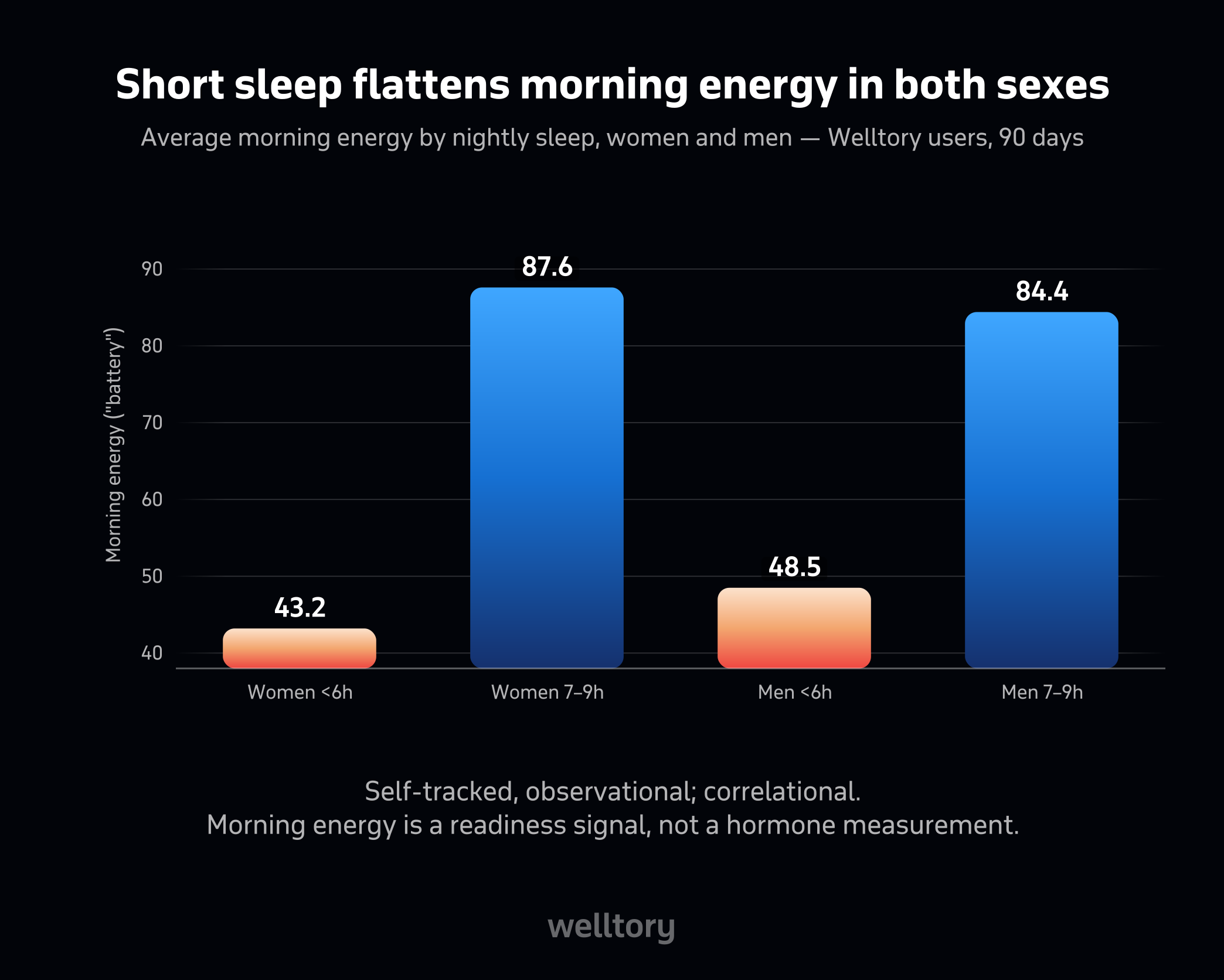
Women who averaged under 6 hours a night started the day with an average morning energy of 43.2, compared with 87.6 for women who averaged 7 to 9 hours. That means short sleepers had about half the morning reserve. For men, the numbers were 48.5 versus 84.4.
Two things stand out. First, the pattern is the same for women and men: short sleep and low morning energy go together. Second, the gap looked larger in women (43.2 vs 87.6) than in men (48.5 vs 84.4), though we did not test whether that difference is statistically meaningful.
We can't tell from this data why the gap is bigger in women. We don't know who in the dataset was perimenopausal, and morning energy is not a hormone test. The studies above suggest reasons short sleep might cost women more in midlife — night sweats, more awakenings, more time lying awake — but our data only shows the link, not the cause. What it does show is that the difference between averaging under 6 hours and averaging 7 to 9 hours is not a small one in how your body starts the day.
Is it perimenopause, or is it my sleep?
For women in their 40s and early 50s, this is often the most confusing question. Tiredness, low mood, irritability, brain fog, a racing heart and lower desire can all come from perimenopause — and all of them can also come from weeks of broken sleep, which perimenopause itself causes. Thyroid problems, low iron, depression and sleep apnea can look similar too.
A few clues help:
Timing with your cycle. Symptoms that cluster in the days before and during your period, or that started as your cycles became irregular, point toward hormones. (doi.org)
Heat at night. Waking hot, sweaty or with a pounding heart points toward night sweats rather than "just stress." (doi.org)
What happens on a good night. If a rare full night of sleep makes you feel largely like yourself again, sleep loss is doing a lot of the damage — whatever is causing it.
In practice, it's usually both, and improving sleep is one of the few levers that helps both sides at once. We sort through the look-alikes in perimenopause symptoms or something else?
What helps perimenopause and menopause insomnia?
The good news is that there are treatments with solid evidence, and they aren't limited to sleeping pills.
CBT for insomnia (CBT-I) is the first-line treatment. Cognitive behavioral therapy for insomnia is a structured, short program that retrains your sleep habits and the worries that keep you awake. It includes sleep restriction (temporarily matching time in bed to actual sleep), stimulus control (using the bed only for sleep), and working on unhelpful thoughts about sleep. The American College of Physicians recommends CBT-I as the initial treatment for all adults with chronic insomnia. (doi.org)
It works in midlife women specifically. In the MsFLASH trial, 106 perimenopausal and postmenopausal women aged 40 to 65 with insomnia and at least two hot flashes a day got six telephone sessions over 8 weeks of either CBT-I or menopause education. Insomnia scores fell by 9.9 points with CBT-I versus 4.7 points with education. At 8 weeks, 70% of the CBT-I group were in the no-insomnia range, compared with 24% of the education group — and at 24 weeks, 84% versus 43%. CBT-I didn't change how often hot flashes happened, but it made them interfere less with daily life. (doi.org) Our guide to perimenopause treatment puts CBT-I alongside the other options.
Hormone therapy is the most effective treatment for hot flashes. The Menopause Society (formerly The North American Menopause Society) states that hormone therapy remains the most effective treatment for hot flashes and night sweats. For women younger than 60 or within 10 years of menopause who have no contraindications, it considers the benefit-risk balance favorable for bothersome symptoms. (doi.org) In the KEEPS trial, recently menopausal women taking either oral estrogen or an estrogen skin patch (both with cyclic progesterone) improved their sleep quality scores about twice as much as women on placebo, and improvements tracked with fewer hot flashes and night sweats. (doi.org) Hormone therapy relieves sleep complaints best when hot flashes are part of the problem. (doi.org)
There are good non-hormone options too. For women who can't or don't want to use hormones — for example, after an estrogen-sensitive cancer — The Menopause Society's 2023 statement recommends, based on good evidence, cognitive behavioral therapy, clinical hypnosis, certain antidepressants (SSRIs and SNRIs), gabapentin and fezolinetant, a newer non-hormone drug that acts on the brain's temperature-control center (it requires liver blood tests; fda.gov). (doi.org) The same statement did not recommend herbal supplements, soy, paced breathing or cooling techniques as treatments for hot flashes, because the evidence isn't there. A cool bedroom can still make nights more comfortable; it just isn't a treatment on its own.
Progesterone may help sleep, based on the small trials above, and it is usually discussed as part of hormone therapy rather than on its own. (doi.org)
What protects the sleep your hormones run on
You can't reverse the age-related changes in sleep, but these habits protect the quality you have, for women and men alike.
Keep a regular sleep and wake time. Your cortisol rhythm is set mainly by your body clock, and big shifts in sleep timing disrupt it sharply. (doi.org) A consistent wake-up time, even after a bad night, is one of the core parts of CBT-I.
Move during the day. A meta-analysis of 66 studies found that regular exercise has small benefits for total sleep time and sleep efficiency and a moderate benefit for sleep quality. (doi.org) Exercise isn't a treatment for hot flashes, but it helps sleep in its own right.
Watch alcohol close to bed. Alcohol helps you fall asleep faster, but it causes more disruption in the second half of the night and, at moderate to high doses, reduces REM sleep. (doi.org) In midlife, when the second half of the night is already fragile, that trade-off gets worse.
Protect the "switch-off" window. Because insomnia is partly a state of hyperarousal (doi.org), a wind-down routine that lowers mental and physical arousal — dim light, no work email, a warm shower, a few minutes of slow breathing — helps more than trying harder to sleep.
Don't lie in bed fighting it. If you've been awake for what feels like 20 minutes, get up, do something calm in dim light, and go back when you feel sleepy. This is stimulus control, one of the parts of CBT-I tested in the MsFLASH trial. (doi.org)
Treat snoring and unrefreshing sleep as a reason to get checked. Sleep apnea becomes more common with age in both sexes and especially after menopause. (doi.org) (doi.org)
When to see a doctor about sleep and hormones
See a doctor if poor sleep has lasted more than a few weeks and is affecting your days. Long-lasting (chronic) insomnia deserves proper treatment rather than white-knuckling, and CBT-I is the recommended first step. (doi.org)
Some signs deserve attention sooner:
loud snoring, gasping or choking at night, pauses in breathing noticed by a partner, morning headaches, or dozing off while driving — possible sleep apnea;
hot flashes and night sweats that wake you most nights and wear you down;
new, very heavy or irregular bleeding, or any bleeding after menopause;
low mood, loss of interest in things you used to enjoy, or anxiety that doesn't lift (if you have thoughts of harming yourself, contact a crisis line or emergency services right away; in the US, call or text 988);
a racing or irregular heartbeat, chest pain or fainting — seek urgent care for chest pain or fainting;
in men, low energy, low desire and erectile problems together, which are worth a proper testosterone check;
sleep problems that started with a new medication.
How to bring this up with your doctor — and what to ask for
Say it plainly, and ask for the sleep question and the hormone question together. "My sleep has changed over the last year, and so have my energy, mood and libido. I'd like both looked at" describes the real situation. Split into two appointments, each half tends to get dismissed as the explanation for the other.
Bring context: two weeks of nights. Write down bedtime, wake time, how many times you woke, whether you woke hot or sweaty, alcohol, and where you are in your cycle. If you track, add night-time heart rate and HRV. A written pattern turns "my sleep is bad" into something a clinician can act on.
Ask these specifically.
For women: Where am I in the menopausal transition, and could my sleep problems be perimenopause? Would hormone therapy or a non-hormone option make sense for my night sweats? Can you refer me to CBT for insomnia? Ask where you are in the transition based on your symptoms and cycles, rather than relying on a single hormone test.
For men: Can we check my testosterone with a morning blood sample? It's highest in the morning, so an afternoon test can be misleading. (doi.org)
For everyone: Could this be sleep apnea, and should I have a sleep study? Should we check my thyroid, blood count and ferritin (iron stores), since these can cause similar symptoms? Could any of my medications be affecting my sleep?
If you are dismissed. "I understand sleep often gets worse at my age, but it's affecting my work and my health. Can we note it in my record and look at treatable causes?" Sleep apnea is easy to miss in midlife, especially in women, because it can look like insomnia rather than loud snoring. (doi.org) It's reasonable to ask for a referral to a sleep specialist. If you've also recently had a baby, sleep loss and hormone shifts stack up; see postpartum recovery after 35.
How Welltory helps
You can't see your hormones on a chart, but you can see the sleep that drives them — and how your body responds to it. That's where Welltory earns its place.
Welltory shows your sleep duration and quality, including how much deep sleep you're getting, alongside your resting heart rate and HRV during the night and your morning energy as a readout of whether your body actually recovered. It also tracks your stress load across the day, so you can see whether a string of short or broken nights lines up with a more reactive nervous system.
That lets you treat sleep like the hormonal lever it is. You can see whether a glass of wine at dinner is eating into your deep sleep, whether your recovery lifts after a week of consistent bedtimes, and whether flat mornings track with short nights. With My Patterns, you can add notes like "night sweats," "period day 1," "started HRT" or "CBT-I week 2," and over a few weeks see what tends to come before your worst nights and your best ones.
Welltory won't diagnose perimenopause, menopause, low testosterone or sleep apnea, and it doesn't measure hormones. But persistently unrefreshing sleep, a night-time heart rate that stays high, or HRV that keeps sliding are useful nudges to talk to a doctor — and a few weeks of data gives you and your clinician a timeline instead of a vague feeling.
How we made it
The clinical content rests on peer-reviewed research and clinical guidelines: sleep architecture across the lifespan (Ohayon et al. 2004; Van Cauter, Leproult & Plat 2000), sleep and the stress system (Leproult et al. 1997; Spiegel, Leproult & Van Cauter 1999; Vgontzas et al. 2001; Balbo, Leproult & Van Cauter 2010; Guyon et al. 2014), sleep and testosterone (Leproult & Van Cauter 2011; Wittert 2014; Su et al. 2021; Sowers et al. 2008; Penev 2007), sleep in the menopausal transition from SWAN and other cohorts (Kravitz et al. 2003, 2005; Ohayon 2006; Avis et al. 2015; Baker et al. 2018; Haufe & Leeners 2023), hot flashes and sleep (de Zambotti et al. 2014), sleep apnea (Young et al. 2003; Peppard et al. 2013), progesterone and GABA (Majewska et al. 1986; Schüssler et al. 2008; Caufriez et al. 2011), treatment trials and guidelines (McCurry et al. 2016; Cintron et al. 2018; Qaseem et al. 2016; The North American Menopause Society 2022, 2023; US Food and Drug Administration 2024), and sleep habits (Kredlow et al. 2015; Ebrahim et al. 2013).
The Welltory figures come from an aggregated, de-identified dataset of 5,061 users with sleep and morning-energy data, averaged per user over 90 days (December 15, 2025 – March 14, 2026). We compared people averaging under 6 hours of sleep with those averaging 7–9 hours, separately for women (357 and 1,842) and men (362 and 981). The data are observational and self-tracked. Morning energy is a readiness score, not a hormone measurement, and Welltory does not record menopausal status.


Discounts for blog readers: up to 36% off
See what affects your energy, stress, sleep, and daily state with Welltory
This article is for educational purposes only and is not medical advice. Persistent sleep problems or hormonal symptoms deserve a doctor's attention — including possible sleep apnea, thyroid issues, perimenopause, or low testosterone. Welltory measures physiological signals like heart rate, HRV, sleep, activity, and stress; it does not measure hormones.
Was this helpful?
Ask AI for a summary of page


Written by Jane Smorodnikova

The founder and CEO of Welltory. A recognized tech leader with two Master's degrees and experience at MIT, she has scaled Welltory to over 17 million users.
Written by Tatsiana Yashyna

Deputy COO at Welltory. With a background in medicine and years of working with health data, she translates research and real physiological signals — sleep, stress, heart rate, and hormones — into clear, evidence-based explanations that help people understand what their bodies are telling them.
Reviewed by Anna Elitzur
-2.jpg)
With her medical degree, Anna reviews Welltory's health content for medical accuracy and alignment with current clinical guidelines and research.
References
- Ohayon MM, Carskadon MA, Guilleminault C, Vitiello MV. Meta-analysis of quantitative sleep parameters from childhood to old age in healthy individuals: developing normative sleep values across the human lifespan. Sleep 2004;27(7):1255-1273. https://doi.org/10.1093/sleep/27.7.1255
- Van Cauter E, Leproult R, Plat L. Age-related changes in slow wave sleep and REM sleep and relationship with growth hormone and cortisol levels in healthy men. JAMA 2000;284(7):861-868. https://doi.org/10.1001/jama.284.7.861
- Wittert G. The relationship between sleep disorders and testosterone in men. Asian Journal of Andrology 2014;16(2):262-265. https://doi.org/10.4103/1008-682X.122586
- Balbo M, Leproult R, Van Cauter E. Impact of sleep and its disturbances on hypothalamo-pituitary-adrenal axis activity. International Journal of Endocrinology 2010;2010:759234. https://doi.org/10.1155/2010/759234
- Kravitz HM, Ganz PA, Bromberger J, Powell LH, Sutton-Tyrrell K, Meyer PM. Sleep difficulty in women at midlife: a community survey of sleep and the menopausal transition. Menopause 2003;10(1):19-28. https://doi.org/10.1097/00042192-200310010-00005
- Ohayon MM. Severe hot flashes are associated with chronic insomnia. Archives of Internal Medicine 2006;166(12):1262-1268. https://doi.org/10.1001/archinte.166.12.1262
- Baker FC, Lampio L, Saaresranta T, Polo-Kantola P. Sleep and sleep disorders in the menopausal transition. Sleep Medicine Clinics 2018;13(3):443-456. https://doi.org/10.1016/j.jsmc.2018.04.011
- Kravitz HM, Janssen I, Santoro N, et al. Relationship of day-to-day reproductive hormone levels to sleep in midlife women. Archives of Internal Medicine 2005;165(20):2370-2376. https://doi.org/10.1001/archinte.165.20.2370
- de Zambotti M, Colrain IM, Javitz HS, Baker FC. Magnitude of the impact of hot flashes on sleep in perimenopausal women. Fertility and Sterility 2014;102(6):1708-1715.e1. https://doi.org/10.1016/j.fertnstert.2014.08.016
- Avis NE, Crawford SL, Greendale G, et al. Duration of menopausal vasomotor symptoms over the menopause transition. JAMA Internal Medicine 2015;175(4):531-539. https://doi.org/10.1001/jamainternmed.2014.8063
- Haufe A, Leeners B. Sleep disturbances across a woman's lifespan: what is the role of reproductive hormones? Journal of the Endocrine Society 2023;7(5):bvad036. https://doi.org/10.1210/jendso/bvad036
- Majewska MD, Harrison NL, Schwartz RD, Barker JL, Paul SM. Steroid hormone metabolites are barbiturate-like modulators of the GABA receptor. Science 1986;232(4753):1004-1007. https://doi.org/10.1126/science.2422758
- Schüssler P, Kluge M, Yassouridis A, et al. Progesterone reduces wakefulness in sleep EEG and has no effect on cognition in healthy postmenopausal women. Psychoneuroendocrinology 2008;33(8):1124-1131. https://doi.org/10.1016/j.psyneuen.2008.05.013
- Caufriez A, Leproult R, L'Hermite-Balériaux M, Kerkhofs M, Copinschi G. Progesterone prevents sleep disturbances and modulates GH, TSH, and melatonin secretion in postmenopausal women. Journal of Clinical Endocrinology & Metabolism 2011;96(4):E614-E623. https://doi.org/10.1210/jc.2010-2558
- The 2022 Hormone Therapy Position Statement of The North American Menopause Society Advisory Panel. The 2022 hormone therapy position statement of The North American Menopause Society. Menopause 2022;29(7):767-794. https://doi.org/10.1097/GME.0000000000002028
- Young T, Finn L, Austin D, Peterson A. Menopausal status and sleep-disordered breathing in the Wisconsin Sleep Cohort Study. American Journal of Respiratory and Critical Care Medicine 2003;167(9):1181-1185. https://doi.org/10.1164/rccm.200209-1055OC
- Peppard PE, Young T, Barnet JH, Palta M, Hagen EW, Hla KM. Increased prevalence of sleep-disordered breathing in adults. American Journal of Epidemiology 2013;177(9):1006-1014. https://doi.org/10.1093/aje/kws342
- Leproult R, Copinschi G, Buxton O, Van Cauter E. Sleep loss results in an elevation of cortisol levels the next evening. Sleep 1997;20(10):865-870. https://doi.org/10.1093/sleep/20.10.865
- Spiegel K, Leproult R, Van Cauter E. Impact of sleep debt on metabolic and endocrine function. The Lancet 1999;354(9188):1435-1439. https://doi.org/10.1016/S0140-6736%2899%2901376-8
- Guyon A, Balbo M, Morselli LL, et al. Adverse effects of two nights of sleep restriction on the hypothalamic-pituitary-adrenal axis in healthy men. Journal of Clinical Endocrinology & Metabolism 2014;99(8):2861-2868. https://doi.org/10.1210/jc.2013-4254
- Vgontzas AN, Bixler EO, Lin HM, et al. Chronic insomnia is associated with nyctohemeral activation of the hypothalamic-pituitary-adrenal axis: clinical implications. Journal of Clinical Endocrinology & Metabolism 2001;86(8):3787-3794. https://doi.org/10.1210/jcem.86.8.7778
- Leproult R, Van Cauter E. Effect of 1 week of sleep restriction on testosterone levels in young healthy men. JAMA 2011;305(21):2173-2174. https://doi.org/10.1001/jama.2011.710
- Penev PD. Association between sleep and morning testosterone levels in older men. Sleep 2007;30(4):427-432. https://doi.org/10.1093/sleep/30.4.427
- Su L, Zhang SZ, Zhu J, Wu J, Jiao YZ. Effect of partial and total sleep deprivation on serum testosterone in healthy males: a systematic review and meta-analysis. Sleep Medicine 2021;88:267-273. https://doi.org/10.1016/j.sleep.2021.10.031
- Sowers MF, Zheng H, Kravitz HM, et al. Sex steroid hormone profiles are related to sleep measures from polysomnography and the Pittsburgh Sleep Quality Index. Sleep 2008;31(10):1339-1349. https://doi.org/10.5665/sleep/31.10.1339
- Qaseem A, Kansagara D, Forciea MA, Cooke M, Denberg TD; Clinical Guidelines Committee of the American College of Physicians. Management of chronic insomnia disorder in adults: a clinical practice guideline from the American College of Physicians. Annals of Internal Medicine 2016;165(2):125-133. https://doi.org/10.7326/M15-2175
- McCurry SM, Guthrie KA, Morin CM, et al. Telephone-based cognitive behavioral therapy for insomnia in perimenopausal and postmenopausal women with vasomotor symptoms: a MsFLASH randomized clinical trial. JAMA Internal Medicine 2016;176(7):913-920. https://doi.org/10.1001/jamainternmed.2016.1795
- Cintron D, Lahr BD, Bailey KR, et al. Effects of oral versus transdermal menopausal hormone treatments on self-reported sleep domains and their association with vasomotor symptoms in recently menopausal women enrolled in the Kronos Early Estrogen Prevention Study (KEEPS). Menopause 2018;25(2):145-153. https://doi.org/10.1097/GME.0000000000000971
- The 2023 Nonhormone Therapy Position Statement of The North American Menopause Society Advisory Panel. The 2023 nonhormone therapy position statement of The North American Menopause Society. Menopause 2023;30(6):573-590. https://doi.org/10.1097/GME.0000000000002200
- US Food and Drug Administration. FDA adds warning about rare occurrence of serious liver injury with use of Veozah (fezolinetant) for hot flashes due to menopause. Drug Safety Communication, September 12, 2024; updated December 16, 2024 (Boxed Warning). https://www.fda.gov/drugs/drug-safety-communications/fda-adds-warning-about-rare-occurrence-serious-liver-injury-use-veozah-fezolinetant-hot-flashes-due
- Kredlow MA, Capozzoli MC, Hearon BA, Calkins AW, Otto MW. The effects of physical activity on sleep: a meta-analytic review. Journal of Behavioral Medicine 2015;38(3):427-449. https://doi.org/10.1007/s10865-015-9617-6
- Ebrahim IO, Shapiro CM, Williams AJ, Fenwick PB. Alcohol and sleep I: effects on normal sleep. Alcoholism: Clinical and Experimental Research 2013;37(4):539-549. https://doi.org/10.1111/acer.12006
- Welltory. Sleep duration and morning energy by gender, per-user 90-day averages (15 Dec 2025 – 14 Mar 2026); women <6 h n = 357, 7–9 h n = 1,842; men <6 h n = 362, 7–9 h n = 981. Internal observational dataset.