
Night wakings and morning stress: why a broken night leaves you waking up wired — and how long it takes to settle
Wake up tense before anything has happened? A broken night leaves your body measurably more stressed the next morning — through cortisol and lost deep sleep. Here's the science, the Welltory data, and how fast it settles.

Short Answer
If you wake up after a broken night feeling tense, wired, and stressed before anything has even happened — that's not in your head, and it's not a coincidence. A poor night leaves your body in a measurably more stressed state the next morning. There are two reasons. First, every morning your body produces a cortisol surge to get you up and going — the cortisol awakening response — and sleep loss makes that stress machinery run hotter, because short or fragmented sleep keeps cortisol elevated and blunts the "off" signals that normally calm it. Second, the part of sleep that does the most to calm your nervous system — deep, slow-wave sleep — is exactly what gets sacrificed when your night is fragmented. During deep sleep your body shifts into "rest-and-digest" recovery; break the night up and you lose that recovery, so you surface already on edge. In our own Welltory data the pattern is clear: the adults who get the least deep sleep wake with the highest morning stress readings. The good news is that this reverses — and often faster than you'd think. Here's why it happens, and how long it takes to settle.
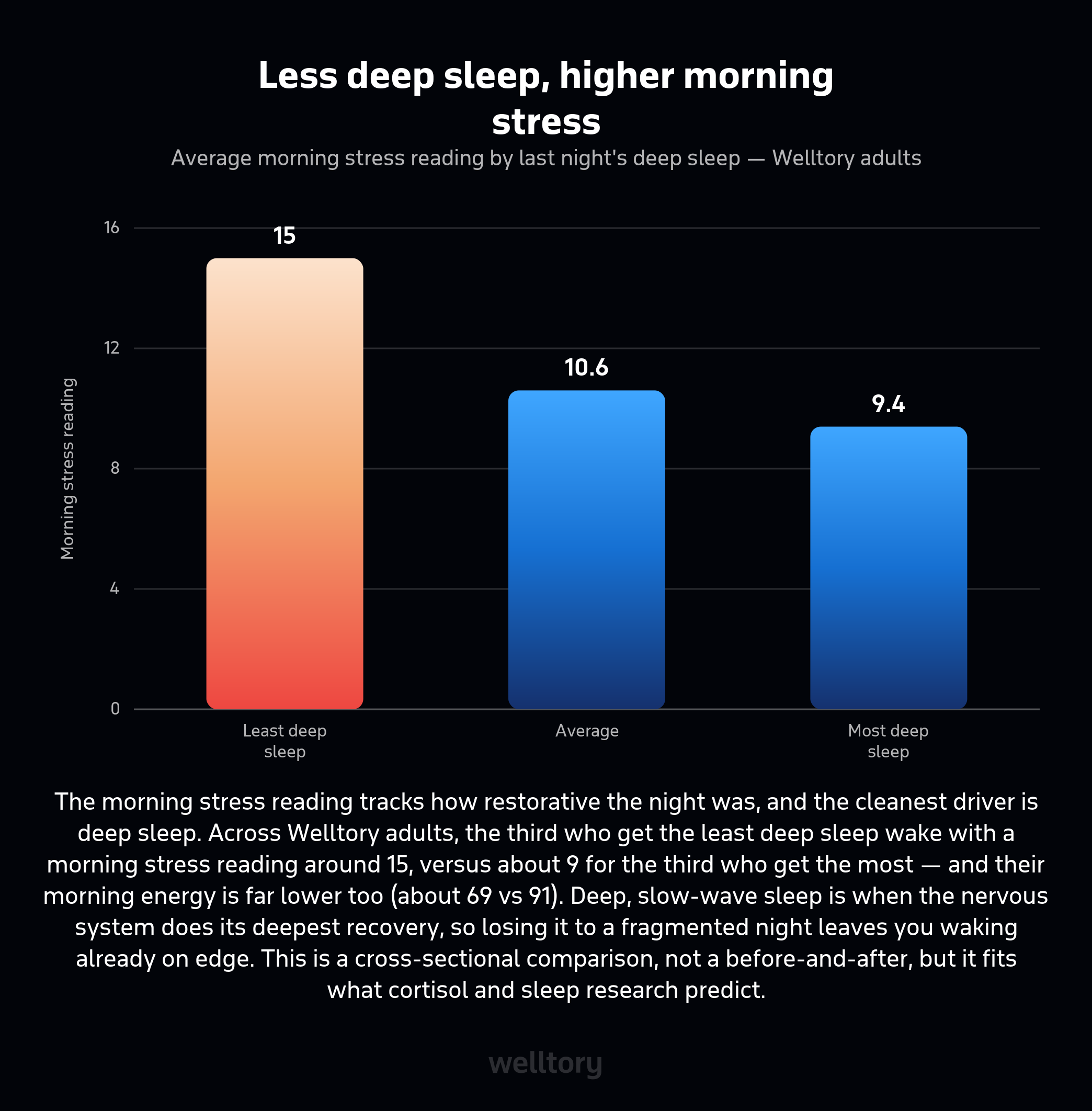
A note on the data: this one is grounded in our own numbers. Looking across Welltory adults, the morning stress reading tracks how restorative the night was — and the single cleanest driver is deep sleep. It's a between-person comparison, not a before-and-after, but it lines up exactly with what cortisol and sleep research predict.
Why mornings are a little stressful even at the best of times
Waking up is, physiologically, a small stress event by design. In the first 30–45 minutes after you wake, cortisol rises sharply — the cortisol awakening response — a built-in burst of the stress hormone that lifts you into the day, boosting arousal and energy. (endocrine.org) In a well-slept body, this surge is clean and brief: it peaks, does its job, and settles. The problem starts when you arrive at morning already depleted — because then this normal surge lands on top of a nervous system that never fully stood down overnight.
Why a broken night makes it worse
Poor sleep amplifies the morning stress state through both cortisol and your autonomic nervous system.
On the cortisol side, sleep loss keeps the stress axis switched on. After sleep deprivation, cortisol runs higher the next evening and the body is slower to shut cortisol production down, reflecting weakened "brakes" on the stress system. (academic.oup.com) So a rough night doesn't just make you tired — it leaves your stress hormones dysregulated into the following day.
On the nervous system side, the issue is what kind of sleep you lost. Deep, slow-wave sleep is when your parasympathetic "rest-and-digest" branch dominates and your heart-rate variability (a marker of recovery) is highest — it's your body's deepest nightly recovery. But repeated awakenings prevent you from settling into those deep, parasympathetic-dominant stretches, so HRV stays suppressed and the recovery never fully happens. (pmc.ncbi.nlm.nih.gov) You wake up not having recovered — which your body registers as stress.
What our data shows
Because Welltory takes a morning physiological stress reading and measures your sleep stages, we can see this link directly. Across our adult users, the morning stress reading falls steeply as deep sleep rises: the third who get the least deep sleep wake with a morning stress reading around 15, versus about 9 for the third who get the most — and their morning energy is far lower too (about 69 vs 91). The same direction shows up for time spent lying awake: the more minutes you're awake in the night, the higher your morning stress reading tends to run. And overall sleep quality tells the starkest version — the poorest sleepers average a morning stress reading roughly double the best sleepers'. None of this is a controlled before-and-after, and a morning reading has many inputs — but it's a consistent, dose-responsive fingerprint of the same thing the science describes: lose the deep, unbroken sleep, and you wake up stressed.
How long until it settles?
This is the reassuring part, and it depends on whether you're recovering from one bad night or a long stretch of them:
One rough night. Your body is remarkably good at bouncing back from a single broken night. It actually prioritizes deep sleep on the very next night — a rebound effect — so morning stress from one bad night typically resets within a night or two of decent sleep. One night of poor sleep is not a crisis.
A stretch of broken nights. Accumulated "sleep debt" doesn't get repaid by a single weekend lie-in. If your sleep has been fragmented for weeks — stress, a new baby, a bad habit, a disrupted schedule — it generally takes one to two weeks of consistent, protected, unbroken sleep for your deep sleep to rebuild and your morning stress to settle back down. Because deep sleep is what rebounds first, the good news is you often feel the morning edge ease after just a few solid nights, well before everything is fully back to baseline.
When to look deeper. If broken nights persist despite good sleep habits — especially with loud snoring, gasping, or unrefreshing sleep no matter how long you're in bed — that's worth a doctor's look, since conditions like sleep apnea fragment sleep and keep morning stress high until they're addressed.
How Welltory helps
This is a place where seeing your own numbers changes the story from "I'm just an anxious morning person" to "my nights are broken, and that's fixable." Track your deep sleep and awakenings alongside your morning stress reading, HRV, and energy, and you'll likely see the connection described above — that your most-fragmented nights are followed by your most-wired mornings. Then use it to find what actually restores your sleep: test an earlier, consistent bedtime, a cooler dark room, a screen cutoff, less late alcohol or caffeine, and watch your deep sleep rebuild and your morning stress ease over the following week or two. It turns vague advice into a personal experiment with visible feedback. Two honest caveats: sleep-stage estimates and morning readings are noisy night to night, so read the trend across a week rather than reacting to a single morning, and a tracker can't diagnose a sleep disorder — persistent broken sleep deserves a doctor. But for understanding why your mornings feel the way they do, and for watching them get better, it's exactly the right mirror.


Discounts for blog readers: up to 36% off
See what affects your energy, stress, sleep, and daily state with Welltory
This article is for educational purposes only and is not medical advice. If night waking is frequent or exhausting, or you suspect a sleep disorder, talk to a doctor. Welltory measures physiological signals like heart rate, HRV, sleep, activity, and stress; it does not diagnose anything.
Was this helpful?
Ask AI for a summary of page


Written by Jane Smorodnikova

The founder and CEO of Welltory. A recognized tech leader with two Master's degrees and experience at MIT, she has scaled Welltory to over 17 million users.
Written by Tatsiana Yashyna

Deputy COO at Welltory. With a background in medicine and years of working with health data, she translates research and real physiological signals — sleep, stress, heart rate, and hormones — into clear, evidence-based explanations that help people understand what their bodies are telling them.
Reviewed by Anna Elitzur
-2.jpg)
With her medical degree, Anna reviews Welltory's health content for medical accuracy and alignment with current clinical guidelines and research.
References
- The Cortisol Awakening Response. Endocrine Society / Endocrine Reviews. https://www.endocrine.org/journals/endocrine-reviews/the-cortisol-awakening-response
- Leproult R, et al. Sleep loss results in an elevation of cortisol levels the next evening. SLEEP 1997. https://academic.oup.com/sleep/article-pdf/20/10/865/8564977/sleep-20-10-865.pdf
- Heart rate variability during slow-wave sleep is linked to functional connectivity in the central autonomic network. Brain Communications 2023. https://pmc.ncbi.nlm.nih.gov/articles/PMC10208252/
- Impact of Sleep and Its Disturbances on Hypothalamo-Pituitary-Adrenal Axis Activity. International Journal of Endocrinology 2010. https://onlinelibrary.wiley.com/doi/10.1155/2010/759234