

Short Answer
As you move past 40, you don't just sleep a little less — you lose a disproportionate share of your most valuable sleep. Deep (slow-wave) sleep and REM (dreaming) sleep both shrink with age, while lighter sleep and nighttime awakenings increase. That matters because these aren't interchangeable hours: deep sleep is when the body does much of its physical repair and hormonal reset, and REM is when the brain consolidates memory and processes emotion. Losing them helps explain why midlife sleep can feel less restorative even when the hours look "fine," and why mood, focus, and recovery take a hit. You can't fully stop the age-related decline, but you can protect the quality sleep you have — and the habits that do so are concrete. This article covers what changes, why deep and REM sleep matter, what quietly steals more of them, how tracking helps, and what genuinely protects them.
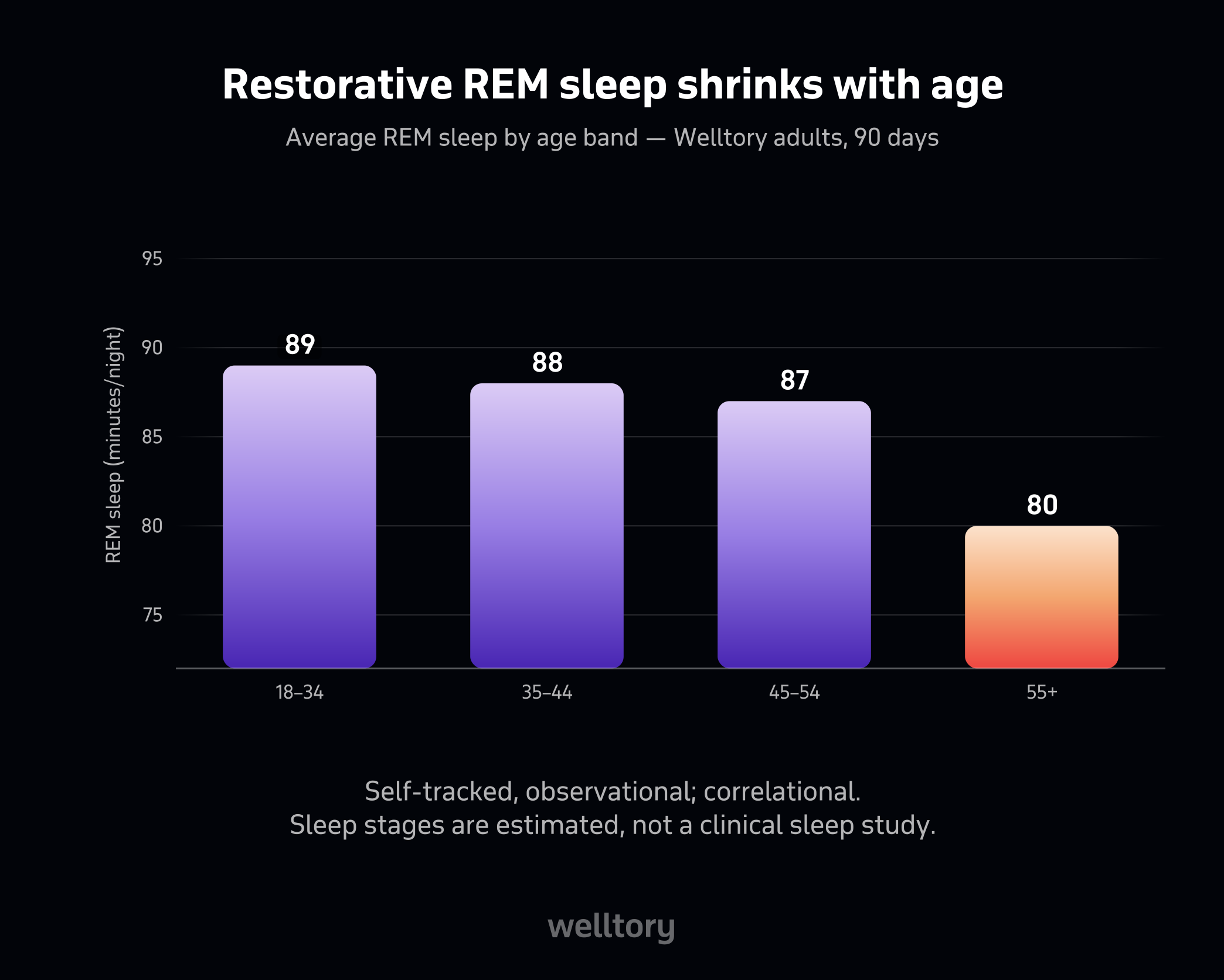
What our data shows: REM sleep shrinks with age
Welltory's sleep-stage estimates are approximate, but the age pattern is clear and matches the science. Across our users, average REM sleep declined with age — holding fairly steady through the earlier decades and then dropping in the oldest group (from roughly 89 minutes a night to about 80). In other words, the same seven or eight hours in bed deliver less of the restorative, dreaming sleep your brain and body rely on — which is part of why sleep can feel less refreshing after 40 even when the total looks unchanged, and why "I slept eight hours but still feel foggy" is a real, physiological complaint.
What's actually changing
The shift is well-documented. A meta-analysis spanning childhood to old age found that in adults, total sleep time, sleep efficiency, deep (slow-wave) sleep, and REM sleep all decline with age, while time awake after falling asleep and lighter sleep stages increase. (academic.oup.com) So the problem isn't only shorter sleep — it's a change in architecture: more fragmented, lighter nights and less of the two stages that do the heaviest lifting. Interestingly, much of the deep-sleep decline happens earlier in adulthood, while continued erosion of sleep efficiency keeps going with age — so protecting quality becomes a lifelong project, not a one-time fix.
Why deep and REM sleep matter
These stages aren't optional — they each run a specific overnight maintenance job, which is exactly why losing them is felt so clearly.
Deep (slow-wave) sleep is the body's repair and cleanup shift. It's when growth hormone is released to drive tissue repair, muscle recovery, and bone maintenance; when cortisol sits at its lowest; and when the immune system consolidates. It's also when the brain's glymphatic system switches on and flushes metabolic waste — including the amyloid-beta protein linked to Alzheimer's — most efficiently, which is one reason deep sleep is increasingly tied to long-term brain health. (frontiersin.org) Lose deep sleep and you blunt physical recovery, hormonal restoration, immune function, and overnight brain "housekeeping" all at once.
REM (dreaming) sleep is the brain's filing and emotional-processing shift — when memories are consolidated into durable knowledge and the emotional charge of the day is dialed down. That's why poor REM shows up as foggy thinking, worse memory, and a shorter emotional fuse. When both stages shrink, you can be "in bed eight hours" and still wake under-recovered — the hours were there, the restorative quality wasn't. That mismatch is the core of the midlife sleep complaint, and it compounds quietly: the same night that used to repair you now does a little less of every one of these jobs.
What quietly steals more of it
Age sets the baseline, but several everyday things make midlife REM and deep sleep worse than they need to be. Alcohol is a big one — it suppresses REM, especially in the second half of the night, so a nightcap leaves you unrefreshed even after "enough" hours. Irregular schedules and late screens and light fragment sleep and delay your body clock. Untreated sleep apnea — more common with age and often undiagnosed — repeatedly pulls you out of deep and REM sleep, which is why it's such a common hidden cause of "I sleep but I'm exhausted." And chronic stress keeps the nervous system too activated to sink fully into slow-wave sleep. These are the levers most within your control — and the most rewarding to fix.
Two related pieces: how midlife hormones and sleep pull on each other, and what repeated night wakings cost you.
How Welltory helps you protect it
Sleep-stage estimates from a wearable aren't a lab sleep study, but they're genuinely useful for tracking your own trends — and that's where Welltory helps. You can watch your deep and REM sleep, total sleep, and sleep consistency over time and connect them to what you do: see how a couple of drinks flattens your REM, how a regular bedtime deepens your sleep, how a stressful week fragments it. That feedback loop turns "why am I so tired lately?" into something you can act on, and — importantly — helps you catch a red flag. If your sleep looks persistently fragmented or unrefreshing, or you snore loudly, that's a clear nudge to screen for sleep apnea with a doctor, rather than writing it off as "just getting older." The data can't diagnose, but it can point you to the right question.
How to protect the sleep you have
You can't restore a 25-year-old's sleep architecture, but you can defend your quality. Keep a consistent sleep and wake time — your body clock rewards regularity. Get morning daylight and stay active, both of which deepen sleep. Keep evenings dimmer, cooler, and screen-light-lower, and cut alcohol close to bedtime to protect the back half of the night. And take loud snoring, gasping, or persistent unrefreshing sleep seriously — screening for sleep apnea is one of the highest-impact things you can do for midlife sleep. Small, steady habits protect the deep and REM sleep your brain and body still need.


Discounts for blog readers: up to 36% off
See what affects your energy, stress, sleep, and daily state with Welltory
This article is for educational purposes only and is not medical advice. Persistent unrefreshing sleep, loud snoring, or daytime sleepiness can signal a sleep disorder like sleep apnea and deserve a doctor's attention. Welltory measures physiological signals like heart rate, HRV, sleep, activity, and stress; sleep-stage estimates are approximate and not a clinical sleep study.
Was this helpful?
Ask AI for a summary of page


Written by Jane Smorodnikova

The founder and CEO of Welltory. A recognized tech leader with two Master's degrees and experience at MIT, she has scaled Welltory to over 17 million users.
Written by Tatsiana Yashyna

Deputy COO at Welltory. With a background in medicine and years of working with health data, she translates research and real physiological signals — sleep, stress, heart rate, and hormones — into clear, evidence-based explanations that help people understand what their bodies are telling them.
Reviewed by Anna Elitzur
-2.jpg)
With her medical degree, Anna reviews Welltory's health content for medical accuracy and alignment with current clinical guidelines and research.
References
- Ohayon MM et al. Meta-analysis of quantitative sleep parameters across the lifespan (deep and REM sleep decline with age). SLEEP. 2004. https://academic.oup.com/sleep/article/27/7/1255/2696819
- From macro to micro: slow-wave sleep and its pivotal health implications (glymphatic clearance, growth hormone, immune, memory). Frontiers in Sleep 2024. https://www.frontiersin.org/journals/sleep/articles/10.3389/frsle.2024.1322995/full
- Welltory adult cohort context (REM sleep by age band). Reproducible script: `persona_lab/scripts/midlife_age_bands.py`.
- Voss A et al. Short-term heart rate variability — influence of gender and age in healthy subjects (KORA S4, n=1906; autonomic changes that accompany the same decades in which deep sleep shrinks). PLoS ONE, 2015. PMID 25822720. https://journals.plos.org/plosone/article?id=10.1371/journal.pone.0118308
- Regulation and functional correlates of slow wave sleep. Journal of Clinical Sleep Medicine. https://link.springer.com/article/10.5664/jcsm.52s.S6


