

Short Answer
Fatigue, broken sleep, irritability, brain fog, a shorter fuse for stress, a flatter mood, waning desire — in your 40s, these can be burnout, perimenopause, or (very often) both at once. That overlap is exactly why they're so easy to confuse, and why no wearable can tell them apart: in the body they push the same levers — a nervous system tilted toward "fight-or-flight," disrupted sleep, and lower heart-rate variability (HRV). The single most useful distinguishing clue isn't a number on a tracker at all — it's your menstrual cycle: changes in cycle length and regularity are the defining marker of perimenopause, while stress alone doesn't reorganize your cycle the same way. What your data can do is show the severity and trend over months, flag cycle-linked swings, and turn "I just feel off" into concrete evidence for a doctor. What it can't do is diagnose — and because look-alikes like thyroid disease and iron-deficiency anemia are common and treatable, that clinical conversation genuinely matters. This article maps what overlaps, the cycle-based clues that point one way or the other, the conditions a good workup rules out, and how to get a real answer instead of guessing.
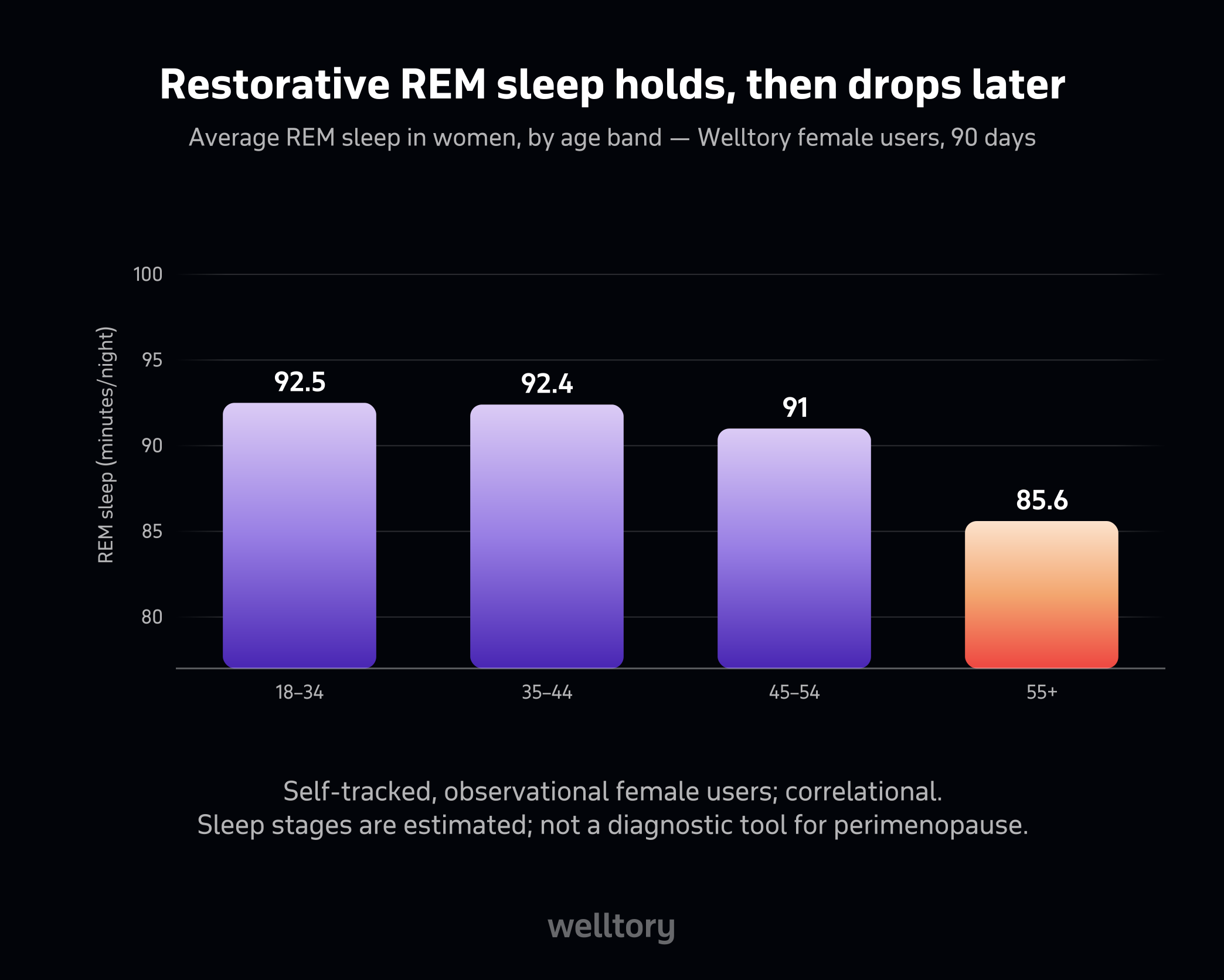
A note on the data: Welltory can't diagnose anything, but the physiological drift of the midlife years is visible in aggregate. Among women in our data, average REM sleep holds fairly steady through the 40s and then drops in the 55+ group, while HRV eases down and stress load rises with age. The changes are gradual and overlapping — which is the whole point: your data shows a trend, not a verdict, and the trend alone can't separate "stress" from "hormones."
Worth saying before the differences: if you feel like a different person than you were three years ago and no one has been able to tell you why, you are not imagining the change and you are not failing to cope with an ordinary life. Stress and perimenopause produce overlapping symptoms, both are real, and the fact that they are hard to tell apart is a genuine clinical difficulty — not a sign that the problem is in your head.
Why stress and perimenopause feel identical
Perimenopause is the multi-year window of fluctuating hormones before your final period, and it shares a striking amount of biology with chronic stress. The key word is fluctuating: in perimenopause estrogen doesn't glide smoothly downward, it swings unpredictably — up and down, sometimes within weeks — and those swings ripple straight into the systems that stress also hits. Falling and fluctuating estrogen shifts the autonomic nervous system toward higher sympathetic ("fight-or-flight") tone and reduced HRV — the very same direction chronic stress pushes it. (journals.lww.com) Both disrupt sleep, both raise stress sensitivity, both flatten mood and energy, and both can lower HRV.
So a wearable reading "low HRV, poor sleep, high stress load" genuinely cannot say whether the driver is your calendar or your hormones. And honestly, it's frequently both — perimenopause makes you less stress-resilient, while a demanding life amplifies perimenopausal symptoms, each feeding the other. That's not a measurement failure; it's the biology. Which is why the way to tell them apart isn't a better sensor — it's the pattern of your cycle and symptoms over time.
What our data shows about the midlife years
Welltory can't diagnose anything, but the physiological drift of midlife is visible in aggregate — and it illustrates exactly why the trend alone can't settle the question. Among women in our data, average REM sleep holds fairly steady through the 40s and then steps down in the 55+ group, while HRV eases lower and daily stress load rises with age. The shifts are gradual and overlapping, not a clean break — the same muted, slow drift you'd expect from either accumulating stress or the hormonal transition. That's the honest limit of the numbers: they show the direction your body is moving, which is genuinely useful for spotting a real trend versus a bad month, but they can't label the cause. The label comes from your cycle pattern and a clinician, not from the curve.
The clues that lean one way or the other
No single symptom settles it, but the pattern shifts the odds. Here's how the common complaints tend to sort:
| Clue | Leans toward perimenopause | Leans toward stress/burnout |
|---|---|---|
| Menstrual cycle | Cycle length varies by ≥7 days, gets irregular, skips, or changes flow — the hallmark sign | Cycle usually stays regular (stress can delay a period, but not reorganize the pattern for months) |
| Hot flashes / night sweats | Present, especially waking you at night — fairly specific to the hormonal transition | Absent (night sweats from pure stress are less typical) |
| Timing of symptoms | Ride along with the cycle; worsen over months to years | Track your workload, deadlines, and life events; ease on a real holiday |
| Response to rest | A relaxing week helps mood and energy but doesn't stop flashes or restore the cycle | Symptoms genuinely lift with sustained rest and lower demands |
| Vaginal dryness, new joint aches | Common in the transition | Not typical of stress alone |
| Fatigue, brain fog, low mood, poor sleep, low HRV | Yes — but non-specific | Yes — equally non-specific (this is the overlap zone) |
The takeaway: cycle changes and vasomotor symptoms (hot flashes/night sweats) are the closest thing to a fingerprint for perimenopause, whereas symptoms that rise and fall with your workload — and lift on holiday — point toward stress. When both are present, it's likely both.
What perimenopause actually is (so you know the timeline)
Clinicians stage the menopause transition with a framework called STRAW+10. Perimenopause usually begins in the mid-40s and lasts about 4–8 years, and it has two stages. In the early transition, the defining sign is a variable cycle — a difference of 7 or more days between consecutive cycles. In the late transition (typically 1–3 years), cycles stretch out, with stretches of 60+ days without a period; this is when hot flashes and night sweats are most common. (pharmaceutical-journal.com) Knowing the timeline is itself reassuring: perimenopause is a phase with a beginning and an end, not a permanent new normal — and its symptoms are treatable while you're in it.
This is also why the cycle is the anchor clue. Estrogen fluctuation is invisible; a shifting cycle is something you can actually track, and it's the criterion clinicians themselves lean on most for women over 45.
The sleep piece — why perimenopause wrecks nights specifically
Poor sleep is where stress and perimenopause overlap most, but perimenopause has a mechanism of its own: nighttime hot flashes. Sleep-lab research is blunt about it — in one study, about 70% of nighttime hot flashes woke women up, fragmenting sleep measured directly by brain-activity sensors, and experimental work has shown that nocturnal flashes interrupt objectively-measured sleep. (swhr.org) Around a quarter of women report severe sleep symptoms during the transition. So if you're waking drenched at 3 a.m. and can't get back down, that's a pattern pointing more toward hormones than a stressful week — and it's exactly the kind of nighttime signature a tracker can help you notice and time.
The look-alikes a good workup must rule out
This is the part that makes the "just track it and assume menopause" approach risky. Every classic perimenopause symptom — fatigue, brain fog, mood swings, weight change, poor sleep, hair changes — also appears in hypothyroidism, iron-deficiency anemia, vitamin-D deficiency, depression, and chronic stress. Perimenopause doesn't protect you from any of them, and they frequently coexist. (globalrph.com) Treating a low-HRV, bad-sleep stretch as "definitely menopause" can miss a thyroid problem or anemia that's genuinely treatable.
One counterintuitive point worth knowing before you ask for tests: for typical perimenopause at age 45+, a single FSH or estradiol blood test is usually unhelpful and can mislead, because those hormones rise, fall, and contradict each other within weeks — one draw can falsely reassure or needlessly alarm. What's actually useful is targeted testing to rule out the look-alikes — TSH (thyroid), a complete blood count and ferritin (iron), and vitamin D — guided by your symptoms rather than a blind hormone panel. (globalrph.com) That's a conversation to have with a clinician, and it's the single most valuable reason not to self-diagnose from a wearable.
What your data can — and can't — tell you
Even though it can't diagnose, tracking earns its place in three concrete ways.
It shows severity and trend: whether your sleep, HRV, resting heart rate, and stress load are genuinely drifting over months, or just having a rough patch — the difference between a real shift and a bad week.
It reveals cycle-linked and nighttime patterns: if your resting heart rate, HRV, or wake-ups swing with your cycle, that nudges toward a hormonal component, and a cluster of 3 a.m. drenched wake-ups points toward vasomotor symptoms. Meanwhile, tracking your actual cycle length is the closest thing to a perimenopause marker you can log yourself.
And it gives you objective evidence to bring to an appointment — a documented pattern instead of a vague "I feel off," which often speeds up getting the right help.
Where it stops is just as important: HRV, sleep, and resting heart rate are non-specific — they move with perimenopause, stress, thyroid disease, anemia, depression, and sleep apnea alike. The data is a flashlight that shows you where to look, not a diagnosis of what's there.
How to bring this up with your doctor — and what to ask for
Lead with the timeline, not the list. Symptoms alone will not separate the two. What does is the pattern over time: when the change started, whether your cycles have shifted in length or heaviness, and whether symptoms cluster at particular points in the cycle. Say that explicitly — the timeline is the diagnostic information.
Ask what a hormone test can and cannot tell you. In perimenopause, hormone levels swing so much between days that a single blood test often explains nothing, and a normal result is frequently used to close the conversation prematurely. Asking about this directly is reasonable: is a single measurement useful here, or is the diagnosis based on my symptoms and cycle history?
Ask for the look-alikes to be ruled out. Thyroid function, a blood count with ferritin, and vitamin D. Thyroid problems and low iron stores imitate this picture closely, both are common in these years, and both are simple to check.
Bring three cycles of notes. Cycle dates and length, sleep, mood, night sweats, and workload. This turns two overlapping stories into one visible pattern — and it is the single most useful thing you can bring to an appointment like this.
Three neighbouring pieces: what your metrics do across the menstrual cycle, how midlife sleep and hormones pull on each other, and why desire changes in these years.
How Welltory helps here
Welltory's honest role in this question is to make the trend visible and the appointment more productive — not to label you. You can watch the severity and direction of your sleep, HRV, resting heart rate, and stress over months; spot cycle-linked swings and nighttime wake-up clusters that hint at a hormonal component; and package it all into a clear record to hand a doctor. What it deliberately won't do is tell you "this is perimenopause" or wave away a treatable look-alike. Used that way — as evidence-gathering, not diagnosis — it turns a confusing, gaslighting-prone stretch of midlife into something you can describe precisely and act on.
How to actually get an answer — and what helps either way
Build the case, then bring it to a professional. Log your symptoms and their timing, your cycle changes (length, regularity, flow), and your sleep, HRV, and stress trends. Then see a clinician — a GP or a menopause-informed specialist — who can take a history, rule out thyroid disease and anemia with targeted bloods, and stage the transition based mostly on your cycle pattern.
The encouraging part: the most effective help doesn't require a label first, because the same levers work whether it's stress, perimenopause, or both.
For bothersome hot flashes and disrupted sleep, menopausal hormone therapy (MHT) has a favorable benefit-risk balance for most women under 60 and within 10 years of menopause, and is worth discussing if symptoms are significant. (jogc.com00603-4/abstract))
A non-hormonal option that genuinely works is cognitive behavioral therapy — a brief, 4–6 session course that reduces how much hot flashes bother you and improves sleep and quality of life, useful especially if you can't or prefer not to take hormones. (pubmed.ncbi.nlm.nih.gov)
Everyday levers help too: protect consistent sleep, keep moving (moderate exercise supports mood, sleep, and long-term health), lower chronic stress, and know the common flash triggers — caffeine, alcohol, and stress itself. (jogc.com00603-4/abstract)) You don't have to know the exact label to start feeling better — but you do want a clinician to rule out the treatable look-alikes along the way.


Discounts for blog readers: up to 36% off
See what affects your energy, stress, sleep, and daily state with Welltory
This article is for educational purposes only and is not medical advice or a diagnostic tool. Only a clinician can diagnose perimenopause or rule out other causes (thyroid, anemia, mood disorders, and more). Welltory measures physiological signals like heart rate, HRV, sleep, activity, and stress; it does not diagnose perimenopause or any condition.
Was this helpful?
Ask AI for a summary of page


Written by Jane Smorodnikova

The founder and CEO of Welltory. A recognized tech leader with two Master's degrees and experience at MIT, she has scaled Welltory to over 17 million users.
Written by Tatsiana Yashyna

Deputy COO at Welltory. With a background in medicine and years of working with health data, she translates research and real physiological signals — sleep, stress, heart rate, and hormones — into clear, evidence-based explanations that help people understand what their bodies are telling them.
Reviewed by Anna Elitzur
-2.jpg)
With her medical degree, Anna reviews Welltory's health content for medical accuracy and alignment with current clinical guidelines and research.
References
- Menopause, estrogen, and autonomic control of the heart (lower HRV, higher sympathetic tone). Medical Journal of DY Patil Vidyapeeth. https://journals.lww.com/mjdy/fulltext/2012/05010/menopause_and_autonomic_control_of_heart.2.aspx
- Perimenopause: symptoms and management (STRAW+10 staging; cycle criteria; timeline). The Pharmaceutical Journal. https://pharmaceutical-journal.com/article/ld/perimenopause-symptoms-and-management
- Menopausal hot flashes: middle-of-the-night sleep intruders (nighttime flashes fragment objective sleep). Society for Women's Health Research. https://swhr.org/menopausal-hot-flashes-middle-of-the-night-sleep-intruders/
- Perimenopause vs thyroid vs mood: sorting symptom overlap; FSH testing limits; targeted workup. GlobalRPH. https://globalrph.com/2026/06/perimenopause-vs-thyroid-vs-mood-sorting-symptom-overlap-efficiently/
- Guideline No. 422a: Menopause — vasomotor symptoms, therapeutic agents, nutrition, and lifestyle (MHT balance; exercise; triggers). Journal of Obstetrics and Gynaecology Canada. https://www.jogc.com/article/S1701-2163(21
- Cognitive behavioral therapy for menopausal symptoms (reduces VMS bother, improves sleep). PubMed. https://pubmed.ncbi.nlm.nih.gov/32627593/
- Welltory women's cohort context (REM sleep, HRV, and stress by age band). Reproducible script: `persona_lab/scripts/midlife_age_bands.py`.