

Short answer
Being stuck in fight or flight means your stress response keeps running after the stress is over, so your body stays braced even at rest. Worry, poor sleep and nonstop demands keep it switched on. Slow breathing at about six breaths a minute is a quick, low-risk way to start calming it; exercise, sleep, time in nature and therapy lower the baseline over time.
If you can't relax even when you finally have the time, you're not imagining it, and it's not a character flaw. Relaxing is not a decision you make with willpower. It is a body state, and your nervous system has to allow it. After weeks or months of pressure, the body can learn to stay on guard by default. That is a physiological pattern, and patterns can be retrained.
This article explains why your body stays switched on after the stress has passed, what being stuck in fight or flight feels like, what our own data shows about stress and rest, and how to get out of it: quick tools for the moment, daily habits that lower the baseline, and longer-term help. It also covers when constant tension is a sign of something that needs a doctor.
Why can't I relax, even when I'm resting?
Your autonomic nervous system — the part that runs your body without you thinking about it — has two main branches. The sympathetic branch is the accelerator: it drives the fight-or-flight response, speeding up your heart, tensing your muscles and sharpening your focus. The parasympathetic branch is the brake, often called "rest and digest." It slows your heart, supports digestion and lets the body repair. A second system, the HPA axis (hypothalamus, pituitary and adrenal glands), releases the stress hormone cortisol.
In a healthy stress response, both systems rev up for a challenge and then settle back down once it is over. Neuroscientist Bruce McEwen called the wear and tear from repeated or drawn-out stress responses allostatic load. One of the main ways it builds up is a stress response that fails to shut off after the stressor has passed, so stress hormones stay raised instead of returning to baseline (doi.org). McEwen described four patterns of trouble: frequent stress hits, failing to get used to a repeated stressor, a prolonged response that doesn't turn off, and an inadequate response (doi.org). "I can't relax even when I'm resting" is the everyday feeling of the third one.
There's another reason relaxing on command is so hard. A theory from researchers Jos Brosschot, Bart Verkuil and Julian Thayer proposes that the stress response is not something the body switches on only when danger appears. It is the body's default setting, and it stays quiet only while the brain actively registers that you are safe. When safety feels uncertain — even with no real threat in the room — the brake lifts and the stress response comes forward (doi.org). In this view, the problem is not that you are "creating" stress on the sofa. It is that your brain hasn't yet received enough signals of safety to take its foot off the accelerator.
That's why "just relax" rarely works. You can't talk a nervous system into feeling safe. You can, however, send it signals it understands — through breathing, movement, sleep, routine and time — and that is what the rest of this article is about. If you've seen this pattern described as "nervous system dysregulation," we cover that term and what it does and doesn't mean in nervous system dysregulation. A related idea, the window of tolerance, describes the zone in which you can handle stress without tipping into overdrive or shutdown.
Why does the body stay in fight or flight after the stress is over?
The stressful event may be over, but several things can keep the system running long after it.
Worry and rumination. Replaying the past and rehearsing the future keep the body reacting as if the stressor were still there. Researchers call this perseverative cognition, and they have argued it is one of the main ways short stressors turn into long-lasting physical activation (doi.org). A meta-analysis of 60 studies in healthy people found that worry and rumination were linked to higher heart rate, higher blood pressure, higher cortisol and lower heart rate variability (HRV) — the beat-to-beat variation in your heart rate that tends to be higher when the "brake" is working well (doi.org). In other words, a stressful meeting can last 30 minutes, but thinking about it can keep your body in it all evening.
The type of stress. Not all stress hits the body equally. A meta-analysis of 208 lab studies found that tasks which were both uncontrollable and involved being judged by others produced the biggest cortisol responses and the longest recovery times (doi.org). Many modern stressors fit that description exactly: a critical boss, an unpredictable workload, money worries, a conflict you can't resolve. The difference between emotional and physical load matters here too, and we explain it in emotional stress vs physical stress.
Never really leaving work. Recovery depends on psychological detachment — actually switching off from work, in thought as well as action, during your time off. A review of research on this found that heavy workload predicts low detachment, and low detachment in turn predicts more strain, burnout and lower life satisfaction (doi.org). Checking email at 10 p.m. or mentally drafting tomorrow's to-do list keeps the stress response fed. Why weekends often fail to fix this is covered in why a weekend isn't enough to recover from stress.
Short or broken sleep. Sleep loss is a stressor in its own right. In a classic lab study, 11 young men who were limited to four hours in bed for six nights had higher evening cortisol and more sympathetic nervous system activity than after a recovery week of full sleep (doi.org). A review of human and animal research concluded that restricted and disrupted sleep mildly activates both major stress systems and, over time, may change how strongly they react to other stressors (doi.org). It runs both ways: in a study of 59 healthy adults, giving a stressful speech right before bed lowered parasympathetic activity during sleep, and the normal rise in "rest and digest" activity across the night was blunted (doi.org). Stress disturbs sleep, and poor sleep makes the next day's stress hit harder. If the tension shows up most at bedtime, see why you feel anxious at night for no reason.
Hypervigilance. After a long period of pressure, conflict, or a frightening experience, the brain can stay tuned for the next threat — scanning faces, flinching at your phone, bracing before you open an email. This fits the "default stress response" idea above: when the brain has learned that the world is unpredictable, it keeps the brake lifted (doi.org). Hypervigilance that follows a traumatic event and comes with nightmares or flashbacks can be a sign of PTSD, which we cover below.
Caring for others. Looking after a sick relative, small children, or people in crisis at work means your stress response rarely gets a clean end point. If that sounds like you, read about compassion fatigue.
Over months, this stuck state adds up. A systematic review of 267 studies found that higher allostatic load is linked to poorer physical and mental health outcomes (doi.org). In the Whitehall II study of 10,308 British civil servants, chronic work stress was linked to lower HRV, a higher morning rise in cortisol, and a higher risk of coronary heart disease (doi.org). These are associations, not proof that stress alone caused the outcomes, but they show why a body that never stands down is worth taking seriously. For how cortisol fits into this picture, see how to lower cortisol.
What does fight or flight feel like?
In an acute moment, fight or flight is hard to miss: a pounding heart, fast shallow breathing, a rush of heat, sweaty palms, a dry mouth, a tight stomach and a sudden sharp focus. That is the sympathetic nervous system and stress hormones preparing your body to act, and in a real emergency it is useful (doi.org).
When the response is stuck at a lower level, it feels quieter and harder to name. People often describe it as:
Tired but wired. Exhausted all day, then alert and restless at night.
A body that won't unclench. Tight shoulders and neck, a clenched jaw, headaches, or grinding teeth.
Breathing high in the chest. Frequent sighing, shallow breaths, or a feeling you can't get a full breath.
A heart that runs a little fast. Noticing your pulse when you lie down, or palpitations when nothing is happening.
A touchy gut. Nausea, loss of appetite, or bowel changes during stressful stretches.
A short fuse. Snapping at small things, being easily startled, or feeling overwhelmed by noise.
Racing thoughts. Replaying conversations, planning ahead, and a mind that won't go quiet when you finally stop.
None of these on its own proves anything — most have other possible causes too — but together they paint a familiar picture of a body running its engine in the red while parked.
What are the signs your body is stuck in fight or flight?
The feelings above are the inside view. There are also patterns you can notice over days and weeks, and some of them can be measured.
You can't come down after the day ends. You finish work, sit down, and still feel braced an hour or two later.
Rest doesn't restore you. Weekends or even holidays take days to "kick in," or never do.
You sleep but don't wake refreshed. Falling asleep is hard, you wake at 3 or 4 a.m. with a busy mind, or you wake already tense.
You feel restless when you slow down. Sitting still feels uncomfortable, so you keep busy to avoid it.
Your body signals stay "up." Resting heart rate a few beats higher than your normal and HRV lower than your normal, especially over several days. Stress research has repeatedly found lower parasympathetic activity, reflected in lower HRV, when people are under stress (doi.org).
Chronic stress symptoms start piling up. Headaches, muscle pain, digestive trouble, frequent colds, low sex drive, poor concentration, irritability and low mood are all common chronic stress symptoms — and all can have other causes, which is why a doctor's view matters if they persist.
Sometimes nobody around you can tell. You meet deadlines, look calm and keep going while your body stays on high alert. If that sounds familiar, read about high-functioning anxiety and what it does to your body.
What our data shows: an hour less rest when stress load runs high
We looked at adult Welltory users over a 90-day window and split them into three equal groups — low, medium and high — based on their average daily stress load. Then we compared how much of each day their bodies spent in rest.
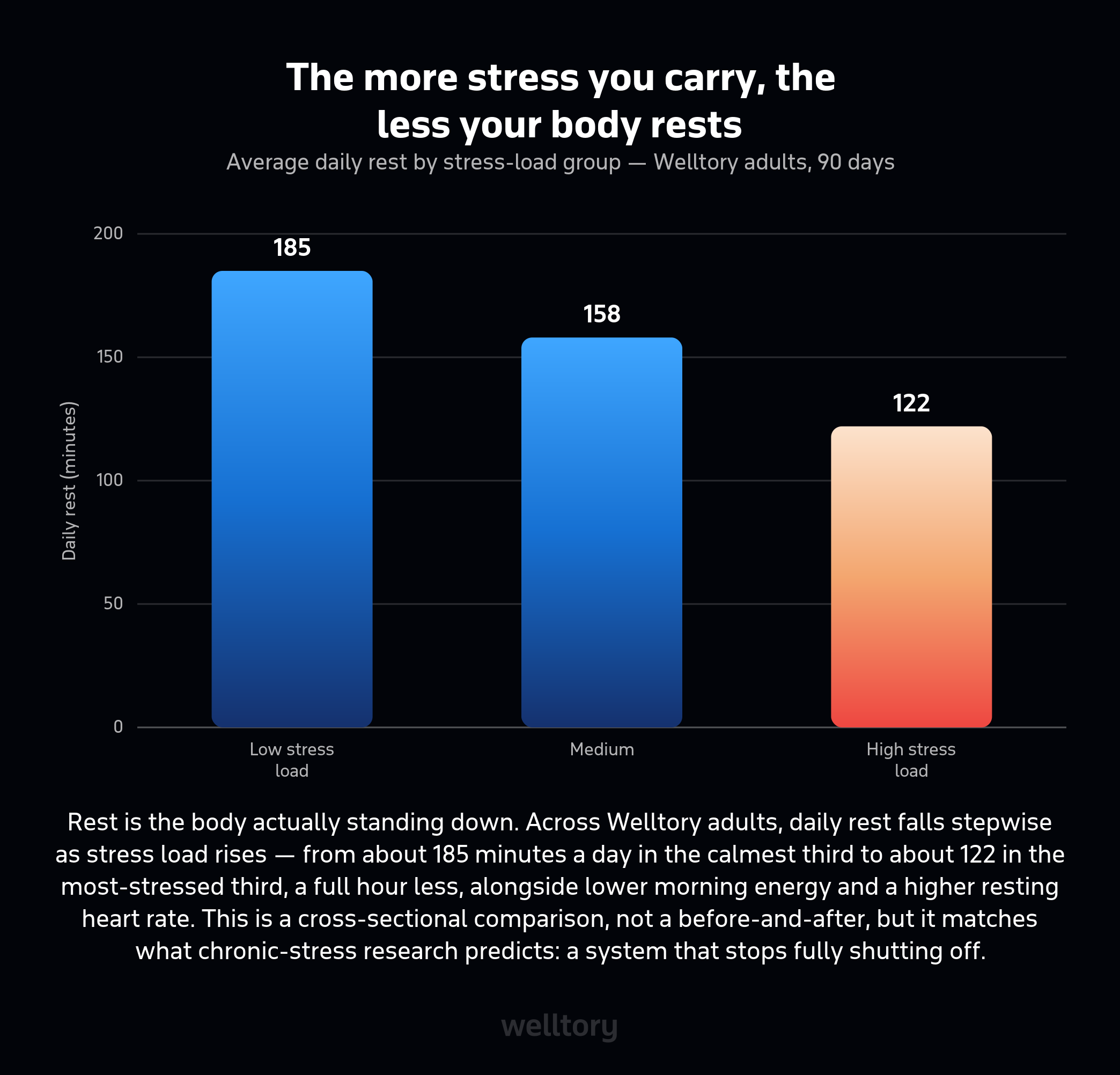
The difference climbs step by step. People in the low-stress group logged about 185 minutes of rest a day. The medium group logged about 158 minutes. In the high-stress group, it dropped to about 122 minutes — roughly an hour a day less than the calmest group.
The other signals moved in the same direction:
Morning energy averaged about 83 in the low-stress group, 81 in the medium group and 77 in the high-stress group.
Resting heart rate averaged about 60 bpm, 63 bpm and 67 bpm, respectively.
Put together, the most stressed group had less time in recovery, started the day with a little less in the tank, and had hearts that beat faster at rest. The groups differed on every measure, in the same direction.
This is a snapshot that compares different people, not a before-and-after, so it can't show that stress load caused the lower rest — people who rest less may also feel more stressed, and other factors may play a part. But it lines up with what chronic stress research predicts: a stress response that keeps running leaves less room for recovery.
How to get out of fight or flight mode: fast tools
The quickest lever you have is your breath. Breathing is one of the few parts of the autonomic nervous system you can control directly, and slowing it down sends a strong "safe" signal to the brake.
Slow breathing. A large meta-analysis of 223 studies found that voluntary slow breathing increased vagally mediated HRV — a marker of parasympathetic "brake" activity — during the breathing itself, right after a single session, and after multi-week programs (doi.org). A systematic review of slow-breathing studies (fewer than 10 breaths a minute) in healthy people linked it with more comfort and relaxation and fewer symptoms of arousal, anxiety and anger (doi.org). Even one session can help: in a study of 47 adults, a single session of deep, slow breathing increased a measure of vagal activity and reduced anxiety in both younger and older participants (doi.org).
Resonance breathing, about six breaths a minute. For most adults, the biggest heart rate swings with each breath happen at about six breaths a minute, roughly five seconds in and five seconds out. This is called resonance frequency breathing, and it is the basis of HRV biofeedback, where you watch your heart rate rise and fall on a screen and learn to breathe in sync with it (doi.org). In a meta-analysis of 24 studies with 484 participants, HRV biofeedback training was linked to a large reduction in self-reported stress and anxiety compared with control conditions (doi.org). A broader meta-analysis of 58 randomized controlled trials found a small-to-moderate overall benefit, with the largest effects for anxiety, depression and anger (doi.org).
The physiological sigh (cyclic sighing). In a Stanford randomized trial, 108 adults spent five minutes a day for a month on one of three breathing exercises or mindfulness meditation. Cyclic sighing — two inhales through the nose (a full breath, then a short extra top-up) followed by a long, slow exhale through the mouth — produced the biggest improvement in positive mood and the largest drop in resting breathing rate, and improved mood more than mindfulness did (doi.org). One honest caveat: over the month, none of the groups showed changes in HRV or resting heart rate on their wearables.
How much it helps overall. A meta-analysis of 12 randomized trials with 785 adults found breathwork was linked to lower stress than control conditions, with a small-to-medium effect, and similar effects on anxiety and low mood. The authors also warned that the hype is running ahead of the evidence and many trials had some risk of bias (doi.org). So breathing is a real, useful tool — not a cure-all.
A simple way to start. Sit or lie down. Breathe in through your nose for about four to five seconds, letting your belly expand, then breathe out slowly through your mouth or nose for five to six seconds. Keep going for five minutes. If you feel lightheaded, breathe a little less deeply. When you're in the middle of a stress spike, try two or three cyclic sighs first, then settle into the slower rhythm.
Breathing works on the vagus nerve, the main nerve of the "rest and digest" system. For more on what shifts vagal tone and what doesn't, read vagus nerve exercises and what actually shifts vagal tone, and for devices and techniques that claim to stimulate it, see vagus nerve stimulation.
How do you calm your nervous system for good?
Fast tools get you out of a spike. Daily habits lower the baseline, so you spend less time in fight or flight to begin with.
Move your body regularly. Exercise is one of the best-supported ways to lower stress and anxiety. An umbrella review of 97 reviews, covering 1,039 trials and 128,119 participants, found that physical activity had medium-sized benefits for anxiety and even larger ones for psychological distress compared with usual care, and higher-intensity activity was linked to bigger improvements (doi.org). You don't need a gym: brisk walks, cycling, dancing or strength training all count. Movement also gives the stress response what it was preparing for — physical action — and a clear end point.
Protect your sleep. Because sleep loss raises stress hormones and sympathetic activity (doi.org), it's often the first thing to fix. Keep a regular wake-up time, give yourself a wind-down buffer before bed, and move worry out of bed: write tomorrow's list an hour before sleep so your brain doesn't have to hold it. If a stressful evening makes your sleep lighter, remember the Hall study — stress right before bed carries into the night (doi.org).
Get outside, ideally somewhere green. In an eight-week study of 36 city dwellers, a "nature pill" of 20 to 30 minutes somewhere that felt natural gave the most stress relief per minute: salivary cortisol fell 21.3% per hour beyond its normal daily decline (doi.org). A meta-analysis of 143 studies linked more greenspace exposure with lower cortisol, lower heart rate and higher high-frequency HRV, a marker of parasympathetic activity (doi.org). Most of those studies were observational, so they show links rather than proof, but a park walk is low-risk and easy to try.
Create real off-time. Since low detachment from work predicts more strain (doi.org), build clear boundaries: a set time when work notifications go off, a ritual that marks the end of the workday (a walk, a change of clothes, a shower), and activities that absorb your attention fully, like sport, cooking or music.
Give worry a time slot. Because rumination keeps your heart rate and cortisol up (doi.org), it helps to catch it early. When you notice yourself replaying a conversation, name it ("I'm ruminating"), write down the one thing you can do about it, and bring your attention back to your body or surroundings.
Watch the stimulants. Late caffeine, nicotine and evening alcohol can all make it harder for your body to settle and for your sleep to do its repair work. Alcohol can feel relaxing at first, but if you rely on it to come down in the evening, mention it to your doctor.
Connect with people. Feeling safe with others is a powerful safety signal, which fits the idea that the stress response quiets when safety is perceived (doi.org). A walk with a friend combines three of these habits at once.
Longer-term help: therapy works
If you've been stuck in fight or flight for months, habits may not be enough on their own, and that's not a failure. Talking therapies have strong evidence for anxiety and stress-related problems.
Cognitive behavioral therapy (CBT) teaches you to notice and change the thought patterns and avoidance habits that keep the alarm system firing. A meta-analysis of 41 placebo-controlled trials with 2,843 patients found CBT had a moderate effect on anxiety-related disorders, with people nearly three times the odds of responding as with placebo, and large effects for generalized anxiety disorder and acute stress disorder (doi.org).
Mindfulness-based stress reduction (MBSR) is an eight-week group course of meditation, body awareness and gentle movement. In a randomized trial of 276 adults with anxiety disorders, eight weeks of MBSR worked as well as the antidepressant escitalopram at reducing anxiety (doi.org).
For some people, medication is part of the plan, especially when anxiety or depression is diagnosed. That is a decision to make with a doctor.
How long does it take to get out of fight or flight?
It depends on whether you're coming down from one stressful moment or from months of stress.
After a single stressful event, the body usually settles once the event is truly over, but how quickly varies. Stressors that feel uncontrollable or involve being judged by others take the longest for cortisol to recover from (doi.org), and worrying about the event afterwards keeps the physical response going (doi.org). A few minutes of slow breathing can start shifting you toward the brake right away: HRV rises during and right after a single session (doi.org).
After a long stretch of stress, think in weeks, not days. In the Stanford breathing trial, participants practiced for a month (doi.org); MBSR runs for eight weeks (doi.org); in the nature study, participants followed their routine for eight weeks (doi.org). Progress rarely runs in a straight line. A stressful week can knock you back, and that doesn't mean the retraining failed. Watching trends over weeks — how you feel, and ideally how your resting heart rate and HRV move — tells you more than any single day.
When is it more than stress?
Feeling constantly on edge is common under chronic stress, but sometimes it points to something that needs specific treatment.
Anxiety disorders. Anxiety disorders are among the most common mental health conditions: in a large US survey, 28.8% of adults met the criteria for one at some point in their lives (doi.org). Generalized anxiety disorder involves excessive, hard-to-control worry on most days for at least six months, along with symptoms such as restlessness, fatigue, poor concentration, irritability, muscle tension and sleep problems (doi.org). Panic attacks — sudden surges of intense fear with a racing heart, breathlessness or dizziness — are another reason to see a doctor.
PTSD. After a traumatic event, some people develop post-traumatic stress disorder, which includes intrusive memories or nightmares, avoidance of reminders, negative changes in mood and thinking, and hyperarousal such as hypervigilance, an exaggerated startle response and poor sleep, lasting more than a month (doi.org). If your "stuck on" feeling started after a frightening or violent experience, trauma-focused therapy can help a lot.
Thyroid problems and other medical causes. An overactive thyroid (hyperthyroidism) can closely imitate chronic stress, with a fast heartbeat, palpitations, tremor, anxiety, poor sleep, heat intolerance, sweating and weight loss (doi.org). A simple blood test can check. Anemia, heart rhythm problems, low blood sugar, certain medications, and heavy caffeine or stimulant use can also cause similar symptoms.
See a doctor soon if:
the tension has lasted more than a few weeks and is getting in the way of work, sleep or relationships;
you have panic attacks, or constant worry you can't control;
it started after a traumatic event and comes with flashbacks or nightmares;
you have a fast heartbeat at rest, tremor, weight loss or heat intolerance;
you're using alcohol, sleeping pills or other substances to come down;
you feel low, hopeless or numb most days.
Get help right away if you have chest pain, fainting or trouble breathing (call emergency services), or thoughts of harming yourself (contact a crisis line (in the US, call or text 988) or emergency services).
How to bring this up with your doctor — and what to ask for
Say it plainly. Rather than "I'm stressed," try describing the failure to switch off: "For about four months I can't calm down even when the day is over. My body stays tense, my heart feels fast, and I wake at 4 a.m. with my mind racing." That is specific, and it points toward assessment and treatment rather than generic advice.
Bring context. When it started, what was happening in your life then, how you're sleeping, how much caffeine and alcohol you use, and any medications or supplements. If you track your resting heart rate, HRV and sleep, bring a few weeks of trends — for example, evenings when your heart rate stays high when it should be falling, or HRV that stays below your usual level for days at a time. A body that never downshifts is easier to act on than a description of feeling tense.
Ask these specifically. Could my thyroid or another medical problem be causing this, and can we check with a blood test? Could this be an anxiety disorder, PTSD or depression? Would CBT or another talking therapy be a good fit, and can you refer me? Is there a stress-reduction or mindfulness program you'd recommend? If you drink in the evenings to wind down, say so — it is common, it can make the pattern worse, and it changes what will help.
If you are dismissed. Try: "I understand stress is common, but this has lasted months and it's affecting my sleep and work. Can we look for causes and note this in my record?" If you still feel brushed off, asking for a second opinion or a direct referral to a mental health professional is reasonable.
How Welltory helps
Being stuck in fight or flight is hard to feel clearly, because it becomes your normal. Welltory can make some of its physical signs visible. It tracks your stress load across the day, your rest time, your HRV and resting heart rate, your sleep, and your morning energy — each compared with your own baseline, not a population average.
That lets you answer questions that are almost impossible to answer by feel. Is my body actually coming down in the evening, or staying revved? Did last week's deadline leave my resting heart rate raised for days afterwards? Does a 20-minute walk or five minutes of slow breathing show up in my numbers? A quick check like the nervous system snapshot gives you a read on how your system is doing right now, and running a measurement before and after a breathing session shows you, in your own data, whether it's working for you.
With My Patterns, you can tag your days with notes like "late email," "argument," "walk outside," "breathing practice," "two glasses of wine" or "bad night," and over a few weeks see which ones come before high-stress days and which come before better rest. That turns vague advice into your own personal list of what actually helps.
Two honest caveats. Changes in HRV and resting heart rate take weeks of consistency, and any single day is noisy, so read the trend. And Welltory can't diagnose an anxiety disorder, PTSD, thyroid disease or anything else. If your stress feels unmanageable, the data is a nudge toward support, not a substitute for it. But for many people, watching the off switch get a little less sticky week by week is one of the most motivating things a tracker can show.
How we made it
The clinical content rests on published research and guidelines: allostatic load and stress mediators (McEwen 1998a, 1998b; Guidi et al. 2021), the default stress response and perceived safety (Brosschot, Verkuil & Thayer 2016), perseverative cognition (Brosschot, Gerin & Thayer 2006; Ottaviani et al. 2016), cortisol responses to acute stressors (Dickerson & Kemeny 2004), stress and HRV (Kim et al. 2018; Chandola et al. 2008), sleep and stress systems (Spiegel, Leproult & Van Cauter 1999; Meerlo, Sgoifo & Suchecki 2008; Hall et al. 2004), psychological detachment from work (Sonnentag & Fritz 2015), slow breathing and breathwork (Laborde et al. 2022; Zaccaro et al. 2018; Magnon, Dutheil & Vallet 2021; Balban et al. 2023; Fincham et al. 2023), HRV biofeedback (Lehrer & Gevirtz 2014; Lehrer et al. 2020; Goessl, Curtiss & Hofmann 2017), physical activity (Singh et al. 2023), nature exposure (Hunter, Gillespie & Chen 2019; Twohig-Bennett & Jones 2018), therapy trials (Carpenter et al. 2018; Hoge et al. 2023), anxiety disorders and PTSD (Kessler et al. 2005; Stein & Sareen 2015; Shalev, Liberzon & Marmar 2017), and the American Thyroid Association guideline on hyperthyroidism (Ross et al. 2016).
The Welltory figures come from an aggregated, de-identified dataset of adult Welltory users over a 90-day window, grouped into low, medium and high thirds by average daily stress load, comparing each group's average daily rest time, morning energy and resting heart rate. It is a cross-sectional, observational comparison and does not show cause and effect.


Discounts for blog readers: up to 36% off
See what affects your energy, stress, sleep, and daily state with Welltory
This article is for educational purposes only and is not medical advice. If stress is overwhelming, persistent, or tied to low mood or anxiety, please consider talking to a doctor or mental-health professional. Welltory measures physiological signals like heart rate, HRV, sleep, activity, and stress; it does not diagnose anything.
Was this helpful?
Ask AI for a summary of page


Written by Jane Smorodnikova

The founder and CEO of Welltory. A recognized tech leader with two Master's degrees and experience at MIT, she has scaled Welltory to over 17 million users.
Written by Tatsiana Yashyna

Deputy COO at Welltory. With a background in medicine and years of working with health data, she translates research and real physiological signals — sleep, stress, heart rate, and hormones — into clear, evidence-based explanations that help people understand what their bodies are telling them.
Reviewed by Anna Elitzur
-2.jpg)
With her medical degree, Anna reviews Welltory's health content for medical accuracy and alignment with current clinical guidelines and research.
References
- McEwen BS. Stress, adaptation, and disease: allostasis and allostatic load. Annals of the New York Academy of Sciences 1998;840:33-44. https://doi.org/10.1111/j.1749-6632.1998.tb09546.x
- McEwen BS. Protective and damaging effects of stress mediators. New England Journal of Medicine 1998;338(3):171-179. https://doi.org/10.1056/NEJM199801153380307
- Guidi J, Lucente M, Sonino N, Fava GA. Allostatic load and its impact on health: a systematic review. Psychotherapy and Psychosomatics 2021;90(1):11-27. https://doi.org/10.1159/000510696
- Brosschot JF, Verkuil B, Thayer JF. The default response to uncertainty and the importance of perceived safety in anxiety and stress: an evolution-theoretical perspective. Journal of Anxiety Disorders 2016;41:22-34. https://doi.org/10.1016/j.janxdis.2016.04.012
- Brosschot JF, Gerin W, Thayer JF. The perseverative cognition hypothesis: a review of worry, prolonged stress-related physiological activation, and health. Journal of Psychosomatic Research 2006;60(2):113-124. https://doi.org/10.1016/j.jpsychores.2005.06.074
- Ottaviani C, Thayer JF, Verkuil B, et al. Physiological concomitants of perseverative cognition: a systematic review and meta-analysis. Psychological Bulletin 2016;142(3):231-259. https://doi.org/10.1037/bul0000036
- Dickerson SS, Kemeny ME. Acute stressors and cortisol responses: a theoretical integration and synthesis of laboratory research. Psychological Bulletin 2004;130(3):355-391. https://doi.org/10.1037/0033-2909.130.3.355
- Kim HG, Cheon EJ, Bai DS, Lee YH, Koo BH. Stress and heart rate variability: a meta-analysis and review of the literature. Psychiatry Investigation 2018;15(3):235-245. https://doi.org/10.30773/pi.2017.08.17
- Chandola T, Britton A, Brunner E, et al. Work stress and coronary heart disease: what are the mechanisms? European Heart Journal 2008;29(5):640-648. https://doi.org/10.1093/eurheartj/ehm584
- Spiegel K, Leproult R, Van Cauter E. Impact of sleep debt on metabolic and endocrine function. The Lancet 1999;354(9188):1435-1439. https://doi.org/10.1016/S0140-6736%2899%2901376-8
- Meerlo P, Sgoifo A, Suchecki D. Restricted and disrupted sleep: effects on autonomic function, neuroendocrine stress systems and stress responsivity. Sleep Medicine Reviews 2008;12(3):197-210. https://doi.org/10.1016/j.smrv.2007.07.007
- Hall M, Vasko R, Buysse D, et al. Acute stress affects heart rate variability during sleep. Psychosomatic Medicine 2004;66(1):56-62. https://doi.org/10.1097/01.PSY.0000106884.58744.09
- Sonnentag S, Fritz C. Recovery from job stress: the stressor-detachment model as an integrative framework. Journal of Organizational Behavior 2015;36(S1):S72-S103. https://doi.org/10.1002/job.1924
- Laborde S, Allen MS, Borges U, et al. Effects of voluntary slow breathing on heart rate and heart rate variability: a systematic review and a meta-analysis. Neuroscience & Biobehavioral Reviews 2022;138:104711. https://doi.org/10.1016/j.neubiorev.2022.104711
- Zaccaro A, Piarulli A, Laurino M, et al. How breath-control can change your life: a systematic review on psycho-physiological correlates of slow breathing. Frontiers in Human Neuroscience 2018;12:353. https://doi.org/10.3389/fnhum.2018.00353
- Magnon V, Dutheil F, Vallet GT. Benefits from one session of deep and slow breathing on vagal tone and anxiety in young and older adults. Scientific Reports 2021;11(1):19267. https://doi.org/10.1038/s41598-021-98736-9
- Balban MY, Neri E, Kogon MM, et al. Brief structured respiration practices enhance mood and reduce physiological arousal. Cell Reports Medicine 2023;4(1):100895. https://doi.org/10.1016/j.xcrm.2022.100895
- Fincham GW, Strauss C, Montero-Marin J, Cavanagh K. Effect of breathwork on stress and mental health: a meta-analysis of randomised-controlled trials. Scientific Reports 2023;13(1):432. https://doi.org/10.1038/s41598-022-27247-y
- Lehrer PM, Gevirtz R. Heart rate variability biofeedback: how and why does it work? Frontiers in Psychology 2014;5:756. https://doi.org/10.3389/fpsyg.2014.00756
- Lehrer P, Kaur K, Sharma A, et al. Heart rate variability biofeedback improves emotional and physical health and performance: a systematic review and meta analysis. Applied Psychophysiology and Biofeedback 2020;45(3):109-129. https://doi.org/10.1007/s10484-020-09466-z
- Goessl VC, Curtiss JE, Hofmann SG. The effect of heart rate variability biofeedback training on stress and anxiety: a meta-analysis. Psychological Medicine 2017;47(15):2578-2586. https://doi.org/10.1017/S0033291717001003
- Singh B, Olds T, Curtis R, et al. Effectiveness of physical activity interventions for improving depression, anxiety and distress: an overview of systematic reviews. British Journal of Sports Medicine 2023;57(18):1203-1209. https://doi.org/10.1136/bjsports-2022-106195
- Hunter MR, Gillespie BW, Chen SY. Urban nature experiences reduce stress in the context of daily life based on salivary biomarkers. Frontiers in Psychology 2019;10:722. https://doi.org/10.3389/fpsyg.2019.00722
- Twohig-Bennett C, Jones A. The health benefits of the great outdoors: a systematic review and meta-analysis of greenspace exposure and health outcomes. Environmental Research 2018;166:628-637. https://doi.org/10.1016/j.envres.2018.06.030
- Carpenter JK, Andrews LA, Witcraft SM, et al. Cognitive behavioral therapy for anxiety and related disorders: a meta-analysis of randomized placebo-controlled trials. Depression and Anxiety 2018;35(6):502-514. https://doi.org/10.1002/da.22728
- Hoge EA, Bui E, Mete M, et al. Mindfulness-based stress reduction vs escitalopram for the treatment of adults with anxiety disorders: a randomized clinical trial. JAMA Psychiatry 2023;80(1):13-21. https://doi.org/10.1001/jamapsychiatry.2022.3679
- Kessler RC, Berglund P, Demler O, et al. Lifetime prevalence and age-of-onset distributions of DSM-IV disorders in the National Comorbidity Survey Replication. Archives of General Psychiatry 2005;62(6):593-602. https://doi.org/10.1001/archpsyc.62.6.593
- Stein MB, Sareen J. Generalized anxiety disorder. New England Journal of Medicine 2015;373(21):2059-2068. https://doi.org/10.1056/NEJMcp1502514
- Shalev A, Liberzon I, Marmar C. Post-traumatic stress disorder. New England Journal of Medicine 2017;376(25):2459-2469. https://doi.org/10.1056/NEJMra1612499
- Ross DS, Burch HB, Cooper DS, et al. 2016 American Thyroid Association guidelines for diagnosis and management of hyperthyroidism and other causes of thyrotoxicosis. Thyroid 2016;26(10):1343-1421. https://doi.org/10.1089/thy.2016.0229
- Welltory adult cohort context (daily rest, morning energy, and resting heart rate by stress-load group). Reproducible script: `persona_lab/scripts/chronic_stress_recovery.py`.