
Too tired to love: why women are 2x more likely to burn out in relationships
We pulled data from 1,820 Welltory users about work strain, caregiving, and burnout. The results are frustrating as hell, but probably not surprising.


The double load: men vs. women
15% of people are living under what we call "double load," which means carrying high strain at work/school AND high caregiving strain at home.
Predictably, women are nearly twice as likely to be in this pattern:
.png?2026-05-04T17%3A39%3A35.708Z)
And this takes a toll both on the body and the relationships.
What this does to you
People under double load are 3.5x more likely to experience burnout, and sleep becomes almost impossible to recover from.
.png?2026-05-04T17%3A39%3A46.443Z)
- 48% experience burnout (vs. 14% for everyone else)
- 54% report high stress (vs. 19% for everyone else)
- 8% feel rested "waking up” (vs. 29% for everyone else)
- 47% suffer from non-restorative sleep (vs. 27% for everyone else)
Just think about it: 92% of these people wake up exhausted. Every single day.
What "high caregiving strain" actually means
It's not just doing the dishes or picking up the kids. In this data, "high caregiving strain" means people said it "takes a lot of energy," "affects my sleep and personal time," or is "completely exhausting".
You are doing the invisible work if:
- You manage everyone's schedules
- You plan the meals
- You anticipate what's needed before anyone asks
- You're the default person everyone comes to
It's not big, flashy moments. It's a thousand small things. And your body is keeping score even when you're not.
The age that gets hit hardest
26% of women aged 40-50 are in double load. One in four.
.png?2026-05-04T17%3A40%3A04.704Z)
This is the life stage where everything converges:
- Kids still need you (even if they've left home)
- Parents are aging and need care
- Your career is at its peak (or you're trying to get it there)
You're sandwiched between generations, and it shows up in your data as an elevated resting heart rate, poor sleep recovery, and stress you can't feel until your body forces you to stop.
Why this is a relationship issue
Because exhaustion kills love. It kills your capacity to connect.
When you're running on broken sleep and your brain is cycling through tomorrow's to-do list, you can't be fully present and you can't show up emotionally.
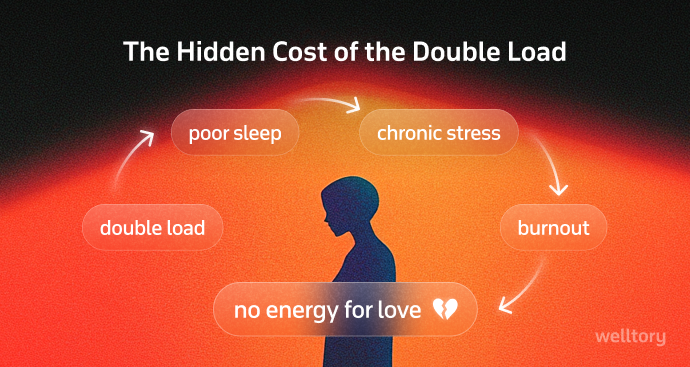
You can't feel romantic when exhaustion is your baseline. And you can't be emotionally available when your body is just trying to survive. There can’t be intimacy when every interaction feels like one more thing to manage.


Discounts for blog readers: up to 36% off
See what affects your energy, stress, sleep, and daily state with Welltory
What actually helps
Flowers and dinner reservations on Valentine's Day can feel meaningful, but they don’t reduce daily strain. For exhausted partners, love is felt through consistent support, not just symbolic moments.
Here's what creates actual capacity for love:
- Letting your partner sleep in.
- Taking something off their plate without being asked.
- Noticing the invisible work and sharing the load.
When one person is carrying a double load, the relationship itself becomes another responsibility to manage. But when the load is shared, there's space to actually connect.
So, if you see your partner in these numbers, support doesn’t need to start with a conversation. It can be as simple as taking over bedtime one evening, handling breakfast the next morning, or noticing what needs doing and quietly taking care of it — without announcements or credit.
If you see yourself in these numbers, show this to your partner (not as an attack; as data). Help them see that you're carrying a double load, and the data shows exactly what that does to you and your relationship. Your exhaustion is measurable, and fixable — but not by you alone.
________
About this data. 1,820 Welltory users. Self-reported work/caregiving strain + physiological metrics
Limitations: iOS-heavy sample, mostly Apple Watch users. Self-report bias. Shows correlation, not causation.
Was this helpful?
Ask AI for a summary of page


Written by Irina Motovilova
Welltory’s brand and community lead. A hyperpolyglot specializing in UX writing and content strategy, she builds global communities and creates content people actually want to read.