

Short answer
Responsive desire is sexual desire that shows up after touch, closeness or arousal has already started, rather than before. It is common and normal: in a Portuguese online survey, about 31% of partnered women who became aroused easily said desire typically or always came only once arousal began — and starting sex without desire was more common among women in long relationships.
If you rarely feel "in the mood" beforehand but enjoy sex once it starts, you're not broken, and it's not your fault. Desire that needs a warm-up is not a weaker kind of desire. It is a different on-ramp. Many people, and many long-term couples, work exactly this way.
This article explains what responsive desire is and how it differs from spontaneous desire, where the idea comes from (Rosemary Basson's circular model), what the research does and doesn't show, why desire shifts in long relationships, how the "accelerators and brakes" model helps, what to do when partners want sex at different levels, how to think about a sexless marriage without shame, and when a change in desire is worth taking to a doctor.
What is responsive desire?
For a long time, textbooks described sex as a straight line: first you feel desire, then you get aroused, then you have sex, then orgasm. In that picture, desire is the starting gun. If it doesn't fire on its own, something must be wrong.
In 2000, Canadian physician and researcher Rosemary Basson proposed a different picture based on her clinical work with women in long-term relationships. Many women, she noted, don't start from a spontaneous urge. They start from a neutral place, but they are open to being close — for reasons like wanting intimacy, affection or connection with their partner. If touch and context are good, arousal builds, and desire arrives during the experience rather than before it. (doi.org) She called this the responsive component of desire, and one of her stated aims was to stop doctors from labeling a response as a dysfunction when it was "simply different."
In plain words: responsive desire means "I wasn't thinking about sex, but once we started, I wanted it." It is desire that answers something — a kiss, a touch, a relaxed evening, the feeling of being wanted — instead of arriving out of nowhere.
Later survey data fit this picture. In an online survey of 3,687 Portuguese women, the researchers looked closely at 1,865 women in committed relationships who became aroused easily. In that group, about 31% said they typically or always feel desire only once they are already aroused, and only 15.5% said they have sex only when they feel desire first. Across relationship lengths, often starting sex without desire at the outset (and then getting aroused easily) was almost twice as common among women in relationships of more than 10 years as among those in relationships of under a year: 42% versus 22.4%. (doi.org) The sample was self-selected, fairly young (average age 29) and more educated than average, so the exact numbers shouldn't be applied to every woman, but the pattern is clear: responsive desire is ordinary, not rare.
Responsive vs spontaneous desire: what's the difference?
Spontaneous desire is the "out of nowhere" kind. You think about sex during the day, you notice a pull toward your partner, you feel like initiating. It is what films show, and what many people remember from the start of a relationship.
Responsive desire comes second. It needs a cue — touch, closeness, a certain mood, an erotic moment — and then it grows. Before the cue, there may be little or no conscious wanting. After it, desire can be just as real and just as strong.
A few points make the difference easier to live with:
Both can live in the same person. Basson's follow-up work described one simple cycle that combines responsive and "spontaneous" desire, with the emotions and sensations of each experience feeding back into the next. (doi.org)
The line is blurry. Reviews of the research note that it is hard to define desire cleanly, and that the line between "untriggered" and "responsive" desire is still debated. (doi.org) Even so-called spontaneous desire may be set off by something you didn't consciously notice — a smell, a memory, a relaxed body.
Neither is better. Responsive desire is not the "consolation prize." A review that helped shape the current diagnostic criteria pointed out that, for women, sexual activity often begins without desire, and that sexual fantasies out of the blue are relatively infrequent — so a definition built only on spontaneous urges misses how many women actually work. (doi.org)
A useful everyday test: once you are in a good situation with your partner, does desire usually show up? If yes, your desire is probably working fine. The question then becomes how often you get into that situation — which is a very different problem from "I have no libido."
The Basson model: a circular map of female sexual response
Basson's model is often called the circular model of female sexual response, because it is drawn as a loop rather than a line. In simple terms, the loop goes like this:
A neutral starting point. No strong urge, but openness.
Reasons to be close. Wanting intimacy, affection, to feel connected, or to share pleasure — motives that aren't strictly about lust.
Sexual stimuli in the right context. Touch, words, setting, privacy, feeling safe and unhurried.
Arousal. The body and mind respond; the mind appraises that arousal as pleasant.
Desire appears. Now there is a wish to continue.
Satisfaction. If the experience feels emotionally and physically good, closeness grows — which makes the next loop easier to start.
Basson also used the loop in the clinic. When she assessed 47 women referred for low desire, all of them could relate to the model, and several "breaks" in the cycle were identified. Emotional intimacy was not enough to motivate them in 50%, sexual stimuli and context were minimal in 53%, psychological factors that dampen arousal were present in 85%, and depression contributed in 43%. Androgen deficiency — the explanation their referring doctors had suggested — contributed in only 25%. Simply finding the missing pieces was itself therapeutic. (doi.org)
That is the practical value of the model. Instead of asking "why don't I want sex?", it asks "where does my loop break?" Is it the reasons to be close (resentment, distance)? The context (no privacy, no time, a toddler in the next room)? The arousal stage (pain, dryness, distraction)? Or the ending (sex that is routinely unsatisfying, so the loop never builds momentum)?
Is responsive desire real — and is it normal?
Yes, it is real, and it is a normal pattern — but it is not the only normal pattern, and it helps to be honest about what the research shows.
Basson's 2000 paper was a clinical model, not a data study. (doi.org) Researchers have since tested it. In a mailed survey answered by 133 nurses, roughly equal proportions of women chose each of three models — two classic linear models (Masters and Johnson's and Kaplan's) or Basson's circular model — as the best description of their own experience. (doi.org) In an online survey of 404 women, a linear model fit women without sexual difficulties well, while a modified circular model fit women with sexual difficulties better. (doi.org) Women who chose Basson's model in the nurses' study also had lower sexual function scores on average.
What does that mean for you? Three things:
Responsive desire is a common, healthy way desire works. The survey data above show that many women, especially in long relationships, regularly start sex before desire shows up. (doi.org)
People differ. Some people mostly feel spontaneous desire, some mostly responsive, most a mix — and the balance can shift with life stage, stress and relationship length.
The circular model is especially useful when things feel stuck. It maps where the loop breaks, which may be why it fits women with sexual difficulties best.
Context matters for men's desire too. In a small qualitative study based on interviews with 30 men aged 30 to 65 in relationships lasting an average of 13 years, men described desire that was shaped strongly by context: feeling desired by their partner, exciting or unexpected encounters and intimate communication raised it, while rejection, health problems and emotional disconnection lowered it. (doi.org) For the men's side of the story, see what really drives male libido and erections.
Crucially, needing a warm-up is not a disorder. The International Society for the Study of Women's Sexual Health (ISSWSH) defines hypoactive sexual desire disorder as a loss of spontaneous desire or of responsive desire — meaning desire doesn't show up even with good cues — lasting at least six months and causing personal distress. (doi.org) If desire does show up once things begin, that is responsive desire doing its job.
Why does desire change in long relationships?
Almost everyone notices that the early "can't keep our hands off each other" phase doesn't last forever. That is not a sign the relationship is failing.
In a very large online survey run on a US news website, with 38,747 people who had been together for at least three years, 83% of both men and women said they had been sexually satisfied in their first six months together. Now, only about half were satisfied (55% of women, 43% of men). Yet more than one in three (38% of women, 32% of men) said their sex life was still as passionate as at the start — so the decline is common, but not inevitable. (doi.org)
A few forces push desire around over the years:
Novelty fades. In a study of 170 university students aged 18 to 25, women's desire went down as their relationships got longer, even after accounting for relationship and sexual satisfaction; men's did not. (doi.org) This was a small sample of young students in relatively short relationships, so it shouldn't be stretched to long marriages. But it matches what many couples feel: the "new" that fuels spontaneous desire wears off, and responsive desire becomes a bigger share of the picture.
Life gets fuller. A systematic review of 64 studies on keeping desire alive in long-term relationships grouped the influences into three levels: individual (such as mood, stress, health and body image), interpersonal (how the couple relates, communicates and treats each other) and societal (roles, expectations, culture). (doi.org) Midlife tends to load all three at once — careers, children, aging parents, health changes.
The household load. In two studies of mothers partnered with men (677 and 396 women), those who did a larger share of the housework and childcare reported lower desire for their partner. The link seemed to run partly through feeling the partner was more like a dependent than an equal, and through seeing the division of labor as unfair. (doi.org) This is not a lack of love; it is hard to feel erotic toward someone you've been picking up after all day. We explore how that exhaustion plays out in why women burn out in relationships.
The relationship itself. In Britain's national sex survey, Natsal-3, women who were not happy in their relationship had about four times the odds of low sexual function, and those who found it hard to talk about sex with their partner had nearly three times the odds. (doi.org)
Bodies change. Perimenopause can bring hot flashes, broken sleep, vaginal dryness and pain with sex, all of which make the loop harder to start. We cover this in why desire changes with age and perimenopause symptoms. If you are not sure whether what you're feeling is perimenopause or simply a hard stretch, see stress or perimenopause?
What is the dual control model?
The most useful tool for understanding desire in long relationships is the dual control model, developed at the Kinsey Institute by John Bancroft and Erick Janssen. It says your sexual response depends on the balance between two separate systems: an accelerator (sexual excitation) that responds to anything sexually interesting, and a brake (sexual inhibition) that responds to reasons not to be sexual right now. (doi.org)
The original model described two kinds of brake: one tied to fear of "failing" sexually, and one tied to outside threats, including ones from within the relationship itself. (doi.org) People vary a lot in how sensitive each system is, and some braking is healthy and protective. (doi.org)
For women, the brake side seems to matter most when things go wrong. In a study of 540 women, the brake factors were the strongest predictors of sexual problems, including low interest — stronger than age, relationship status or health. The two biggest were needing conditions to be "just right" to get aroused, and worrying about how sex would go. (doi.org)
Put the two models together and a long relationship makes sense. Responsive desire needs the accelerator to be touched — by closeness, touch, feeling wanted. But if the brakes are pressed hard — by exhaustion, stress, resentment, pain, a mental to-do list, or the feeling of being on a schedule — the car doesn't move, no matter what you do with the gas.
That is why so many couples say "we love each other, we're attracted to each other, and still nothing happens." Nothing is wrong with the accelerator. Something is sitting on the brake.
Why chasing spontaneous desire backfires
A common reaction to fading spontaneous desire is to try harder: wait for the old spark, force it on a tired night, or have a tense "we need to have more sex" conversation. These usually make things worse, for three research-backed reasons.
Pressure is a brake. In the dual control research, worrying about how sex will go was one of the strongest predictors of sexual problems in women. (doi.org) Sex that has become a test — of the relationship, of your body, of whether you are "normal" — adds exactly that worry. The same spiral in the body is covered in sexual performance anxiety.
Why you have sex matters. Across three studies, including daily diaries from long-term couples, having sex for "approach" reasons — to feel close, to share pleasure — went with more satisfaction for both partners, while having sex for "avoidance" reasons — to avoid disappointing a partner or avoid a fight — went with less. In every study, the link ran through desire. (doi.org) In other words, going along with sex to keep the peace tends to go with lower desire and satisfaction, while saying yes because you want closeness tends to go with more of both.
Waiting for a spark means waiting a long time. If your desire is mostly responsive, the spark comes after the start, not before. Waiting for it to show up on its own before you allow any closeness can mean months of distance for a couple who would, in fact, enjoy each other once they began.
The alternative isn't "have sex you don't want." It is creating unpressured chances for the loop to start — touch that doesn't have to lead anywhere, time together when you're not depleted — and letting desire decide from there.
What our data shows: stress load is higher from 35 on
Welltory can't see desire, but it can measure something research links to the brakes: how much load your nervous system is under during the day. Welltory's stress load is built from heart rate and heart rate variability (HRV), the small beat-to-beat changes in your heart rhythm that reflect how much your body is in "rest-and-digest" mode.
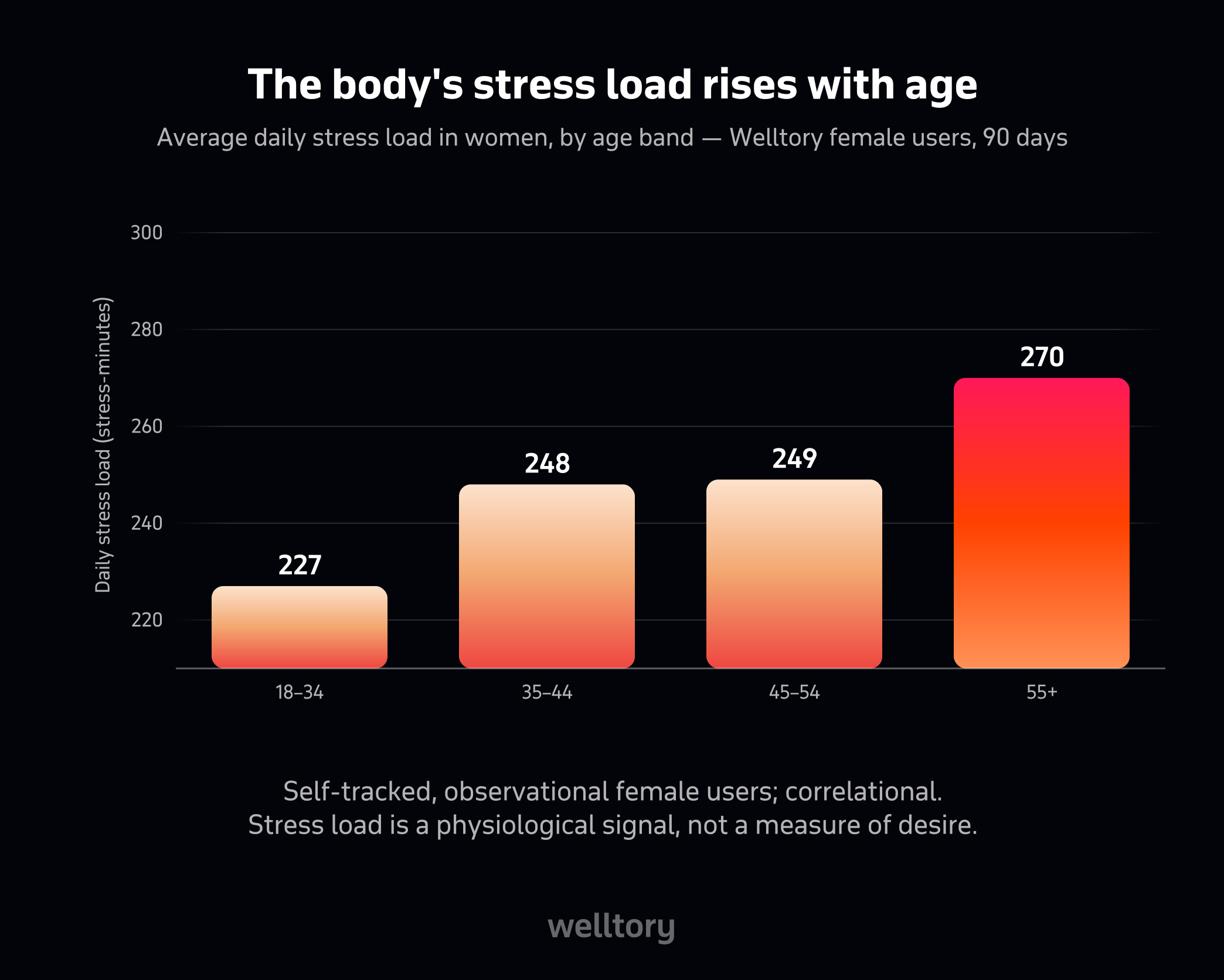
We looked at 3,086 Welltory women with a known age over a 90-day window. The youngest group, aged 18 to 34, averaged a daily stress load of 227. Women aged 35 to 44 averaged 248, and women aged 45 to 54 averaged almost exactly the same, 249. The highest group was women aged 55 and over, at 270. Morning energy — Welltory's estimate of how recovered the body is on waking — was gently lower in each older group, from 85.2 to 83.7, 82.9 and 81.5.
So in our data, the step up comes at around 35, stays level through the 40s and early 50s, and is highest after 55. These are different women in each age group, not the same women getting older, and none of these figures measures desire. They simply show that measured stress load is higher in the older age groups of our users. This data can't tell us whether that affects anyone's desire; the dual control model only suggests that a heavier background load is one more thing that can press on the brake.
Welltory female users with age data, per-user 90-day averages (15 Dec 2025 – 14 Mar 2026): 18–34, n = 155; 35–44, n = 505; 45–54, n = 936; 55+, n = 1,490. Observational and cross-sectional. Stress load is derived from heart rate and HRV; it is not a measure of desire or sex life.
The link between stress and desire has been studied directly. In a 2025 study, 63 people in heterosexual relationships rated their stress, desire and arousal six times a day for two weeks and gave six saliva samples a day. At moments of higher stress, desire and arousal were lower, and higher cortisol went with lower same-moment desire more strongly in women than in men. (doi.org) In a small lab study of 30 women, those under high chronic stress showed lower genital arousal, higher cortisol and more distraction — and distraction was the strongest factor. (doi.org) Sleep counts too: in a two-week diary study of 171 women recruited at a US university, longer sleep was followed by more desire the next day. (doi.org) For the deeper mechanism, see cortisol and "frozen" libido in your 40s and what stress and sleep do to women's libido.
How do you handle desire discrepancy or mismatched libido?
Desire discrepancy — one partner wanting sex more often than the other — is one of the most common issues couples face. In Natsal-3, 27.4% of women and 23.4% of men in relationships said they and their partner didn't share the same level of interest in sex. (doi.org) It is also among the main reasons couples seek therapy. (doi.org)
It matters because it can wear on both people. In a study of 1,054 married couples, the bigger the gap between how often someone wanted sex and how often they actually had it, the lower their relationship satisfaction and stability and the more conflict they reported — regardless of how long they had been married. (doi.org)
Mismatched libido is often a mismatch of types of desire, not just amounts. One partner may feel spontaneous desire and read the other's lack of initiating as rejection. The other may feel responsive desire and experience constant requests as pressure — which, as we saw, is a brake. Naming this difference can take a lot of heat out of the conflict.
What seems to help:
Handle it together. In a study of 229 people in long-term relationships, those who used partnered strategies — talking about it, doing something together with their partner (intimate, affectionate or otherwise), or having sex anyway — reported higher sexual and relationship satisfaction than those who dealt with the gap alone. None of the strategies was linked to higher desire itself, and the study was a one-time survey, so it can't show that the strategies caused the difference. (doi.org)
Care about each other's needs — within your own limits. In a 21-day study of 44 long-term couples, people who were more motivated to meet their partner's sexual needs (researchers call this sexual communal strength) felt more desire day to day, and their desire was less likely to drop over the following four months. (doi.org) This is not the same as going along with sex you don't want; it is about genuine responsiveness, balanced with your own boundaries.
Widen what counts. Sexually satisfied people in the 38,747-person survey reported more mood setting, more variety and more talking about sex — not just more intercourse. (doi.org)
Make initiation safe. The higher-desire partner can offer closeness without expectation; the responsive partner can say "I'm not in the mood yet, but I'm open to seeing where it goes" — or "not tonight, but I'd love to cuddle." Both messages keep the door open without pressure.
Is a sexless marriage a problem?
There is no single definition of a sexless marriage. Some researchers count no sex in the past month, others in the past year, and others use a low number of times per year. The term also hides very different situations: a couple dealing with illness, new parents in survival mode, two people who are both content without sex, or one partner quietly hurting.
It is more common than people think. In a US national survey of 6,029 married people, with data collected in the late 1980s, 16% of marriages had been sexually inactive in the month before the interview. Sexual inactivity was more common with older age, poor health, the presence of preschool children, less shared activity and more unhappiness in the marriage. (doi.org) Among partnered US adults aged 57 to 85 who had not had sex for three months or more, the most common reason given was the male partner's physical health, reported by 55% of men and 64% of women. (doi.org)
More sex is also not endlessly better. Across three studies with 30,645 participants, sexual frequency was linked to well-being in people in relationships, but the link levelled off at about once a week — more than that was not tied to greater well-being. (doi.org)
So when is it a problem? A useful rule of thumb: it is a problem when it is a problem for one of you. A low-sex or no-sex marriage that both partners are genuinely comfortable with is not a medical issue. It is worth addressing when:
one partner feels lonely, rejected or resentful;
sex has stopped because of pain, erectile trouble, illness or a medication, and nobody has looked into it;
one or both of you avoids touch altogether, to avoid it "leading somewhere";
it is fueling arguments or thoughts of leaving.
In those cases, the loop has usually broken somewhere — reasons to be close, context, arousal, or satisfaction — and it can often be rebuilt. A doctor can check for medical causes on both sides. A sex therapist or couples therapist can help you talk about it without blame. For why a couple's sex life is also a window onto physical health, see your sex life as a vital sign.
How to work with responsive desire
Working with responsive desire means changing the question from "why don't I want it?" to "what helps desire show up?" Here is what the research points to.
Give desire a runway. Build in unpressured touch: kissing, massage, lying close, showering together — without the rule that it must lead to sex. Sex therapists use structured versions of this, called sensate focus, in which couples take turns touching with the goal of noticing sensation rather than performing. (doi.org) If desire shows up, great. If not, you still had closeness.
Lower the brakes first. Look at what is pressing on them: sleep debt, a relentless workload, an unfair split of chores, unresolved conflict, pain. Handing off real responsibility — not just tasks you still have to remember — can matter more than lingerie. (doi.org)
Protect the conditions. Responsive desire needs a body that isn't running on empty. Stressed moments tend to be lower-desire moments, and longer sleep has been followed by more next-day desire. (doi.org) (doi.org)
Plan time, not sex. Some couples find it helps to plan unhurried time together, when both are rested, without deciding in advance what will happen. For responsive desire, the plan creates the context; desire can decide the rest.
Say yes for good reasons. Aim for closeness you actually want — for pleasure, connection or curiosity — rather than sex to avoid guilt or conflict. (doi.org)
Talk about it outside the bedroom. In Natsal-3, women who found it hard to talk about sex with their partner were more likely to report low sexual function. (doi.org) Try: "I've realized my desire usually shows up after we start. It would help if we had more time for closeness that doesn't have to go anywhere."
Drop the scoreboard. Comparing now to the first six months measures the wrong thing. Desire that builds is still desire.
Get help if it stays stuck. Sex therapy can help. In a randomized trial of 148 women diagnosed with sexual interest/arousal disorder, both groups — eight weekly group sessions of either mindfulness-based therapy or supportive sex education — showed large improvements in desire and arousal that lasted at least 12 months. The trial had no untreated comparison group, so it can't say how much of the change came from the therapy itself. (doi.org)
When is low desire a medical problem?
Low desire becomes a medical diagnosis — hypoactive sexual desire disorder (HSDD) in ISSWSH terms, or female sexual interest/arousal disorder in the US psychiatric manual, DSM-5 — only when it lasts at least six months and causes clinically significant distress. (doi.org) (doi.org) Both definitions treat a lack of responsive interest — desire not showing up even with good cues — as a possible symptom. Responsive desire itself is not a symptom. About 1 in 10 women have low desire with distress. (doi.org)
See a doctor sooner if:
desire dropped suddenly or steeply, rather than gradually over years;
sex has become painful, or you have new bleeding, discharge or dryness;
the change started with a new medication or contraceptive;
it comes with low mood, loss of interest in other things, or hopelessness (if you have thoughts of harming yourself, contact a crisis line or emergency services right away);
it comes with other body changes — hot flashes, night sweats, irregular periods, tiredness with weight change, or feeling cold all the time;
your partner has new erection problems — those deserve their own medical check-up;
you feel pressured, coerced or unsafe about sex in your relationship — that is never a desire problem to fix, and support services can help.
How to bring this up with your doctor — and what to ask for
Say it plainly. "My desire has changed a lot over the past year, and it's bothering me" — or "it's causing strain in my relationship" — is a complete and useful opening. Sex often goes undiscussed at the doctor's office: in a US study of adults aged 57 to 85, only 22% of women and 38% of men had discussed sex with a doctor since turning 50. (doi.org) So it helps to raise it yourself.
Bring context. When did it start, and what changed around then — a new job, a baby, a new pill, perimenopause symptoms, poor sleep, a hard year? Does desire still show up once things get started? That single detail helps a clinician tell responsive desire from a true loss of desire. A few weeks of notes on sleep, stress and your cycle turns a vague feeling into a pattern.
Ask these specifically. Could any of my medications be affecting desire, and is there an alternative? Could this be perimenopause, my thyroid, or low mood — and how would we check? Is the pain or dryness I'm having treatable? Would a referral to a sex therapist, couples therapist or pelvic floor physiotherapist make sense?
If you are dismissed. "I understand this is common, but it's affecting my life and my relationship. Can we note it in my record and look at possible causes?" If your doctor isn't comfortable with the topic, ask for a referral to someone who is.
How Welltory helps
Welltory doesn't measure desire, and it can't tell you why your sex life has changed. What it can show you is the state of the body responsive desire depends on — and that is often where the brakes are hiding.
Welltory tracks your stress load across the day, your HRV and resting heart rate, your sleep, and your morning energy — each compared with your own baseline rather than a population average. You can read more about what HRV measures and how morning energy works.
That makes a vague feeling concrete. "We never feel like it anymore" can turn into "we've both been sleeping under six hours and my stress load has been high for three weeks." You may notice that the stretches when closeness feels easier line up with better sleep and lower load. If they do, that is useful information for a couple, because it points to something you can change together instead of something wrong with the relationship.
With My Patterns, you can add notes like "date night," "felt close," "exhausted," "period day 1" or "new pill," and over a few weeks see what tends to come before the easier days and the flat ones. It won't diagnose anything, and it can't replace a conversation with your partner or a therapist. But it can give you and your doctor a timeline instead of a guess.
How we made it
The clinical content rests on published research and guidelines: Basson's circular model and clinical work on responsive desire (Basson 2000, 2001a, 2001b), survey data on how women experience desire (Carvalheira et al. 2010; Sand & Fisher 2007; Giles & McCabe 2009), a review of how low desire is defined (Brotto 2010), the dual control model (Bancroft & Janssen 2000; Bancroft et al. 2009; Sanders et al. 2008), desire in long-term relationships (Murray & Milhausen 2012; Murray et al. 2017; Mark & Lasslo 2018; Frederick et al. 2017; Harris et al. 2022), sexual motivation and desire discrepancy (Muise et al. 2013a, 2013b; Willoughby et al. 2014; Vowels & Mark 2020), sexual frequency and sexless marriage (Donnelly 1993; Muise et al. 2016; Lindau et al. 2007), population data from Natsal-3 (Mitchell et al. 2013), stress and sleep studies (Mües et al. 2025; Hamilton & Meston 2013; Kalmbach et al. 2015), therapy (Linschoten et al. 2016; Brotto et al. 2021), and diagnostic definitions from ISSWSH (Clayton et al. 2018) and DSM-5 (American Psychiatric Association 2013).
The Welltory figures come from an aggregated, de-identified dataset of 3,086 female users with age data: per-user averages of daily stress load and morning energy over a 90-day window (15 December 2025 – 14 March 2026), grouped into four age bands. The data are observational and cross-sectional. Welltory does not collect data on desire or sexual activity.


Discounts for blog readers: up to 36% off
See what affects your energy, stress, sleep, and daily state with Welltory
This article is for educational purposes only and is not medical advice. If a change in desire distresses you or your relationship, a clinician or a qualified sex or relationship therapist can help. Welltory measures physiological signals like heart rate, HRV, sleep, activity, and stress; it does not measure desire or relationship quality.
Was this helpful?
Ask AI for a summary of page


Written by Jane Smorodnikova

The founder and CEO of Welltory. A recognized tech leader with two Master's degrees and experience at MIT, she has scaled Welltory to over 17 million users.
Written by Tatsiana Yashyna

Deputy COO at Welltory. With a background in medicine and years of working with health data, she translates research and real physiological signals — sleep, stress, heart rate, and hormones — into clear, evidence-based explanations that help people understand what their bodies are telling them.
Reviewed by Anna Elitzur
-2.jpg)
With her medical degree, Anna reviews Welltory's health content for medical accuracy and alignment with current clinical guidelines and research.
References
- Basson R. The female sexual response: a different model. Journal of Sex & Marital Therapy 2000;26(1):51-65. https://doi.org/10.1080/009262300278641
- Basson R. Human sex-response cycles. Journal of Sex & Marital Therapy 2001;27(1):33-43. https://doi.org/10.1080/00926230152035831
- Basson R. Using a different model for female sexual response to address women's problematic low sexual desire. Journal of Sex & Marital Therapy 2001;27(5):395-403. https://doi.org/10.1080/713846827
- Carvalheira AA, Brotto LA, Leal I. Women's motivations for sex: exploring the DSM-IV-TR criteria for hypoactive sexual desire and female sexual arousal disorders. Journal of Sexual Medicine 2010;7(4):1454-1463. https://doi.org/10.1111/j.1743-6109.2009.01693.x
- Sand M, Fisher WA. Women's endorsement of models of female sexual response: the Nurses' Sexuality Study. Journal of Sexual Medicine 2007;4(3):708-719. https://doi.org/10.1111/j.1743-6109.2007.00496.x
- Giles KR, McCabe MP. Conceptualizing women's sexual function: linear vs. circular models of sexual response. Journal of Sexual Medicine 2009;6(10):2761-2771. https://doi.org/10.1111/j.1743-6109.2009.01425.x
- Brotto LA. The DSM diagnostic criteria for hypoactive sexual desire disorder in women. Archives of Sexual Behavior 2010;39(2):221-239. https://doi.org/10.1007/s10508-009-9543-1
- Bancroft J, Janssen E. The dual control model of male sexual response: a theoretical approach to centrally mediated erectile dysfunction. Neuroscience & Biobehavioral Reviews 2000;24(5):571-579. https://doi.org/10.1016/S0149-7634%2800%2900024-5
- Bancroft J, Graham CA, Janssen E, Sanders SA. The dual control model: current status and future directions. Journal of Sex Research 2009;46(2-3):121-142. https://doi.org/10.1080/00224490902747222
- Sanders SA, Graham CA, Milhausen RR. Predicting sexual problems in women: the relevance of sexual excitation and sexual inhibition. Archives of Sexual Behavior 2008;37(2):241-251. https://doi.org/10.1007/s10508-007-9235-7
- Murray SH, Milhausen RR. Sexual desire and relationship duration in young men and women. Journal of Sex & Marital Therapy 2012;38(1):28-40. https://doi.org/10.1080/0092623X.2011.569637
- Murray SH, Milhausen RR, Graham CA, Kuczynski L. A qualitative exploration of factors that affect sexual desire among men aged 30 to 65 in long-term relationships. Journal of Sex Research 2017;54(3):319-330. https://doi.org/10.1080/00224499.2016.1168352
- Mark KP, Lasslo JA. Maintaining sexual desire in long-term relationships: a systematic review and conceptual model. Journal of Sex Research 2018;55(4-5):563-581. https://doi.org/10.1080/00224499.2018.1437592
- Frederick DA, Lever J, Gillespie BJ, Garcia JR. What keeps passion alive? Sexual satisfaction is associated with sexual communication, mood setting, sexual variety, oral sex, orgasm, and sex frequency in a national U.S. study. Journal of Sex Research 2017;54(2):186-201. https://doi.org/10.1080/00224499.2015.1137854
- Harris EA, Gormezano AM, van Anders SM. Gender inequities in household labor predict lower sexual desire in women partnered with men. Archives of Sexual Behavior 2022;51(8):3847-3870. https://doi.org/10.1007/s10508-022-02397-2
- Mitchell KR, Mercer CH, Ploubidis GB, et al. Sexual function in Britain: findings from the third National Survey of Sexual Attitudes and Lifestyles (Natsal-3). The Lancet 2013;382(9907):1817-1829. https://doi.org/10.1016/S0140-6736%2813%2962366-1
- Muise A, Impett EA, Desmarais S. Getting it on versus getting it over with: sexual motivation, desire, and satisfaction in intimate bonds. Personality and Social Psychology Bulletin 2013;39(10):1320-1332. https://doi.org/10.1177/0146167213490963
- Muise A, Impett EA, Kogan A, Desmarais S. Keeping the spark alive: being motivated to meet a partner's sexual needs sustains sexual desire in long-term romantic relationships. Social Psychological and Personality Science 2013;4(3):267-273. https://doi.org/10.1177/1948550612457185
- Willoughby BJ, Farero AM, Busby DM. Exploring the effects of sexual desire discrepancy among married couples. Archives of Sexual Behavior 2014;43(3):551-562. https://doi.org/10.1007/s10508-013-0181-2
- Vowels LM, Mark KP. Strategies for mitigating sexual desire discrepancy in relationships. Archives of Sexual Behavior 2020;49(3):1017-1028. https://doi.org/10.1007/s10508-020-01640-y
- Donnelly DA. Sexually inactive marriages. Journal of Sex Research 1993;30(2):171-179. https://doi.org/10.1080/00224499309551698
- Lindau ST, Schumm LP, Laumann EO, Levinson W, O'Muircheartaigh CA, Waite LJ. A study of sexuality and health among older adults in the United States. New England Journal of Medicine 2007;357(8):762-774. https://doi.org/10.1056/NEJMoa067423
- Muise A, Schimmack U, Impett EA. Sexual frequency predicts greater well-being, but more is not always better. Social Psychological and Personality Science 2016;7(4):295-302. https://doi.org/10.1177/1948550615616462
- Mües HM, Markert C, Feneberg AC, Nater UM. Too stressed for sex? Associations between stress and sex in daily life. Psychoneuroendocrinology 2025;181:107583. https://doi.org/10.1016/j.psyneuen.2025.107583
- Hamilton LD, Meston CM. Chronic stress and sexual function in women. Journal of Sexual Medicine 2013;10(10):2443-2454. https://doi.org/10.1111/jsm.12249
- Kalmbach DA, Arnedt JT, Pillai V, Ciesla JA. The impact of sleep on female sexual response and behavior: a pilot study. Journal of Sexual Medicine 2015;12(5):1221-1232. https://doi.org/10.1111/jsm.12858
- Linschoten M, Weiner L, Avery-Clark C. Sensate focus: a critical literature review. Sexual and Relationship Therapy 2016;31(2):230-247. https://doi.org/10.1080/14681994.2015.1127909
- Brotto LA, Zdaniuk B, Chivers ML, et al. A randomized trial comparing group mindfulness-based cognitive therapy with group supportive sex education and therapy for the treatment of female sexual interest/arousal disorder. Journal of Consulting and Clinical Psychology 2021;89(7):626-639. https://doi.org/10.1037/ccp0000661
- Clayton AH, Goldstein I, Kim NN, et al. The International Society for the Study of Women's Sexual Health process of care for management of hypoactive sexual desire disorder in women. Mayo Clinic Proceedings 2018;93(4):467-487. https://doi.org/10.1016/j.mayocp.2017.11.002
- American Psychiatric Association. Diagnostic and Statistical Manual of Mental Disorders, Fifth Edition (DSM-5). Arlington, VA: American Psychiatric Publishing; 2013. https://doi.org/10.1176/appi.books.9780890425596
- Welltory. Daily stress load and morning energy by age band, women, per-user 90-day averages (15 Dec 2025 – 14 Mar 2026); 18–34 n = 155, 35–44 n = 505, 45–54 n = 936, 55+ n = 1,490. Internal observational dataset.