


Blog
Global Stress Levels Are Surprisingly Similar — But Bodies Respond Very Differently
Dealing with high stress on a daily basis has become normal, no matter where we live. Deadlines, meetings, illness, family challenges, financial pressures are all taking a toll on our lives. But while the feeling of stress is similar worldwide, the way different nations respond to it is far from uniform.
Drawing on internal data from Welltory which analyzed the physiological metrics of over 1.5 million users across 23 countries, we found that although average stress levels of countries remain fairly consistent, measures like average recovery levels, average HRV score, and average health resilience score reveal significant differences in how bodies cope with stress.
Understanding the metrics: What the scores mean?
To make sense of the data, it’s important to know what each measurement means and what the scores reflect.
- Stress represents the physical and mental load on the body and a high score suggests the body is under a lot of stress.
- Recovery represents how effectively the body restores itself after dealing with stress. Higher recovery levels mean you’re restoring quickly and a low score points to fatigue and strain.
- Heart Rate Variability (HRV) represents the variation between each heartbeat. A higher score indicates that the autonomic nervous system is healthier, and a lower score suggests that the body experiences stress.
- Health Resilience represents how well we adapt to stress and keep our body in balance. A high score reflects better adaptation and coping capacity.
How the US, Canada, and Australia Handle Stress
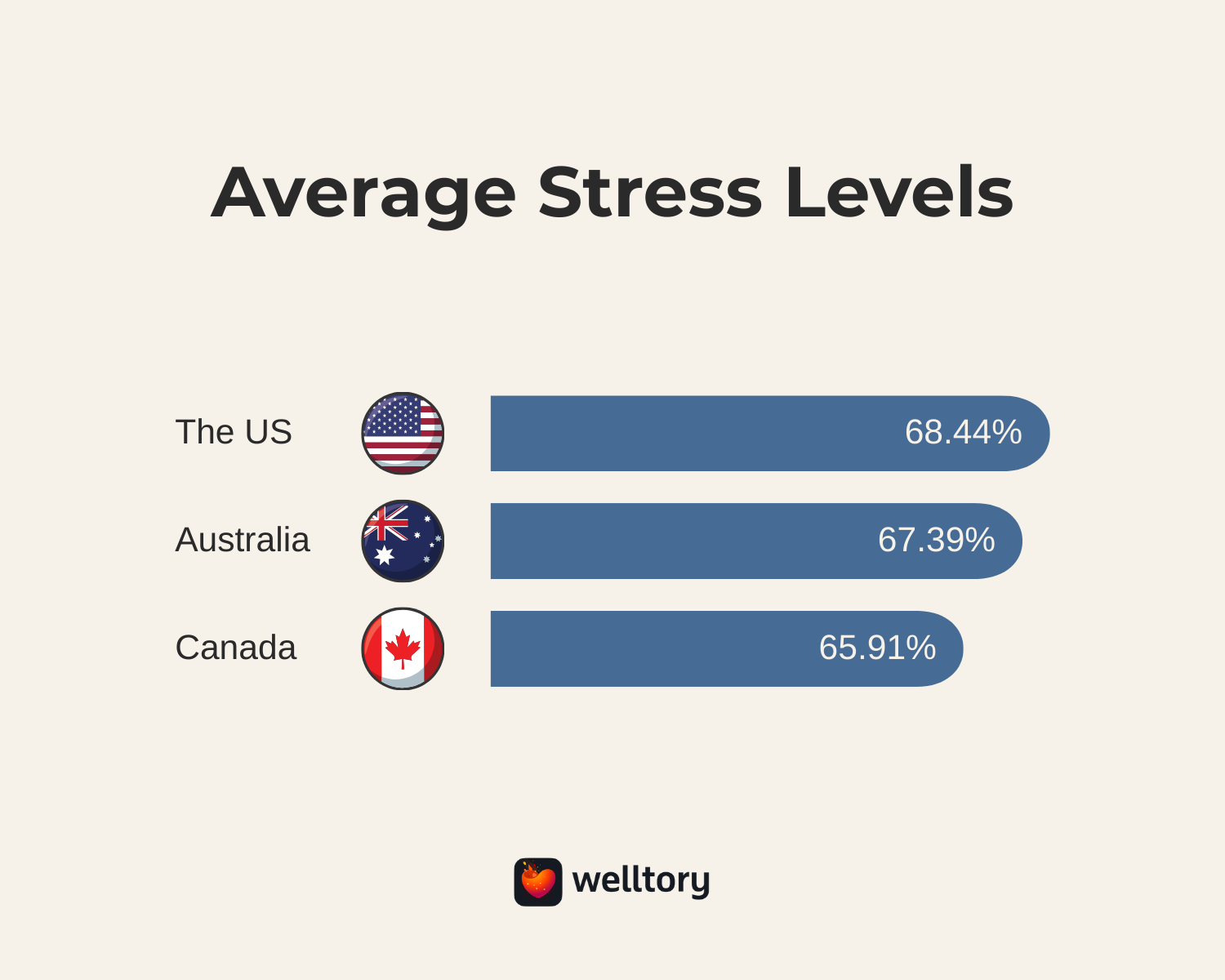
Stress levels in the US, Australia and Canada are very similar, ranging from 66% to 68%, showing that people from these countries are affected by daily pressure constantly. But the body’s response to stress tells a totally different story.
Canada leads in recovery levels (75.47%) and HRV (25.01) which reflects that Canadians bounce back quicker and have a more flexible nervous system. They also have the lowest stress levels (65.91%) and highest health resilience score (89.3).
On the other side, the US stress levels are the highest (68.44%) and the average recovery level is the lowest (73.63%). Meanwhile Australia falls in between — average stress levels (67.39%) and strong recovery level (75.2%) showing that their response to stress is better than in the US but not as effective as in Canada.
In comparison with European countries, all three have relatively high stress levels and low recovery, HRV, and health resilience scores.
“Higher stress levels and lower recovery levels and resilience scores in countries like the US, Canada, and Australia could be influenced by long working hours, high work pressure, commuting time, and less emphasis on daily rest compared to most of the European countries. Environmental factors, diet, and social support systems also play a role, showing that while stress is universal, how our bodies cope is shaped by both culture and daily habits.” said Anna Elitzur, MD, Mental Health Expert at Welltory.
Europe Proves Stress Isn’t the Problem — Poor Recovery Is
Stress, on its own, is not inherently harmful. It is a normal body response that helps the body adapt to challenges, maintain focus, and respond to changing demands. It actually can be beneficial because it strengthens nervous systems’ ability to cope with future pressure.
Stress only becomes bad when it is persistent and inadequately recovered from so the body does not return to baseline, allowing strain to accumulate over time.
To better understand how this dynamic plays out across Europe, we selected five European countries with the lowest and five with the highest average stress levels. This approach allows for a balanced comparison of stress exposure but also on how people from these countries recover from it.
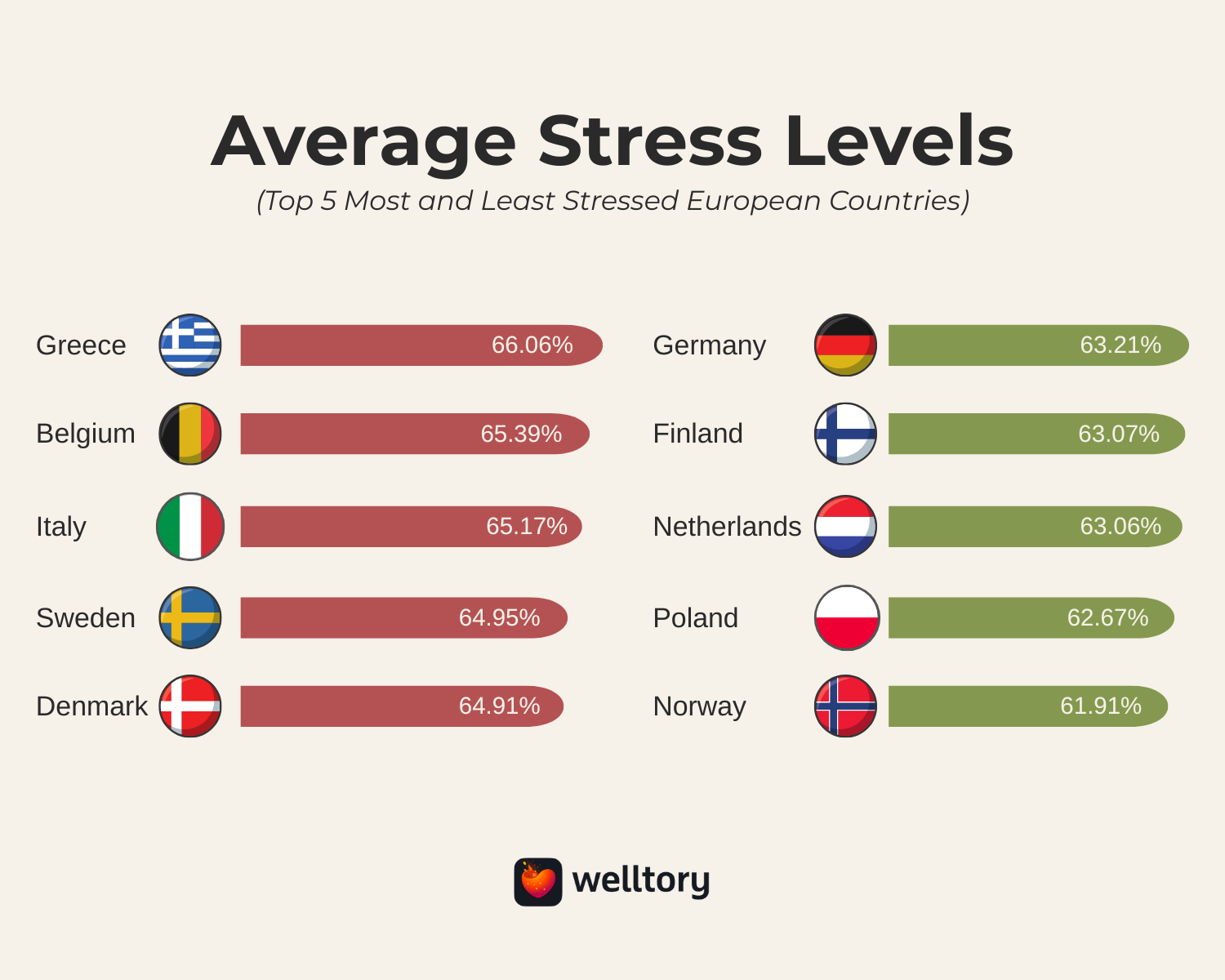
In Europe, stress levels are lower than in the US, Canada, and Australia ranging from 61.91% in Norway to 66.06% in Greece. But the real story emerges when we look at recovery, HRV, and health resilience. Northern and Western European countries like the Netherlands, Germany, Finland, and Norway stand out with the highest HRV and recovery levels. When we add the high health resilience score of all European countries being above 89, we get an image on how Europeans recover quicker and their body handles stress better than most countries from all around the world.
Interestingly, countries with higher levels of stress like Greece (66.06%) and Belgium (65.39%), still maintain solid recovery and resilience scores, hinting at how important cultural practices and lifestyle habits are. Overall, Europe presents a pattern of moderate stress but strong recovery and resilience showing that how the body handles and recovers from stress is what matters most.
How Do Asian Countries Handle Stress?
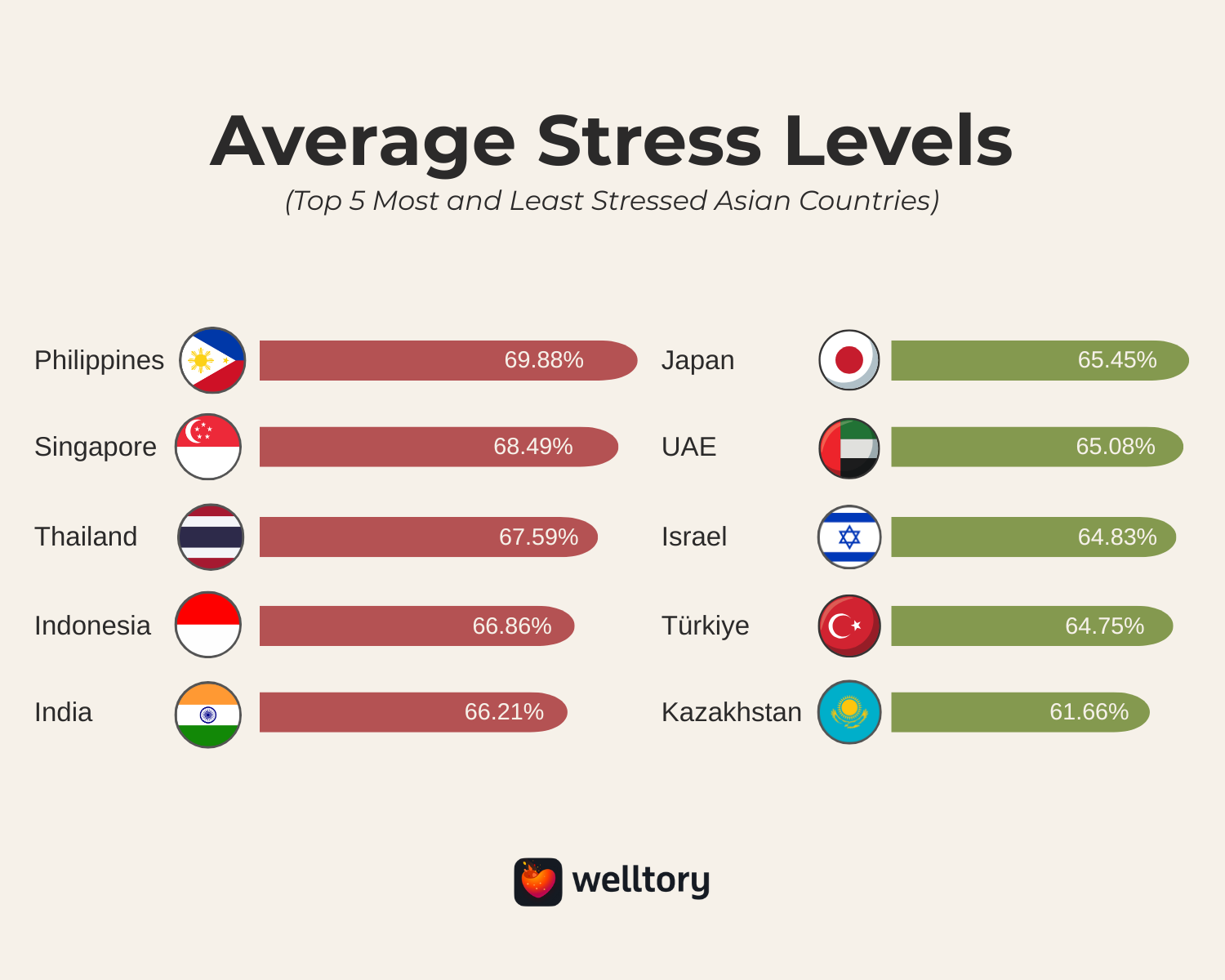
Stress levels in Asia vary more widely than in Europe, ranging from 61.66% in Kazakhstan to 69.88% in Philippines. Together with highest average stress levels, Philippines have the lowest recovery levels and HRV and the second lowest health resilience score. This makes the Philippines the most stressed Asian country that also has the most difficult time to recover from stress. What’s really interesting is that a well developed country like Singapore is the second one in average stress levels reflecting high work pressure, intense focus on academic achievement from a young age, and a high cost of living.
In contrast, countries like Japan, the UAE, and Israel combine moderate stress levels with high recovery and HRV highlighting that even under pressure, they bounce back quicker.
Kazakhstan stands out as the country with the lowest average stress levels, the second-highest recovery levels, the highest HRV and health resilience score reflecting a slower pace of life and a strong connection to nature.
Overall, Asia shows a wide range of stress and recovery patterns showing that while some countries face high levels of stress, others demonstrate strong resilience and recovery supported by lifestyle and environmental factors.
Global Stress Patterns in Perspective
Stress is a global experience but how our bodies react to it and recover varies widely across nations. While the US, Australia, and Canada face high levels of stress and moderate recovery, European countries face moderate stress and have high levels of recovery and health resilience. Asia on the other side, presents a mixed picture with some countries under intense pressure and others bouncing back exceptionally well.
“The data should be eye-opening for policymakers and public health officials, highlighting the need to study how lifestyle, cultural habits, and environmental factors shape stress adaptation and how we can improve this so people from all around the world recover quicker and are more health resilient” said Anna Elitzur, MD, Mental Health Expert at Welltory.
Understanding your stress, recovery, HRV, and health resilience can help guide healthier habits, better work-life balance, and more effective ways to manage daily challenges, no matter where you live.


.svg)


