

Short answer
Reactive hypoglycemia is low blood sugar that shows up after a meal rather than after a long fast — usually two to four hours after eating, sometimes up to five. It happens when the insulin response to a meal overshoots: glucose rises, insulin keeps working after the rise is over, and blood sugar dips below where it started.
The body answers the dip with adrenaline, and that is what you feel: shaky hands, a pounding heart, sweating, sudden hunger, irritability, brain fog. Eating something usually brings relief within minutes.
If that sounds like your afternoons, you're not imagining it. A blood sugar crash after eating is real physiology, and you don't need diabetes to feel one. In over 1,000 healthy adults wearing glucose monitors, bigger dips two to three hours after a meal predicted more hunger, an earlier next meal and more food eaten over the following day. (doi.org)
But there is an important twist. Most people who feel a "crash" don't have truly low blood sugar when it happens. In a classic study, researchers measured glucose during people's typical attacks: only 5% of 132 symptomatic episodes came with glucose at or below 50 mg/dL (2.8 mmol/L). (doi.org) The symptoms were real, but in most episodes glucose wasn't low. Other things can produce the same feelings — a fast fall that stops short of the low range, a stress response, blood pooling in the gut after a big meal, or caffeine — though that study didn't test them. That is why doctors diagnose hypoglycemia only when a low reading is caught at the same moment as the symptoms. (doi.org)
This article explains what reactive hypoglycemia is, why it can feel like panic, what causes it, how it overlaps with POTS, what a glucose monitor can and can't show, what actually helps — and how to track the pattern.
What is reactive hypoglycemia?
Reactive hypoglycemia — doctors also call it postprandial hypoglycemia, "postprandial" meaning "after a meal" — is a drop in blood glucose into the low range within a few hours of eating, in someone who isn't on glucose-lowering medication.
A 2019 review describes three timing patterns: (doi.org)
| Type | When it happens | Typical background |
|---|---|---|
| Alimentary (early) | Within about 2 hours of eating | Fast stomach emptying, often after stomach or bariatric surgery |
| Idiopathic | Around 3 hours after eating | No clear cause found |
| Late | Around 4–5 hours after eating | A delayed, oversized insulin release — often linked to early insulin resistance |
The mechanism behind the common forms is timing. After a carbohydrate-rich meal, the pancreas normally releases a quick first burst of insulin and then a slower second wave. If the first burst is weak, glucose climbs higher than it should, and the pancreas compensates with a late, excessive second wave. By the time that insulin peaks, the meal's glucose is already cleared — so blood sugar falls below baseline. (doi.org)
It's worth separating three things that people often lump together:
A normal post-meal dip. Glucose rises after food and falls back, sometimes a little below where it started. Almost everyone does this. Healthy, non-obese children and adults (aged 7 to 80) wearing a continuous glucose monitor still spent a median of about 15 minutes a day below 70 mg/dL (3.9 mmol/L). (doi.org)
A blood sugar crash. A fast fall after a spike that feels bad — shaky, hungry, foggy — even if the number never gets truly low.
True reactive hypoglycemia. Glucose that actually falls into the low range (doctors usually use below 55 mg/dL, or 3.0 mmol/L, when investigating people without diabetes), with symptoms at the same time and relief when glucose is raised. (doi.org)
All three can be uncomfortable. Only the third is a diagnosis.
Reactive hypoglycemia symptoms: why a crash feels like a panic attack
The strangest thing about a blood sugar crash is that it rarely feels like "low sugar". It feels like anxiety.
That's because your body defends its glucose in stages, and the alarm goes off before the tank is empty. In experiments where researchers lowered healthy volunteers' glucose step by step under controlled conditions, the body started releasing adrenaline and glucagon at around 68–69 mg/dL (3.8 mmol/L) — still inside the normal range. (doi.org) (doi.org) Symptoms came later, in a clear order:
| Glucose level (approximate) | What happens | What it feels like |
|---|---|---|
| ~68 mg/dL (3.8 mmol/L) | Adrenaline, noradrenaline, glucagon and growth hormone released | Often nothing yet — the body is quietly correcting |
| ~58 mg/dL (3.2 mmol/L) | Autonomic ("warning") symptoms begin | Anxiety, palpitations, sweating, irritability, tremor |
| ~51 mg/dL (2.8 mmol/L) | Brain-fuel symptoms begin | Hunger, dizziness, tingling, blurred vision, difficulty thinking, faintness |
| ~49 mg/dL (2.7 mmol/L) | Measurable drop in thinking speed | Confusion, slowness |
Thresholds from a controlled study in 10 healthy volunteers. (doi.org)
So the typical reactive hypoglycemia symptoms are:
Shaking or trembling, especially the hands — the reason people search for "shaky after eating"
A racing or pounding heart
Sweating, often cold and clammy
Sudden, urgent hunger
Anxiety or a sense of dread, irritability, feeling "hangry"
Brain fog, trouble concentrating, feeling spaced out
Weakness, dizziness or lightheadedness
Blurred vision or tingling around the lips, in deeper dips
The first half of that list is adrenaline. It's the same chemistry as a stress response, which is why a crash can be mistaken for a panic attack — and why people with anxiety sometimes wonder whether their attacks are really about blood sugar. (We cover the difference between the two in panic attack vs anxiety attack.) The heart side of the response is measurable: when researchers induced low blood sugar in a small group of volunteers, cardiac vagal tone — the "calming" branch of the nervous system — dropped, and took about 30 minutes to recover in people without diabetes. (doi.org)
There's also a timing clue. A crash that arrives two to four hours after a meal and eases within minutes of eating points toward a glucose problem. Anxiety that doesn't care when you last ate points elsewhere.
Can you have hypoglycemia without diabetes?
Yes — but true low blood sugar without diabetes is less common than the feeling of it.
The 1989 study mentioned above is still one of the most useful pieces of evidence. Researchers gave 28 people referred for suspected postprandial hypoglycemia a way to measure their glucose at home while their usual symptoms were happening. Five of the 28 (18%) had at least one episode with glucose at or below 50 mg/dL, and eight more had readings between 52 and 59 mg/dL. Across all 132 symptomatic episodes, only 5% came with a clearly low reading. In 17 people without symptoms, glucose never fell that low across 140 measurements. (doi.org)
Two findings from that study matter for anyone trying to work out what's going on:
No single symptom predicted a low reading. None of the symptoms people reported was specifically linked to low glucose.
Relief after eating was a better clue. 86% of episodes with glucose at or below about 59 mg/dL (3.3 mmol/L) were relieved by food, compared with 53% of episodes with higher glucose.
When symptoms come after meals but glucose measured at the time is normal, doctors sometimes call it idiopathic postprandial syndrome — the same symptom package without biochemical hypoglycemia. It's a diagnosis made once other causes are excluded, and it's usually managed the same way, with meal changes. (doi.org) That isn't "it's all in your head". It means the trigger is something other than a low number — often the speed of the fall, the adrenaline response itself, or circulation changes after a meal.
So the honest answer to "can you have hypoglycemia without diabetes" is: yes, it exists, and it's worth investigating when it's frequent or severe — but the only way to know is to catch a low reading during symptoms.
What causes reactive hypoglycemia?
Most of the time, the cause is ordinary. Sometimes it isn't. Here are the main groups, from most to least common.
The meal itself. A large load of fast carbohydrates on its own — sweet coffee drinks, juice, pastries, white bread, a big bowl of pasta, a sugary breakfast cereal — produces a steep glucose rise and a big insulin response, which sets up the fall. Liquid sugar is the fastest of all. A meal that pairs carbohydrate with protein, fat and fiber rises more slowly and falls more gently.
Early insulin resistance. When cells respond sluggishly to insulin, the pancreas makes more of it, and the late second wave can overshoot. The 2019 review argues that hypoglycemia four to five hours after a glucose drink may be an early warning sign of future diabetes, especially in people with weight gain or a family history of diabetes. (doi.org) It can happen at a normal weight too: a 2026 case series described three young, normal-weight women whose reactive hypoglycemia was likely driven by disproportionate insulin release, possibly left over from childhood obesity. (doi.org) If you get crashes regularly, it's worth knowing the signs of insulin resistance and prediabetes.
Stomach or bariatric surgery. After gastric bypass, sleeve gastrectomy and some other upper-gut operations, food reaches the intestine very fast, triggering a large, early insulin release. Symptoms of post-bariatric hypoglycemia have been reported in up to 30% of patients after surgery, and they are frequently misattributed to other conditions for years. (doi.org) It typically appears more than a year after the operation, not straight away. (doi.org) If you've had this kind of surgery and get post-meal episodes, tell your surgical team — this is a recognised complication with specific treatments.
Alcohol, exercise and empty-stomach caffeine. Alcohol reduces the liver's ability to release glucose; hard exercise uses glucose faster; caffeine amplifies the adrenaline response. None of these cause reactive hypoglycemia on their own, but each can deepen or sharpen a post-meal dip. (More on the morning after drinking in what alcohol does to your body overnight, and on caffeine in the caffeine crash.)
Rare causes. Insulin-producing tumours (insulinoma), autoimmune reactions against insulin, some medications, hormone deficiencies and a few inherited conditions can all cause hypoglycemia. They are uncommon, but they're the reason clinical guidelines recommend proper testing when low glucose is documented. (doi.org) Episodes while fasting, at night or getting worse over time deserve a doctor rather than a diet change.
Why crashes hit harder on stressful days and after bad sleep
Many people notice that the same lunch is fine one day and knocks them out the next. There are good reasons for that.
Short sleep makes the body less sensitive to insulin. In healthy adults, a single night of about four hours' sleep reduced insulin sensitivity the next day: the glucose infusion needed to keep blood sugar steady fell by about 25%, with both the liver and the muscles affected. (doi.org) Less sensitive tissues mean a higher post-meal peak and, in some people, a bigger insulin response and a sharper fall afterwards.
Stress changes how you handle the same meal. In a small crossover study of 15 men with post-traumatic stress disorder, the same glucose drink produced higher blood glucose and insulin on a day with acute psychological stress than on a rest day. (doi.org)
Stress and a crash feel alike. A crash is an adrenaline response, and so is stress, so a tense afternoon and a sugar dip can blur together: stress can push the post-meal peak higher, and if the fall afterwards reaches the low range, it adds adrenaline of its own. From the inside it can feel like one long bad afternoon.
That's why looking at the meal alone often doesn't explain the pattern. The day around the meal matters — which is covered in more detail in our guide to continuous glucose monitors and in emotional vs physical stress.
Reactive hypoglycemia and POTS: two problems that feel the same
If you have POTS (postural orthostatic tachycardia syndrome) or another form of dysautonomia, post-meal crashes are extremely familiar — and they're easy to blame on blood sugar when the cause is actually circulation.
After you eat, a large share of your blood flows to the gut to help with digestion. In people with POTS, whose circulation already struggles to keep blood up in the chest and head when standing, that shift can tip them into symptoms. A 2022 study gave 12 women with POTS — chosen because their symptoms got worse after meals — and 13 healthy women the same glucose drink. Afterwards, standing heart rate rose by 21% in the POTS group compared with 6% in controls, and the amount of blood the heart pumped with each beat fell by about 10%. The change tracked a gut hormone called GIP, which widens blood vessels in the digestive tract. (doi.org)
That means a POTS patient can feel shaky, lightheaded, sweaty and racing-hearted after a carb-heavy meal without low blood sugar — the problem is blood pooling, not glucose. And some people have both.
| | Reactive hypoglycemia | Post-meal POTS flare |
|---|---|---|
| Timing | Usually 2–4 hours after eating | Often within the first hour or two |
| Worse when standing? | Not especially | Yes, clearly |
| Relieved by eating? | Yes, within minutes | No — eating more can make it worse |
| Relieved by lying down, fluids, salt? | Not much | Often yes |
| Glucose during symptoms | Low | Normal |
Practical overlaps: both tend to improve with smaller, more frequent meals and fewer refined carbohydrates at once. If you have POTS, a fingerstick glucose during a post-meal episode is the simplest way to tell the two apart. More on POTS in what causes POTS and how POTS is diagnosed.
What a glucose monitor can and can't tell you
Continuous glucose monitors are now available without a prescription, and many people with suspected reactive hypoglycemia buy one to see what's happening. That can help — if you know the limits.
What it can show well:
The shape of your post-meal curve — how high you go, how fast you fall, and whether you dip below your starting point two to four hours later.
Which meals do it. The same person often has a gentle curve after eggs and toast and a steep one after cereal and juice.
Whether the dip lines up with your symptoms. That's the most useful single thing a monitor can tell you.
Where it can mislead:
Normal people dip too. A median of 15 minutes a day below 70 mg/dL was normal in healthy children and adults. (doi.org) A brief low on the graph is not a diagnosis.
Lying on the sensor causes false lows. In healthy volunteers wearing sensors overnight, sudden drops in reported glucose were strongly linked to lying on the sensor, most likely because pressure reduces local blood flow. (doi.org) Sharp overnight lows that recover as soon as you roll over are usually this.
Sensors lag. They measure fluid under the skin, which trails blood glucose by several minutes — more during fast changes, exactly when a crash happens.
Accuracy is weakest at the low end, which is the range that matters here.
The rule of thumb: if the monitor shows a low during symptoms, confirm it with a fingerstick meter before you act on it, and bring both readings to your doctor. A glucose monitor is a way to find a pattern, not the test that diagnoses it.
Reactive hypoglycemia treatment: what actually helps
Treatment depends on the cause, so the first step is knowing whether your glucose actually goes low. For the common, idiopathic form, the evidence mostly comes from clinical experience, reviews and case reports rather than large trials — but the approach is consistent, low-risk and worth trying. (doi.org) (doi.org)
The reactive hypoglycemia diet, in practice
Build each meal around protein, fat and fiber, with carbohydrate as a side rather than the main event. Eggs, Greek yogurt, fish, chicken, beans, lentils, nuts, vegetables and whole grains slow the rise and soften the fall.
Cut liquid sugar first. Juice, soda, sweet coffee drinks and smoothies on an empty stomach produce the steepest spikes. If you have one, have it with food.
Eat smaller meals more often instead of two big ones. A large meal after a long gap is a classic setup for a crash.
Don't arrive at meals starving. Extreme hunger leads to fast eating and large portions, which leads to the next spike and dip.
Pair carbohydrate with something. An apple with peanut butter behaves very differently from an apple alone.
Watch alcohol on an empty stomach and caffeine on its own — both sharpen the dip.
Move after meals. A meta-analysis of seven trials found that breaking up sitting with short bouts of standing lowered post-meal glucose, and light walking worked better than standing. (doi.org) Those trials broke up a whole day of sitting, mostly in people with overweight; a short walk after meals is a practical everyday version of the same idea.
If a crash is happening now
If you have symptoms and can check your glucose, check it. If it's low, or you can't check and feel shaky, sweaty and weak, eat or drink 15 to 20 grams of fast carbohydrate — for example four glucose tablets, half a cup of regular juice, half a can of regular soda, or a tablespoon of sugar or honey — then wait 15 minutes and check again. If your next meal is more than an hour away, have a snack. (niddk.nih.gov) A snack with some protein or fat can help you avoid bouncing back down. If you take acarbose or miglitol, use glucose tablets or gel only: these drugs slow the absorption of table sugar, juice and other carbohydrates, so they won't raise your glucose fast enough. (niddk.nih.gov) If you become confused, faint, or can't swallow safely, someone should call emergency services.
When a doctor adds medication
Medication is usually reserved for documented, frequent hypoglycemia that diet doesn't control — most often after bariatric surgery. No drug is FDA-approved specifically for post-bariatric hypoglycemia, and trials are scarce, so specialists choose treatment case by case. (doi.org) Acarbose, which slows carbohydrate absorption, is one of the conventional options; newer drugs are being tried in case reports when standard approaches aren't enough. (doi.org) Where early insulin resistance is the driver, the review suggests treating that underlying state can help. (doi.org)
How to track your crash pattern — with or without a glucose monitor
Reactive hypoglycemia is a timing problem, so the most useful thing you can bring to a doctor is a timeline. You need three things for each episode: what you ate, when the symptoms started, and what else was happening.
This is where Welltory fits, as long as you're clear about what it measures. Welltory doesn't read glucose. It does detect stress episodes in real time from your heart rate and physiological signals — and the adrenaline surge of a crash is, physiologically, a stress response. So a crash can show up in Welltory as a stress episode two to four hours after a meal, with heart rate up and heart rate variability down, sometimes followed by a dip in your daily energy (body battery).
What Welltory data shows: stress episodes are an everyday event
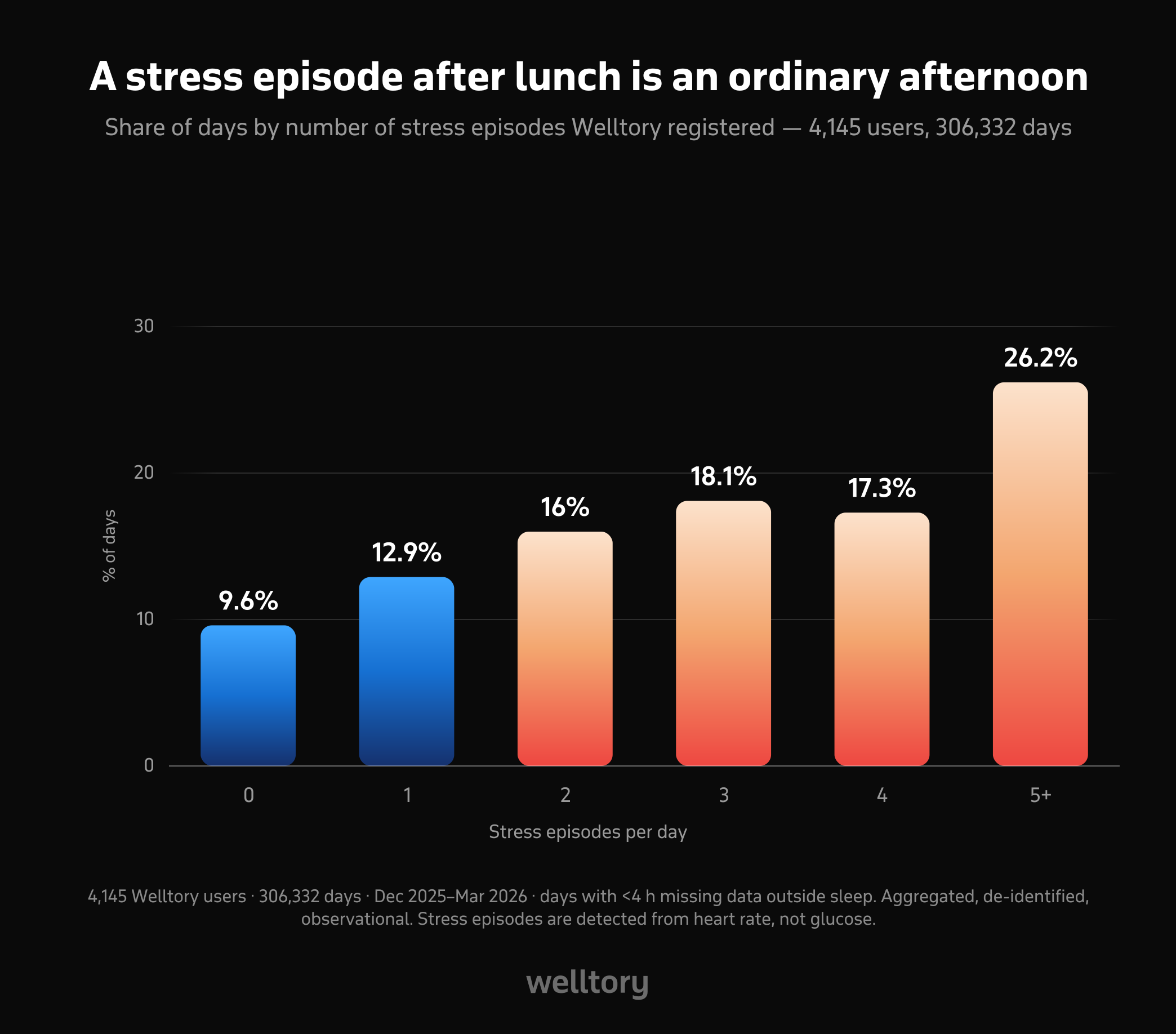
Before you read a post-meal stress episode as a crash, it helps to know how common stress episodes are anyway. Across 4,145 Welltory users and 306,332 well-tracked days, the typical user registered about three stress episodes a day (median 3.25; the middle half of users ranged from 2.3 to 4.1). 90.4% of days had at least one, and 77.5% had two or more.
The rate barely changed between groups: 3.18 a day in users who report no health conditions, 3.41 in those who report three or more, and 3.43 in users who self-report POTS. In other words, a stress episode a couple of hours after lunch is what an ordinary afternoon often looks like. It starts to mean something only when it keeps landing in the same window after the same kind of meal — and when a glucose reading taken at that moment is low.
Welltory users who wore a wearable for the 90-day window (Dec 2025–Mar 2026), days with less than four hours of missing data outside sleep. Observational and aggregated; stress episodes are detected from heart rate and physiological signals, not from glucose.
A simple two-week method:
Log meals as notes in My Patterns — "sweet breakfast", "pasta lunch", "protein breakfast", "walk after lunch". Each note becomes a tag.
When a crash hits, add a note — "shaky", "crash" — and, if you have a meter or a glucose monitor, the reading.
After two weeks, look at the timing. Do the crash tags cluster two to four hours after the same kinds of meals? Do they come more often after short nights or on high-stress days? Do protein-first meals or post-lunch walks show up with calmer afternoons?
Two cautions. A stress episode after a meal is not proof of low blood sugar — it could be the meal, the meeting you walked into, or a POTS response. And a calm afternoon doesn't prove your glucose was fine. Treat the pattern as a lead to test, not a result.
What does the evidence not show?
That every crash is hypoglycemia. Most symptomatic episodes in people who suspect reactive hypoglycemia come with normal glucose. (doi.org)
That a glucose drink test proves it. The same 1989 study found no correlation between glucose after an oral glucose drink and glucose measured during real-life symptoms, and concluded that the drink test is not helpful for this question. Clinical guidelines base the diagnosis on a low reading during symptoms instead. (doi.org) (doi.org)
That a specific diet is proven. Protein-and-fiber-first eating, smaller meals and less liquid sugar are standard advice with good physiological logic, but large randomised trials in idiopathic reactive hypoglycemia are lacking.
That reactive hypoglycemia always leads to diabetes. Late dips may signal early insulin resistance in some people, especially with weight gain or family history, but that link is based on clinical observation rather than long prospective studies. (doi.org)
That Welltory can detect low blood sugar. It can't. It detects stress responses, which a crash can trigger — along with many other things. Our users average about three stress episodes a day, so one episode after a meal proves nothing on its own.
When should you see a doctor?
Make an appointment if crashes happen regularly, disrupt your work or sleep, or you've had stomach or bariatric surgery. See a doctor promptly — not just a dietitian — if:
Symptoms happen while fasting, first thing in the morning, overnight or after exercise without food
You've fainted, had a seizure, or become confused during an episode
Episodes are getting more frequent or more severe
You're losing weight without trying, or have other new symptoms
Symptoms don't improve within 15–20 minutes of eating
You take medications that might lower glucose, or have kidney, liver or adrenal problems
How to bring this up with your doctor — and what to ask for
Bring a timeline, not just a description. Two weeks of meals, symptom times and — if you have them — glucose readings taken during symptoms. The key detail is how many hours after eating the symptoms start, and whether food relieves them.
Say what you want to know. "I get shaky, sweaty and foggy two to three hours after meals, and it goes away when I eat. Could this be reactive hypoglycemia, and how can we check?"
Ask these specifically. Can we confirm a low glucose during a real episode, with a meter or a lab test? Would a mixed-meal test make sense for me? Should I be checked for insulin resistance or prediabetes — fasting glucose, HbA1c? Could any of my medications, alcohol or past surgery play a role? Could this be POTS or anxiety instead, and how would we tell?
If you are dismissed. "Can you note in my record that I'm having recurrent post-meal episodes relieved by eating, and tell me what reading would make you want to investigate?" A documented concern gets revisited more often.
How Welltory helps
Welltory doesn't measure glucose, and it isn't a hypoglycemia test. What it does is record the body's response to a crash — the stress episode, the heart rate jump, the drop in heart rate variability — alongside your sleep, stress and daily energy, against your own baseline rather than a population average.
With My Patterns, your meal notes become tags, and over a few weeks you can see which meals keep turning up before a crash, which ones don't, and how much short sleep or a stressful day changes the picture. That's the timeline a doctor needs — and often the first time people see that their "random" crashes follow a very regular pattern. (For the hunger version of the same alarm, see why you feel shaky when hungry; for the heavy-eyed version, see why you feel tired after eating.)
How we made it
The clinical content rests on published research: the Endocrine Society guideline on hypoglycemic disorders (Cryer et al. 2009), a review of postprandial reactive hypoglycemia (Altuntaş 2019), glucose measured during spontaneous symptoms (Palardy et al. 1989), glycemic thresholds for counterregulation and symptoms (Mitrakou et al. 1991; Schwartz et al. 1987), autonomic responses to hypoglycemia (Bitsch Poulsen et al. 2026), post-meal glucose dips and appetite (Wyatt et al. 2021), CGM reference ranges in healthy adults (Shah et al. 2019), sensor compression artefacts (Mensh et al. 2013), glucose and orthostatic tachycardia in POTS (Breier et al. 2022), post-bariatric hypoglycemia (Lawler et al. 2025; Abdelgadir et al. 2025; Milosavljevic et al. 2026), idiopathic postprandial syndrome (Isaacs et al. 2025), reactive hypoglycemia in normal-weight women (Akamatsu et al. 2026), sleep restriction and insulin sensitivity (Donga et al. 2010), acute stress and glucose (Nowotny et al. 2010), and activity breaks after meals (Buffey et al. 2022). Practical treatment steps follow NIDDK guidance.
Welltory does not measure glucose, so no glucose figures here come from our own data. The stress-episode figures come from an aggregated, de-identified Welltory dataset: 4,145 users with good-quality wearable data, 306,332 days (December 2025 to March 2026), checked separately by the number of conditions users report, in users reporting no conditions and in users who self-report POTS. Product descriptions reflect how Welltory's stress episodes, body battery and My Patterns work today.


Discounts for blog readers: up to 36% off
See what affects your energy, stress, sleep, and daily state with Welltory
This article is for educational purposes only and is not a substitute for medical advice, diagnosis, or treatment from a qualified clinician.
Was this helpful?
Ask AI for a summary of page


Written by Jane Smorodnikova

The founder and CEO of Welltory. A recognized tech leader with two Master's degrees and experience at MIT, she has scaled Welltory to over 17 million users.
Written by Tatsiana Yashyna

Deputy COO at Welltory. With a background in medicine and years of working with health data, she translates research and real physiological signals — sleep, stress, heart rate, and hormones — into clear, evidence-based explanations that help people understand what their bodies are telling them.
References
- Cryer PE, Axelrod L, Grossman AB, et al. Evaluation and management of adult hypoglycemic disorders: an Endocrine Society clinical practice guideline. Journal of Clinical Endocrinology & Metabolism 2009;94(3):709-728. https://doi.org/10.1210/jc.2008-1410
- Altuntaş Y. Postprandial reactive hypoglycemia. Sisli Etfal Hastanesi Tip Bulteni 2019;53(3):215-220. https://doi.org/10.14744/SEMB.2019.59455
- Palardy J, Havrankova J, Lepage R, et al. Blood glucose measurements during symptomatic episodes in patients with suspected postprandial hypoglycemia. New England Journal of Medicine 1989;321(21):1421-1425. https://doi.org/10.1056/NEJM198911233212101
- Mitrakou A, Ryan C, Veneman T, et al. Hierarchy of glycemic thresholds for counterregulatory hormone secretion, symptoms, and cerebral dysfunction. American Journal of Physiology — Endocrinology and Metabolism 1991;260(1):E67-E74. https://doi.org/10.1152/ajpendo.1991.260.1.e67
- Schwartz NS, Clutter WE, Shah SD, Cryer PE. Glycemic thresholds for activation of glucose counterregulatory systems are higher than the threshold for symptoms. Journal of Clinical Investigation 1987;79(3):777-781. https://doi.org/10.1172/JCI112884
- Bitsch Poulsen M, Brock C, Julu PO. Real-time autonomic responses to insulin-induced hypoglycaemia in volunteers with type I diabetes compared to controls. IBRO Neuroscience Reports 2026;20:119-124. https://doi.org/10.1016/j.ibneur.2025.12.014
- Wyatt P, Berry SE, Finlayson G, et al. Postprandial glycaemic dips predict appetite and energy intake in healthy individuals. Nature Metabolism 2021;3(4):523-529. https://doi.org/10.1038/s42255-021-00383-x
- Shah VN, DuBose SN, Li Z, et al. Continuous glucose monitoring profiles in healthy nondiabetic participants: a multicenter prospective study. Journal of Clinical Endocrinology & Metabolism 2019;104(10):4356-4364. https://doi.org/10.1210/jc.2018-02763
- Mensh BD, Wisniewski NA, Neil BM, Burnett DR. Susceptibility of interstitial continuous glucose monitor performance to sleeping position. Journal of Diabetes Science and Technology 2013;7(4):863-870. https://doi.org/10.1177/193229681300700408
- Breier NC, Paranjape SY, Scudder S, et al. Worsening postural tachycardia syndrome is associated with increased glucose-dependent insulinotropic polypeptide secretion. Hypertension 2022;79(5):e89-e99. https://doi.org/10.1161/HYPERTENSIONAHA.121.17852
- Lawler HM, McGinnis T, Patti ME. Diagnosis and management of post-bariatric hypoglycemia. Journal of the American Board of Family Medicine 2025;38(2):383-394. https://doi.org/10.3122/jabfm.2024.240335R1
- Isaacs D, Kashefi M, Downs I, Weinreb J. A veteran presenting with symptomatic postprandial episodes. Federal Practitioner 2025;42(2):1-6. https://doi.org/10.12788/fp.0541
- Akamatsu Y, Anno T, Murakami K, et al. Postprandial reactive hypoglycemia due to disproportionate insulin secretion in young adult Japanese women with a normal weight and a history of childhood obesity: a three-case series with a review of literature. Internal Medicine 2026. https://doi.org/10.2169/internalmedicine.7270-26
- Donga E, van Dijk M, van Dijk JG, et al. A single night of partial sleep deprivation induces insulin resistance in multiple metabolic pathways in healthy subjects. Journal of Clinical Endocrinology & Metabolism 2010;95(6):2963-2968. https://doi.org/10.1210/jc.2009-2430
- Nowotny B, Cavka M, Herder C, et al. Effects of acute psychological stress on glucose metabolism and subclinical inflammation in patients with post-traumatic stress disorder. Hormone and Metabolic Research 2010;42(10):746-753. https://doi.org/10.1055/s-0030-1261924
- Buffey AJ, Herring MP, Langley CK, et al. The acute effects of interrupting prolonged sitting time in adults with standing and light-intensity walking on biomarkers of cardiometabolic health in adults: a systematic review and meta-analysis. Sports Medicine 2022;52(8):1765-1787. https://doi.org/10.1007/s40279-022-01649-4
- National Institute of Diabetes and Digestive and Kidney Diseases. Low blood glucose (hypoglycemia). https://www.niddk.nih.gov/health-information/diabetes/overview/preventing-problems/low-blood-glucose-hypoglycemia
- Abdelgadir E, Rashid F, Al Awadi F, et al. Post-bariatric hypoglycemia management: a Gulf Cooperation Council consensus statement. Journal of the Endocrine Society 2026;10(2):bvaf225. https://doi.org/10.1210/jendso/bvaf225
- Milosavljevic J, Meyer C, Levine JA, Sachdev S. Tirzepatide for treatment of postbariatric hypoglycemia after Roux-en-Y gastric bypass: a report of 3 cases. JCEM Case Reports 2026;4(10):luag216. https://doi.org/10.1210/jcemcr/luag216


