
What causes POTS? Triggers, mechanisms, and why it rarely comes alone
There's no single cause — the mechanisms (neuropathic, hyperadrenergic, hypovolemic), the common triggers (post-viral, EDS, autoimmune, hormonal), why it's reported more in women, why it seems more common now, and what it overlaps with.

Short Answer
There is no single cause of POTS. It’s better understood as a final common pathway: different problems can all end in the same body-level pattern — when you sit or stand, blood doesn’t return upward efficiently enough, blood flow to the brain and organs becomes harder to keep steady, and your heart speeds up to compensate. Researchers group POTS into overlapping patterns such as neuropathic POTS, where small-fiber/autonomic nerve problems can let blood pool in the legs or abdomen; hyperadrenergic POTS, where the sympathetic “fight-or-flight” system is overactive; and hypovolemic POTS, where blood volume is lower than it should be. These patterns often overlap rather than fitting into one clean box. (my.clevelandclinic.org)
POTS “is defined by chronic orthostatic intolerance accompanied by an excessive increment in sinus heart rate on standing in the absence of significant orthostatic hypotension” (Chopra, Frontiers in Neurology, 2026) — and that excessive heart-rate rise is often a compensation, not a primary heart problem.
That’s why “what causes POTS?” usually has more than one answer. In some people, symptoms begin after a viral illness, including COVID-19; in others, POTS is linked with joint hypermobility or Ehlers-Danlos syndrome, autoimmune conditions such as lupus or Sjögren’s syndrome, surgery, physical trauma, pregnancy, puberty, or symptom flares around periods. The common thread is not that all of these triggers damage the same organ in the same way. It’s that they can disturb the autonomic system, blood-vessel tightening, blood volume, connective-tissue support, inflammation, or stress-hormone signaling — the systems your body uses every second to keep blood moving upward when gravity pulls it down. (my.clevelandclinic.org)
The main mechanisms of POTS
POTS is usually not one clean “cause.” It’s more like a circulation-control problem with several possible drivers. When you stand, your autonomic nervous system is supposed to tighten blood vessels, keep enough blood returning to your heart, and adjust your heart rate so your brain still gets steady blood flow. In POTS, that coordination can break down in different ways — and the same person can have more than one mechanism at once. The 2015 Heart Rhythm Society consensus describes autonomic denervation, low blood volume, hyperadrenergic activation, and deconditioning as mechanisms that often co-exist rather than neat, separate boxes. (pmc.ncbi.nlm.nih.gov)
| Mechanism type | What's thought to drive it | Notes |
|---|---|---|
| Neuropathic POTS | Small-fiber or autonomic nerve dysfunction can weaken the signal that tells blood vessels — especially in the legs and lower body — to constrict when you stand. Blood then pools downward, less blood returns to the heart, and your heart rate may climb to compensate. | Often involves lower-limb and sometimes abdominal/splanchnic blood pooling. A clinician may look for neuropathic clues with autonomic testing or skin biopsy, but this is not something you diagnose from symptoms alone. (pmc.ncbi.nlm.nih.gov) |
| Hyperadrenergic POTS | This is the “fight-or-flight is too loud when upright” pattern. Standing may trigger excess sympathetic activation, with high standing norepinephrine in testing, pounding heart, tremor, sweating, shakiness, and anxiety-like surges that come from the body’s adrenaline system — not simply from “being anxious.” | The Heart Rhythm Society describes hyperadrenergic POTS as a pattern that can include elevated standing norepinephrine, a rise in standing systolic blood pressure, palpitations, tachycardia, tremor, and anxiety-like symptoms. Dysautonomia International also lists hyperadrenergic POTS as a subtype associated with elevated norepinephrine. (pmc.ncbi.nlm.nih.gov) |
| Hypovolemic / deconditioning | Low blood volume means there is less circulating fluid available to fill the blood vessels when you stand. Deconditioning after illness, bed rest, or a long period of reduced activity can make the same upright posture feel much harder because the heart and blood vessels have less reserve. | Often overlaps with neuropathic and hyperadrenergic patterns. Cleveland Clinic notes that low blood volume can create symptoms similar to, and overlapping with, other POTS types; Dysautonomia International also includes prolonged bed rest/deconditioning among POTS-like mechanisms. (my.clevelandclinic.org) |
These labels are useful for explaining why your body reacts the way it does, but they are not rigid identity tags. Many people do not fit neatly into one subtype: neuropathic blood pooling can sit alongside low blood volume; hyperadrenergic surges can appear because the body is trying to compensate for poor blood return; deconditioning can amplify the whole loop. That is why a good POTS evaluation usually looks for patterns — heart rate, blood pressure, symptoms, blood volume clues, neuropathy clues, triggers, and overlapping conditions — rather than asking you to pick one subtype from a list. (dysautonomiainternational.org)
Common triggers and associations
POTS usually isn’t a single-cause condition. Think of it as a vulnerable circulation-and-autonomic system meeting a stressor: an infection, hormonal shift, injury, surgery, pregnancy, prolonged bed rest, or another condition that changes blood volume, blood-vessel tone, immune signaling, or connective-tissue support. In your body, that can mean more blood settling in the legs and abdomen when you stand, less steady blood return to the heart, and a nervous system that compensates by pushing heart rate higher. Cleveland Clinic, Johns Hopkins, Dysautonomia International, and PoTS UK all describe POTS as multifactorial, with common links to viral illness, COVID/long COVID, hypermobility or Ehlers-Danlos syndrome, autoimmune disease, pregnancy or other stressors, trauma/surgery, and deconditioning. (my.clevelandclinic.org)
Viral illness, including COVID-19 / long COVID — POTS can begin after an infection. Viral illnesses such as mononucleosis and COVID-19 are recognized onset stressors, and long COVID can include autonomic dysfunction — the system that regulates heart rate, blood pressure, breathing, and other automatic functions. (my.clevelandclinic.org)
Hypermobility / Ehlers-Danlos (EDS) — Hypermobility spectrum disorder and hypermobile EDS commonly overlap with POTS. One likely “why” is mechanical: looser connective tissue may give veins less support, so blood can pool more easily when you stand, forcing your heart to beat faster to keep blood moving upward. (hopkinsmedicine.org)
Autoimmune conditions — Autoimmunity is implicated in a subset of POTS cases. POTS is reported alongside autoimmune conditions such as Sjögren’s syndrome, lupus, celiac disease, autoimmune autonomic neuropathy, diabetes, and sarcoidosis; research also discusses immune and autoantibody pathways in POTS and long COVID. (my.clevelandclinic.org)
Hormonal shifts — Puberty, pregnancy, postpartum changes, the menstrual cycle, and perimenopause can all change the terrain your autonomic nervous system is working in. Periods are a common symptom-worsening time for some people with POTS; pregnancy can trigger onset in some and improve symptoms in others, possibly because blood volume rises. Perimenopause is better framed as a possible flare or “unmasking” period rather than a proven direct cause: estrogen and other hormones fluctuate, cycles may become irregular, sleep and heat tolerance can change, and heavier bleeding can worsen lightheadedness if it contributes to low iron or low blood volume. (my.clevelandclinic.org)
Deconditioning — After prolonged illness, bed rest, injury, or inactivity, the heart and muscles may become less efficient at moving blood back upward. That can worsen orthostatic intolerance — and then symptoms make activity harder, creating a loop. PoTS UK notes that deconditioning may be present in some people with POTS, but it is not always clear whether it is the original cause, a consequence, or both. (potsuk.org)
Other — Trauma, surgery, pregnancy, physical stress, and family history are reported in POTS histories. Some medications or substances can also worsen tachycardia or orthostatic symptoms in certain people, so new or suddenly worse symptoms after a medication change should be reviewed with a clinician rather than assumed to be “just POTS.” (my.clevelandclinic.org)
Can long COVID cause POTS? It can be part of the picture. A safer way to say it is: POTS can develop after COVID-19, and some people with long COVID have autonomic dysfunction or POTS-like orthostatic intolerance. That doesn’t mean every fast heart rate after COVID is POTS — clinicians still need to rule out dehydration, anemia, thyroid disease, heart rhythm problems, pulmonary embolism, myocarditis, medication effects, and other causes. (hopkinsmedicine.org)
Why does EDS or hypermobility connect to POTS? Your veins are not rigid pipes; they’re living, stretchy tissue. If connective tissue is more lax, blood vessels may stretch more and hold more blood in the lower body when you stand. Your brain still needs steady blood flow, so your autonomic nervous system may respond by increasing heart rate and stress-hormone signaling. That’s one reason hypermobility and hEDS are common POTS associations, although they are not the only pathway. (hopkinsmedicine.org)
Can perimenopause cause POTS? Perimenopause is not as clearly established as a direct cause as infection, pregnancy, surgery, trauma, autoimmune disease, or hypermobility. But it can plausibly make orthostatic symptoms more noticeable: hormone levels fluctuate, periods can become irregular or heavier, sleep can worsen, and hot flashes or heat sensitivity can add stress to an already reactive autonomic system. If POTS-like symptoms start in perimenopause, it’s worth asking a clinician to check for overlapping problems such as anemia, thyroid disease, arrhythmias, medication effects, or blood-pressure changes. (hopkinsmedicine.org)
Why does POTS seem so common now?
POTS isn’t a new condition. What changed is the amount of attention around it — from patients, clinicians, long-COVID clinics, wearable heart-rate data, and online communities where people compare the same strange pattern: I stand up, my heart races, I feel dizzy, foggy, shaky, wiped out, and lying down helps. POTS can also take months or years to diagnose because symptoms move across body systems — heart rate, blood flow, fatigue, brain fog, digestion, sweating, sleep — so many people who might once have been told “anxiety,” “deconditioning,” or “nothing obvious on tests” are now more likely to be evaluated for dysautonomia. (my.clevelandclinic.org)
COVID-19 added another layer. Viral illnesses have long been recognized as possible POTS triggers, and SARS-CoV-2 created a very large post-viral population all at once. Long COVID commonly includes symptoms that overlap with autonomic dysfunction — fast or pounding heart, dizziness when standing, fatigue, brain fog, shortness of breath, and post-exertional worsening — and some people recovering from COVID-19 go on to meet criteria for POTS after other causes are ruled out. (cdc.gov)
That does not mean every racing heart after COVID is POTS. Your body may be dealing with anemia, thyroid changes, dehydration, medication effects, heart rhythm problems, lung injury, blood clots, inflammation, deconditioning, or another condition that can look similar from the inside. That’s why clinicians don’t diagnose POTS from symptoms alone; they look for the posture-linked heart-rate pattern and check for other explanations. (hopkinsmedicine.org)
So the short answer is: POTS seems more common now because more people know what to look for, more clinicians are screening for it, and COVID-19 increased recognition of post-viral dysautonomia. The real story is probably a mix of more cases, better detection, and less dismissal — especially for people whose symptoms were real but hard to name.
Why is POTS more common in women?
POTS is reported much more often in women, especially during the reproductive years. Dysautonomia International summarizes the typical POTS population as 80–85% female, most commonly women of childbearing age; Cleveland Clinic similarly notes that most people with POTS are females ages 15 to 50, though men and boys can develop it too. (dysautonomiainternational.org)
The honest answer is: we don’t know one single reason. It’s probably a mix of biology, hormones, immune patterns, connective tissue differences, and diagnosis patterns. Estrogen and progesterone can affect blood volume, salt-and-water handling, blood vessel tone, and how strongly your autonomic nervous system reacts when you stand. If your vessels don’t tighten enough, blood pools lower in your body; your brain gets less steady blood flow; your nervous system pushes the heart to beat faster to compensate. That is the basic “why” behind many POTS symptoms — and it may be easier to trigger in bodies where hormone shifts change fluid balance and vascular tone across the menstrual cycle, puberty, pregnancy, postpartum, or perimenopause. Cleveland Clinic lists being on your period among situations that can worsen POTS symptoms, and POTS is also described in the literature as predominantly affecting premenopausal females. (my.clevelandclinic.org)
That doesn’t mean POTS is “a women’s problem,” or that hormones are the whole cause. It means POTS sits at the intersection of systems that often fluctuate more visibly in women: circulation, autonomic control, immune activity, pain processing, hypermobility, migraine, mast-cell symptoms, and menstrual health. For you, the useful takeaway is practical: if your dizziness, racing heart, brain fog, heat intolerance, or fatigue reliably changes around your period, ovulation, pregnancy, postpartum, or perimenopause, that pattern is worth bringing to your clinician — not as proof of one cause, but as a clue about what your body is struggling to regulate.
POTS rarely comes alone — overlapping conditions
POTS often shows up as part of a wider body-wide pattern, not as one isolated heart-rate problem. That matters because the same autonomic nervous system that helps control heart rate and blood vessel tightening also helps regulate digestion, sweating, temperature control, blood flow to the brain, and how your body responds to stressors like infection, heat, standing, and exertion. Dysautonomia International describes POTS as a syndrome with many possible underlying or associated conditions, including infections, autoimmune diseases, Ehlers-Danlos syndrome, mast cell activation disorders, vitamin deficiencies or anemia, trauma, pregnancy, surgery, and other medical problems. Johns Hopkins also notes that “secondary POTS” can be associated with conditions that may affect autonomic nerves, such as diabetes, Lyme disease, lupus, or Sjögren’s syndrome. (dysautonomiainternational.org)
This is why many people with POTS recognize more than dizziness and a racing heart. You may also have fatigue that feels disproportionate, migraine, brain fog, nausea, bowel symptoms, chronic pain, heat intolerance, exercise intolerance, or symptoms that flare after a cold, COVID-19, standing still, a large meal, or a hot shower. Johns Hopkins lists ME/CFS, fibromyalgia, gastrointestinal motility disorders such as irritable bowel syndrome, inappropriate sinus tachycardia, and joint hypermobility disorders among conditions that can overlap with or resemble POTS; Dysautonomia International also describes chronic fatigue/chronic fatigue syndrome and EDS-hypermobility overlap as common clinical patterns. (hopkinsmedicine.org)
The overlap does not mean every symptom has one cause. It means your “why” may be layered. In a person with hypermobility, stretchier connective tissue may make it harder for blood vessels to push blood upward when standing. In a person after COVID-19 or another infection, immune and autonomic changes may become part of the picture. In someone with migraine, fibromyalgia, ME/CFS, IBS, or chronic pain, the nervous system may already be more sensitive to shifts in blood flow, pain signaling, sleep, exertion, or inflammation. Reviews in the medical literature describe POTS as a heterogeneous condition with associated conditions including COVID-19, ME/CFS, chronic fatigue syndrome, hypermobile Ehlers-Danlos syndrome, mast cell activation syndrome, migraine, and small fiber neuropathy. (pubmed.ncbi.nlm.nih.gov)
So treating POTS often starts with the standing problem — blood pooling, low circulating volume, excessive tachycardia, hyperadrenergic surges — but it should not stop there. Good care also asks: What else is driving the flares? Hypermobility? Long COVID? Migraine? Gut motility? Chronic pain? Autoimmune disease? ME/CFS-style post-exertional worsening? The answer can change the plan, the pacing, the referrals, and the expectations. Johns Hopkins emphasizes that POTS treatment should be tailored to the person because symptoms and underlying conditions vary widely. (hopkinsmedicine.org)
What our own data shows: POTS almost never travels alone.
Among 359 Welltory users who self-reported POTS, about 85% also reported at least one overlapping condition — most often ME/CFS (41% vs 9% of other users), chronic pain (55% vs 25%), migraine, IBS, or fibromyalgia, and long COVID was roughly 6× more common than in users without POTS. Only 2% reported no other symptoms, versus 36% of everyone else. It fits the picture on this page: POTS usually sits inside a wider multi-system pattern rather than standing alone.
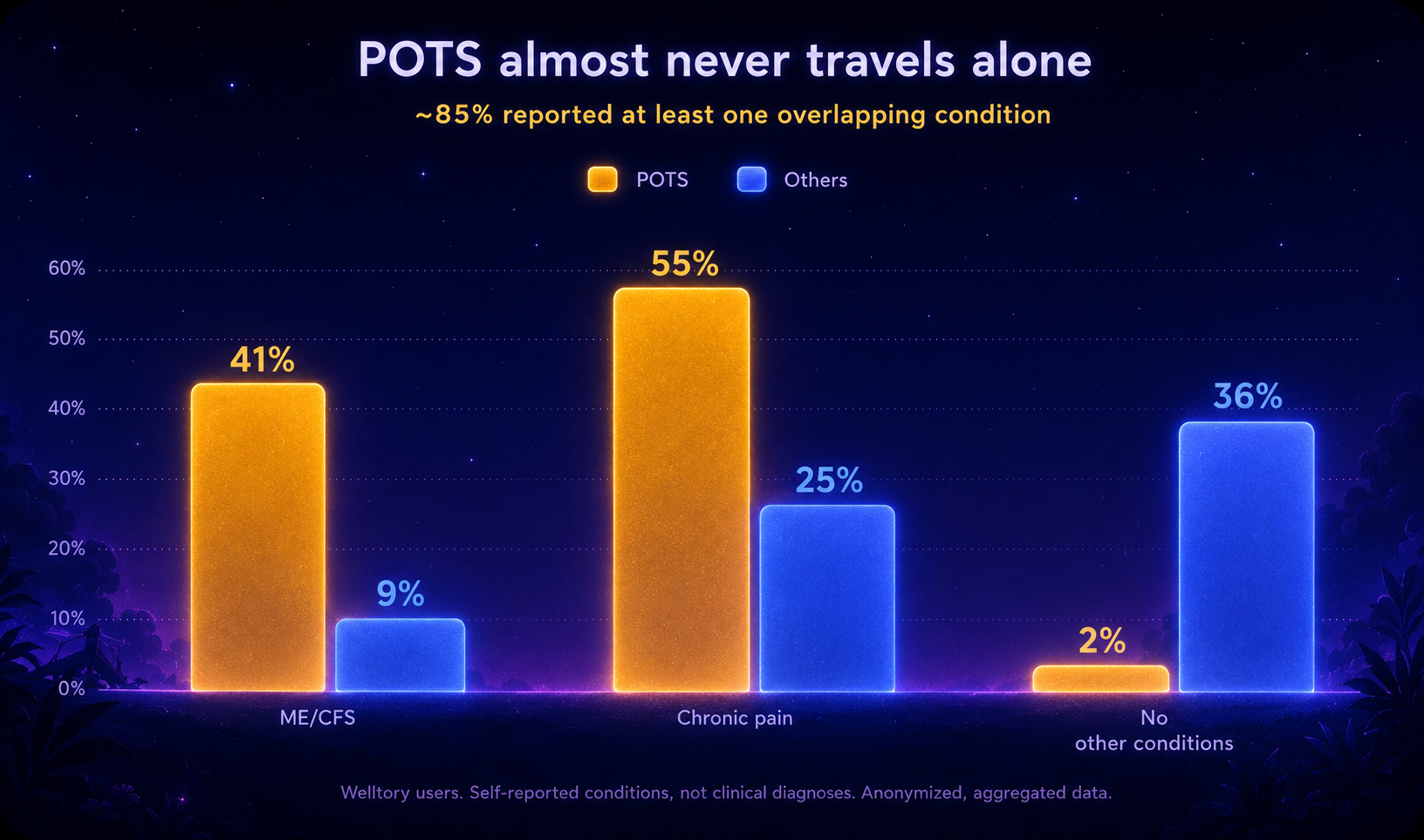
Welltory user data, self-reported POTS, observational. Self-report can overstate co-occurrence (people with symptoms are likelier to flag conditions); all figures are anonymized and aggregated, and this is not a diagnostic tool.
"Does POTS cause…?" — reverse questions
Does POTS cause brain fog? Yes — brain fog is one of the most commonly reported cognitive symptoms in POTS. People often describe it as feeling cloudy, forgetful, slow to find words, or unable to focus. The “why” is physical: when you’re upright, blood can pool below the heart, your nervous system pushes harder to compensate, and the brain may receive less steady blood flow. Research links POTS-related brain fog to changes in cerebral blood-flow regulation, autonomic arousal, short-term memory, attention, and the extra strain of standing or prolonged mental effort — not to laziness or “just anxiety.” (hopkinsmedicine.org)
Does POTS cause memory loss? POTS can cause memory complaints, especially short-term “where did I put that?” or “I can’t hold the next step in my head” problems. In one POTS brain-fog study, people frequently used words like forgetful and described trouble focusing, thinking, and communicating; common triggers included fatigue, poor sleep, prolonged standing, dehydration, and feeling faint. That pattern fits a fluctuating cognitive-load problem: symptoms can worsen when your body is under orthostatic stress, underslept, overheated, or under-fueled, then improve when the nervous system and circulation are better supported. (pubmed.ncbi.nlm.nih.gov)
Can POTS cause brain damage? The usual POTS “brain fog” story is not the same as brain damage. POTS research describes reversible or variable problems with attention, alertness, processing, working memory, cerebral blood-flow regulation, and autonomic activation. That can feel frightening — especially when you lose words mid-sentence or can’t think clearly while standing — but the “brain damage” framing is not supported by the way POTS is typically described in clinical and research sources. Johns Hopkins also notes that POTS can be life-changing but is not considered life-threatening. (hopkinsmedicine.org)
Does POTS cause high heart rate? POTS is defined by an excessive heart-rate rise after standing, together with orthostatic symptoms and without orthostatic hypotension. The Heart Rhythm Society consensus definition uses a rise of at least 30 bpm in adults, or at least 40 bpm in people ages 12–19, when moving from lying down to standing; Johns Hopkins describes the same adult/adolescent thresholds within the first 10 minutes of standing or tilt testing. (pmc.ncbi.nlm.nih.gov)
Can POTS cause low heart rate? Low heart rate is not the defining feature of POTS. The diagnosis is about the change when you stand, not one fixed number on your watch. Some people may see lower readings at rest, during sleep, after certain medications, with athletic conditioning, or around fainting/vasovagal episodes — and POTS and vasovagal syncope can overlap. If your heart rate is repeatedly very low, comes with chest pain, fainting, new shortness of breath, or feels different from your usual POTS pattern, that deserves clinician review rather than assuming it is “just POTS.” (pmc.ncbi.nlm.nih.gov)
When to see a doctor
New fainting, chest pain or pressure, severe shortness of breath, or a very fast or irregular heartbeat that won’t settle should be treated as urgent — seek immediate medical attention, especially if the symptoms are new for you, stronger than usual, happen at rest, or come with weakness, confusion, or feeling like you might pass out. POTS can cause palpitations, chest discomfort, shortness of breath, and fainting or near-fainting, but those same symptoms can also come from heart rhythm problems or other conditions that need prompt care. (hopkinsmedicine.org)
If your symptoms are persistent — for example, you often feel lightheaded, shaky, nauseated, foggy, unusually tired, or your heart races when you stand — book a proper medical work-up rather than trying to “push through.” A clinician can check your heart rate and blood pressure lying down and standing, rule out dehydration, blood loss, orthostatic hypotension, anemia, thyroid problems, arrhythmias, medication effects, and other causes, and decide whether you need testing such as an ECG, blood tests, tilt-table testing, or autonomic evaluation. (hopkinsmedicine.org)
Also get reassessed if you already have a POTS diagnosis but your pattern changes: fainting becomes more frequent, recovery takes longer, symptoms start waking you from sleep, exercise tolerance drops sharply, or you develop new chest pain, breathlessness, neurological symptoms, or an irregular rhythm. POTS is real, but it is not a “catch-all” explanation for every new symptom — your body may be signaling a new trigger, an overlapping condition, or something unrelated that deserves attention.
How Welltory fits
Welltory can give you a clearer timeline of what your body is doing between appointments: how your heart rate and body-state trends shift with standing, walking, workouts, poor sleep, illness recovery, heat, your period, or a stressful day. That context matters because POTS symptoms are tied to being upright, and clinicians look at how heart rate and blood pressure respond when you move from lying down to standing or during tilt-table testing. (hopkinsmedicine.org)
Use Welltory as a pattern notebook, not a diagnostic tool. If your logs repeatedly show heart-rate jumps with standing, crashes after activity, or worse days during infection recovery — alongside symptoms like dizziness, palpitations, fatigue, brain fog, nausea, or exercise intolerance — bring that timeline to your clinician. It can help the conversation get specific: what happens when I stand, what happens after exertion, and what else was happening in my body that day. But POTS still requires medical evaluation. Johns Hopkins describes diagnostic criteria as a heart-rate rise of at least 30 bpm in adults, or at least 40 bpm in adolescents, within the first 10 minutes of standing or tilt-table testing, with orthostatic hypotension and acute dehydration or blood loss ruled out. (hopkinsmedicine.org)
How we made it
Made with AI tools, then edited, fact-checked, and medically reviewed by the Welltory team.


Discounts for blog readers: up to 36% off
See what affects your energy, stress, sleep, and daily state with Welltory
This is general education about what causes POTS. It does not diagnose you. POTS has many possible causes and overlaps with other conditions, so any new or persistent symptoms should be evaluated by a qualified clinician.
Was this helpful?
Ask AI for a summary of page


Written by Jane Smorodnikova

The founder and CEO of Welltory. A recognized tech leader with two Master's degrees and experience at MIT, she has scaled Welltory to over 17 million users.
Written by Kseniia Iaroslavtseva

She reviews scientific research and turns it into structured, readable insights.
Reviewed by Anna Elitzur
-2.jpg)
With her medical degree, Anna reviews Welltory's health content for medical accuracy and alignment with current clinical guidelines and research.
References
- Frontiers in Neurology. DOI: 10.3389/fneur.2026.1806502 https://doi.org/10.3389/fneur.2026.1806502
- 2015 Heart Rhythm Society Expert Consensus Statement on the Diagnosis and Treatment of POTS, IST, and Vasovagal Syncope — PMC https://pmc.ncbi.nlm.nih.gov/articles/PMC5267948/
- 2015 Heart Rhythm Society Expert Consensus Statement — PubMed https://pubmed.ncbi.nlm.nih.gov/25980576/
- Postural Orthostatic Tachycardia Syndrome (POTS) — Cleveland Clinic https://my.clevelandclinic.org/health/diseases/16560-postural-orthostatic-tachycardia-syndrome-pots
- Postural Orthostatic Tachycardia Syndrome (POTS) — Johns Hopkins Medicine https://www.hopkinsmedicine.org/health/conditions-and-diseases/postural-orthostatic-tachycardia-syndrome-pots
- COVID-19 and POTS: Is There a Link? — Johns Hopkins Medicine https://www.hopkinsmedicine.org/health/expert-qa/covid19-and-pots-is-there-a-link
- Long COVID Signs and Symptoms — CDC https://www.cdc.gov/long-covid/signs-symptoms/index.html
- Postural Orthostatic Tachycardia Syndrome as a Sequela of COVID-19 — PMC https://pmc.ncbi.nlm.nih.gov/articles/PMC9287587/
- Postural Tachycardia Syndrome (POTS) Summary — Dysautonomia International https://www.dysautonomiainternational.org/pdf/SummaryOfPosturalOrthostaticTachycardiaSyndrome.pdf
- Postural Orthostatic Tachycardia Syndrome (POTS) — Dysautonomia International https://www.dysautonomiainternational.org/conditions.php?ID=1
- 10 Facts Doctors Should Know About POTS — Dysautonomia International https://www.dysautonomiainternational.org/page.php?ID=180
- Causes and Classification — PoTS UK https://www.potsuk.org/about-pots/classification/
- Postural Tachycardia Syndrome (PoTS) — NHS https://www.nhs.uk/conditions/postural-tachycardia-syndrome/
- Dysautonomia — Cleveland Clinic https://my.clevelandclinic.org/health/diseases/6004-dysautonomia
- Perimenopause — Johns Hopkins Medicine https://www.hopkinsmedicine.org/health/conditions-and-diseases/perimenopause
- Symptoms of Menopause and Perimenopause — NHS https://www.nhs.uk/conditions/menopause-and-perimenopause/symptoms/
- Vasovagal Syncope — Mayo Clinic https://www.mayoclinic.org/diseases-conditions/vasovagal-syncope/symptoms-causes/syc-20350527
- What Is Brain Fog? An Evaluation of the Symptom in Postural Tachycardia Syndrome — PubMed https://pubmed.ncbi.nlm.nih.gov/23999934/
- Brain Fog in Postural Tachycardia Syndrome: An Objective Cerebral Blood Flow and Neurocognitive Analysis — PubMed https://pubmed.ncbi.nlm.nih.gov/32528589/
- Narrative Review of Postural Orthostatic Tachycardia Syndrome: Associated Conditions and Management Strategies — PubMed https://pubmed.ncbi.nlm.nih.gov/39559520/


