

Short Answer
POTS symptoms usually have a pattern: they appear or get worse when you’re upright and ease when you lie down. The guideline-based heart-rate criterion is a sustained heart-rate rise of ≥30 beats per minute within 10 minutes of standing in adults, or ≥40 beats per minute in adolescents, without a significant blood-pressure drop (Heart Rhythm Society 2015).
POTS “is defined by chronic orthostatic intolerance accompanied by an excessive increment in sinus heart rate on standing in the absence of significant orthostatic hypotension” (Chopra, Frontiers in Neurology, 2026) — but the lived experience is broader than a fast pulse.
You may feel lightheaded, shaky, exhausted, foggy, nauseated, overheated, chilled, or “wired but drained.” Some people mainly notice palpitations. Others notice brain fog, post-exertional crashes, headaches, GI problems, sweating changes, or cold, discolored hands and feet. That wider pattern is why POTS is often discussed alongside the symptoms of dysautonomia — problems in the autonomic nervous system, the body system that helps regulate heart rate, blood pressure, digestion, sweating, temperature, and more (Cleveland Clinic).
The Orthostatic Core: Symptoms That Track With Posture
The most important clue is not one isolated symptom. It’s the posture pattern.
When you stand, gravity pulls more blood toward your legs and lower body. Normally, your autonomic nervous system responds quickly: blood vessels tighten, your heart rate adjusts, and enough blood keeps reaching your brain. In POTS, that adjustment does not work smoothly. Your body may compensate by driving the heart faster, and you can feel the effects in your chest, head, muscles, vision, and energy.
Common orthostatic symptoms include:
Lightheadedness or dizziness after standing
A racing heart or pounding heartbeat
Palpitations
Shakiness or internal trembling
Blurred vision, tunnel vision, or “white-out” vision
Weakness in the legs or whole body
Shortness of breath with standing or light activity
Chest discomfort or pressure
Nausea
Near-fainting
Fainting in some people
Feeling better after lying down
These symptoms can build over seconds or minutes. They may be worse after a hot shower, a long line at the store, standing still, illness, dehydration, poor sleep, or a large meal (Cleveland Clinic).
The Full Symptom Picture: Whole-Body POTS and Dysautonomia
POTS can feel confusing because it does not stay neatly in the “heart” category. The autonomic nervous system touches many organs, so symptoms may show up in several body systems at once.
Cardiovascular — Racing heart on standing, palpitations, chest discomfort, exercise intolerance
Neurological / cognitive — Lightheadedness, brain fog, headache/migraine, "wired-but-tired", trouble concentrating
Whole-body / energy — Fatigue, post-exertional crashes, poor sleep, feeling unrefreshed in the morning
GI — Nausea, bloating, early fullness, constipation or diarrhea
Autonomic / other — Temperature dysregulation, sweating changes, cold/discolored hands and feet, shakiness
Cardiovascular Symptoms
The “classic” POTS symptom is a heart rate that jumps when you stand. You may feel your heart racing, pounding, fluttering, or skipping beats. Some people feel chest tightness or discomfort, especially during flares.
A fast heart rate on standing is not automatically POTS. Dehydration, anemia, thyroid disease, infection, medication effects, panic attacks, deconditioning, and other conditions can cause similar symptoms. That’s why the pattern needs clinical evaluation, not self-diagnosis.
Neurological and Cognitive Symptoms
Lightheadedness is common, but many people are more distressed by the cognitive symptoms: brain fog, trouble finding words, difficulty reading, feeling detached, or losing focus when upright. If your brain is not getting steady blood flow or your body is fighting to maintain circulation, thinking can feel physically harder.
Headaches and migraine-like symptoms may also occur (Johns Hopkins).
Energy and Post-Exertional Symptoms
Fatigue in POTS is not ordinary tiredness. You may wake up unrefreshed, feel drained after routine tasks, or crash after activity that used to be easy. Some people describe a delayed crash after exertion — the body feels “spent” later that day or the next day.
This matters because the outside world may see only a normal-looking person. Inside, your autonomic system may be working hard just to stand, shower, eat, or walk across a room.
That gap between how you feel and what's outwardly visible shows up in wearable data too — why your wearable and your feelings may disagree looks at exactly this mismatch for people with energy-limiting conditions, including what to do when your morning HRV or battery reading doesn't match how you feel.
GI Symptoms
Because the autonomic nervous system helps coordinate digestion, POTS and dysautonomia can come with nausea, bloating, early fullness, abdominal discomfort, constipation, diarrhea, or shifting bowel patterns (Cleveland Clinic).
Temperature, Sweating, and Skin Symptoms
Autonomic symptoms can also affect how your body handles heat, cold, and sweating. You may overheat easily, feel chilled, sweat too much or too little, or notice cold, mottled, red, purple, or bluish hands and feet. Some people search for “dysautonomia skin symptoms” because these color and temperature changes can be alarming, especially when they come and go with posture or temperature (Dysautonomia International).
The Symptoms People Miss: Brain Fog and Crashes
Many people search for “weird POTS symptoms” because the heart-rate part gets all the attention, while the hardest parts — brain fog and post-exertional crashes — go unnamed.
If this is your experience, it does not mean the symptoms are “in your head.” Brain fog can happen when your body is struggling with circulation, stress-hormone surges, sleep disruption, pain, migraine, or autonomic instability. Crashes can happen when a task costs your body more energy than it looks like from the outside.
What our own data shows: brain fog isn't a side note — it's central.
Among 359 Welltory users who self-reported POTS (with about three months of quality wearable data), about 50% flagged brain fog versus 23% of the 3,786 users without POTS — more than twice as often. The gap held even when we compared people with the same number of other conditions, so it isn't just "more conditions overall." For many people the most disruptive part of POTS isn't the heart rate you can measure — it's the cognitive fog you can't.
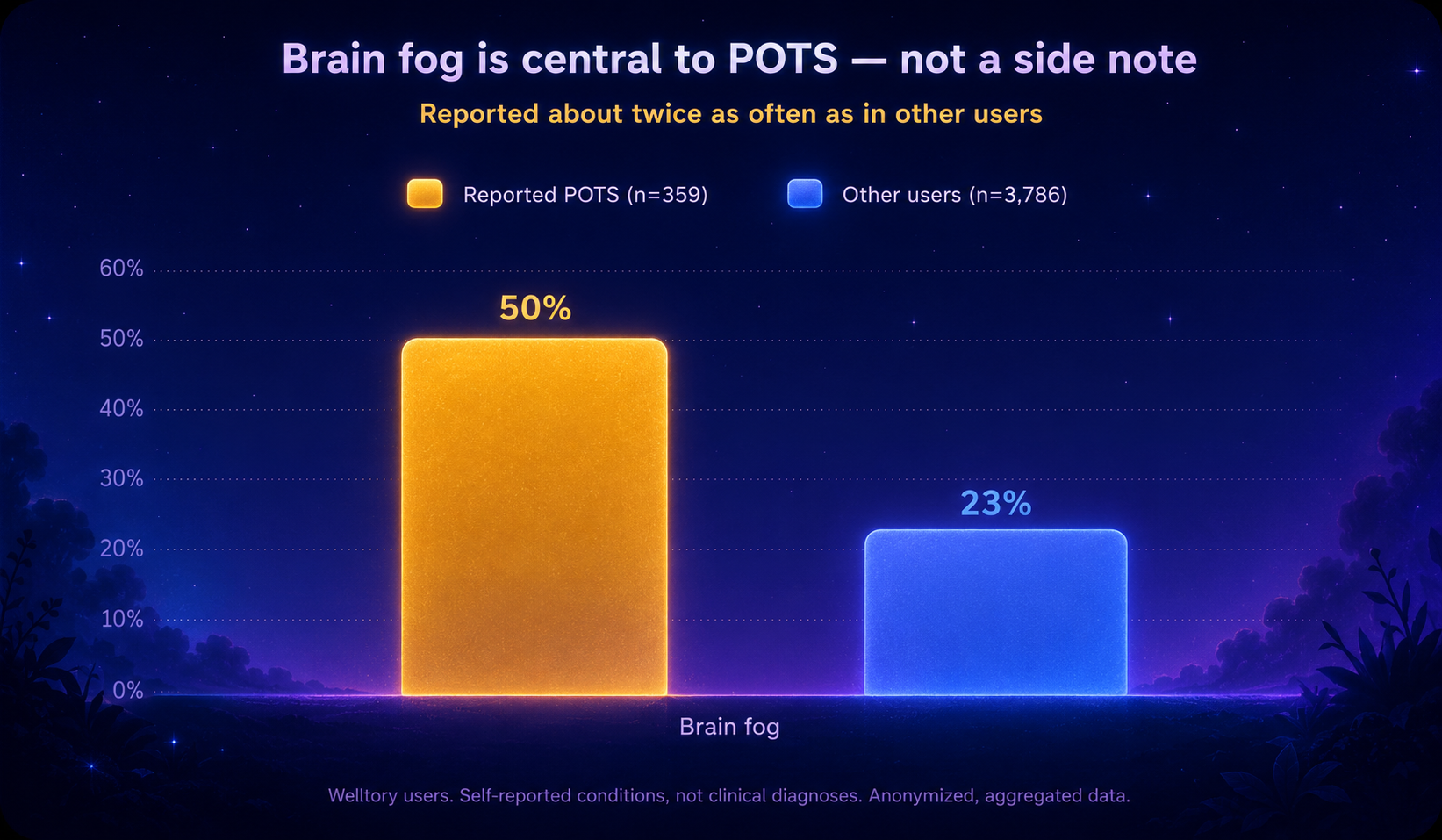
Welltory user data, self-reported POTS, observational. All figures are reported as anonymized, aggregated data; no individual user is identifiable. This is not a diagnostic tool.
Source to be finalized: anonymized observational Welltory cohort data; wording pending DATA step.
POTS Symptoms in Women
POTS is commonly reported in women and people assigned female at birth, especially during reproductive years (Cleveland Clinic). That does not mean men cannot have POTS. They can. But the condition is often discussed in the context of women’s health because symptoms may overlap with menstrual-cycle changes, migraine, fatigue, pain syndromes, hypermobility, and conditions that are too often dismissed as stress or anxiety.
For some people, symptoms fluctuate before or during a period. You may notice more lightheadedness, palpitations, fatigue, migraine, GI symptoms, or temperature sensitivity around hormonal shifts (Dysautonomia International).
This is one reason a symptom diary can help. If you track posture, heart rate, sleep, cycle phase, meals, heat exposure, and activity, patterns may become easier to explain to a clinician.
Search phrase note: people often look for POTS symptoms women or “symptoms of dysautonomia in women” because they want to know whether cycle-linked flares and dismissal as anxiety are part of the story. They can be part of the story — but they still deserve proper medical evaluation.
Hyperadrenergic POTS Symptoms
Hyperadrenergic POTS is a pattern where symptoms can feel especially “adrenaline-driven” (Dysautonomia International).
You may notice:
Trembling or shaking
A surge of anxiety-like physical symptoms
Palpitations
Sweating
Cold, clammy hands or feet
A wired, over-alert feeling
Headache
Nausea
Chest discomfort
Symptoms that feel worse with standing, stress, heat, or poor sleep
Sometimes higher blood pressure while standing (Heart Rhythm Society 2015)
The word “anxiety-like” is important. These episodes can feel like panic, but that does not prove the cause is psychological. Your autonomic nervous system can create a very real fight-or-flight body state. A clinician can help sort out whether symptoms fit POTS, anxiety, both, or something else.
POTS and MCAS: Overlapping Symptoms
Some people with POTS also report symptoms that overlap with mast cell activation syndrome, or MCAS, and hypermobility-related conditions (Dysautonomia International).
Possible overlap symptoms include:
Flushing
Itching
Hives
Swelling
Allergic-type reactions
Wheezing or throat tightness
Nausea, cramping, diarrhea, or abdominal pain
Headache
Lightheadedness
Heart racing during reactions
Symptoms triggered by foods, heat, stress, alcohol, fragrances, or infections
These symptoms do not automatically mean MCAS. Allergies, asthma, GI disorders, medication reactions, thyroid problems, and other conditions can look similar. But if you have POTS-like orthostatic symptoms plus flushing, hives, itching, or repeated allergic-type episodes, it is worth bringing that pattern to a clinician.
Dysautonomia Symptoms and Types
“Dysautonomia” is an umbrella term for problems with the autonomic nervous system. POTS is one type. Other forms can affect heart rate, blood pressure, sweating, digestion, bladder function, pupils, temperature regulation, and fainting risk (NINDS).
Common symptoms of dysautonomia can include:
Dizziness or lightheadedness
Fainting or near-fainting
Abnormal heart-rate responses
Blood-pressure instability
Exercise intolerance
Fatigue
Brain fog
GI symptoms
Sweating changes
Heat or cold intolerance
Bladder symptoms
Vision changes
Tremor or shakiness
Skin color changes in hands or feet
Types and related conditions may include:
POTS — Orthostatic symptoms with an excessive heart-rate rise on standing (Heart Rhythm Society 2015)
Neurocardiogenic syncope / vasovagal syncope — Fainting or near-fainting, often with nausea, warmth, sweating, tunnel vision, or triggers such as prolonged standing
Orthostatic hypotension — Symptoms when standing related to a clinically significant blood-pressure drop (NINDS)
Autonomic neuropathy — Autonomic symptoms caused by nerve damage; may affect sweating, digestion, blood pressure, bladder function, or heart-rate control
Familial dysautonomia — A rare inherited autonomic disorder; symptoms and course differ from typical POTS (NINDS)
Because dysautonomia has many causes and patterns, the label should come from a clinician. Your role is to notice and document what happens in your body.
Symptom Checklist: Bring This to Your Clinician
This checklist is not a diagnosis. It is a way to organize your symptoms so your appointment is more useful.
Track what you can when symptoms happen, especially if they are frequent, changing, or hard to explain. Use these notes as context for a clinician, not as a home test.
Posture Pattern
Write down:
What happens when you stand up
How long it takes symptoms to start
Whether symptoms improve when you sit or lie down
Whether standing still is worse than walking
Whether symptoms happen after showers, meals, heat, or long lines
Heart Rate and Blood Pressure Context
If you have a device and your clinician has said it is appropriate, record:
Resting heart rate
Heart rate after standing
How long you were standing
Blood pressure if available
Symptoms at the same time
Do not use home numbers to diagnose yourself. Bring them as context.
Symptom List
Check any symptoms you experience:
Racing heart
Palpitations
Lightheadedness
Near-fainting or fainting
Shakiness
Weakness
Chest discomfort
Shortness of breath
Brain fog
Headache or migraine
Fatigue
Post-exertional crash
Poor sleep
Nausea
Bloating
Early fullness
Constipation
Diarrhea
Heat intolerance
Cold intolerance
Sweating changes
Cold or discolored hands/feet
Flushing, itching, or hives
Symptoms before or during your period
Triggers
Note whether symptoms worsen with:
Heat
Dehydration
Illness
Poor sleep
Alcohol
Large meals
High-carbohydrate meals
Long standing
Stress
Menstrual-cycle changes
Exercise or exertion
Travel
Deconditioning after bed rest or reduced activity
What Helps
Record what seems to reduce symptoms:
Lying down
Sitting with legs elevated
Cooling down
Fluids or electrolytes if recommended by your clinician
Smaller meals
Compression garments if recommended
Pacing activity
Sleep consistency
Avoiding long periods of standing
Bring the notes to a clinician, especially if symptoms are new, worsening, or interfering with school, work, caregiving, exercise, or basic daily tasks (Dysautonomia International).
Flares: When Symptoms Spike
A flare is a period when symptoms become more intense or easier to trigger. Flares can last hours, days, or longer depending on the person and the trigger.
Common flare triggers include:
Heat or hot showers
Dehydration
Illness or infection
Hormonal shifts
Menstrual-cycle changes
Large meals
Alcohol
Poor sleep
Stress
Standing too long
Rapid changes in activity level
Deconditioning after inactivity
Travel or time-zone disruption
During a flare, symptoms may feel more whole-body: faster heart rate, more dizziness, stronger fatigue, brain fog, nausea, headache, shakiness, sweating changes, and lower exercise tolerance (Dysautonomia International).
If a flare feels different from your usual pattern — especially with chest pain, severe shortness of breath, fainting injury, new neurological symptoms, or a heartbeat that feels irregular and will not settle — treat it as a red flag.
When Symptoms Are a Red Flag
Seek immediate medical attention if you have:
Chest pain, pressure, or pain spreading to the arm, jaw, back, or shoulder
Fainting, especially with injury or during exertion
Severe shortness of breath
A very fast or irregular heartbeat that does not settle
New weakness, numbness, facial droop, confusion, trouble speaking, or vision loss
Severe headache that is sudden or unlike your usual headaches
Blue lips, severe allergic-type symptoms, throat swelling, or trouble breathing
Symptoms after a new medication, overdose risk, or possible poisoning
Severe dehydration, inability to keep fluids down, or persistent vomiting
Pregnancy with fainting, chest pain, severe shortness of breath, or concerning symptoms
Do not wait to see whether these symptoms “fit POTS.” Emergency symptoms need urgent care.
How Welltory Fits
Welltory can help you track how your heart rate and body state change with posture, activity, recovery, sleep, and time. That context may help you notice patterns and prepare better notes for a clinician.
Welltory does not diagnose POTS, dysautonomia, MCAS, anxiety, or any other condition. It is a tracking tool, not a medical test.
How we made it
Made with AI tools, then edited, fact-checked, and medically reviewed by the Welltory team.


Discounts for blog readers: up to 36% off
See what affects your energy, stress, sleep, and daily state with Welltory
This is general education about POTS and dysautonomia symptoms. It does not diagnose you. Many conditions cause these symptoms, so any new, severe, or persistent symptoms should be evaluated by a qualified clinician.
Was this helpful?
Ask AI for a summary of page


Written by Jane Smorodnikova

The founder and CEO of Welltory. A recognized tech leader with two Master's degrees and experience at MIT, she has scaled Welltory to over 17 million users.
Written by Kseniia Iaroslavtseva

She reviews scientific research and turns it into structured, readable insights.
Reviewed by Anna Elitzur
-2.jpg)
With her medical degree, Anna reviews Welltory's health content for medical accuracy and alignment with current clinical guidelines and research.
References
- 2015 Heart Rhythm Society Expert Consensus Statement on the Diagnosis and Treatment of POTS, Inappropriate Sinus Tachycardia, and Vasovagal Syncope. https://pmc.ncbi.nlm.nih.gov/articles/PMC5267948/
- National Institute of Neurological Disorders and Stroke: Postural Tachycardia Syndrome. https://www.ninds.nih.gov/health-information/disorders/postural-tachycardia-syndrome
- Cleveland Clinic: Postural Orthostatic Tachycardia Syndrome (POTS). https://my.clevelandclinic.org/health/diseases/16560-postural-orthostatic-tachycardia-syndrome-pots
- Johns Hopkins Medicine: Postural Orthostatic Tachycardia Syndrome (POTS). https://www.hopkinsmedicine.org/health/conditions-and-diseases/postural-orthostatic-tachycardia-syndrome-pots
- Dysautonomia International: POTS and dysautonomia resources. https://www.dysautonomiainternational.org/page.php?ID=180
- PoTS UK: POTS symptoms, flares, and tracking guidance. https://www.potsuk.org/about-pots/symptoms/
- Chopra P. POTS: when dysautonomia misleads. Frontiers in Neurology. 2026. https://doi.org/10.3389/fneur.2026.1806502


