
Sense and Sensors
Why your wearable and your feelings may disagree — and what to do about it if you live with energy-limiting conditions


-2.jpg)

The 95% battery, and a terrible morning
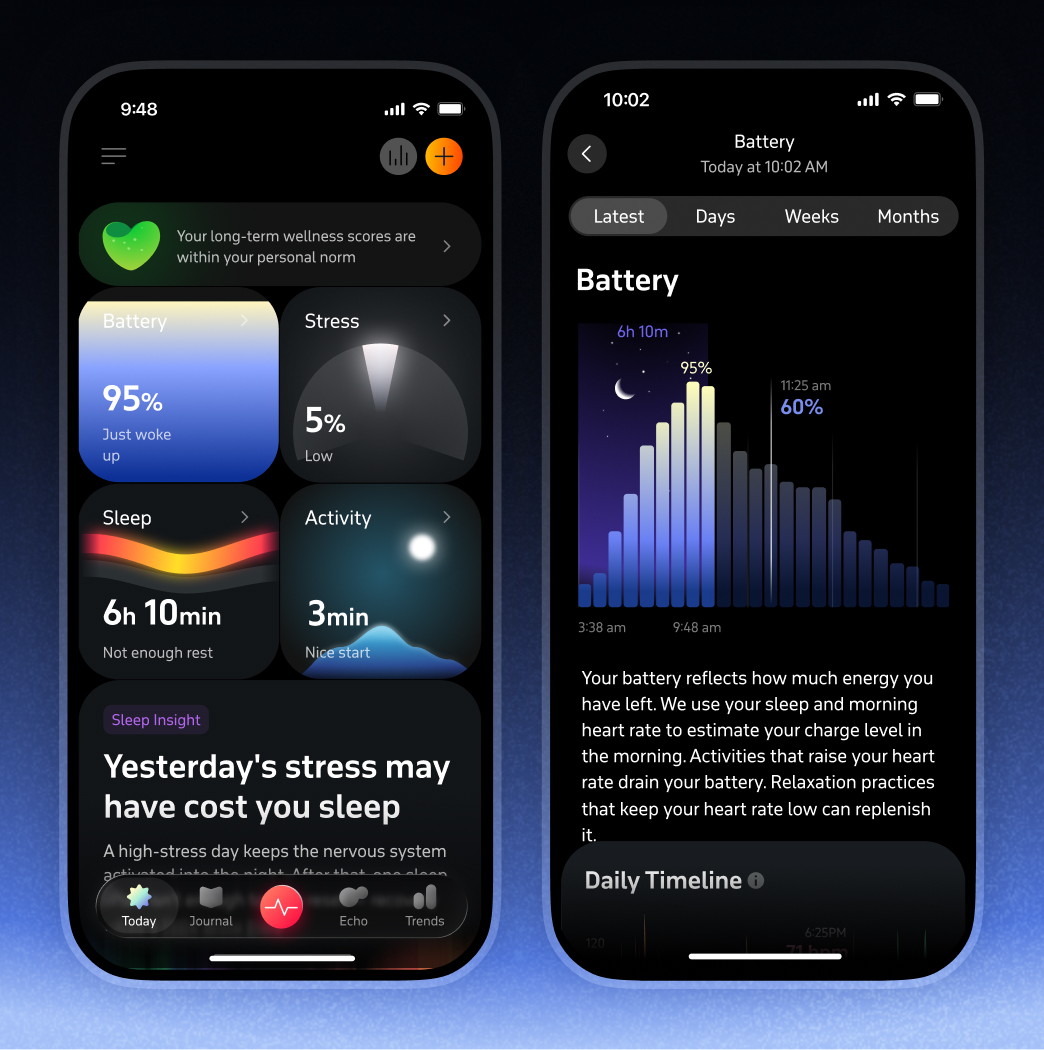
It's 9:48 in the morning. You slept badly, your head aches, and getting to the shower feels like a project. Your "Battery" at the Welltory app says: "95%"
You're not imagining the gap, and you're not reading your body wrong. Your scores and feelings are two different kinds of signal pointed at two different things. In this example, your morning starting charge is calculated from resting heart rate at wake-up plus sleep quality and quantity. Your feeling, by the time you read the screen, has already folded in the last twenty-four hours at once: your mood, the brain fog, your hormones, the week you're having, pain.
Key takeaways
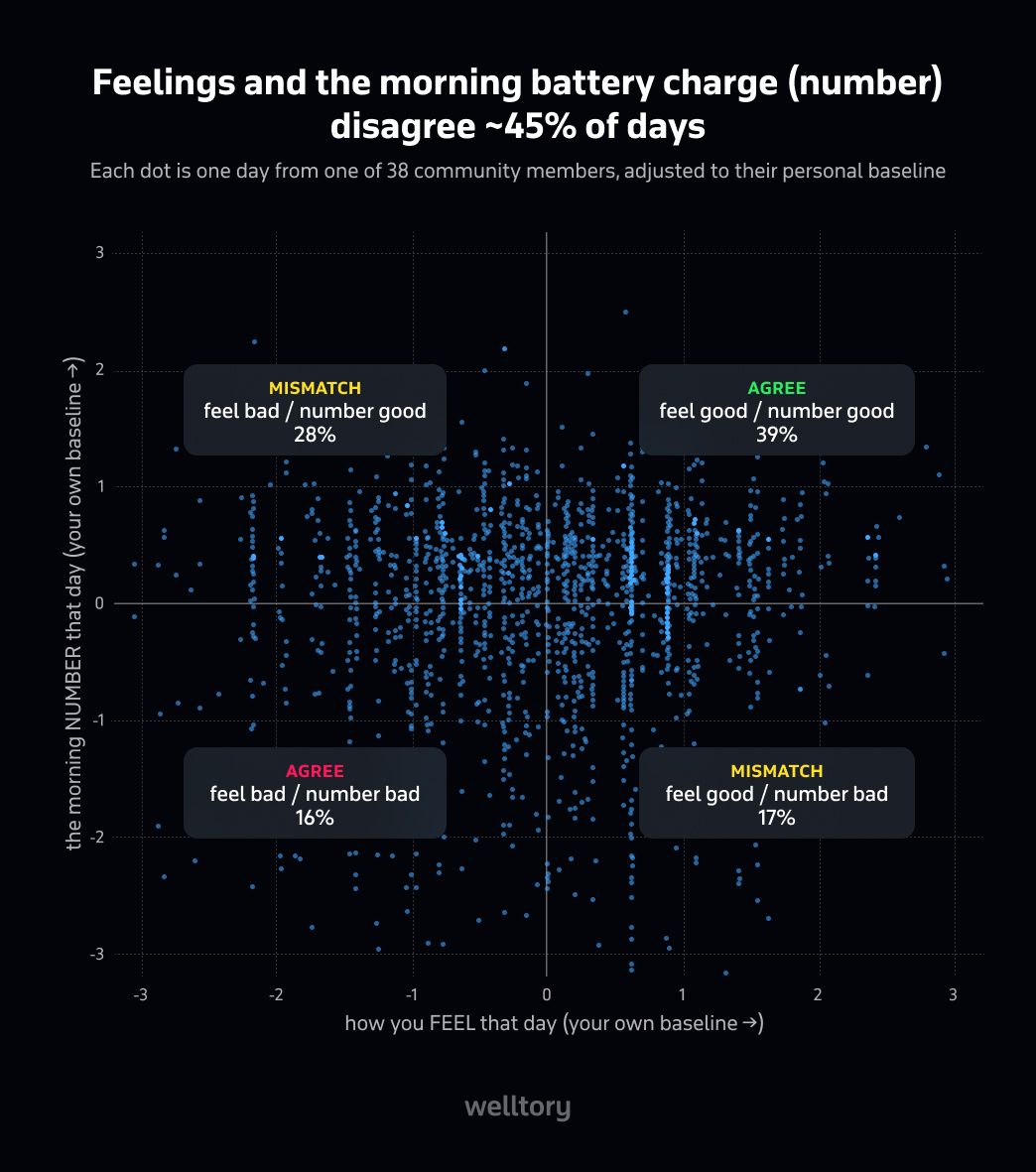
Disagreement is normal, not a malfunction. On roughly 45% of days, how you feel and what your wearable shows point in different directions — because they measure different things. Your morning battery charge is calculated only from resting heart rate and sleep from a single night, while your feeling folds in the last 24 hours of pain, hormones, mood, and brain fog. Neither reading is wrong.
High HRV on a bad morning can be the crash itself, not recovery. When the body is depleted and resting deeply, the "rest-and-digest" branch of the nervous system can dominate and push HRV higher — so a high number doesn't automatically mean you're bouncing back.
No universal reading exists. The same signal can mean the opposite thing in different bodies: a rising HRV is recovery for one person and the start of a crash for another. Tag your feelings in the app for at least three weeks and track your pattern. If a real shift sticks around for weeks, especially with new symptoms, that's worth a clinician's opinion, not a wearable guess. If you have an energy-limiting condition, you can track this alongside others in Welltory's Energy Lab.
Practical rule. You don't have to choose whether to trust the number, or to ignore it. When feeling and number disagree, act on the more cautious of the two — the symptom-contingent pacing the CDC and Workwell Foundation recommend.
Is it ok that my feelings and the app's numbers disagree?
Absolutely. The clearest data we have on this looked specifically at morning readings: about 45% of logged days, the body says one thing and the screen another.
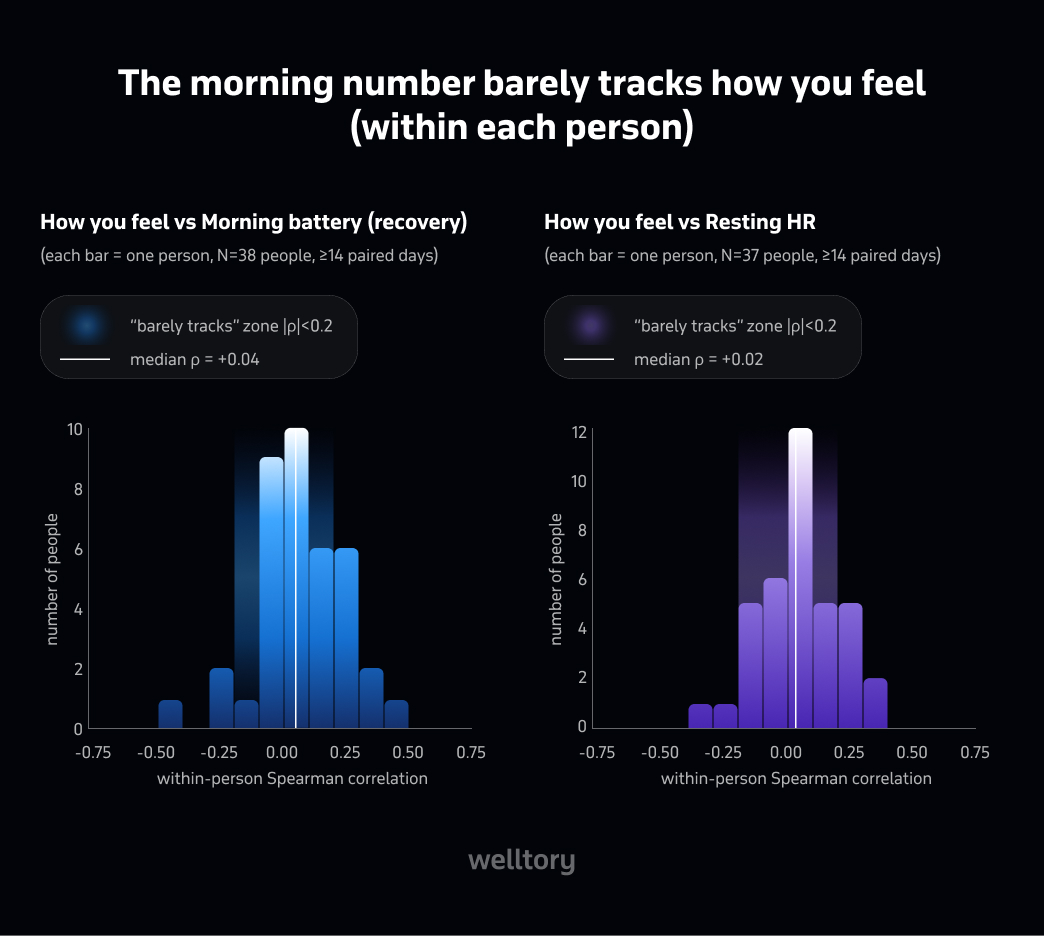
Inside a single person, morning feeling and the morning battery charge barely moved together — a median correlation near zero. A shuffle test confirmed they're genuinely close to independent, not a strong signal buried in noise.
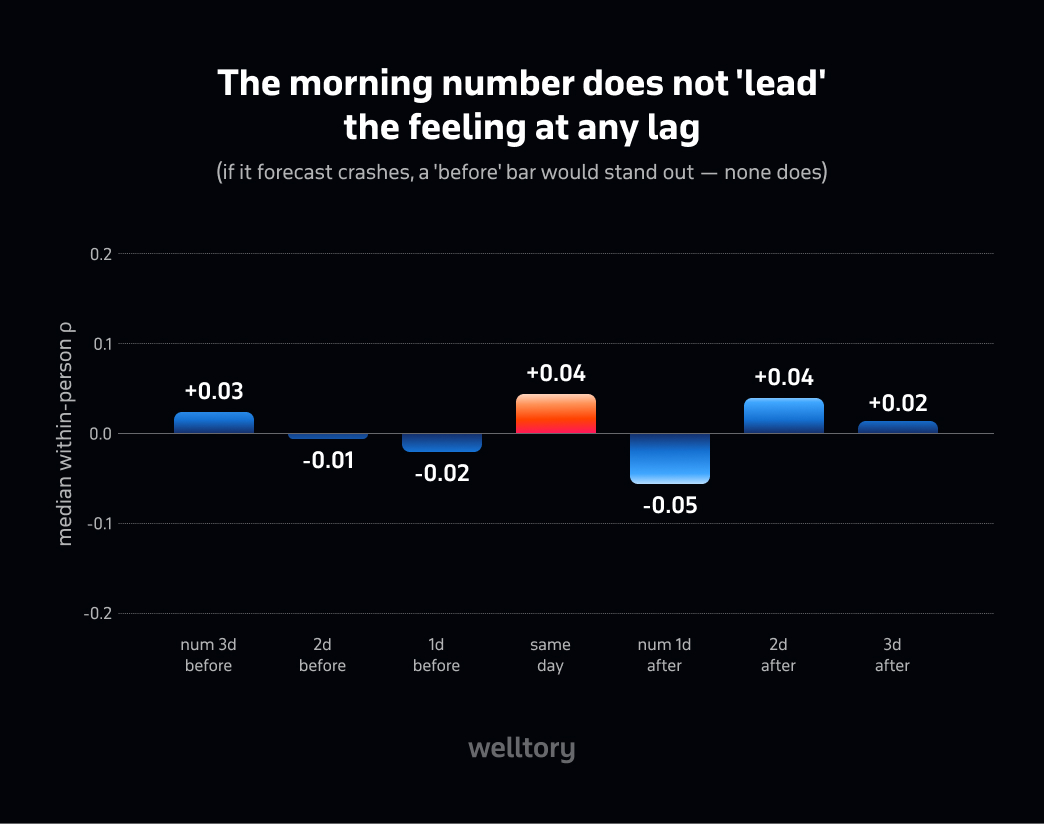
In our data we also found that morning battery charge doesn't forecast how you'll feel one, two, or three days later — at every lag, the connection sits near zero. It's a rough read on the night you just had, not a look ahead.
Consumer devices also carry real error: wearables lose meaningful heart-rate accuracy during movement (Bent et al., 2020).
Welltory tracks these metrics not to mirror your mood but to see the reserve and strain in your autonomic system.
I feel terrible in the morning — why is my HRV high?
HRV comes from a single measurement. Often high reading means your body is already shifting into recovery and you'll likely feel better soon. Recovery from a previous stressful day can take more than one night.
There's a physiological reason why you wake up feeling bad but see high HRV. When the body is depleted and resting deeply, the "rest-and-digest" branch of the nervous system can dominate — and that can push heart-rate variability higher. So high HRV can be the crash itself, not recovery. In our data, HRV on crash days ran above each person's baseline, not below it.
Can I trust my morning HRV? What's it good for?
You shouldn't rely on a single reading. Instead, explore your own patterns: how your HRV changes over time.
The largest study to date (4,244 people; Aitken et al., 2026) found that mornings with rising HR and falling HRV were associated with a higher chance of a crash, fatigue, or brain fog that day.
Think of it like your smartphone: if the screen shows 40% battery, is that good or bad? You can't tell without the trend. If it was 20% an hour ago, it's charging; if it was 80% this morning, it's draining. Your Energy score works the exact same way — the number means nothing without knowing which direction it is heading.
Note that neither the number nor your feeling is a diagnostic tool. Chest pain, fainting, a racing or irregular heartbeat, or severe shortness of breath — seek immediate medical attention. A crash or PEM flare that feels worse than usual, lasts longer than usual, or comes with new symptoms — treat that as a question for your clinician, not a tracking question.
I feel energized — why does Welltory say I'm stressed?
Worldwide, 37% of adults say they felt stressed just yesterday — one of the most commonly reported negative emotions, right up there with worry (Gallup, State of the World's Emotional Health, 2025). Welltory's own data across 1.2 million U.S. users puts average physiological stress at 70%! People usually assume the app flags high stress when we're nervous or actively doing something that spikes the heart rate. But there are two separate measurements of stress in Welltory app:
The percentage on a single reading — the stress score you see the moment you open the app — is a snapshot of how activated your nervous system is right now.
The Stress Insight / Stress Impact report tracks sustained sedentary stress: your heart working too hard while you're still and staying that way.
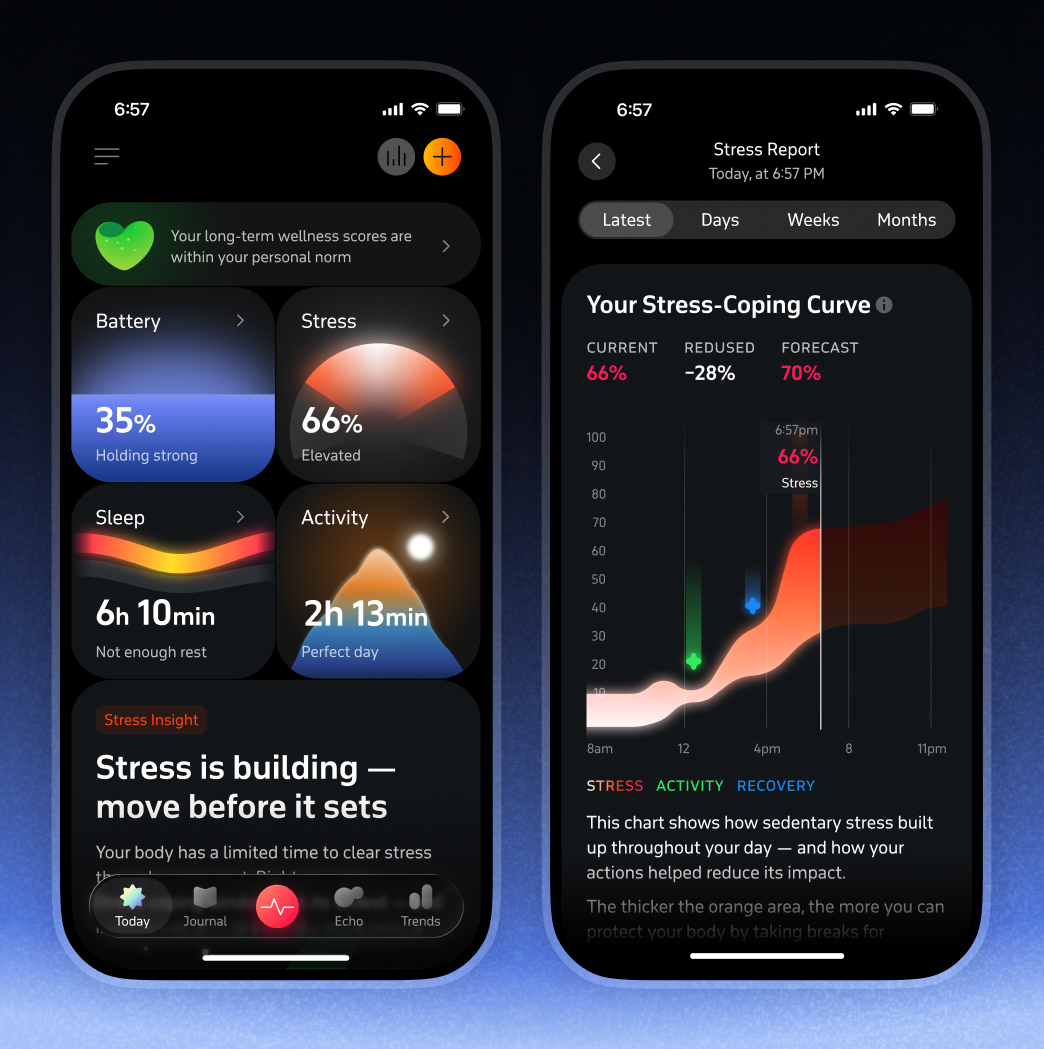
High percent on a single reading combined with feeling energized can often be driven by stress chemistry: adrenaline and cortisol keep the nervous system revved up, masking true exhaustion. People describe it as "wired but tired." The cost is delayed by one to three days, so the good feeling arrives before the bill — documented physiology, not a lack of willpower. A 2024 meta-analysis (37 studies, 543 people with ME/CFS) found higher resting adrenaline and an abnormal adrenergic response to exertion specifically in ME/CFS (Hendrix et al., 2024).
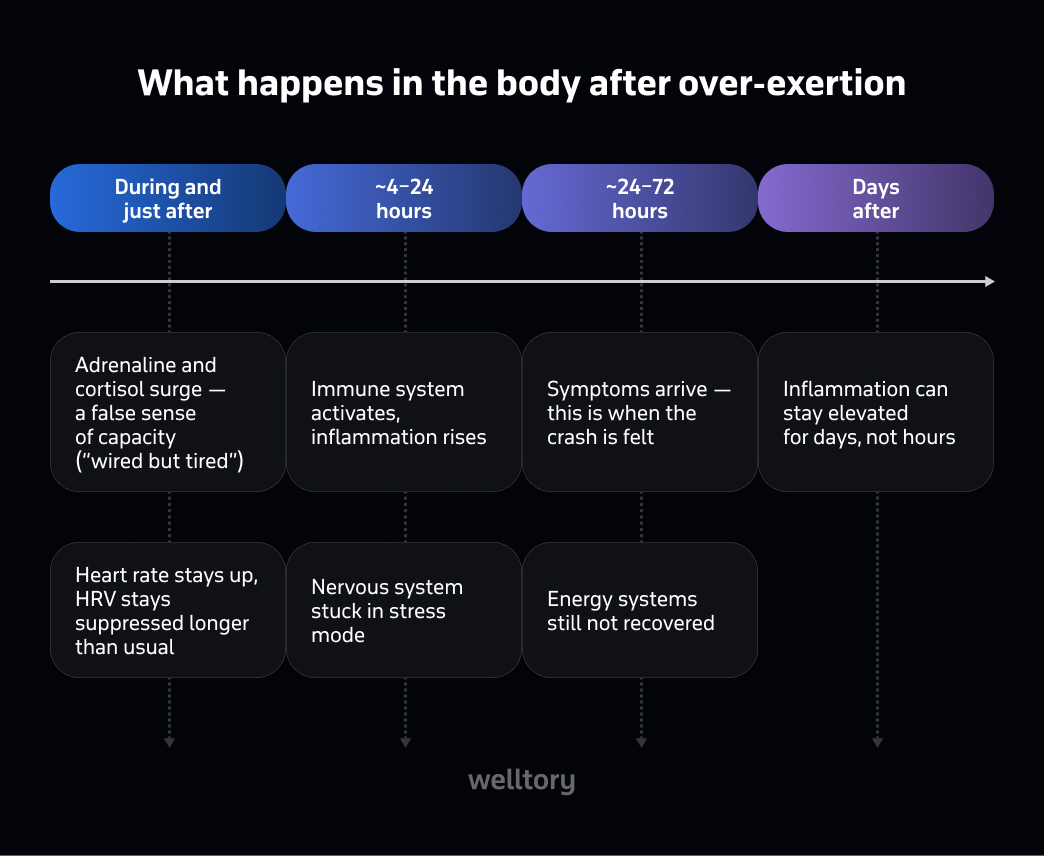
Think of your feelings as a phone's screen and your autonomic metrics as its battery and temperature gauge. Running on stress chemistry is like keeping your phone on max brightness with a heavy app open: everything flies, but that very speed heats the chip and drains the battery. Your experience measures the brightness, while the sensors measure the drain. Both are right: the screen shows the moment; the gauge shows your reserve.
High stress in the Stress Impact report and feeling energized at the same time can show up during positive excitement, a caffeine or stimulant effect, focused mental engagement or sedentary stress — heart rate elevated without movement.
As it builds up, sedentary stress takes a real toll on your cardiovascular system. Over time, this pattern adds up. It can leave blood vessels stiffer and less responsive, make the blood more prone to clotting, and keep blood sugar higher after meals. These are slow, cumulative changes that build over months and years. But here's the crucial part: if you live with an energy-limiting condition (ELC) like ME/CFS or POTS, you cannot just push through this, you need to stay safely within your body's energy limits. Instead of exercising it off, you can lie down to rest, practice slow breathing, reduce sensory stimulation, or take a very gentle, easy walk if your body is up for it.
Can wearable devices accurately predict crashes or track recovery for everyone based on trends in HRV score?
No, because the same score can mean something opposite in different bodies and periods of life.
For example, during menstruation, a scoping review of 40 studies found that resting heart rate tends to rise and HRV to dip from the follicular into the luteal phase (the roughly two weeks before a period) (Johnson et al., 2026). A redder app that week isn't necessarily you getting worse — it may be reading your hormones. The score doesn't know what period of life you're in. You do.
The same is true for crashes, for anyone living with post-exertional malaise. Researchers have tried hard and repeatedly failed to find one crash-prediction rule that fits everyone. The deepest reason is striking — the same signal means opposite things in different bodies and diagnoses. A rising HRV is recovery for one person and the start of a crash for another; an elevated heart rate is over-exertion for one person and ordinary dysautonomia for another. Most failed crash-prediction projects tripped over exactly this kind of person-to-person difference. In our community data, only about 1 in 6 people showed the classic "did too much yesterday → crash today" pattern (these shares come from a small early sample and will shift as we collect more data). About half of crash days came from prolonged states lasting one to two weeks. The rest were triggered by illness, hormones, or stress.
If no app works for everyone, why bother tracking?
Fair question. But the same research points clearly to what does work: not one rule for all, but a model built on your own baseline — learn what your normal looks like, then flag your own deviations. Within-person prediction works where between-person prediction fails (Aitken et al., 2026). Roughly 21 days of your own data is enough for personal patterns to start emerging. And some members here already read their own number well, because they have learned what it means for them.
Remember, that number is a gentle second opinion, not a boss. Looking at it less is allowed, if a red score every morning becomes a source of dread.
What should I do if my wearable and my feelings disagree?
You don't need the feeling and the number to agree before you act. Act on the more cautious of the two. A bad feeling is a valid reason to ease off, whatever the data says. A bad, unstable data trend is also a reason to ease off, even on a day you feel okay.
People are often told their labs look normal, so they must be fine, and over time they learn to doubt their own body. What this data shows is that the mismatch is real and common. Your feelings and your numbers watch different things, and the cost of a hard day can lag a day or two behind, so they will not always agree. That gap is information, and going with the more cautious of the two is a reasonable, well-supported way to use it.
The takeaway: reading a metric and a feeling together
This table is for today's pacing decision, not a diagnosis. A single day's mismatch between the number and how you feel is normal noise. Only if the same mismatch repeats for several days in a row does it become a trend worth paying attention to.
"High / low" = relative to your own baseline, not to other people.
| Autonomic signal | Feels GOOD | Feels BAD |
|---|---|---|
| Resting HR — HIGH | Load your feeling hasn't caught yet — often "running on stress chemistry." Treat the number as an early caution flag, even though you feel fine. | Both agree: strain, and you feel it. The clearest cue to ease off. |
| Resting HR — LOW | Both agree: genuinely recovered relative to your own baseline. Green light, in moderation. | Your feeling is catching what the heart can't — pain, fog, mood. During a crash, low HR can mean that several systems (heart, stress hormones, nervous system reset) have each hit their own limit and have less left to give. Trust the feeling. |
| HRV (RMSSD) — HIGH | Usually genuine recovery — rested, parasympathetic. Best-case agreement. | High HRV often means your body is already shifting into recovery and you'll likely feel better soon. But for some people it can be parasympathetic rebound during a crash, rather than true recovery. Trust how you feel. |
| HRV (RMSSD) — LOW | Alertness likely riding on sympathetic drive ("wired"). The low HRV is a cost not yet felt — a caution flag. | Both agree: low reserve, and you feel it. Rest. |
| Battery (morning charge) — HIGH | Agreement — you started the day with good reserves. Go, in moderation. | Morning charge is calculated only from last night's resting HR and sleep quality/quantity — it never sees pain, fog, mood, or hormones directly. Trust the feeling. |
| Battery (morning charge) — LOW | Night scored poorly but you feel fine — your feeling may be ahead of the data, or stress may be masking it. Ease off a little; watch. | Agreement — depleted. Rest. |
When feeling and metric agree, it's confirmation. When they disagree, act on the more cautious of the two — a warning signal outweighs a reassuring one.
Information is not a substitute for medical advice.
Do I have to figure this out alone?
You don't, and you shouldn't have to. The fastest way to learn what your own signals mean is to compare notes — to other people who are dealing with the same problem. This trend is called "the age of interdependence" — a move away from figuring everything out solo. On your own, you're guessing. One person tries something and wonders if it helped. A group trying it together can actually see the pattern.
Welltory's Energy Lab community is for women who are learning to control their bodies through peer support, understanding their own data, and group-level education. If you live with an energy-limiting condition we would like to invite you to join our community, so you won't feel alone anymore.


You're not imagining it. And you're not alone.
How we made this article
Welltory runs a community called Energy Lab — women living with energy-limiting conditions due to ME/CFS, Long COVID, fibromyalgia, POTS, and related diagnoses. 38 of them logged two signals — what their watch reported and how they felt — for at least 21 paired days during June — July 2026 (numbers vary slightly between metrics because not every member logged every signal). "Feeling" is the in-app daily self-rating (a five-point scale from −2 to +2) plus tags (mood/crash/fatigue/pain). We pulled anonymized data from the members who kept both logs going, and did something simple — for each woman, we lined up her own feeling and her own ANS metrics (HRV, heart rate, resting heart rate) and sleep quality and quantity, day by day. We watched what happened on the days her body said one thing and the screen said another. Each member's data was compared only to her own baseline, never against anyone else in the group. The data for this article was aggregated using AI tools.
What this sample is and isn't
Small, self-selected, self-reported, and Apple Watch-heavy. Everyone here chose to join a peer community and keep two logs going for weeks — that likely skews the sample toward people who are unusually engaged with tracking and attentive to their symptoms, not a random cross-section of everyone living with an energy-limiting condition. These are early, group-level observations, not clinical measurements, and the figures will move as more people log data. Running the same analysis across Welltory's full user base, not just Energy Lab, would be the natural next step to find out patterns across people with no ELC.
Key terms
Heart rate variability (HRV) — The variation in time between consecutive heartbeats, measured in milliseconds. Higher HRV generally indicates greater autonomic flexibility, but the same HRV value can mean different things in different bodies. If you're pregnant or living with heart or kidney disease, your HR and HRV shift for reasons this article doesn't cover — ask your clinician what your numbers mean for you specifically.
Battery — Welltory's composite metric that shows how much energy is available right now and how that changes over the day. Morning starting charge is calculated from resting heart rate at wake-up plus sleep quality and quantity — not just hours in bed, but whether that amount of sleep was enough given yesterday's stress and activity load. Daytime dynamics: battery drains when heart rate rises without movement (sedentary stress) and recharges during rest, light activity, and sleep. Do not confuse it with Energy, which is a snapshot from a single HRV measurement (Heartbeat Report) and reflects your recovery systems at that one moment.
Energy-limiting condition (ELC) — An umbrella term for chronic illnesses — including ME/CFS, Long COVID, fibromyalgia, and POTS — in which the body's usable energy is unpredictable and easily depleted, often requiring people to pace activity around a limited daily reserve.
Postural orthostatic tachycardia syndrome (POTS) — A form of dysautonomia in which standing up triggers an abnormally large jump in heart rate, along with dizziness, fatigue, and brain fog. It frequently overlaps with ME/CFS and Long COVID.
Post-exertional malaise (PEM) — A worsening of symptoms after physical or mental exertion, typically delayed by 12-72 hours. It is a hallmark of ME/CFS and related energy-limiting conditions.
Brain fog — Not a diagnosis but an umbrella term for a cluster of cognitive symptoms — trouble concentrating, slowed thinking, difficulty finding words, and short-term memory lapses. It commonly accompanies ME/CFS, Long COVID, POTS, hormonal shifts, and sleep deprivation.
Symptom-contingent pacing — A strategy where activity levels are guided by current symptoms rather than a predetermined schedule. It is the standard of care recommended by the U.S. CDC, the Bateman Horne Center, and the Workwell Foundation.
Was this helpful?
Ask AI for a summary of page


Written by Jane Smorodnikova
The founder and CEO of Welltory. A recognized tech leader with two Master's degrees and experience at MIT, she has scaled Welltory to over 17 million users.
Written by Mariia Podobed
Carefully explores the lived experience of chronic conditions, transforming it into clear, accessible content that helps people find understanding, support, and answers.
Reviewed by Anna Elitzur
With her medical degree, Anna reviews Welltory's health content for medical accuracy and alignment with current clinical guidelines and research.
References
- Gallup, Tracking the World's Emotional Health, State of the World's Emotional Health Report (2025) — https://news.gallup.com/poll/695963/tracking-world-emotional-health.aspx
- Aitken A, et al. (2026), npj Digital Medicine — DOI 10.1038/s41746-026-02543-3 — https://www.nature.com/articles/s41746-026-02543-3
- Hendrix J, et al. (2024), Eur J Clin Invest 55:e14318 — DOI 10.1111/eci.14318 (PMID 39319943) — https://onlinelibrary.wiley.com/doi/10.1111/eci.14318
- Johnson SC, et al. (2026), npj Women's Health — "Decoding menstrual health across the lifespan" — DOI 10.1038/s44294-026-00146-7 — https://www.nature.com/articles/s44294-026-00146-7
- Bent B, et al. (2020), npj Digital Medicine 3:18 — DOI 10.1038/s41746-020-0226-6 — https://www.nature.com/articles/s41746-020-0226-6
- Symptom-contingent pacing / energy envelope — U.S. CDC ME/CFS clinical care guidance; Bateman Horne Center; Workwell Foundation.
- Welltory Energy Lab community analysis (2026). Within-person design; aggregates only where 11+ members contribute. Early data, will update. All figures are reported as anonymized, aggregated data; no individual user is identifiable.

