

Short answer
To raise blood sugar fast, take 15 to 20 grams of fast-acting carbohydrate, wait 15 minutes, and check again. If you're still low, repeat. Once you're back in range, have a snack if your next meal is more than an hour away. That is the 15-15 rule, and it's what the US National Institute of Diabetes and Digestive and Kidney Diseases recommends. (niddk.nih.gov)
One important exception: if you take a medicine that slows carbohydrate digestion, such as acarbose or miglitol, use glucose tablets or gel only — other sugars won't work fast enough. (niddk.nih.gov)
Good choices for those 15–20 grams: four glucose tablets or one tube of glucose gel, half a cup of regular fruit juice, half a can of regular soda, or one tablespoon of sugar, honey or corn syrup. (niddk.nih.gov)
What matters most is how much glucose is in what you take. That's why chocolate, nuts, cheese or a protein bar are poor choices in the moment: fat can delay and then drag out the glucose response, and protein doesn't raise glucose in a useful way. (doi.org)
If you've ever felt your hands shake and your heart pound and wondered whether you're overreacting — you're not imagining it. Low blood sugar sets off a real adrenaline response, and it feels urgent because it is designed to. This article explains exactly what to take, what to skip, how long it takes to work, what to do afterwards so you don't crash again, and when a low needs more than a snack.
What counts as low blood sugar?
For most people with diabetes, low blood sugar (hypoglycemia) means a reading below 70 mg/dL (3.9 mmol/L). (niddk.nih.gov) The American Diabetes Association grades it in three levels: (doi.org)
| Level | Glucose | What it means | What to do |
|---|---|---|---|
| Level 1 | Below 70 mg/dL (3.9 mmol/L) but 54 mg/dL (3.0 mmol/L) or higher | An alert value | Treat with fast carbohydrate and recheck |
| Level 2 | Below 54 mg/dL (3.0 mmol/L) | Clinically significant low | Treat right away; tell your care team if it happens |
| Level 3 | Any level, when the person needs someone else's help | Severe — confusion, passing out, seizure | Glucagon and emergency help |
If you don't have diabetes, the picture is different. Healthy people dip below 70 mg/dL briefly more often than you'd think — healthy, non-obese children and adults (aged 7 to 80) wearing a glucose monitor spent a median of about 15 minutes a day below that line. (doi.org) When doctors investigate hypoglycemia in people without diabetes, they usually look for readings below 55 mg/dL (3.0 mmol/L), together with symptoms at the same time and relief once glucose is raised. (doi.org)
Low blood sugar symptoms: how to know you need to act
Your body starts defending its glucose before you feel anything. In controlled experiments in healthy volunteers, adrenaline and glucagon release began at around 68 mg/dL; warning symptoms — anxiety, palpitations, sweating, irritability, tremor — began at about 58 mg/dL; and brain-fuel symptoms — hunger, dizziness, tingling, blurred vision, trouble thinking — at about 51 mg/dL. (doi.org)
So the common signs are:
Shaky or jittery, especially the hands
Sweating, often cold and clammy
A racing or pounding heart
Sudden hunger
Irritability, anxiety or feeling "hangry"
Dizziness, lightheadedness, headache
Tiredness, weakness, trouble concentrating, confusion
Blurred vision or tingling around the mouth
At night, low blood sugar can show up as nightmares, crying out, heavy sweating, or waking up tired and confused. (niddk.nih.gov)
Symptoms alone can mislead. In a study where people with suspected post-meal hypoglycemia measured their glucose during their usual attacks, only 5% of 132 symptomatic episodes came with glucose at or below 50 mg/dL. (doi.org) If you have a meter, check before you treat. If you can't check and you feel clearly low, treat anyway — a small amount of sugar you didn't need is far less risky than a low you didn't treat.
How to raise blood sugar fast: the 15-15 rule step by step
Check your glucose if you can.
Take 15–20 grams of fast-acting carbohydrate (options below).
Wait 15 minutes. Sit down. Don't keep eating while you wait — that's how people overshoot into a high.
Check again. If you're still below 70 mg/dL, or still have symptoms and can't check, take another 15–20 grams.
Once you're back in range, have a snack if your next meal is more than an hour away — NIDDK suggests crackers or a piece of fruit; adding some protein or fat can help keep you steady.
Why 15 to 20 grams and not "as much as possible"? Because the goal is to get back into range, not to spike. In a classic study in people with insulin-treated diabetes held at 55 mg/dL, 20 grams of pure glucose corrected the low without a rebound high, and kept glucose up for at least 40 minutes. The researchers concluded that the glucose content of what people ate was an important determinant of the response. (PubMed)
What to eat when your blood sugar is low: the fastest options
| Option | Amount for about 15 g carbohydrate | How fast | Notes |
|---|---|---|---|
| Glucose tablets | 4 tablets (check the label) | Fastest | Pure glucose; easy to dose; carry in a bag or pocket |
| Glucose gel | 1 tube | Fastest | Good if chewing is hard |
| Regular fruit juice | ½ cup (4 oz / 120 ml) | Fast | Not "light" or reduced-sugar. Skip orange juice if you have kidney disease (high potassium) |
| Regular soda | ½ can (4–6 oz) | Fast | Not diet or zero-sugar |
| Sugar, honey or corn syrup | 1 tablespoon | Fast | Can dissolve sugar in water |
| Hard candies or jelly beans | Check the label for grams | Fast | Chew rather than suck to speed up |
Amounts from NIDDK. (niddk.nih.gov)
Two practical tips from research:
Sugar candy works as well as glucose tablets; fruit sugar doesn't. In a randomised crossover study in children with type 1 diabetes, a sucrose candy (Skittles) was as effective as glucose tablets at lifting glucose to at least 4.0 mmol/L (72 mg/dL) within 15 minutes, but a fructose-based fruit snack was clearly less effective. (doi.org) Fructose — the sugar in fruit leathers and many "natural" sweets — has to go through the liver first and raises blood glucose slowly.
Liquids and chewables beat solid meals. Anything that has to be digested — a sandwich, a granola bar — takes longer to reach your blood.
Foods that don't work well for a low (even though they have sugar)
Chocolate, cookies, pastries, ice cream. The sugar is there, but so is fat, and fat slows stomach emptying. The ADA notes that added fat may delay and then prolong the glucose response. (doi.org)
Protein-only snacks — nuts, cheese, jerky, protein shakes. Protein doesn't raise glucose in a useful way and isn't an effective treatment for hypoglycemia. (doi.org) Save these for after you've recovered.
Fruit leathers and whole fruit as the first step. Mostly fructose plus fiber — too slow.
Diet soda, sugar-free candy, "zero" drinks. No usable sugar at all.
Milk as the only treatment. It contains lactose, protein and fat, so it acts more slowly than juice or glucose.
A large sugary meal. It will fix the low, then often cause a spike and — especially if you're prone to reactive hypoglycemia — another crash a couple of hours later.
How long does it take to raise blood sugar?
The 15-15 rule says to wait 15 minutes before rechecking. (niddk.nih.gov) In practice, that gives fast-acting glucose time to show up in a reading. Symptoms can lag behind the number: your glucose may be back in range while you still feel shaky, because adrenaline takes a while to clear. That is one of the main reasons people overtreat.
If you use a continuous glucose monitor, remember it measures fluid under the skin, which trails blood glucose by several minutes. During a fast rise after treatment, the sensor may still read low when your blood has already recovered. A fingerstick is more reliable in the moment.
What to eat after a low so you don't crash again
Fast sugar is a rescue, not a meal. Once you're back in range, a small snack that combines protein or fat with slower carbohydrate steadies things for the next few hours:
Whole-grain toast with peanut butter
Greek yogurt with a few berries
Cheese and crackers
An apple with a handful of nuts
Half a sandwich
This matters most for people who get crashes after eating. A second big hit of sugar can restart the cycle: spike, insulin overshoot, dip. The rescue-then-real-food sequence breaks it.
How to raise blood sugar if you don't have diabetes
Most lows in people without diabetes are mild and linked to something obvious: a long gap without food, a meal of fast carbohydrates two to four hours earlier, alcohol, hard exercise on an empty stomach, or illness. The same 15-15 approach works, but a few points differ:
Keep the rescue small. If your low came after a sugary meal, a large dose of sugar can set up the next dip. Start with 15 grams.
Follow with real food within the hour.
Look for the pattern. Crashes that come two to four hours after meals and ease quickly with food point toward reactive hypoglycemia; getting shaky only when you've gone too long without eating is covered in why you feel shaky when hungry.
Don't ignore lows while fasting or overnight. In someone without diabetes, those deserve a doctor. Clinical guidelines list medications, alcohol, critical illness, hormone deficiencies and, rarely, insulin-producing tumours among the causes worth ruling out. (doi.org)
Low blood sugar at night: what to watch for
Night-time lows are mainly a concern for people who use insulin or certain other diabetes medicines, especially after evening exercise or alcohol. Signs include nightmares, crying out, drenching sweats, a pounding heart, and waking with a headache or feeling confused. (niddk.nih.gov)
If you wear a glucose monitor and see a sharp overnight drop, check whether you were lying on the sensor. In healthy volunteers wearing sensors overnight, sudden false drops were strongly linked to lying on the device, likely because pressure reduces local blood flow. (doi.org) A reading that snaps back as soon as you roll over is usually this, not a real low.
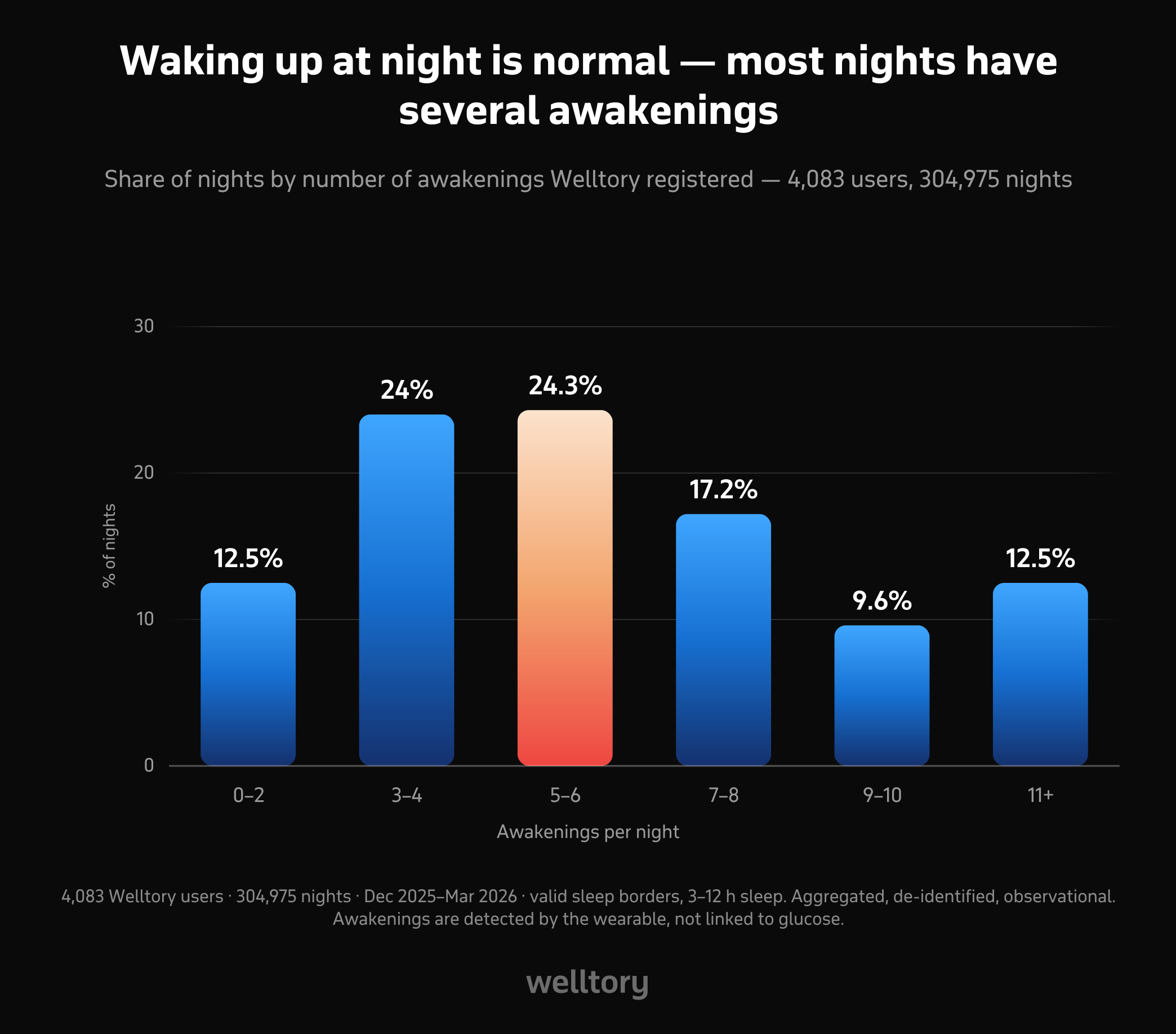
What Welltory data shows: waking up at night is normal. Brief awakenings are part of ordinary sleep. Across 4,083 Welltory users and 304,975 nights, the median night had six registered awakenings (the middle half of nights had four to eight), and 97.5% of nights had at least one. The number was similar in users who report no health conditions and in those who report several. So waking up — even with a racing heart — is not, on its own, a sign of low blood sugar. A low is more likely when the waking comes with drenching sweat, shakiness or confusion, eases after sugar, and is confirmed by a meter.
Welltory users with good-quality wearable data, Dec 2025–Mar 2026; nights with valid sleep borders and 3–12 hours of sleep. Aggregated, de-identified, observational.
If you do wake up low, use the same 15-15 rule, then have a small snack before going back to sleep.
When a low is an emergency — glucagon and who to call
If someone is unconscious, having a seizure, or too confused to swallow safely, don't put food or drink in their mouth. Glucagon — a hormone that makes the liver release glucose — is the best treatment for severe low blood sugar, and it comes as an injection or a nasal spray. (niddk.nih.gov) The ADA recommends that glucagon be prescribed for people who take insulin or are at high risk of hypoglycemia, and that the people around them know where it is and how to use it. (doi.org)
Call emergency services right away after giving glucagon, or straight away if there's no glucagon to hand. (niddk.nih.gov) Also call if:
The person has a seizure or stays confused
Glucose stays low after two or three rounds of treatment
You don't know why the person is unwell
Once someone is awake and can swallow, give fast sugar, then food.
Can a smartwatch tell you your blood sugar is dropping?
Not yet as a medical feature — but the signal is real. When glucose falls, the adrenaline response raises heart rate and lowers heart rate variability. A 2023 study in 22 adults with insulin-treated diabetes combined a smartwatch and a research wristband with machine learning and detected hypoglycemia (below 3.9 mmol/L) in people the model hadn't seen before, with an accuracy score (AUROC) of 0.76. The model linked lows with a higher heart rate, lower heart rate variability and more sweating. (doi.org)
That's promising research, not a replacement for a meter or a glucose monitor. It also means the reverse: a racing heart and low HRV can come from a low — or from stress, caffeine, poor sleep or an infection.
How Welltory can help you spot the pattern
Welltory doesn't measure glucose and can't tell you your blood sugar is low. What it does is detect stress episodes in real time from your heart rate and physiological signals, record your sleep and overnight recovery, and track your daily energy with body battery. A low blood sugar episode triggers the same adrenaline response Welltory registers as stress — so if you get lows, some of them will leave a trace.
To use that honestly:
Tag your lows in My Patterns — "low 62", "shaky before lunch" — along with meals, exercise and alcohol.
Look at what comes before. Over a few weeks, see whether lows cluster after certain meals, late workouts, drinks or short nights.
Check your nights. Repeated night-time heart rate spikes and restless sleep on nights after evening alcohol or exercise are worth a glucose check the next time it happens.
A stress episode is not proof of a low. Treat what Welltory shows as a clue that tells you when to check your glucose — and which days to bring to your doctor.
What does the evidence not show?
That symptoms alone confirm a low. Most symptomatic episodes in people who suspect post-meal hypoglycemia come with normal glucose. (doi.org)
That more sugar is better. In the classic dosing study, 20 grams of glucose was enough to correct a low without a rebound high, and the glucose content of the food mattered; there's no evidence that much larger doses help, and they make overshooting more likely. (PubMed)
That the same rules fit everyone. Children, pregnant women, older adults and people with kidney disease or on specific medications may get different targets and doses from their care team.
That wearables can diagnose hypoglycemia. Heart rate and HRV patterns track lows in research settings, but they are not validated medical alerts. (doi.org)
When should you see a doctor?
See a doctor if you have lows without diabetes more than occasionally, if they happen while fasting, at night or after exercise, if you've had stomach or bariatric surgery, or if you've ever passed out or had a seizure. If you have diabetes, tell your care team about any level 2 or level 3 low — it usually means your treatment plan needs adjusting. (doi.org)
How to bring this up with your doctor — and what to ask for
Bring readings, not just feelings. Glucose values taken during symptoms, what you'd eaten and when, and what you did to treat them.
Say what you want to know. "I've had several readings under 60 with shakiness, usually a few hours after meals. What could cause this, and what should I test?"
Ask these specifically. Should I carry glucagon? Could any of my medications be causing lows? Would a glucose monitor help me catch patterns? If I don't have diabetes, should I be checked for reactive hypoglycemia, insulin resistance or other causes?
If you are dismissed. "Can you note in my record that I've documented low glucose readings during symptoms, and tell me what would make you want to investigate further?" A documented concern gets revisited more often.
How Welltory helps
Welltory is not a glucose monitor and doesn't replace one. It adds what your meter can't see: the stress response around a low, your sleep the night before, your energy across the day — against your own baseline. With My Patterns, each note becomes a tag, so after a few weeks you can see which meals, workouts, drinks or short nights keep turning up before your lows. That's how a scattered set of scary moments becomes a pattern you — and your doctor — can act on. (If your glucose tends to swing the other way, see our guide to continuous glucose monitors.)
How we made it
Treatment steps and food amounts follow the National Institute of Diabetes and Digestive and Kidney Diseases (NIDDK) and the American Diabetes Association Standards of Care in Diabetes—2026 (section 6). Supporting research: glucose dosing and rebound (Brodows et al. 1984), glucose vs sucrose vs fructose for treating lows (Husband et al. 2010), glycemic thresholds for symptoms (Mitrakou et al. 1991), glucose during spontaneous symptoms (Palardy et al. 1989), evaluation of hypoglycemia without diabetes (Cryer et al. 2009), CGM ranges in healthy adults (Shah et al. 2019), sensor compression lows (Mensh et al. 2013) and smartwatch detection of hypoglycemia (Lehmann et al. 2023).
Welltory does not measure glucose, so no glucose figures here come from our own data. The awakening figures come from an aggregated, de-identified Welltory dataset: 4,083 users with good-quality wearable data and 304,975 nights (December 2025 to March 2026), checked separately by the number of conditions users report. Product descriptions reflect how Welltory's stress episodes, sleep tracking, body battery and My Patterns work today.


Discounts for blog readers: up to 36% off
See what affects your energy, stress, sleep, and daily state with Welltory
This article is for educational purposes only and is not a substitute for medical advice, diagnosis, or treatment from a qualified clinician.
Was this helpful?
Ask AI for a summary of page


Written by Jane Smorodnikova

The founder and CEO of Welltory. A recognized tech leader with two Master's degrees and experience at MIT, she has scaled Welltory to over 17 million users.
Written by Tatsiana Yashyna

Deputy COO at Welltory. With a background in medicine and years of working with health data, she translates research and real physiological signals — sleep, stress, heart rate, and hormones — into clear, evidence-based explanations that help people understand what their bodies are telling them.
References
- National Institute of Diabetes and Digestive and Kidney Diseases. Low blood glucose (hypoglycemia). https://www.niddk.nih.gov/health-information/diabetes/overview/preventing-problems/low-blood-glucose-hypoglycemia
- American Diabetes Association Professional Practice Committee for Diabetes. 6. Glycemic goals, hypoglycemia, and hyperglycemic crises: Standards of Care in Diabetes—2026. Diabetes Care 2026;49(Suppl 1):S132-S149. https://doi.org/10.2337/dc26-S006
- Brodows RG, Williams C, Amatruda JM. Treatment of insulin reactions in diabetics. JAMA 1984;252(24):3378-3381. https://pubmed.ncbi.nlm.nih.gov/6389915/
- Husband AC, Crawford S, McCoy LA, Pacaud D. The effectiveness of glucose, sucrose, and fructose in treating hypoglycemia in children with type 1 diabetes. Pediatric Diabetes 2010;11(3):154-158. https://doi.org/10.1111/j.1399-5448.2009.00558.x
- Mitrakou A, Ryan C, Veneman T, et al. Hierarchy of glycemic thresholds for counterregulatory hormone secretion, symptoms, and cerebral dysfunction. American Journal of Physiology — Endocrinology and Metabolism 1991;260(1):E67-E74. https://doi.org/10.1152/ajpendo.1991.260.1.e67
- Palardy J, Havrankova J, Lepage R, et al. Blood glucose measurements during symptomatic episodes in patients with suspected postprandial hypoglycemia. New England Journal of Medicine 1989;321(21):1421-1425. https://doi.org/10.1056/NEJM198911233212101
- Cryer PE, Axelrod L, Grossman AB, et al. Evaluation and management of adult hypoglycemic disorders: an Endocrine Society clinical practice guideline. Journal of Clinical Endocrinology & Metabolism 2009;94(3):709-728. https://doi.org/10.1210/jc.2008-1410
- Shah VN, DuBose SN, Li Z, et al. Continuous glucose monitoring profiles in healthy nondiabetic participants: a multicenter prospective study. Journal of Clinical Endocrinology & Metabolism 2019;104(10):4356-4364. https://doi.org/10.1210/jc.2018-02763
- Mensh BD, Wisniewski NA, Neil BM, Burnett DR. Susceptibility of interstitial continuous glucose monitor performance to sleeping position. Journal of Diabetes Science and Technology 2013;7(4):863-870. https://doi.org/10.1177/193229681300700408
- Lehmann V, Föll S, Maritsch M, et al. Noninvasive hypoglycemia detection in people with diabetes using smartwatch data. Diabetes Care 2023;46(5):993-997. https://doi.org/10.2337/dc22-2290


