

Short answer
The glucose test in pregnancy checks how well your body handles sugar, to find gestational diabetes. Most people have it between 24 and 28 weeks, and US guidelines recommend screening everyone without known diabetes at 24 weeks or later. (doi.org) (cdc.gov)
There are two main approaches:
Two-step (most common in the US). First, a 1-hour glucose challenge test: you drink 50 g of glucose, usually without fasting, and have blood drawn an hour later. A result at or above 130, 135 or 140 mg/dL (the cut-off depends on your clinic) means you go on to a 3-hour test with 100 g of glucose after fasting. (doi.org)
One-step. A 2-hour test with 75 g of glucose after fasting, with blood drawn at the start, at 1 hour and at 2 hours. (doi.org)
If you've just been told you "failed" the 1-hour test and you're panicking — you're not imagining how stressful that is, but it isn't a diagnosis. The 1-hour test is a screening filter, built to catch as many possible cases as it can. In a large Canadian study, 18.5% of women screened positive on the 1-hour test, but only about 1 in 7 of them turned out to have gestational diabetes on the full test (using the stricter National Diabetes Data Group criteria). (PubMed)
This article explains each test, the normal ranges, what to eat before, how to prepare, what your results mean, and what happens next.
When do they test for gestational diabetes?
24–28 weeks for most people. Gestational diabetes usually develops around the 24th week, so testing in this window catches most cases. (cdc.gov)
Earlier — often at the first prenatal visit — if you have risk factors, such as gestational diabetes in a previous pregnancy, overweight, PCOS, a strong family history of type 2 diabetes or prediabetes. The goal of early testing is partly to find type 2 diabetes that was there before pregnancy.
Whether treating gestational diabetes found before 20 weeks helps has now been tested. In a randomised trial of 802 women with risk factors who were diagnosed early, immediate treatment modestly reduced a composite of problems in the newborn — 24.9% versus 30.5% with deferred or no treatment — without changing rates of pregnancy-related high blood pressure. (doi.org)
The 1-hour glucose test (glucose challenge test)
What happens. You drink a sweet 50 g glucose drink — usually orange- or lemon-flavoured — within about five minutes. You stay at the clinic, and one hour later your blood is drawn. For most clinics, you don't need to fast.
1-hour glucose tolerance test normal range in pregnancy. A result below your clinic's cut-off is considered normal. The ADA lists three cut-offs in use: 130, 135 or 140 mg/dL (7.2, 7.5 or 7.8 mmol/L). (doi.org) Lower cut-offs catch more cases but send more people to the 3-hour test.
How accurate it is. Against the 3-hour test, the 1-hour test with a 140 mg/dL cut-off picks up about 82% of cases; a 135 mg/dL cut-off picks up about 93%, at the cost of more false alarms. (doi.org)
Can't stand the drink? Tell your clinic. In one study of pregnant women, 28 jelly beans (50 g of simple carbohydrate) produced the same 1-hour glucose as the standard drink, with fewer side effects — 20% versus 38% — and 76% of women preferred them. (doi.org) The study found only five cases of gestational diabetes, and the two methods didn't always flag the same women, so not every clinic accepts alternatives, so ask first rather than swapping on your own.
The 3-hour glucose test (oral glucose tolerance test)
What happens. You fast overnight (usually at least 8 hours), have a fasting blood draw, drink 100 g of glucose, then have blood drawn at 1, 2 and 3 hours. You stay seated at the clinic the whole time.
3-hour glucose test normal ranges in pregnancy. Two sets of criteria are used in the US. Gestational diabetes is diagnosed if two or more values are at or above the thresholds. (doi.org)
| Time | Carpenter–Coustan | National Diabetes Data Group |
|---|---|---|
| Fasting | 95 mg/dL (5.3 mmol/L) | 105 mg/dL (5.8 mmol/L) |
| 1 hour | 180 mg/dL (10.0 mmol/L) | 190 mg/dL (10.6 mmol/L) |
| 2 hours | 155 mg/dL (8.6 mmol/L) | 165 mg/dL (9.2 mmol/L) |
| 3 hours | 140 mg/dL (7.8 mmol/L) | 145 mg/dL (8.0 mmol/L) |
Under this rule, one abnormal value alone doesn't meet the definition. But ACOG notes that one elevated value can be used for diagnosis, and some US clinics do diagnose on a single high value — ask which rule your clinic uses. (doi.org)
The 2-hour, one-step test
What happens. After an overnight fast of at least 8 hours, you have a fasting blood draw, drink 75 g of glucose, and have blood drawn at 1 and 2 hours.
Normal ranges. Gestational diabetes is diagnosed if any one value is at or above: (doi.org)
Fasting — 92 mg/dL (5.1 mmol/L)
1 hour — 180 mg/dL (10.0 mmol/L)
2 hours — 153 mg/dL (8.5 mmol/L)
Because one high value is enough, the one-step approach diagnoses more women. In five randomised trials with nearly 26,000 women, one-step testing diagnosed gestational diabetes in 11.5% versus 4.9% with the two-step approach — but without better health outcomes for mothers or babies. (doi.org) That's why US practices differ, and why a friend in another city may have had a different test.
What to eat before a glucose test in pregnancy
Before the 1-hour test (non-fasting):
Eat a normal, balanced meal a couple of hours before — protein, some fat, fiber and a moderate amount of carbohydrate. Eggs and whole-grain toast, Greek yogurt with nuts, or oatmeal with peanut butter all work.
Skip the sugar-heavy breakfast — juice, pastries, sweet coffee drinks, pancakes with syrup — right before the test.
Know that timing matters. In the Toronto study, the time since the last meal had a marked effect on the 1-hour result, which is why some researchers suggested different cut-offs depending on when people last ate. (PubMed) Some clinics ask you to fast or to eat at a set time — follow their instructions.
Before the 2-hour or 3-hour test (fasting):
Eat normally for the three days before. The ADA advises a mixed diet with at least 150 g of carbohydrate a day for three days before an oral glucose tolerance test. (doi.org) Cutting carbs sharply to "pass" can backfire — after a few low-carb days, your body handles a big glucose load worse, which can produce a false high result.
Fast for at least 8 hours (usually overnight). Water is normally allowed; check with your clinic about anything else.
Book an early-morning slot, so the fast is mostly sleep.
Should you try to "game" the test? No. The point is to find out how your body really handles glucose in pregnancy. A false pass means untreated high glucose for the rest of pregnancy; a false fail means an extra test. Eat normally, prepare as instructed, and let the test do its job.
How to prepare for the glucose test in pregnancy
Protect your sleep in the days before. In a pooled analysis of 287 pregnant women whose sleep was measured objectively over several days, those who usually slept 6.25 hours or less had 1-hour glucose challenge results about 0.65 mmol/L (about 12 mg/dL) higher than women who slept longer. (doi.org) That's an association with habitual sleep, not proof that one night changes your result — but there's no reason to arrive exhausted.
Don't arrive in a rush. Stress hormones raise blood glucose; giving yourself time to get there calmly is worth it.
Bring things to do. You'll be sitting for one to three hours.
Stay seated during the test. Walking lowers glucose and can make results unreliable; clinics ask you to stay put. No smoking.
Bring a snack for afterwards, especially after a fasting test — something with protein and carbohydrate.
Tell staff if you feel faint or vomit. Vomiting usually means the test needs to be redone on another day.
Mention medications such as steroids, which raise glucose.
What Welltory data shows: short nights are common
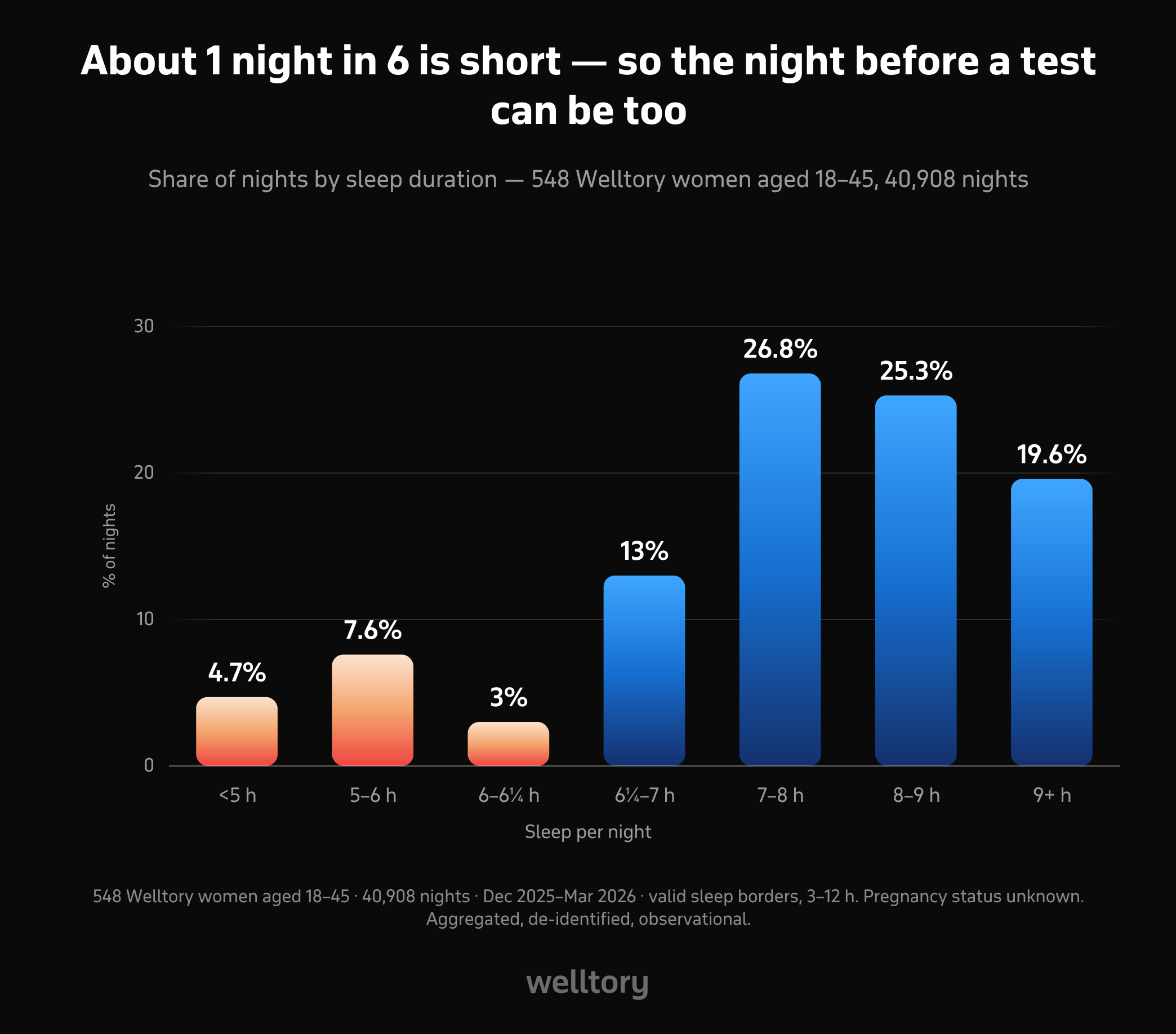
How likely is it that the night before your test is a short one? We can't see pregnancy in our data, but we can see sleep in 548 women aged 18–45 who use Welltory with a wearable, across 40,908 nights. On a typical night they slept well — a median of about 7.8 hours — yet 15.5% of nights were 6 hours 15 minutes or shorter, and about half of all weeks (49.3%) included at least one such night. The figure held across age bands (13.8% in women 18–34, 15.8% in women 35–45) and rose slightly with the number of health conditions women report (13.7% with none, 18.1% with three or more). In practice, that means roughly a 1-in-6 chance that any given night — including the one before your appointment — is short, so it's worth planning an early night and an early slot.
548 Welltory women aged 18–45 with good-quality wearable data, Dec 2025–Mar 2026; nights with valid sleep borders and 3–12 hours of sleep. Aggregated, de-identified, observational; pregnancy status unknown.
Is the glucose drink safe for the baby?
For most pregnancies, yes. The 50 g drink contains roughly as much sugar as a large regular soda, and the 75 g and 100 g drinks are bigger versions of the same thing. Your glucose rises for an hour or two and then comes back down, just as it would after a very sweet meal. There's no evidence that a single test harms the baby, while missing gestational diabetes clearly can: untreated high glucose over the remaining months of pregnancy is linked to larger babies and delivery complications, and treatment reduces those risks. (doi.org)
Two situations where you should talk to your team first:
You've had bariatric or stomach surgery. After gastric bypass and some other operations, a large glucose load can trigger rapid "dumping" symptoms and a steep drop in blood sugar an hour or two later. Post-bariatric hypoglycemia is a recognised complication that often goes unrecognised for years. (doi.org) Ask your team whether an alternative, such as a period of home glucose monitoring, makes more sense for you than the drink test.
You're taking steroids — for example, to help the baby's lungs mature before an early delivery — or have an acute illness. Both raise glucose temporarily, so timing of the test may need to change.
Signs you passed your glucose test
There aren't any you can feel. Feeling fine, shaky, tired or nauseated after the drink tells you nothing about your result — many people feel lightheaded an hour or two after a large glucose load regardless of the outcome. The only way to know is your result:
1-hour test: below your clinic's cut-off (130, 135 or 140 mg/dL) = passed; at or above = go on to the diagnostic test.
3-hour test: fewer than two values at or above the thresholds = no gestational diabetes under the two-value rule (some clinics diagnose on one high value).
2-hour one-step test: all three values below the thresholds = no gestational diabetes.
Ask your provider which cut-offs your clinic uses so you can read your own results.
Failed the glucose test in pregnancy? What happens next
If you failed the 1-hour test: you'll be scheduled for the 3-hour test, usually within a week or two. Remember the Toronto numbers: most women who screen positive on the 1-hour test don't turn out to have gestational diabetes. (PubMed) If your result was very high, some clinics diagnose gestational diabetes without the second test.
If you're diagnosed with gestational diabetes: you'll usually be referred for nutrition advice and taught to check your glucose at home, typically fasting and after meals. The targets are below 95 mg/dL fasting, below 140 mg/dL one hour after a meal, or below 120 mg/dL two hours after. (doi.org) Most women manage with food and activity; some need insulin. We explain what the diagnosis means, the risks and how it's managed in our guide to gestational diabetes.
Why finding it matters: treatment clearly helps. In the evidence review for the US Preventive Services Task Force, treating gestational diabetes after 24 weeks reduced macrosomia, large-for-gestational-age babies, shoulder dystocia, caesarean delivery and neonatal intensive care admissions. (doi.org)
Can a continuous glucose monitor replace the glucose test?
Not yet. Continuous glucose monitors show 24-hour glucose patterns and can catch highs that a single test misses, and researchers are studying whether they could help diagnose gestational diabetes — so far that's described as potential rather than proven, and the oral glucose test remains the standard. (doi.org) After diagnosis, a CGM may be offered to help manage glucose; in gestational diabetes, it probably reduces weight gain in pregnancy and preeclampsia compared with finger-stick monitoring, based on a small number of trials. (doi.org)
If you already wear a sensor, don't use it to decide whether to take the glucose test. Pregnancy targets and diagnostic thresholds are specific to lab tests.
Why the test can feel awful — and what's normal
A large glucose drink on a mostly empty stomach can make you nauseated, jittery, sweaty or tired, and some people feel shaky or foggy in the hour or two afterwards as glucose peaks and then falls. That's the body's normal response to a big sugar load, not a sign of the result. Eat a proper snack as soon as the test is over, and if you feel very unwell afterwards — faint, confused, vomiting — tell the clinic. If you're prone to blood sugar crashes after eating, mention it to staff before the test, and see how to raise blood sugar fast for what to do if you get a low afterwards.
How Welltory can help around the test
Welltory doesn't measure glucose and has no role in the test itself. What it can do is help with the two things you can influence in the days before: sleep and stress.
Sleep. Welltory tracks your sleep and overnight recovery, so you can see whether you've been running short in the week before your appointment — and the research above links habitually short sleep in pregnancy to higher screening results. (doi.org)
Stress. Welltory detects stress episodes from your heart rate in real time. If a test morning is shaping up to be a stress spike, it's a nudge to leave earlier and give yourself time.
Your baseline. Resting heart rate normally rises during pregnancy, by about 8 beats per minute between 10 and 40 weeks on average, so comparing yourself to your own trend makes more sense than comparing to non-pregnant norms. (doi.org)
If you're diagnosed, My Patterns lets you add your glucose readings and meals as notes, so over a few weeks you can see whether higher fasting numbers follow shorter nights or more stressful days.
What does the evidence not show?
That one approach is clearly better. One-step testing diagnoses more than twice as many women as two-step, without proven better outcomes, so both remain in use. (doi.org)
That special pre-test diets improve accuracy. Beyond eating normally for three days before a fasting test and avoiding a sugar-heavy meal right before a non-fasting test, there's little evidence for specific foods.
That one night's sleep changes your result. Habitually short sleep is linked to higher screening results, but that's an association and wasn't tested for the night before the test; the aim is an accurate test, not a lower number. (doi.org)
That a CGM can replace the test. Promising, not yet standard. (doi.org)
When should you call your care team?
Call your provider if you vomited during the test and haven't been told what to do next, if you haven't received results within the time you were told, if you feel faint or unwell for hours afterwards, or if you're diagnosed and don't yet have a follow-up plan. Outside the test, call if you notice severe headache, vision changes or sudden swelling of the face or hands, or if the baby is moving less than usual.
How to bring this up with your doctor — and what to ask for
Ask before the test. Which test am I having — one-step or two-step? Do I need to fast? What should I eat beforehand? Can I have an alternative if the drink makes me sick?
Ask about your results. What were my exact numbers, and what cut-offs does this clinic use? If one value was high on the 3-hour test, what does that mean for the rest of my pregnancy?
If you're diagnosed. Can I see a dietitian? What are my targets, and how often should I check? When should I call you? Would a glucose monitor help?
If you feel dismissed. "Can you note in my record that I have risk factors and would like earlier or repeat testing?" A documented request gets revisited more often.
How Welltory helps
The glucose test is a lab test, and Welltory doesn't change it. What Welltory adds is the picture around it — how you've been sleeping, how stressful your days have been, how much energy you have for the walks that help keep glucose steady. If the test finds gestational diabetes, My Patterns turns your readings and notes into tags, so the link between your nights, your days and your numbers becomes visible instead of guesswork. (For what moves glucose outside pregnancy, see continuous glucose monitors.)
How we made it
Test procedures and thresholds follow the ADA Standards of Care in Diabetes—2026 (sections 2 and 15) and the USPSTF 2021 recommendation. Supporting research: the USPSTF evidence review on screening accuracy and treatment (Pillay et al. 2021), the Toronto Tri-Hospital Gestational Diabetes Project (Sermer et al. 1998), jelly beans as an alternative glucose load (Lamar et al. 1999), post-bariatric hypoglycemia (Lawler et al. 2025), treatment of early gestational diabetes (Simmons et al. 2023), sleep duration and glucose in pregnancy (Reutrakul et al. 2018), CGM in gestational diabetes (Leow et al. 2025; Burk and Sweeting 2026) and heart rate in pregnancy (Loerup et al. 2019). Timing information follows CDC guidance.
Welltory does not measure glucose, so no glucose figures here come from our own data. The sleep figures come from an aggregated, de-identified Welltory dataset of 548 women aged 18–45 with good-quality wearable data and 40,908 nights (December 2025 to March 2026), checked by age band and by the number of health conditions reported; pregnancy status is not known. Product descriptions reflect how Welltory's sleep tracking, stress episodes and My Patterns work today.


Discounts for blog readers: up to 36% off
See what affects your energy, stress, sleep, and daily state with Welltory
This article is for educational purposes only and is not a substitute for medical advice, diagnosis, or treatment from a qualified clinician.
Was this helpful?
Ask AI for a summary of page


Written by Jane Smorodnikova

The founder and CEO of Welltory. A recognized tech leader with two Master's degrees and experience at MIT, she has scaled Welltory to over 17 million users.
Written by Tatsiana Yashyna

Deputy COO at Welltory. With a background in medicine and years of working with health data, she translates research and real physiological signals — sleep, stress, heart rate, and hormones — into clear, evidence-based explanations that help people understand what their bodies are telling them.
References
- American Diabetes Association Professional Practice Committee for Diabetes. 2. Diagnosis and classification of diabetes: Standards of Care in Diabetes—2026. Diabetes Care 2026;49(Suppl 1):S27-S49. https://doi.org/10.2337/dc26-S002
- American Diabetes Association Professional Practice Committee for Diabetes. 15. Management of diabetes in pregnancy: Standards of Care in Diabetes—2026. Diabetes Care 2026;49(Suppl 1):S321-S338. https://doi.org/10.2337/dc26-S015
- US Preventive Services Task Force. Screening for gestational diabetes: US Preventive Services Task Force recommendation statement. JAMA 2021;326(6):531-538. https://doi.org/10.1001/jama.2021.11922
- Pillay J, Donovan L, Guitard S, et al. Screening for gestational diabetes: updated evidence report and systematic review for the US Preventive Services Task Force. JAMA 2021;326(6):539-562. https://doi.org/10.1001/jama.2021.10404
- Centers for Disease Control and Prevention. Gestational diabetes. https://www.cdc.gov/diabetes/about/gestational-diabetes.html
- Sermer M, Naylor CD, Farine D, et al. The Toronto Tri-Hospital Gestational Diabetes Project: a preliminary review. Diabetes Care 1998;21(Suppl 2):B33-B42. https://pubmed.ncbi.nlm.nih.gov/9704225/
- Lamar ME, Kuehl TJ, Cooney AT, et al. Jelly beans as an alternative to a fifty-gram glucose beverage for gestational diabetes screening. American Journal of Obstetrics and Gynecology 1999;181(5):1154-1157. https://doi.org/10.1016/S0002-9378%2899%2970099-2
- Simmons D, Immanuel J, Hague WM, et al. Treatment of gestational diabetes mellitus diagnosed early in pregnancy. New England Journal of Medicine 2023;388(23):2132-2144. https://doi.org/10.1056/NEJMoa2214956
- Reutrakul S, Anothaisintawee T, Herring SJ, et al. Short sleep duration and hyperglycemia in pregnancy: aggregate and individual patient data meta-analysis. Sleep Medicine Reviews 2018;40:31-42. https://doi.org/10.1016/j.smrv.2017.09.003
- Leow HW, Forbes K, Scott E. The role of continuous glucose monitoring in the diagnosis and management of gestational diabetes mellitus. Best Practice & Research Clinical Endocrinology & Metabolism 2025;39(6):102060. https://doi.org/10.1016/j.beem.2025.102060
- Burk J, Sweeting A. Glucose monitoring in the management of diabetes in pregnancy: a systematic review and meta-analysis. Pregnancy 2026;2(1):e70214. https://doi.org/10.1002/pmf2.70214
- Loerup L, Pullon RM, Birks J, et al. Trends of blood pressure and heart rate in normal pregnancies: a systematic review and meta-analysis. BMC Medicine 2019;17(1):167. https://doi.org/10.1186/s12916-019-1399-1
- Lawler HM, McGinnis T, Patti ME. Diagnosis and management of post-bariatric hypoglycemia. Journal of the American Board of Family Medicine 2025;38(2):383-394. https://doi.org/10.3122/jabfm.2024.240335R1


