

Short answer
Gestational diabetes (gestational diabetes mellitus, or GDM) is high blood sugar that develops or is first found during pregnancy. It happens because hormones from the placenta make your body steadily more resistant to insulin as pregnancy goes on — and in some women, the pancreas can't make enough extra insulin to keep up. (doi.org)
It usually appears around the 24th week, which is why most women are tested between 24 and 28 weeks. (cdc.gov)
If you've just been diagnosed and you're wondering what you did wrong — it's not your fault. Pregnancy itself is the main cause. Risk factors like family history, age and PCOS make it more likely, but plenty of women with none of them still develop it. In the US, an estimated 5.8% to 9.2% of pregnancies are affected, and more with broader diagnostic criteria. (doi.org)
The good news is that treatment works. In a large randomised trial of mild gestational diabetes, treatment — diet, glucose monitoring and insulin if needed — cut the rate of babies born over 4,000 g (about 8 lb 13 oz) from 14.3% to 5.9%, and lowered rates of shoulder dystocia, caesarean delivery, and preeclampsia or high blood pressure in pregnancy. The trial's main combined measure of serious newborn complications was not significantly different (32.4% vs 37.0%). (doi.org) Most women manage it with food changes, activity and regular glucose checks, and blood sugar usually returns to normal after birth. The long-term part — a higher risk of type 2 diabetes later — is real, and it's also the part you can do most about.
What is gestational diabetes?
Gestational diabetes is glucose intolerance that begins or is first recognised during pregnancy. It is now one of the most common pregnancy complications worldwide. (doi.org)
Doctors sometimes use two labels:
A1GDM — gestational diabetes managed with diet and activity alone
A2GDM — gestational diabetes that needs medication, usually insulin or sometimes metformin
It's different from type 1 or type 2 diabetes that existed before pregnancy. If very high glucose is found early in pregnancy, your doctor may check whether you had undiagnosed type 2 diabetes before conceiving.
What causes gestational diabetes?
Insulin resistance is a normal part of pregnancy. As the placenta grows, it releases hormones that make the mother's tissues less responsive to insulin, so more glucose stays in the blood for the baby. In a small study of 15 women with obesity whose insulin sensitivity was measured before pregnancy, in early pregnancy and in late pregnancy, sensitivity fell as pregnancy advanced in both groups — and it was lower in the women who developed gestational diabetes. (doi.org)
To cope, the pancreas normally doubles down and makes more insulin. Gestational diabetes happens when it can't keep up: in most cases, it is the result of pancreatic beta-cell dysfunction on a background of chronic insulin resistance. (doi.org) That's also why gestational diabetes and type 2 diabetes are so closely linked — they share the same weak point.
Risk factors
You're more likely to develop gestational diabetes if you: (cdc.gov)
Had gestational diabetes in a previous pregnancy
Are overweight or have obesity
Have a parent or sibling with type 2 diabetes
Have given birth to a baby who weighed over 9 pounds
Are African American, Hispanic or Latina, American Indian, Alaska Native, Native Hawaiian or Pacific Islander
Older maternal age is another established risk factor. (doi.org) Because gestational diabetes and type 2 diabetes share the same weak point, it's also worth knowing the signs of insulin resistance and prediabetes before pregnancy.
Is gestational diabetes genetic?
Partly. A family history of diabetes is one of the strongest risk factors. Genome-wide studies have found that most of the gene variants linked to glucose traits in pregnancy overlap with those found in people who aren't pregnant and in people with type 2 diabetes. (doi.org) Genes load the dice; pregnancy, weight, age, activity and sleep influence how they roll.
Gestational diabetes signs and symptoms
Most women have no symptoms at all. When there are signs, they're usually mild — more thirst or peeing more often — and both are common in any pregnancy. (cdc.gov) That's why testing matters so much more than symptoms.
The US Preventive Services Task Force recommends screening all pregnant people without known diabetes at 24 weeks or later. (doi.org) If you have strong risk factors, your doctor may test earlier. The test is usually a glucose drink followed by a blood draw — we explain it step by step in our guide to the glucose test in pregnancy.
What happens if you have gestational diabetes?
"What happens if you have gestational diabetes" is one of the most searched questions about it — and the honest answer has two halves: what can go wrong if glucose stays high, and what usually happens once it's managed.
Why glucose in pregnancy matters
Glucose crosses the placenta freely. When the mother's glucose is high, the baby makes more of its own insulin, which acts as a growth hormone. The largest study of this, HAPO, followed more than 23,000 pregnant women across nine countries. It found strong, continuous links between the mother's glucose and the baby's birth weight and insulin levels — even at glucose levels below the threshold for diabetes. There was no clear safe cut-off; risk rose steadily with glucose. (doi.org)
Gestational diabetes risks for the baby
A larger baby (macrosomia), which raises the chance of a difficult delivery, shoulder dystocia or birth injury
Low blood sugar in the baby right after birth, because the baby's insulin stays high after the mother's glucose supply is cut off
Jaundice and a higher chance of needing neonatal intensive care
A higher long-term risk of obesity and metabolic problems in childhood (doi.org)
Gestational diabetes risks for the mother
Preeclampsia and high blood pressure in pregnancy
Caesarean delivery
Type 2 diabetes later in life — a meta-analysis of more than 1.3 million women found the risk was almost 10 times higher after gestational diabetes than after a pregnancy with normal glucose. (doi.org) The CDC estimates about half of women with gestational diabetes eventually go on to develop type 2 diabetes (cdc.gov); within the follow-up of the studies in that meta-analysis, it was about 10–16%.
What usually happens once it's treated
Several of these risks fall with treatment. In the randomised trial above, treatment compared with usual care reduced the outcomes below — although its main combined measure of serious newborn complications (32.4% vs 37.0%) was not significantly different: (doi.org)
| Outcome | Usual care | Treated |
|---|---|---|
| Large-for-gestational-age babies | 14.5% | 7.1% |
| Birth weight over 4,000 g | 14.3% | 5.9% |
| Shoulder dystocia | 4.0% | 1.5% |
| Caesarean delivery | 33.8% | 26.9% |
| Preeclampsia or gestational hypertension | 13.6% | 8.6% |
Women with mild gestational diabetes in their 24th–31st week, randomised to treatment or usual prenatal care.
Gestational diabetes glucose levels: what are the targets?
Once you're diagnosed, you'll usually check your blood sugar several times a day — typically fasting and after meals. The American Diabetes Association's targets for gestational diabetes are: (doi.org)
Fasting (first thing in the morning) — Below 95 mg/dL (5.3 mmol/L)
1 hour after starting a meal — Below 140 mg/dL (7.8 mmol/L)
2 hours after starting a meal — Below 120 mg/dL (6.7 mmol/L)
Your team may set slightly different targets — follow theirs.
For context, glucose in pregnancy without diabetes runs lower than most people expect. A review of 12 studies in 255 pregnant women with normal weight and normal glucose tolerance, measured mostly in the third trimester, found an average fasting glucose of about 71 mg/dL, about 109 mg/dL one hour after meals and 99 mg/dL two hours after. (doi.org) That's one reason some researchers argue the current targets may be generous.
If you use a continuous glucose monitor, your team may talk about time in range. The pregnancy range is tighter than outside pregnancy — 63–140 mg/dL (3.5–7.8 mmol/L) — though these targets were developed mainly for type 1 diabetes in pregnancy, and evidence for gestational diabetes is still limited. (doi.org)
How to manage gestational diabetes
Management usually happens in steps. (doi.org)
Food: the gestational diabetes diet
There's no single gestational diabetes diet, but the principles are consistent:
Spread carbohydrate across the day — three moderate meals and two to three snacks instead of a few large meals
Keep breakfast lower in carbohydrate — many women find their post-breakfast numbers the hardest to keep in range
Pair carbohydrate with protein, fat and fiber at every meal and snack
Choose slower carbohydrates — whole grains, beans, lentils, vegetables, whole fruit — over juice, sweets and white bread
Have a bedtime snack with protein if your fasting numbers run high or you get lows overnight
A registered dietitian can build a gestational diabetes meal plan around your usual foods and your glucose readings — that's standard care, not an extra.
Activity
Regular, moderate activity lowers glucose after meals. A 10–15-minute walk after eating is one of the simplest tools, and it's safe in most pregnancies. Ask your care team which activities suit you.
Medication, if needed
If targets aren't met with food and activity, the next step is usually insulin, which doesn't cross the placenta and is the preferred medication in the ADA standards. Metformin is sometimes used, though it does cross the placenta. (doi.org) Needing medication doesn't mean you failed — placental hormones keep rising until late pregnancy, and many women need more help as weeks go by.
Monitoring the baby
Your team may add growth scans and extra monitoring in the third trimester, especially if you need medication.
Average week of delivery with gestational diabetes
Most women with well-controlled gestational diabetes can wait for labour or be induced close to term. The American College of Obstetricians and Gynecologists generally suggests delivery between 39 weeks and 40 weeks 6 days for gestational diabetes controlled with diet and exercise, and between 39 weeks and 39 weeks 6 days when it's well controlled with medication — earlier only if glucose is poorly controlled or other problems arise. (doi.org)
Low blood sugar in pregnancy — with or without diabetes
Low blood sugar in pregnancy is searched almost as often as high blood sugar, and it's a real issue, especially early on.
Without diabetes. Pregnancy lowers fasting glucose: the baby draws glucose around the clock, and in early pregnancy nausea, vomiting and long gaps between meals can leave you running on empty. As noted above, normal fasting glucose in pregnancy averages around 71 mg/dL. (doi.org) So feeling shaky, lightheaded, sweaty or suddenly ravenous — especially in the morning or after a long gap — can be a low blood sugar moment even if you don't have diabetes.
With gestational diabetes. Lows can happen if you're on insulin, skip a meal, or eat less carbohydrate than your dose was set for. They're less common with diet-only management.
What to do: if you have a meter, check. If you're low (usually below 70 mg/dL, or the number your team gave you), take 15–20 grams of fast carbohydrate — half a cup of juice or four glucose tablets — wait 15 minutes and recheck, then eat a small snack with protein. We cover this in detail in how to raise blood sugar fast. Tell your care team about any low, and seek help straight away if you faint or feel confused.
Preventing lows in pregnancy: small meals every 2–3 hours, a protein-containing snack at bedtime, something to eat within an hour of waking, and keeping a snack in your bag.
How to prevent gestational diabetes
Not every case can be prevented — pregnancy hormones are the main driver — but some levers make a measurable difference.
Move during pregnancy. A meta-analysis of 106 studies found that, in the randomised trials it included (6,934 women), exercise-only programmes in pregnancy reduced the odds of gestational diabetes by 38% (odds ratio 0.62), and of gestational hypertension and preeclampsia by around 40%. To get at least a 25% reduction, women needed about 600 MET-minutes a week of moderate exercise — roughly 140 minutes of brisk walking, water aerobics, stationary cycling or resistance training. (doi.org)
Sleep enough. In a meta-analysis of more than 17,000 women, those who slept less than 6–7 hours a night were more likely to develop gestational diabetes (odds ratio 1.70). In a pooled analysis of women whose sleep was measured objectively, sleeping 6.25 hours or less was linked to higher glucose on the screening test and nearly three times the odds of gestational diabetes. (doi.org) These are associations, not proof that more sleep prevents it — but short sleep is known to reduce insulin sensitivity outside pregnancy too.
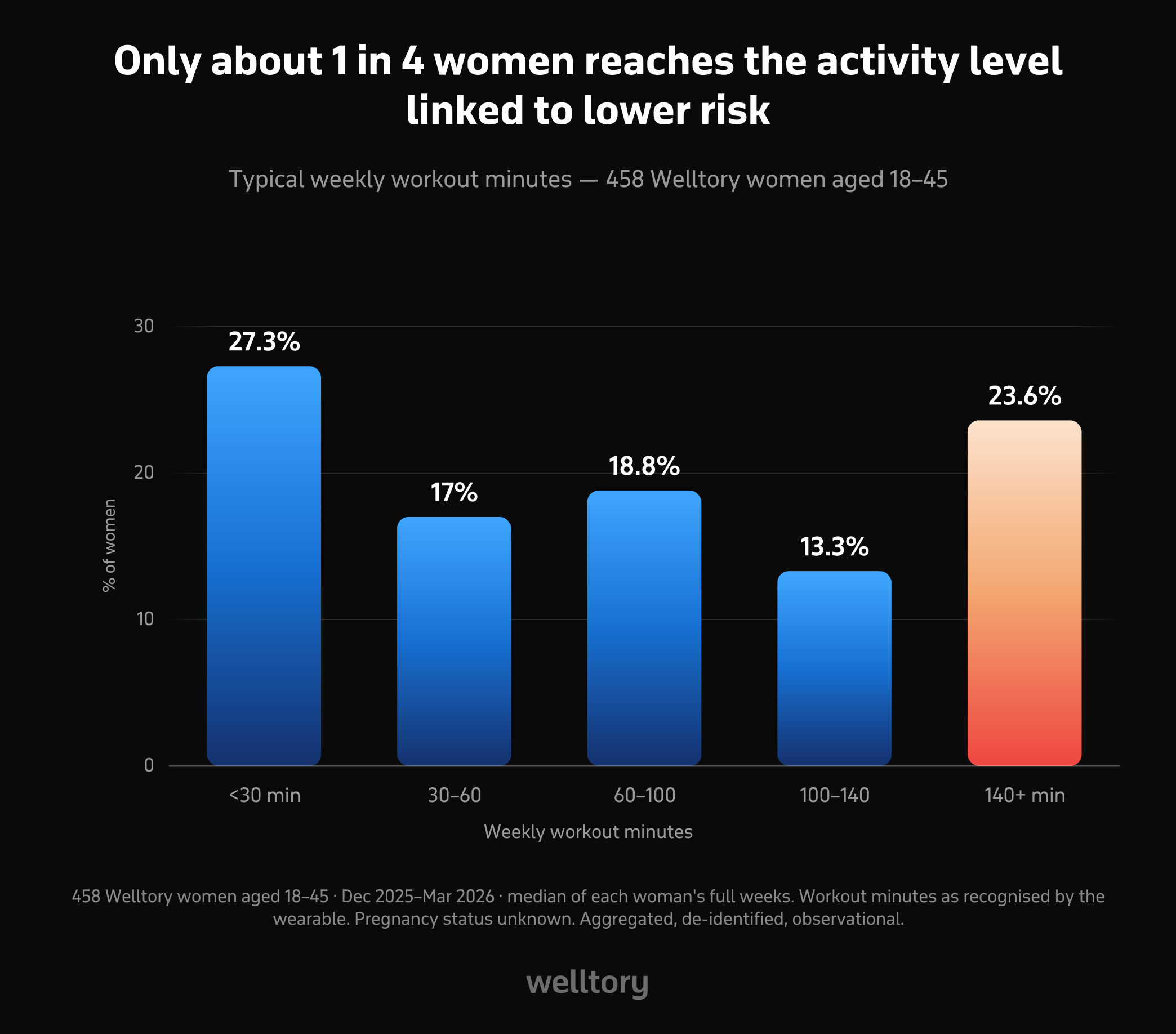
What Welltory data shows about where most women start. We can't see pregnancy in our data, but we can see the two habits above in 548 women aged 18–45 who use Welltory with a wearable. Their typical week included about 70 minutes of workouts the wearable recognised (the middle half ranged from 26 to 136 minutes), and only 23.6% usually reached the ~140 minutes linked to lower gestational diabetes risk; more than a quarter logged under 30 minutes. The share reaching 140 minutes was 28.7% in women who report no health conditions and 15.3% in those who report three or more. Sleep was better than expected on a typical night — a median of about 7.8 hours — but 15.5% of nights were 6 hours 15 minutes or shorter, and about half of all weeks included at least one such night. Workouts are a floor, not a full count: brisk walks that the wearable didn't classify as a workout aren't included.
548 Welltory women aged 18–45 with good-quality wearable data, Dec 2025–Mar 2026 (40,908 nights; 458 women with enough full weeks for the workout figure). Aggregated, de-identified, observational; pregnancy status unknown.
Start pregnancy from a healthier baseline. Before conception, reaching a healthier weight, eating well and staying active may lower the risk. During pregnancy, the focus shifts from weight loss to healthy eating and activity. (cdc.gov) If you're planning, our guide to the 90 days before pregnancy covers what guidelines recommend.
Know your history. If you had gestational diabetes before, have PCOS or a strong family history, ask about earlier testing in your next pregnancy.
After birth: what happens to your blood sugar
For most women, blood sugar returns to normal soon after delivery, once the placenta — and its hormones — are gone. But the underlying tendency remains:
Get tested after birth. The ADA recommends a glucose tolerance test at 4–12 weeks postpartum, then lifelong screening every 1–3 years. (doi.org)
Breastfeed if you can. In a cohort of about 1,000 women with recent gestational diabetes, 11.8% developed type 2 diabetes within two years; more intensive breastfeeding was linked to lower risk, with exclusive breastfeeding associated with about half the risk of exclusive formula feeding. (doi.org)
Keep the habits that worked. The meals, walks and sleep routines that controlled your glucose in pregnancy are the same ones that lower long-term diabetes risk.
Tell future doctors. A history of gestational diabetes belongs in your medical record for life.
(More on the first months after birth in postpartum recovery after 35.)
How Welltory can support you during pregnancy
Welltory doesn't measure glucose and doesn't replace your meter, your CGM or your care team. What it can add is the context around your numbers — the things the research above links to glucose in pregnancy.
Sleep. Short sleep is linked to higher glucose and higher gestational diabetes risk. (doi.org) Welltory tracks your sleep and overnight recovery, so you can see how your nights are trending as pregnancy advances.
Stress. Stress hormones raise glucose. Welltory detects stress episodes from your heart rate in real time, which helps you notice the days when stress is high.
Activity and energy. Welltory's body battery shows your daily energy, which helps when you're trying to fit in regular walks without overdoing it.
Your own baseline. Resting heart rate normally rises during pregnancy — on average from about 79 to 87 beats per minute between 10 and 40 weeks. (doi.org) Comparing yourself to your own trend makes more sense than comparing to non-pregnant norms.
With My Patterns, you can add your glucose readings and meals as notes — "fasting 98", "oatmeal breakfast", "walk after dinner" — and see over a few weeks whether high fasting numbers follow short nights, or whether post-meal readings are calmer on days you walk. Bring that to your appointments; it's the kind of pattern your team can act on.
What does the evidence not show?
That any single cause explains your diagnosis. Gestational diabetes comes from the interaction of normal pregnancy hormones with individual risk. (doi.org)
That more sleep or less stress prevents it. The sleep link is consistent but observational, and self-reported sleep was the main measure in most studies. (doi.org)
That a CGM is proven better than finger-stick checks for everyone. In gestational diabetes, CGM probably reduces weight gain in pregnancy and preeclampsia compared with finger-stick monitoring, but the evidence comes from a small number of trials. (doi.org) Finger-stick monitoring itself clearly improves outcomes compared with no home monitoring.
That diagnosis criteria are the same everywhere. Countries and even hospitals use different tests and cut-offs, which is part of why prevalence estimates vary. (doi.org)
When should you call your care team?
Between visits, call if:
Your readings are above target several times in a week
You have a low below 70 mg/dL (or your team's threshold), or any low with confusion or fainting
You're vomiting and can't keep food down, especially if you use insulin
You notice severe headache, vision changes, swelling of the face or hands, or pain under the ribs — possible signs of preeclampsia
The baby is moving less than usual
How to bring this up with your doctor — and what to ask for
Bring your log. Glucose readings with times, what you ate, and anything unusual — a bad night, an illness, a stressful day.
Say what you want to know. "My fasting numbers are creeping up even though my after-meal numbers are fine. What should we change?"
Ask these specifically. What are my exact targets? When should I call you about a high or low? Should I see a dietitian? Would a continuous glucose monitor help me? What's the plan for delivery timing? When and how will I be tested after birth?
If you feel rushed or dismissed. "Can you note in my record that I'm concerned about my readings and tell me which numbers should prompt a change in treatment?" A documented concern gets revisited more often.
How Welltory helps
Gestational diabetes is managed with food, movement, glucose checks and, sometimes, medication — Welltory doesn't change that. What it adds is a clearer picture of the everyday factors that sit behind your numbers: how you slept, how stressed your days were, how much energy you had to move. With My Patterns, your readings and notes turn into tags, and over a few weeks you can see which habits line up with better numbers — a useful thing to know during pregnancy, and even more useful for the years after it. (For how stress and sleep move glucose outside pregnancy, see continuous glucose monitors.)
How we made it
The clinical content rests on published guidelines and research: ADA Standards of Care in Diabetes—2026 (section 15), the USPSTF 2021 screening recommendation, ACOG guidance on delivery timing, CDC information on gestational diabetes, reviews of gestational diabetes (Sweeting et al. 2022; Plows et al. 2018; Angueira et al. 2015), insulin sensitivity across pregnancy (Catalano et al. 1999), the HAPO study (2008), the treatment trial for mild gestational diabetes (Landon et al. 2009), progression to type 2 diabetes (Vounzoulaki et al. 2020), glycemia in normal pregnancy (Hernandez et al. 2011), prenatal exercise (Davenport et al. 2018), sleep duration (Reutrakul et al. 2018), glucose monitoring in pregnancy (Burk and Sweeting 2026), heart rate in pregnancy (Loerup et al. 2019) and lactation after gestational diabetes (Gunderson et al. 2015).
Welltory does not measure glucose, so no glucose figures here come from our own data. The workout and sleep figures come from an aggregated, de-identified Welltory dataset of 548 women aged 18–45 with good-quality wearable data (December 2025 to March 2026), checked separately by age band and by the number of health conditions reported; pregnancy status is not known. Product descriptions reflect how Welltory's sleep tracking, stress episodes, body battery and My Patterns work today.


Discounts for blog readers: up to 36% off
See what affects your energy, stress, sleep, and daily state with Welltory
This article is for educational purposes only and is not a substitute for medical advice, diagnosis, or treatment from a qualified clinician.
Was this helpful?
Ask AI for a summary of page


Written by Jane Smorodnikova

The founder and CEO of Welltory. A recognized tech leader with two Master's degrees and experience at MIT, she has scaled Welltory to over 17 million users.
Written by Tatsiana Yashyna

Deputy COO at Welltory. With a background in medicine and years of working with health data, she translates research and real physiological signals — sleep, stress, heart rate, and hormones — into clear, evidence-based explanations that help people understand what their bodies are telling them.
References
- American Diabetes Association Professional Practice Committee for Diabetes. 15. Management of diabetes in pregnancy: Standards of Care in Diabetes—2026. Diabetes Care 2026;49(Suppl 1):S321-S338. https://doi.org/10.2337/dc26-S015
- US Preventive Services Task Force. Screening for gestational diabetes: US Preventive Services Task Force recommendation statement. JAMA 2021;326(6):531-538. https://doi.org/10.1001/jama.2021.11922
- Centers for Disease Control and Prevention. Gestational diabetes. https://www.cdc.gov/diabetes/about/gestational-diabetes.html
- Sweeting A, Wong J, Murphy HR, Ross GP. A clinical update on gestational diabetes mellitus. Endocrine Reviews 2022;43(5):763-793. https://doi.org/10.1210/endrev/bnac003
- Plows JF, Stanley JL, Baker PN, et al. The pathophysiology of gestational diabetes mellitus. International Journal of Molecular Sciences 2018;19(11):3342. https://doi.org/10.3390/ijms19113342
- Catalano PM, Huston L, Amini SB, Kalhan SC. Longitudinal changes in glucose metabolism during pregnancy in obese women with normal glucose tolerance and gestational diabetes mellitus. American Journal of Obstetrics and Gynecology 1999;180(4):903-916. https://doi.org/10.1016/S0002-9378%2899%2970662-9
- Angueira AR, Ludvik AE, Reddy TE, et al. New insights into gestational glucose metabolism: lessons learned from 21st century approaches. Diabetes 2015;64(2):327-334. https://doi.org/10.2337/db14-0877
- HAPO Study Cooperative Research Group; Metzger BE, Lowe LP, Dyer AR, et al. Hyperglycemia and adverse pregnancy outcomes. New England Journal of Medicine 2008;358(19):1991-2002. https://doi.org/10.1056/NEJMoa0707943
- Landon MB, Spong CY, Thom E, et al. A multicenter, randomized trial of treatment for mild gestational diabetes. New England Journal of Medicine 2009;361(14):1339-1348. https://doi.org/10.1056/NEJMoa0902430
- Vounzoulaki E, Khunti K, Abner SC, et al. Progression to type 2 diabetes in women with a known history of gestational diabetes: systematic review and meta-analysis. BMJ 2020;369:m1361. https://doi.org/10.1136/bmj.m1361
- Hernandez TL, Friedman JE, Van Pelt RE, Barbour LA. Patterns of glycemia in normal pregnancy: should the current therapeutic targets be challenged? Diabetes Care 2011;34(7):1660-1668. https://doi.org/10.2337/dc11-0241
- American College of Obstetricians and Gynecologists. Medically indicated late-preterm and early-term deliveries: ACOG Committee Opinion No. 831. Obstetrics & Gynecology 2021;138(1):e35-e39. https://doi.org/10.1097/AOG.0000000000004447
- Davenport MH, Ruchat SM, Poitras VJ, et al. Prenatal exercise for the prevention of gestational diabetes mellitus and hypertensive disorders of pregnancy: a systematic review and meta-analysis. British Journal of Sports Medicine 2018;52(21):1367-1375. https://doi.org/10.1136/bjsports-2018-099355
- Reutrakul S, Anothaisintawee T, Herring SJ, et al. Short sleep duration and hyperglycemia in pregnancy: aggregate and individual patient data meta-analysis. Sleep Medicine Reviews 2018;40:31-42. https://doi.org/10.1016/j.smrv.2017.09.003
- Burk J, Sweeting A. Glucose monitoring in the management of diabetes in pregnancy: a systematic review and meta-analysis. Pregnancy 2026;2(1):e70214. https://doi.org/10.1002/pmf2.70214
- Loerup L, Pullon RM, Birks J, et al. Trends of blood pressure and heart rate in normal pregnancies: a systematic review and meta-analysis. BMC Medicine 2019;17(1):167. https://doi.org/10.1186/s12916-019-1399-1
- Gunderson EP, Hurston SR, Ning X, et al. Lactation and progression to type 2 diabetes mellitus after gestational diabetes mellitus: a prospective cohort study. Annals of Internal Medicine 2015;163(12):889-898. https://doi.org/10.7326/M15-0807


