

Short answer
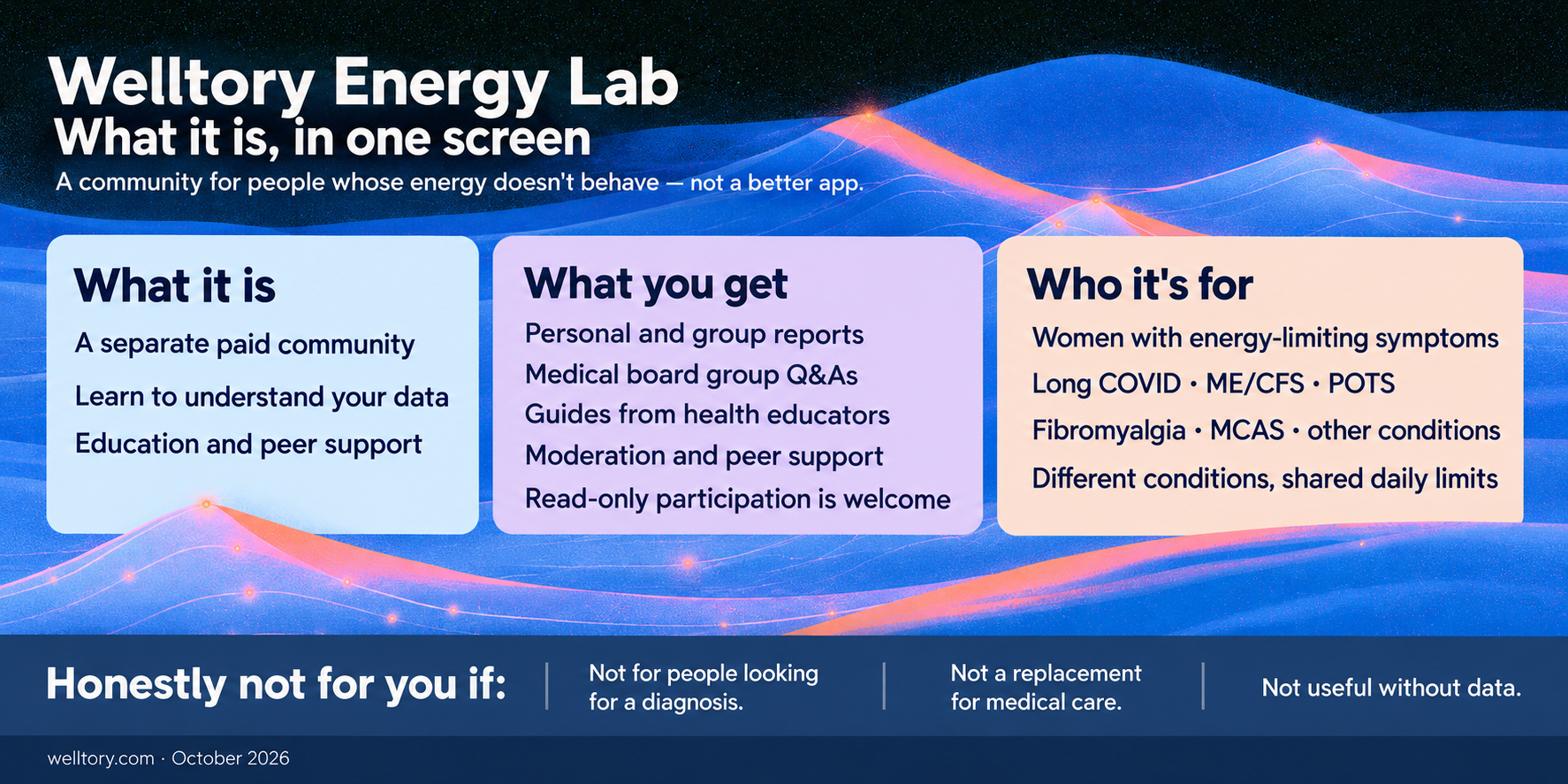
Welltory Energy Lab is a paid, private online community for women aged 18 to 65 who live with an energy-limiting condition — ME/CFS, Long COVID, POTS and other forms of dysautonomia, fibromyalgia, MCAS, hEDS, or something that has not been named yet. You do not need a diagnosis to join.
What makes it different from a support forum: members are grouped in rooms of up to 150 women whose energy patterns look alike, and Welltory's team works with the data you already collect in the app. Once you have logged enough, you get an individual analysis of what tends to come before your own crashes and a health summary you can take to your doctor. Health educators and medical advisors answer the group's questions in plain language.
What it costs: three plans — $99 a month, $219 every three months, or $540 a year. Every plan renews automatically until you cancel. First-time members have a 14-day money-back guarantee.
What it is not: medical care. No diagnosis, no prescriptions, no individual medical advice. Your doctor stays your doctor.
Using Welltory without the Lab? Welltory's Help Center has a dedicated guide: how Welltory can help if you live with chronic and energy-limiting conditions — what the term means, which signals to watch and where the app's tips may not fit your body.
Note: Energy Lab is peer support and education, not medical care. It does not diagnose, prescribe or replace your clinician, and Community Health Educators give group-level educational context, not individual medical advice.
See the Welltory Energy Lab page →
Before you blame yourself for another crash, check what your body already recorded — that idea is the whole reason the Lab exists.
Energy Lab at a glance
Who can join — Women aged 18–65 with ME/CFS, Long COVID, POTS or other dysautonomia, fibromyalgia, MCAS, hEDS or a similar condition — diagnosed, suspected or still being investigated
Where it lives — A members-only Discord server
Group size — Up to 150 members, matched by energy pattern, symptom experience and starting point — not by diagnosis
What you get — Individual data analysis once you have logged enough, a health summary for your doctor, group-level answers from health educators and medical advisors, moderated peer support, lab rounds to test pacing ideas
Time it takes — As much as you like. On average, members spend about 10–15 minutes a day. Just reading is fine
Devices — The Welltory app. iPhone and Apple Watch are not required but are highly recommended
Price — $99/month, $219 every 3 months, or $540/year
Refund — 14-day money-back guarantee on your first Community purchase
What it is not — Medical treatment, a clinic, telehealth, or a research study you are enrolled in
What "energy-limiting condition" means here
A chronic condition is a health problem that lasts a year or more and needs ongoing management or limits daily life. Energy Lab focuses on a particular family of them: conditions where the autonomic nervous system — the body's autopilot that runs heart rate, blood pressure, digestion and temperature — stops regulating the body the way it should.
"Energy-limiting condition", or ELC, is the umbrella term. It covers conditions where everyday activity costs far more energy than it should and can push you into a crash. It overlaps heavily with dysautonomia, the group of conditions in which autonomic regulation breaks down, and autonomic dysfunction is now well described in POTS and in post-COVID illness (Fedorowski & Sutton, 2023). In practice, this is the shared ground of:
ME/CFS — see ME/CFS symptoms
Long COVID — see Long COVID
POTS and other forms of dysautonomia — see What is dysautonomia? and Dysautonomia symptoms
Fibromyalgia — see Fibromyalgia flares
MCAS — see MCAS symptoms
hEDS, and other conditions with the same daily shape
Welltory's Help Center explains the same idea from the app's side in its guide for people living with ME/CFS, Long COVID, POTS, fibromyalgia and other energy-limiting conditions. If you want the mechanism in more depth, Nervous system dysregulation explained walks through it.
"I don't have any of those diagnoses. Can I still join?"
Yes. Energy Lab is built around shared experience and energy patterns, not medical labels, and many people arrive in the long gap between symptoms starting and anyone naming them.
That gap often looks like this. Your labs come back normal. People who love you suggest walking more and resting. You have tried supplements, yoga and plenty else, and nothing sticks. Meanwhile a twenty-minute trip to the store ends with you gripping the cart in the checkout line, afraid you might pass out. Some days a shower is the whole budget. Getting dressed sitting down is not a preference; it is what makes getting dressed possible.
If that sounds familiar, it may be worth raising nervous system dysregulation with a clinician, with or without a formal diagnosis. Energy Lab cannot diagnose you. What it can do is help you see the pattern and describe it clearly.
What you get as a member
Welltory's Help Center and the Energy Lab page describe the membership in the same terms. Here it is, piece by piece.
Your own data, read for you
You keep wearing your watch and using the Welltory app as usual — no extra steps. Once you have logged enough data, Welltory's data team prepares an individual analysis for you:
what tends to come before your own crashes — the signals that move in the days before a bad stretch;
a health summary you can bring to your doctor — a structured way to show what has been happening, instead of "I feel worse on some days";
what the wider group's data shows about patterns like yours.
This matters because one person's data rarely contains enough examples to tell a pattern from a coincidence. When 150 women with similar bodies try the same thing, the pattern has a chance to show up.
Real experts answering the group's questions
The Lab's Community Health Educators and medical advisors answer the group's questions and explain what the body is doing in plain language. According to Welltory's Help Center, every answer is checked by at least two people with medical training. They work at the group level only.
The advisors named on the Energy Lab page are:
Anna Elitzur — Medical Advisor. Educator, researcher, physician by training
Prof. Ancha Baranova — Systems biology expert in chronic diseases and aging
Richard Chen, MD, IFMCP, FAAFP — Family doctor specializing in functional medicine
Ram Prashanth Yogendra, MD, MPH — Physician-scientist focused on Long COVID and immune disorders
Prof. Dr. Kai Wulf — Physician and medical researcher, Long COVID specialist
Health Educators review anonymized, aggregated group-level data only. They do not see your individual health data, and they do not diagnose, prescribe or give individual medical advice.
A room that actually answers
Welltory's Help Center states that about 85% of posts get a real response from someone who lives with a similar condition. For someone rationing energy, that is not a small detail: posting into silence costs energy and gives nothing back.
Moderators and a team behind the room
Moderators and a community manager keep the space safe, answer app questions and make sure nobody is left hanging.
A data scientist looks for patterns across the group that no single member could see alone.
The founder and product team read member feedback and use it to shape future Welltory features for people with similar patterns.
Lab rounds
Members can join a "lab round" — a structured, voluntary group try-out of a pacing strategy, a symptom pattern or a possible trigger. One example from the Help Center: working out your own possible crash triggers.
No pressure, ever
You can read along without posting. You can step back during a crash and come back weeks later without explaining yourself. Nobody tags quiet members for updates. You stay a member either way.
What you can do inside the Lab
During the week, everything is voluntary. You can:
join peer discussions and share your own experience;
learn from anonymized community trends and group-level patterns;
ask Community Health Educators general, group-level educational questions;
join a lab round to test a pacing strategy, symptom pattern or potential trigger;
ask for informational support about the Welltory app and what your data can mean;
give feedback and pitch feature ideas to the product team;
just read.
What the group has seen so far
Welltory's Help Center reports these changes across the group so far. They describe the group as a whole, not what any one person can expect:
members learned that crashes do not all work the same way, and gained a better understanding of their own possible crash triggers;
the number of small wins members shared — real changes they noticed in their own lives — went up almost tenfold;
members report reading their own numbers better and taking them to their doctor in a form that carries weight;
members describe support and validation from each other through losses and wins.
According to the Help Center, the next stage is turning this into a pacing strategy for members who have gathered enough data: which signals to watch, how to tell you are nearing your limit, how to protect recovery time, and early access to new ways of reading your most sensitive signals inside the app.
Results vary by individual. Energy Lab is peer support and education, not medical care, diagnosis or treatment, and not a promise of any individual outcome.
Why a community, and not just more app features
A fair question, since Welltory makes an app and could simply keep adding to it. Two of the problems here do not have a purely software answer.
The first is interpretation. The app can show you that your heart rate variability dropped on Thursday. What it cannot easily tell you alone is whether that drop is the thing that comes before your crashes, or noise, or one bad night. Answering that needs comparison with people whose bodies behave like yours — which is exactly what grouping by pattern is for.
The second is being believed. Many people with energy-limiting conditions spend years having symptoms attributed to anxiety, deconditioning or not trying hard enough. No chart fixes that. Other people describing the same thing without needing it explained does.
There is also the honest history. Welltory was first built for healthy, active users, and many people with chronic conditions used it anyway, just to get through the day. As Jane Smorodnikova, Welltory's founder and CEO, puts it on the Energy Lab page, building for the people who need it most is now a direction the company has committed to. The Lab is where that work happens with members, not just for them.
What your Welltory data may already be showing
You do not need to join the Lab to start reading your own data. Welltory's Help Center, in how to read your Welltory data with an energy-limiting condition, describes the picture that often appears when the nervous system is dysregulated:
HRV — Consistently low and flat. A well-regulated nervous system shows plenty of day-to-day variability; a dysregulated one looks more like a flat line (Shaffer & Ginsberg, 2017)
Resting heart rate — Creeps up over weeks or months and will not come down, without illness or deconditioning to explain it
Stationary stress — The orange zone in your stress timeline — heart rate rising without movement — stays high even on "easy" days
Recovery — The blue zone, when your body is actually repairing, is thin or missing, especially during sleep
Nervous System Snapshot — Rarely green (activated but steady); mostly red (high intensity, low ease) or yellow (alert but unsettled)
None of these is a diagnostic criterion on its own. Together, they can paint a 24-hour picture that a fifteen-minute appointment cannot capture. For a closer look at why your readings and your feelings sometimes disagree, see Sense and sensors. For crash patterns specifically, see What recovery-pattern data can show about post-exertional malaise.
"The app tells me to do things I physically can't"
This happens, and the Help Center says so directly. You may feel awful for three days and get a green screen. Your Battery may drop harder during rest than during activity. You may live with PEM or POTS and still see a suggestion to move more.
That does not mean the data is wrong. It means the data is reading a body that does not behave like the one many of the original tips were written for. Two things already help:
Your own baseline. Many of the ranges behind your Health, Stress and Energy scores are built from your own history over time, not from population norms for your age.
Notes for chronically ill bodies in the Help Center. Welltory has added context to several articles — for example, why a spike in HRV can come before a crash rather than signal recovery, why age and sex reference ranges matter less than your own trend, why a naturally low resting heart rate can make an ordinary task look like an intense workout, and why a consistently high night pulse may be part of your baseline rather than one bad night.
Who Energy Lab is for
The Energy Lab page describes the fit in members' own terms. It may be for you if:
you live with energy-limiting symptoms linked to Long COVID, ME/CFS, fibromyalgia, POTS, MCAS or another condition — diagnosed, suspected or still being investigated;
you have felt dismissed or left without clear answers, even though your symptoms feel real;
you used to run, hike or work full time, and now even a shower drains you;
you have tried different approaches, and activity can still lead to a crash;
you have tracked your data and read the research, and you still want clearer patterns.
Who it is honestly not for
Better to say this plainly than to sell you something you will not use.
Not for anyone looking for a diagnosis. The Lab cannot tell you what you have.
Not a replacement for medical care. No treatment plans, prescriptions or individual medical advice. Health Educators share group-level educational context only.
Not useful without data. The individual analysis needs you to wear a device and use the app. If you will not collect data, most of what you pay for is out of reach.
Not for men, under-18s or over-65s — for now. The Lab currently welcomes women aged 18 to 65.
Not ideal if a recurring charge is a problem right now. Every plan renews automatically until you cancel.
How to join
Choose your plan on the Energy Lab page and check out.
Set your starting point. A few quick questions about your energy patterns and goals, so you are matched with women whose bodies behave like yours.
Get your invite to the members-only Discord space. If you have never used Discord, the team helps you set it up.
Learn with your group — check-ins, lab rounds and discussions, at whatever pace your energy allows.
What Energy Lab costs
These are the plans shown on the Energy Lab page on 20 October 2026, in US dollars. Prices can change, so the page itself is always the source of truth.
| Plan | Billed | Works out at | Renews |
|---|---|---|---|
| Monthly | $99 | $99 a month | $99 every month |
| 3 months | $219 | about $73 a month | $219 every 3 months |
| Annual | $540 | about $45 a month | $540 every year |
Renewal. Every plan renews automatically for as long as your subscription stays active. According to the Energy Lab page, the plan renews at the same promotional price shown at sign-up; if you cancel, switch plans or a payment fails and the subscription ends, that promotional renewal price may no longer apply.
Refunds. Your first Community purchase has a 14-day money-back guarantee: cancel within 14 days of joining for a full refund. Renewals are non-refundable except where required by law.
Cancelling. Email support@welltory.com. Cancelling stops future renewals, and your access continues until the end of the period you have already paid for.
The full rules are in the Community Terms of Service and Community Guidelines.
How this fits with the Welltory app
Energy Lab and the Welltory app are separate subscriptions. The app measures and shows your data; the Lab is where that data is read with help, alongside people like you. The app has its own plans — see How much does Welltory cost for those.
Privacy and data
Your individual Welltory health data is not shared with other members or with Community Health Educators.
Health Educators see only anonymized, aggregated group-level data.
Your posts are visible to other members in the same channels, to Welltory moderators and to Discord as the platform provider. Discord is a third-party service with its own terms and privacy practices.
Good practice: use a pseudonym, and do not post identifiable medical records, insurance details, prescriptions or similar documents.
Anonymized group trends may be used for community learning and product improvement, as described in the Community Privacy Addendum.
"Is this research? Then why do I pay?"
The Help Center answers this directly: there was never an intention to do research on members. The idea is research for people with chronic conditions — an individual service in which the team reads each member's data, answers questions about how ELC bodies work and keeps a safe space to explore data together. If something learned along the way helps others with the same condition, that is a bonus, not the goal.


Start understanding your body
Learn what affects your energy, stress, sleep, and daily state. Get the app.
How Welltory helps — and what it cannot do
The limits first. Welltory is a general wellness product, not a medical device. It does not diagnose, treat or predict any condition, and Energy Lab does not change that.
What you can do in the app today, with or without the Lab:
Watch the five signals above — HRV, resting heart rate, stationary stress, recovery and your Nervous System Snapshot — as trends over one to two weeks, not as single readings.
Tag what happened. When the app asks "What happened?", tap, type or say it: a crash, a long phone call, a hot shower, standing in a queue, a bad night, a busy day at work. Tags turn a pile of readings into events you can look back on.
Look one to three days back from a crash. Check sleep, stress minutes, Battery, resting heart rate and HRV in the days before. Post-exertional malaise is often delayed, so the cause rarely sits on the same day as the crash (pacing scoping review, 2023).
Let My Patterns do the sorting. Once you have tagged at least seven events in a month, plus some history from the month before, My Patterns starts showing which tags tend to come before stress, which ones are rare but hit hard, and how things fall by day of the week.
Build a diary for your doctor. Your list of tagged events, notes and photos is a record you can walk through in an appointment. From the web app you can export your data as CSV (Dashboard → chart → Export).
Use it for pacing. If you are working with an energy envelope, see Energy envelope and Pacing with a chronic illness.
Patterns in your data are links to discuss with your doctor, not proof that a particular trigger causes your symptoms.
Where the Lab adds to this: an individual analysis done for you once you have enough data, a group of up to 150 women with patterns like yours to compare against, and educators who can explain what the group is seeing.


Discounts for blog readers: up to 36% off
See what affects your energy, stress, sleep, and daily state with Welltory
Energy Lab is peer support and education, not medical care, diagnosis or treatment, and not a promise of any individual outcome. Community Health Educators share group-level educational context only and do not give individual medical advice. Prices are in US dollars as shown on the Energy Lab page on 20 October 2026 and can change; the page is the source of truth. Welltory is a general wellness product and holds no regulatory clearance.
Was this helpful?
Ask AI for a summary of page


Written by Jane Smorodnikova

The founder and CEO of Welltory. A recognized tech leader with two Master's degrees and experience at MIT, she has scaled Welltory to over 17 million users.
Written by Tatsiana Yashyna

Deputy COO at Welltory. With a background in medicine and years of working with health data, she translates research and real physiological signals — sleep, stress, heart rate, and hormones — into clear, evidence-based explanations that help people understand what their bodies are telling them.
Written by Veranika Zdanovich

Veranika leads Welltory’s commercial strategy, growth initiatives, and global partnerships. Working at the intersection of health technology, consumer behavior, and product-led growth, she helps build personalized wellness experiences used by millions worldwide.
References
- Welltory Help Center. How Welltory can help if you live with chronic and energy-limiting conditions. https://help.welltory.com/en/articles/16596048-how-welltory-can-help-if-you-live-with-chronic-and-energy-limiting-conditions
- Welltory Energy Lab — membership, plans, refunds and FAQ. https://app.welltory.com/community/?utm_source=blog&utm_medium=article&utm_campaign=energy_lab&utm_content=welltory-energy-lab-community__references
- Welltory Community Terms of Service. https://welltory.com/community-terms/
- Welltory Community Guidelines. https://welltory.com/community-guidelines/
- Fedorowski A, Sutton R. Autonomic dysfunction and postural orthostatic tachycardia syndrome in post-acute COVID-19 syndrome. Nature Reviews Cardiology. 2023;20:281–282. https://www.nature.com/articles/s41569-023-00842-w
- Shaffer F, Ginsberg JP. An overview of heart rate variability metrics and norms. Frontiers in Public Health. 2017;5:258. https://pmc.ncbi.nlm.nih.gov/articles/PMC5624990/
- Sanal-Hayes NEM, et al. A scoping review of "pacing" for management of ME/CFS: lessons learned for the long COVID pandemic. Journal of Translational Medicine. 2023. https://link.springer.com/article/10.1186/s12967-023-04587-5