

Short answer
The sleepy girl mocktail — tart cherry juice, magnesium powder and sparkling water — is a pleasant bedtime drink with thin evidence behind it. Small trials of tart cherry juice, and of magnesium in older adults, show modest effects measured in minutes. If you already sleep reasonably well, it is a ritual; if poor sleep has lasted 3 months or more, it is not a treatment.
If you have tried every drink and still lie awake, that is not a personal failure. Before you blame yourself, check what your body already recorded: in our data, people whose bedtime shifted by less than 45 minutes from night to night woke with a median Battery of 94.1, against 79.9 for people whose bedtime moved by 90 minutes or more.
Note: this article explains a food trend and is not medical advice. Magnesium supplements are not suitable for everyone, particularly people with kidney disease or those taking certain medicines. Ask a doctor or pharmacist before adding one, and see a clinician if poor sleep is persistent.
What is the sleepy girl mocktail?
A non-alcoholic evening drink that spread on TikTok from 2023 and has stayed popular because it is easy, pretty and feels like self-care.
The base recipe has three parts: tart cherry juice, a magnesium powder, and something fizzy — sparkling water, a prebiotic soda or a flavoured seltzer. It is usually drunk an hour or so before bed, often in a wine glass, often as a replacement for an evening drink.
Popular variations swap the soda for coconut water, add ice and lime, or stir in other supplements marketed for sleep. The more that gets added, the harder it becomes to know what any one ingredient is doing — and the more likely it is that something interacts with a medicine you take.
The pitch is that tart cherries contain melatonin and magnesium "calms the nervous system", so together they will help you fall asleep faster and sleep more deeply.
What is actually in the glass:
Tart cherry juice, usually from Montmorency cherries, which contain small amounts of melatonin along with polyphenols such as anthocyanins.
Magnesium, usually as glycinate or citrate. Magnesium is an essential mineral involved in hundreds of processes in the body, including nerve and muscle function.
Fizz and fluid, which make it feel like a drink rather than a supplement.
Sugar, from the cherry juice, which the videos rarely mention.
It is a reasonable thing to drink. The question is how much of what it promises the evidence supports.
Does tart cherry juice help you sleep?
A little, possibly, in some people — based on a handful of small studies. That is a real finding, and also a much smaller one than the trend suggests.
The best-known trial was run by Glyn Howatson and colleagues and published in the European Journal of Nutrition. Twenty healthy adults drank either tart cherry juice concentrate or a placebo for 7 days in a crossover design, so each person tried both. Melatonin was measured from urine collected over 48 hours, and sleep was tracked with wrist actigraphy. With the cherry juice, total melatonin was significantly higher, and time in bed, total sleep time and sleep efficiency all increased (doi.org).
A pilot in older adults with insomnia, published in the Journal of Medicinal Food in 2010, gave 15 older adults with chronic insomnia a tart cherry juice blend and a placebo drink for 2 weeks each, with a 2-week gap between. Compared with placebo, the cherry juice reduced insomnia severity and the minutes spent awake after falling asleep. It did not improve how quickly people fell asleep, their total sleep time or sleep efficiency. The authors called the effects "modest" and noted they were "considerably less than" those of hypnotic medicines or cognitive behavioural therapy for insomnia (doi.org).
A second pilot, measured in a sleep lab, published in the American Journal of Therapeutics in 2018, randomised 11 adults over 50 with insomnia. Three turned out to have sleep apnea and were excluded and referred for care. In the 8 people who completed the study, cherry juice increased sleep time by 84 minutes on polysomnography. The researchers proposed a mechanism that has little to do with melatonin: a compound in cherry juice appeared to slow an enzyme that breaks down tryptophan, leaving more available to the brain (doi.org).
Putting it together. A 2025 systematic review in Food Science & Nutrition found seven interventional studies on tart cherry and sleep. Three reported improvements in sleep measures and three reported higher melatonin, but the doses, durations and populations varied widely, and the authors concluded that "the available evidence is still limited and heterogeneous" (doi.org).
So what does that mean for you? Tart cherry juice is one of the few trendy sleep foods with any controlled trials at all, which counts for something. But the trials are tiny — 8, 15 and 20 people — mostly short, and some used concentrates rather than the juice people buy for mocktails. A plausible small effect is not the same as a reliable fix.
One detail from the 2018 study deserves attention for its own sake: three of eleven volunteers who thought they had insomnia had sleep apnea. If your sleep is poor and you snore, wake gasping or wake with headaches, a drink is not the right first step. Our guide to the signs of sleep apnea explains what to look for.
Does magnesium help you sleep?
The evidence is weaker than the popularity, and most of it comes from older adults.
The trial cited most often was published in the Journal of Research in Medical Sciences in 2012. Forty-six older adults with insomnia took magnesium or placebo for 8 weeks. The magnesium group showed improvements in insomnia severity scores, sleep time, sleep efficiency and time to fall asleep, along with higher melatonin and lower cortisol in the blood (PubMed). It is a single, small study in one population.
The systematic review that pooled the trials is less encouraging. Jonathan Mah and Tyler Pitre, writing in BMC Complementary Medicine and Therapies in 2021, found only three randomised trials comparing oral magnesium with placebo, covering 151 older adults. Pooled together, magnesium shortened the time to fall asleep by about 17 minutes compared with placebo. Total sleep time rose by about 16 minutes, but that difference was not statistically significant. All three trials were at moderate-to-high risk of bias, and the evidence was rated low to very low quality (doi.org).
Read plainly: there is a faint signal, mostly in older adults, that magnesium might help some people fall asleep a little faster. There is very little evidence in younger adults who are not deficient — which describes many of the people making this drink.
The form matters less than the marketing suggests. Glycinate, citrate, "bisglycinate", "sleep blends" — each has its own claims. The trials were small enough that they cannot tell these apart in any meaningful way. Our deeper look at whether supplements like magnesium glycinate help with sleep goes through the forms and the research on each.
Why the ritual itself may help
If the ingredients do little, why do so many people say the drink works? Because the drink is only part of what happens.
Placebo effects in sleep are real and measurable. A 2018 meta-analysis in Sleep Medicine Reviews pooled 13 studies with 566 participants that compared placebo with no treatment at all in people with insomnia symptoms. Placebo improved how people perceived their sleep — time to fall asleep, total sleep time and, most clearly, overall sleep quality. It did not change the one objective measure with enough data to analyse, the time to fall asleep measured by equipment (doi.org).
That split is useful. Expecting a better night can make the night feel better, even when the recording does not change much. That is not foolishness. Feeling rested matters, and how you rate your sleep shapes how you feel the next day.
A wind-down cue works like a bedtime. Making the same drink at the same hour every evening tells your brain the day is closing. For people whose evenings have no clear end, that alone can move bedtime earlier and make it more consistent — which, as we show below, is one of the things that matters most.
It replaces something. Many people use the mocktail instead of a glass of wine or a late coffee. Alcohol fragments the second half of the night, and caffeine can linger for hours. Swapping either for a cherry spritzer may help sleep for reasons that have nothing to do with cherries. (See also: caffeine withdrawal.)
It feels like care. Choosing to do something kind for yourself at the end of the day can lower the sense of pressure around sleep. For people who lie awake worrying about not sleeping, that pressure is part of the problem.
So the ritual is worth keeping if you enjoy it. The mistake is only in crediting the magnesium and cherries for what the routine is doing.
Sugar, kidneys and medicines: who should be careful
For most healthy adults, an occasional glass is fine. A nightly habit with a supplement in it deserves a little more thought.
People with kidney disease. The kidneys clear extra magnesium. The NIH Office of Dietary Supplements notes that "the risk of magnesium toxicity increases with impaired renal function or kidney failure" (NIH ODS). If you have reduced kidney function, do not add magnesium supplements without your doctor's agreement.
People taking certain medicines. The same NIH fact sheet lists several interactions. Magnesium can reduce the absorption of bisphosphonates used for osteoporosis and of some antibiotics (tetracyclines and quinolones), so timing matters. Some diuretics change how much magnesium you lose, and long-term use of proton pump inhibitors for reflux can lower magnesium levels. If you take any regular medicine, ask a pharmacist before adding a nightly supplement.
Anyone whose stomach objects. High amounts of supplemental magnesium often cause diarrhoea, sometimes with nausea and cramps, according to the NIH. If the drink sends you to the bathroom at night, it is not helping your sleep.
People watching sugar. Tart cherry juice is fruit juice, with the natural sugar of the fruit and without the fibre. A glass every night adds up, particularly for people with diabetes or prediabetes, and a sweet drink close to bed is not ideal for teeth either. Some people dilute it heavily or use a smaller splash; that is a reasonable compromise.
People who are pregnant or breastfeeding. Supplements and concentrated extracts have rarely been tested in pregnancy. Check with your midwife or doctor first.
People using it instead of getting help. If you have struggled with sleep for months, the risk is not the drink itself. It is spending another season adjusting a recipe while insomnia, sleep apnea, low mood or pain goes untreated.
What reliably helps: a regular sleep schedule
If you want one change with better evidence than any drink, it is this: go to bed and get up at roughly the same time every day, including weekends.
Regularity predicts health outcomes. In a UK Biobank study published in Sleep, researchers calculated a Sleep Regularity Index from more than 10 million hours of wrist accelerometer data in 60,977 adults. Compared with the least regular fifth of people, the more regular groups had a 20–48% lower risk of death from any cause over about 6 years of follow-up, after adjusting for age, sex, lifestyle and health factors. Sleep regularity was a stronger predictor than sleep duration (doi.org).
The pattern holds across many studies. A 2020 systematic review in Applied Physiology, Nutrition, and Metabolism covered 41 articles and 92,340 participants from 14 countries. Later sleep timing and greater night-to-night variability were generally linked to worse health outcomes, and the authors concluded that "regularity in sleep patterns with consistent bedtimes and wake-up times" is favourably associated with health — while rating the quality of evidence from very low to moderate (doi.org).
Both are observational: they show that regular sleepers do better, not that becoming regular will produce the full difference. But the direction is consistent, the mechanism is plausible — your body clock runs on predictable timing — and the change costs nothing.
What "regular" means in practice:
Anchor the wake time first. It is easier to control when you get up than when you fall asleep, and a fixed wake time pulls bedtime into line over a week or two.
Keep weekends within about an hour of weekdays where you can.
Get daylight soon after waking. Morning light helps set the body clock that decides when you feel sleepy at night.
Let the evening have an ending. A fixed wind-down — and yes, a mocktail can be part of it — helps bedtime happen at the same time.
If the timing of melatonin in your body clock interests you, our article on melatonin timing versus dose explains why when matters more than how much.
A regular bedtime beats any drink: what our data shows
We looked at how the regularity of people's bedtimes relates to how they wake up. The analysis covers 4,489 Welltory users and 332,049 nights from December 2025 to March 2026. For each person we measured how much their time of falling asleep varied from night to night, then grouped people by that variation.
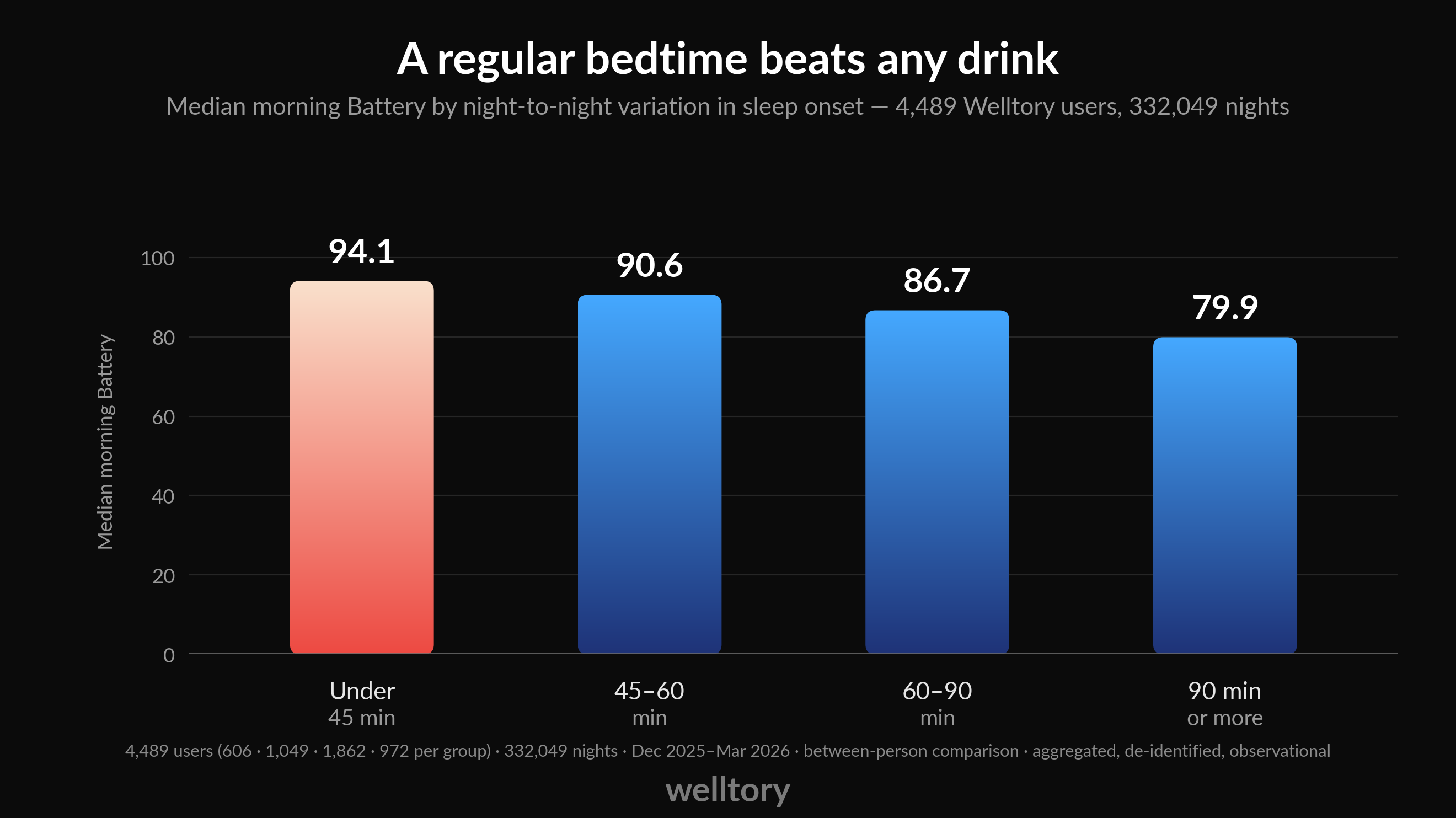
For a typical user, bedtime moved by about 68 minutes from night to night — so an irregular schedule is normal, not a personal quirk.
Morning Battery stepped down as bedtimes got less regular. People whose sleep onset varied by under 45 minutes had a median morning Battery of 94.1. At 45–60 minutes of variation it was 90.6; at 60–90 minutes, 86.7; and at 90 minutes or more, 79.9. That is a gap of more than 14 points between the most and least regular groups.
Other signals moved in the same direction. Median resting heart rate rose from 60.6 bpm in the most regular group to 62.1, 62.7 and 63.7 bpm across the less regular groups. Median deep sleep fell from 107 minutes to 104, 101 and 96 minutes. Median sleep length went from 7.9 hours to 7.7, 7.5 and 7.3 hours. (How much deep sleep matters is covered in our guide to how much deep sleep you need.)
Why this matters for the mocktail. The biggest promise of a sleepy drink is a few extra minutes of sleep. In our data, the difference between a steady and an unsteady bedtime comes with more than half an hour of sleep and a clearly better morning — before any drink is involved.
A note on the data. This is observational, aggregated and de-identified data, and Welltory users are not a random sample of the population. This comparison is between people, not within the same person changing their habits: it shows that regular sleepers wake with higher Battery, not that becoming regular would give any one person the full difference. People with steady bedtimes may also differ in age, work patterns and health — shift workers and parents of young children, for example, are more likely to be in the irregular groups. Regular sleepers also slept longer, and Battery takes sleep into account, so part of the gap reflects sleep length rather than timing alone.
How to try it for two weeks
If you like the idea, there is no harm in trying the mocktail — as long as it is safe for you. A simple two-week test will tell you more than any video.
Week one: keep your normal evening and record. Note bedtime, wake time, how long it took to fall asleep (a rough guess is fine) and how rested you felt, on a 1–5 scale. Do not drink the mocktail.
Week two: add the drink, change nothing else. Same bedtime window, same caffeine, same screens. Drink it at the same time each night.
Compare the weeks. Look at the average, not the best night. If week two is better, ask whether the drink did it — or whether a more regular bedtime did.
Try a version without magnesium. If you want to separate the ingredients, spend a week with just tart cherry juice and sparkling water, or just sparkling water in a nice glass at the same hour. If the plain ritual works as well, you have found what helps, and it is simpler.
Keep the anchor. Whatever you drink, hold the wake time steady for the full two weeks. That is the change most likely to show up in your mornings.
How to bring this up with your doctor
Most people try a trend like this because sleep has been bad for a while. That is worth a proper conversation, and it goes better with specifics.
What to track for two weeks:
Bedtime, time you think you fell asleep, night wakings and wake time.
How rested you felt each morning, on a 1–5 scale.
Caffeine and alcohol, especially after midday.
Snoring, gasping, morning headaches, restless legs, night sweats or pain that wakes you.
Every supplement you take, including magnesium powders and mocktail blends.
What to say: "I have had trouble sleeping for [how long], on about [X] nights a week. It takes me around [X] minutes to fall asleep and I wake [X] times. I have tried tart cherry juice and magnesium." Giving the duration and frequency helps your doctor tell short-term poor sleep from chronic insomnia.
What to ask:
"Could this be insomnia disorder, and would CBT-I help me?" Cognitive behavioural therapy for insomnia is the recommended first-line treatment. Our guide on how to treat chronic insomnia explains how it works.
"Should I be checked for sleep apnea?" — especially if you snore or feel unrefreshed despite enough hours.
"Is magnesium safe with my kidneys and my medicines?"
"Could anything I take be affecting my sleep?" Some medicines for mood, blood pressure, asthma and colds can.
Be persistent if you are told simply to relax. Poor sleep that lasts for months is a health problem with effective treatments, not a character trait.
Before you blame yourself, check what your body already recorded
People rarely start making bedtime potions because sleep is going well. Usually it comes after weeks of frustration, and a quiet story about themselves.
The feeling. "Everyone else just falls asleep." "I've tried everything, so something must be wrong with me." "If I were more disciplined, I'd sleep." When nothing works, it is easy to decide the problem is you — too wired, too anxious, too sensitive.
What the body usually shows. When people look at their own nights, the pattern is often more ordinary. Bedtimes that drift by an hour or more across the week. Late nights on Friday and Saturday, then a Sunday night that will not come. A stretch of high stress load with no evening that feels like an ending. None of that is a failing. It is a body clock receiving mixed signals and doing its best to keep up. In our data, the least regular sleepers woke with a median Battery more than 14 points below the most regular ones.
Permission, and one lever. You do not need a perfect routine or a new supplement. Pick one change — the same wake time every day, weekends included — and hold it for two weeks. Keep the mocktail if you enjoy it. Then look at the trend in your mornings over those two weeks, not at any single night. If things improve, you have found your lever. If they do not, despite steady timing and enough time in bed, that is a clear signal to talk to a doctor.
How Welltory helps — and what it cannot do
The limits first. Welltory is a general wellness product with no regulatory clearance. It does not diagnose sleep disorders, and it cannot tell you whether a supplement is working on a chemical level or whether it is safe for you.
What it can do is make your sleep pattern visible, night after night, measured the same way:
Sleep — when you fell asleep, how long you slept, and how regular your nights have been. Our explainer on what a good sleep score is covers how to read nightly scores without overreacting to one bad night.
Battery — a morning energy score that combines sleep and recovery signals.
Resting heart rate and HRV — compared with your own baseline, so you can see when your body is recovering well or running below your usual.
Stress minutes — an estimate of physiological stress load during the day, which often shapes the night that follows.
Tags and notes — tag the nights you had the mocktail, a glass of wine or a late screen session. My Patterns can show which tagged situations tend to come before stressful stretches, and you can compare tagged nights with untagged ones.
That turns a two-week test into something you can actually read. If the mocktail nights look the same as the others, while the nights with a steady bedtime look better, you know where to put your effort.
The caveat: these signals are non-specific. Alcohol, illness, a warm bedroom and a stressful day all move them the same way. Look at the pattern over one to two weeks, not a single morning.
How we made it
Made with AI tools, then edited and fact-checked by the Welltory team. See our Editorial & AI policy.
Data analysis by Jane Smorodnikova, co-founder of Welltory and the person who built the methodology behind how we read physiological data.
Written by Tatsiana Yashyna.


Discounts for blog readers: up to 36% off
See what affects your energy, stress, sleep, and daily state with Welltory
This article is for educational purposes only and is not medical advice. Magnesium supplements are not suitable for everyone: people with reduced kidney function, those who are pregnant or breastfeeding, and people taking antibiotics, bisphosphonates, diuretics or proton pump inhibitors should ask a doctor or pharmacist first. Poor sleep lasting months, loud snoring or gasping at night need clinical assessment. Welltory holds no regulatory clearance, is a general wellness product, and does not diagnose. Sources were retrieved on 29 September 2026.
Was this helpful?
Ask AI for a summary of page


Written by Jane Smorodnikova

The founder and CEO of Welltory. A recognized tech leader with two Master's degrees and experience at MIT, she has scaled Welltory to over 17 million users.
Written by Tatsiana Yashyna

Deputy COO at Welltory. With a background in medicine and years of working with health data, she translates research and real physiological signals — sleep, stress, heart rate, and hormones — into clear, evidence-based explanations that help people understand what their bodies are telling them.
References
- Howatson G, Bell PG, Tallent J, et al. Effect of tart cherry juice (Prunus cerasus) on melatonin levels and enhanced sleep quality. European Journal of Nutrition 2012;51(8):909–916 (published online 2011). https://doi.org/10.1007/s00394-011-0263-7
- Pigeon WR, Carr M, Gorman C, Perlis ML. Effects of a tart cherry juice beverage on the sleep of older adults with insomnia: a pilot study. Journal of Medicinal Food 2010;13(3):579–583. https://doi.org/10.1089/jmf.2009.0096
- Losso JN, Finley JW, Karki N, et al. Pilot study of the tart cherry juice for the treatment of insomnia and investigation of mechanisms. American Journal of Therapeutics 2018;25(2):e194–e201. https://doi.org/10.1097/MJT.0000000000000584
- Barforoush F, Ebrahimi S, Abdar MK, Khademi S. The effect of tart cherry on sleep quality and sleep disorders: a systematic review. Food Science & Nutrition 2025;13(9):e70923. https://doi.org/10.1002/fsn3.70923
- Abbasi B, Kimiagar M, Sadeghniiat K, et al. The effect of magnesium supplementation on primary insomnia in elderly: a double-blind placebo-controlled clinical trial. Journal of Research in Medical Sciences 2012;17(12):1161–1169. https://pubmed.ncbi.nlm.nih.gov/23853635/
- Mah J, Pitre T. Oral magnesium supplementation for insomnia in older adults: a systematic review & meta-analysis. BMC Complementary Medicine and Therapies 2021;21:125. https://doi.org/10.1186/s12906-021-03297-z
- National Institutes of Health, Office of Dietary Supplements. Magnesium: fact sheet for health professionals. https://ods.od.nih.gov/factsheets/Magnesium-HealthProfessional/
- Yeung V, Sharpe L, Glozier N, Hackett ML, Colagiuri B. A systematic review and meta-analysis of placebo versus no treatment for insomnia symptoms. Sleep Medicine Reviews 2018;38:17–27. https://doi.org/10.1016/j.smrv.2017.03.006
- Windred DP, Burns AC, Lane JM, et al. Sleep regularity is a stronger predictor of mortality risk than sleep duration: a prospective cohort study. Sleep 2024;47(1):zsad253 (published online 2023). https://doi.org/10.1093/sleep/zsad253
- Chaput JP, Dutil C, Featherstone R, et al. Sleep timing, sleep consistency, and health in adults: a systematic review. Applied Physiology, Nutrition, and Metabolism 2020;45(10 Suppl 2):S232–S247. https://doi.org/10.1139/apnm-2020-0032


