

Short answer
A sleep divorce means partners choosing separate beds or rooms so both can sleep better, and more than a third of Americans do it at least occasionally, according to a 2023 American Academy of Sleep Medicine survey. If a partner's snoring, restlessness or schedule breaks your sleep most nights, it can help; if loud snoring comes with pauses or gasping, get checked for sleep apnea first.
Needing your own space to sleep is not a personal failure, and if a partner's snoring keeps waking you, that is not your fault — nor does it make your relationship weaker. Before you blame yourself — or your partner — check what your body already recorded: not just how long you slept, but how broken the nights were.
Note: this article is general information about sleep and relationships and is not medical or couples-therapy advice. Loud snoring with pauses in breathing, persistent insomnia or daytime sleepiness need a clinician's assessment.
What is a sleep divorce?
"Sleep divorce" is a dramatic name for something ordinary: two people in a relationship deciding to sleep apart, some or all of the time, because sleeping together is costing one or both of them sleep. It can mean separate rooms, separate beds in one room, or one person moving to the sofa on nights when the other is snoring or up early.
The word "divorce" makes it sound like the end of something. In practice it usually isn't. Most couples who do it still share evenings, mornings, weekends and often part of the night. The arrangement is about sleep, not about the relationship — although, as we'll see, the two affect each other more than people expect.
How common is it? In March 2023, the American Academy of Sleep Medicine (AASM) commissioned a survey of 2,005 US adults. More than a third said they occasionally or consistently sleep in another room to accommodate a bed partner (aasm.org). The pattern was not evenly spread:
45% of men and 25% of women said they sometimes or always sleep in another room
millennials reported it most often, at 43%, followed by Generation X at 33%, Generation Z at 28% and baby boomers at 22%
The reasons people gave will sound familiar: a partner who snores loudly, a partner who tosses and turns, a partner who takes the covers. Nothing exotic — just two bodies with different habits sharing a small space for eight hours.
Why the numbers matter. If a third of adults already do this at least some of the time, then quietly sleeping apart is not a rare sign of trouble. It is a common, practical adjustment that most people don't talk about because the name makes it sound like a confession.
Why does sleeping next to someone wake you up?
Because sleep is lighter and more reactive than it feels. Even when you don't remember waking, your brain surfaces towards lighter sleep many times a night, and a nearby body gives it plenty of reasons to.
Movement. In a classic study, researchers put wrist movement sensors on 46 couples for 8 nights (doi.org). About 5–6% of all 30-second stretches of sleep contained a movement, and about a third of those movements happened at the same time in both partners — one person shifted, and the other followed. People who slept with a partner moved more than matched people who slept alone, and their movements dropped when the partner was away. Women reported being disturbed by their partner more often than men did. And yet, strikingly, most people said they slept better when their partner was there.
That gap — more disturbance measured, better sleep reported — is the whole topic in miniature. Sharing a bed can feel good and still break your sleep more than you notice.
Snoring. The most common reason couples give for sleeping apart, and the one most worth taking seriously, because it can be a sign of obstructive sleep apnea. More on this below.
Different body clocks. One of you is sleepy at 10 pm and wide awake at 6; the other comes alive at 11 and would sleep until 9 if allowed. A review of couples' sleep research pointed out that sharing a bed carries real implications for sleep quality and health that are "not consistently positive", with differences in chronotype — whether you are naturally a morning or evening person — among the factors that shape how well it works (doi.org). When your natural timings are far apart, one person is usually going to bed too early or being woken too early.
Different schedules. Shift work, early flights, a newborn, a partner who gets up to exercise at 5 — schedules can pull a couple apart at night even when their body clocks match.
Temperature and bedding. Some people run hot at night; others need a heavy duvet. Sharing one blanket often means one of you is too warm and the other too cold, which leads to more waking.
Screens and light. A partner scrolling, reading with a lamp or watching something in bed brings light and noise into a shared space. If one of you falls asleep easily and the other doesn't, the one who struggles tends to pay for it.
Insomnia. If you already find it hard to fall or stay asleep, anything that wakes you — even briefly — can mean an hour lying in the dark. People with insomnia often become very aware of every movement and sound in a shared bed, which adds pressure and makes it harder again.
Does sleeping apart actually improve sleep?
Sometimes, for some people — and not always in the way they expect. The research here is small but useful, because it shows both sides.
The case for sleeping together. A 2020 German sleep-lab study recorded 12 young, healthy couples with full polysomnography, the gold-standard sleep test, on nights when they slept together and nights when they slept apart (doi.org). Sleeping together came with about 10% more REM sleep, the stage associated with dreaming and emotional processing, and REM that was less fragmented. The partners' sleep stages were also more synchronised when they shared a bed, especially in couples who described their relationship as deeper. There was a cost too: more limb movements in the shared bed. But for these couples, sharing a bed seemed to stabilise an important stage of sleep. (If you want to know more about that stage, see how much REM sleep you need.)
The case for sleeping apart — with a twist. A 2009 study in France looked at women who complained that their partner's snoring was ruining their sleep (doi.org). Each woman had one sleep test next to her snoring partner and one sleeping alone. Of the original 23, the researchers had to exclude seven — six because the women turned out to snore substantially themselves, and one because she had sleep apnea. In the remaining 16, sleeping alone reduced light sleep and the number of awakenings, so the nights were less fragmented. But total sleep time, sleep efficiency, deep sleep and REM did not change significantly after a single night apart. The authors concluded that objective sleep did not improve substantially after one night alone.
What to take from that. Two things. First, the effect of sleeping apart depends on what the problem is. When a specific disturbance — loud snoring, big movements, different schedules — is breaking your sleep, removing it can make nights less broken. When the couple sleeps reasonably well together, moving apart may cost a little REM and some closeness for no real gain. Second, one night tells you very little. A new room, a new mattress, the novelty of being alone — all of that shapes the first night. The meaningful comparison is two weeks against two weeks, which is where tracking helps (more on that below).
There's also a quieter lesson in the snoring study: some people who blame their partner's snoring snore themselves. That is worth knowing before you move rooms.
Is a sleep divorce bad for your relationship?
Not in itself. What tends to hurt relationships is bad sleep, resentment and silence — and a sleep divorce can make any of those better or worse depending on how it is done.
Bad sleep makes fights worse. In a 2014 study from the University of California, Berkeley, people kept a 14-day diary of their sleep and their relationship (doi.org). After nights of poor sleep, they reported more conflict with their partner. In a second part of the study, couples came into the lab to talk through a disagreement. When one partner had slept badly, the balance of positive to negative feeling during the conversation shifted towards the negative, and both partners were worse at reading what the other was feeling. Conflicts were most likely to get resolved when both partners were well rested. The effect was not explained by stress, anxiety, low relationship satisfaction or by the partner being the cause of the bad night.
So if sharing a bed is costing one of you sleep night after night, the relationship is already paying — in shorter tempers and harder conversations — whether or not anyone moves out.
Sleep and relationships affect each other. Reviews by sleep researcher Wendy Troxel and colleagues describe the link as running in both directions: how well a relationship is going affects how you sleep, and sleep problems and sleep disorders affect how the relationship goes (doi.org). Sleep is usually studied as something one person does, but for most adults it is a shared behaviour, and that makes it one of the everyday routes by which close relationships affect health (doi.org).
What a sleep divorce can cost. The time just before sleep is, for many couples, when they talk most easily — no screens, no children, no tasks. Physical closeness, touch and sex often happen around bedtime too. Moving apart without replacing that time can leave both people feeling more distant, even if they are sleeping better. The fix is not to avoid sleeping apart, but to protect that time on purpose.
When separate rooms are a signal, not a solution. Sometimes a sleep divorce is a symptom of something else: one person going to bed late to avoid the other, a pattern of arguments at night, or a feeling of not being wanted in the room. If sleeping apart is being used to avoid a conversation, it will tend to make the distance bigger. That is worth raising together, or with a couples therapist.
When it's about control. Sleep should never be used as a weapon. If a partner deliberately keeps you awake, wakes you to argue, controls where or when you are allowed to sleep, or makes you feel afraid at night, that is not a sleep problem — it can be part of a pattern of control. In the US, the National Domestic Violence Hotline is available 24 hours a day at 1-800-799-7233, or text START to 88788.
When it's not the bed: snoring and sleep apnea
This is the part of the topic that matters most for health. Loud, regular snoring — especially with pauses, gasps or choking sounds — can be a sign of obstructive sleep apnea, a condition in which the airway repeatedly narrows or closes during sleep. Moving to another room solves the noise for the partner but leaves the person who snores untreated.
The AASM made exactly this point when it published its survey: if one partner's loud snoring is what is driving separate bedrooms, that partner should talk to a doctor about sleep apnea (aasm.org).
Treating it helps both people. In a small 1999 study at the Mayo Clinic, 10 couples had sleep tests on the same night; midway through, the partner with suspected apnea started CPAP, a machine that keeps the airway open with gentle air pressure (doi.org). Once snoring and breathing pauses were controlled, the bed partners' sleep changed straight away: their arousals fell from a median of 21 to 12 per hour, and their sleep efficiency — the share of time in bed actually spent asleep — rose from 74% to 87%. The authors calculated that over eight hours in bed, this would add about 62 minutes of sleep a night for the partner.
A larger study of 54 couples found that after about 6 weeks of CPAP, bed partners were less sleepy during the day and reported better quality of life, including more vitality and better social functioning — not only the patients (doi.org).
Signs worth getting checked — in the person who snores:
snoring that is loud, most nights, and audible through a closed door
pauses in breathing, gasping or choking noticed by a partner
waking unrefreshed, morning headaches, or dozing off during the day
high blood pressure that is hard to control
Our guides to the signs of sleep apnea and sleep apnea treatment options go into more detail. The short version: if snoring is the reason for the sleep divorce, a sleep assessment is the first step, not the last. Sometimes, once the snoring is treated, the sleep divorce turns out to be unnecessary.
How to sleep apart without drifting apart
If you decide to try separate sleep, how you do it matters more than whether you do it.
Decide together, and say why. "I love you and I want us both to sleep better" lands very differently from quietly moving your pillow to the spare room. Frame it as a shared problem you are solving together, not a judgement on the other person.
Keep the bedtime, change the bed. Many couples find a middle path that people sometimes call "sleep together, sleep apart": get into bed together, talk, read, be close — then one of you moves to the other room to actually sleep. You keep the part of sharing a bed that matters to the relationship and drop the part that breaks your sleep.
Make it flexible. Separate on work nights, together at weekends. Apart during a partner's run of early shifts, together the rest of the time. Apart while one of you has a cold or a newborn is waking at night. The arrangement doesn't have to be permanent to be useful.
Protect closeness on purpose. If bedtime was when you talked or touched, move that time rather than lose it — a morning coffee together, a regular evening walk, a set time to lie together before splitting up for sleep. Intimacy that used to happen by default now needs a slot.
Try fixing the problem first where you can. Separate duvets for different temperatures. A bigger bed so movements travel less. Earplugs or white noise for mild snoring. A partner with a later body clock reading in another room and coming to bed once the other is asleep. Sometimes these are enough.
Check in after a few weeks. Ask each other plainly: are we sleeping better? Do we feel closer, further apart, or the same? The answers can change, and so can the arrangement.
Test it instead of guessing
This is one of the few relationship questions you can answer with data rather than opinion. Instead of debating whether sleeping apart would help, try both and compare.
A simple two-by-two-week test:
Two weeks together, sleeping as you normally do. Keep your usual bedtimes, caffeine and alcohol habits.
Two weeks apart, with everything else as similar as possible.
For each night, note how rested you feel in the morning and how many times you remember waking. If you wear a tracker, look at total sleep, time awake during the night, and how your mornings compare with your usual.
Compare the two blocks, not individual nights. The first two or three nights of any change are noisy.
What to look for. If the nights apart are clearly less broken, you feel better in the mornings, and neither of you feels further apart, the arrangement is doing its job. If the difference is small, sleeping apart may be costing more closeness than it gains in sleep. And if the snoring partner's nights look poor in both blocks, that is another sign to check for sleep apnea rather than keep moving rooms.
Two weeks is also roughly how long it takes for the novelty of a new arrangement to wear off, which is why a single night in the spare room tells you so little.
A broken night costs you, even at the same length: what our data shows
Most people judge a night by its length. But one of the main complaints about sharing a bed is not that it shortens sleep — it is that it breaks it up. So we looked at whether broken sleep costs you something even when the total hours are the same.
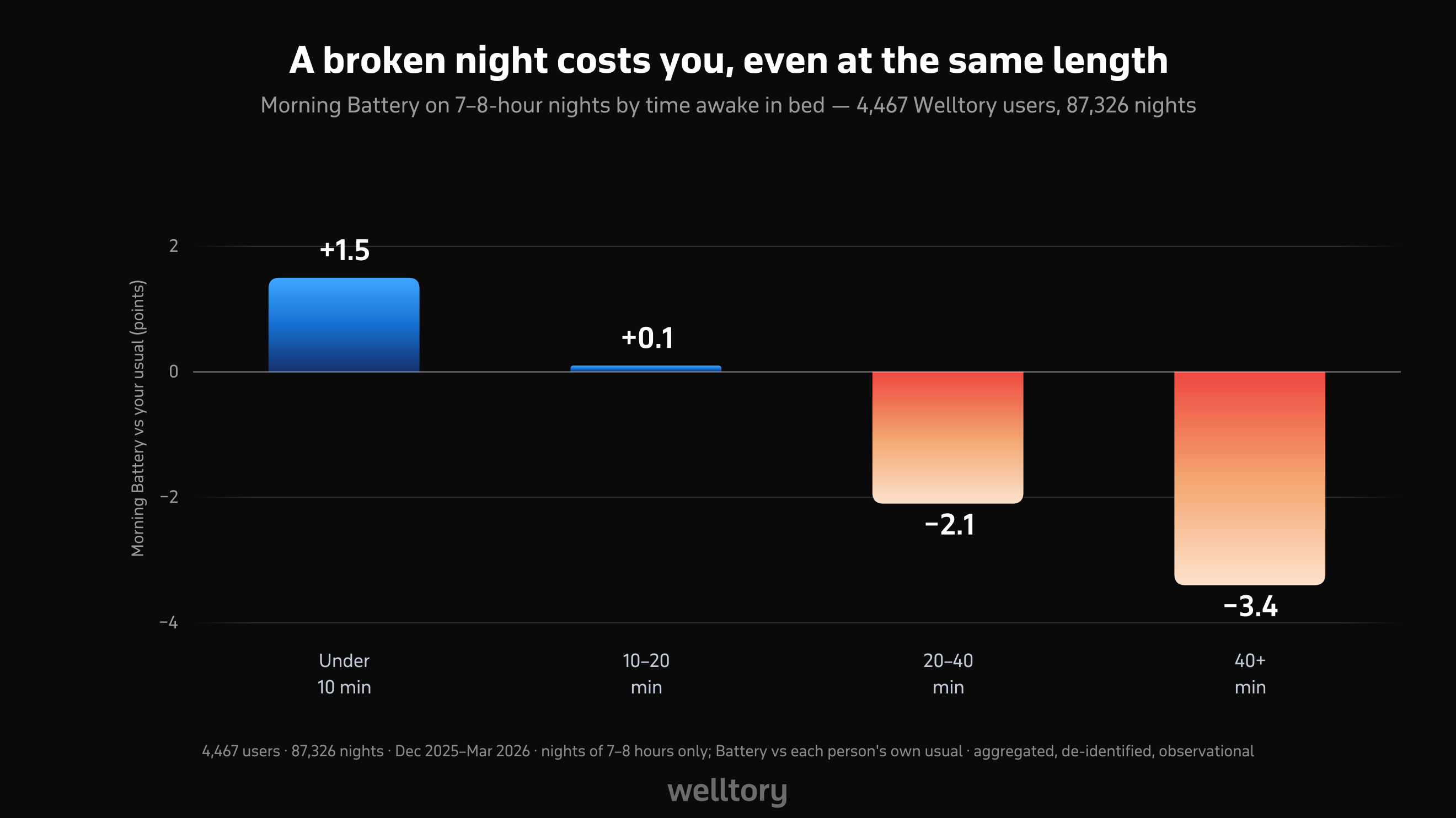
We took 4,467 Welltory users and 87,326 nights in which people slept between 7 and 8 hours, so every night in the comparison was roughly the same length. Then we grouped the nights by how many minutes each person spent awake in bed after falling asleep, and compared next-morning Battery with that person's own usual.
The more time awake in the night, the lower the next morning. After nights with less than 10 minutes awake, morning Battery was about 1.5 points above the person's usual. With 10–20 minutes awake, it was essentially at their usual (+0.1). With 20–40 minutes awake, it fell to about 2.1 points below, and with 40 minutes or more, about 3.4 points below.
What that means. The gap between a nearly unbroken night and a night with 40 or more minutes awake is about 5 points — on nights of the same length. The differences are not dramatic, and a single night's number means little. But they point the same way as the lab studies: it's not only how long you sleep, but how much of the night stays unbroken. If sharing a bed adds waking time night after night, that shows up in your mornings, even when your total sleep looks fine. (Our article on night wakings and deep sleep looks at this from another angle.)
A note on the data. This is observational, aggregated and de-identified data, and Welltory users are not a random sample of the population. We can see how long someone was awake in bed, but not why — a partner, a child, noise, a full bladder or your own racing thoughts all look the same in the data. Battery itself takes sleep quality into account, so part of this link is built into how the score is calculated; what matters is the direction and size of the gap between nights of the same length. And because we only looked at 7–8-hour nights, this doesn't tell us how the pattern plays out on shorter or longer nights.
Resentful, guilty or "too sensitive"? Check your nights first
People who want to sleep apart often carry a quiet story about themselves. "I'm too sensitive — other people can sleep through snoring." "If I really loved them, I wouldn't mind." "Something must be wrong with us." Their partners can carry a mirror version: "They don't want to be near me."
Those feelings are real, but they skip over something simpler. A body that wakes 20, 30 or 40 minutes a night, night after night, is running short on unbroken sleep — and short-changed sleep makes anyone more irritable, less patient and worse at reading the person they love, as the Berkeley study showed. Resentment at 3 am is often exhaustion wearing a relationship costume.
So look at the cause the body records first. How many minutes were you awake last night? How broken were the nights this week compared with the nights you slept alone on a trip? Were the worst nights the ones when your partner snored, came to bed late or got up early? That is information, not a verdict on either of you.
Then give yourself permission and change one thing. Needing unbroken sleep doesn't make you fussy or unloving. Pick one lever — separate duvets, a later partner reading in the other room until you fall asleep, weekday nights apart, or getting the snoring checked — and keep everything else the same. Watch the trend for one to two weeks: your waking time, your mornings, and how the two of you feel. If it helps, keep it. If it doesn't, try the next lever.
How to talk to your doctor or therapist
Two kinds of help are relevant here, and it's worth knowing which one fits.
See a doctor if the problem is in someone's sleep itself. That includes loud snoring with pauses, gasping or choking; daytime sleepiness; insomnia that lasts more than a few weeks; restless or kicking legs at night; or acting out dreams.
What to track before the appointment (for one to two weeks):
bedtimes, wake times and how long it takes to fall asleep
how many times you wake, and roughly how long you're awake
snoring, pauses or gasps your partner notices — a short phone recording can help
daytime sleepiness, morning headaches, caffeine and alcohol
which nights you slept together and which apart
What to say. Be specific: "My partner says I snore loudly most nights and sometimes stop breathing, and I often wake with a headache," or "I've been waking two or three times a night for months, and it's worse when we share a bed." If the snoring is your partner's, encourage them to go — and offer to come along to describe what you hear, because the person snoring usually doesn't know.
What to ask:
Could this be sleep apnea, and should I have a sleep study?
Is this insomnia, and would cognitive behavioural therapy for insomnia (CBT-I) help? (See how chronic insomnia is treated.)
Could any of my medications be affecting my sleep?
What would you expect to change if the snoring or breathing is treated?
See a couples therapist if the problem is between you. If sleeping apart has become a source of hurt, if bedtime arguments are common, or if one of you feels pushed away, a therapist can help you talk about it without it turning into a fight. A helpful opening: "We started sleeping apart for practical reasons, and now we're not sure what it means for us."
And if anything about the situation involves fear, threats or control, contact the National Domestic Violence Hotline at 1-800-799-7233 or text START to 88788.
How Welltory helps — and what it cannot do
The limits first. Welltory is a general wellness product with no regulatory clearance. It does not diagnose sleep apnea, insomnia or any other condition, cannot tell who or what woke you, and is not couples therapy. It can't hear snoring, and it doesn't measure your partner unless they use it too.
What it can do is make the two-week test above concrete. It shows your sleep length and how broken your nights are, your deep sleep, your resting heart rate and heart rate variability against your own baseline, your stress minutes during the day, and your morning Battery compared with your usual. Those are the numbers that tell you whether a change in sleeping arrangement is doing anything for you.
Tags make the comparison possible. Tag the nights you sleep together and the nights you sleep apart — and, if you like, the nights your partner snored or came to bed late. Over a few weeks, My Patterns can show which tagged situations tend to come before lower-Battery mornings or more stressful stretches. That is how "I think I sleep better alone" becomes "on nights apart, I'm awake less and my mornings are better" — or doesn't.
If both of you use it, you can each run the same test and compare notes, which often turns a tense conversation into a practical one: not "you keep me up", but "here's what both our nights look like".
These signals are non-specific — alcohol, a warm room, stress, illness and late meals move them too — so compare blocks of nights rather than single mornings. And if the numbers suggest a pattern that worries you, such as consistently broken sleep in both arrangements, take that to a clinician rather than a spreadsheet.
How we made it
Made with AI tools, then edited and fact-checked by the Welltory team. See our Editorial & AI policy.
Data analysis by Jane Smorodnikova, co-founder of Welltory and the person who built the methodology behind how we read physiological data.
Written by Tatsiana Yashyna.


Discounts for blog readers: up to 36% off
See what affects your energy, stress, sleep, and daily state with Welltory
This article is for educational purposes only and is not medical advice or couples therapy. Loud snoring with pauses in breathing, gasping, persistent insomnia or daytime sleepiness need assessment by a clinician. If a partner uses sleep to control, threaten or frighten you, contact the National Domestic Violence Hotline at 1-800-799-7233 or text START to 88788. Welltory is a general wellness product with no regulatory clearance and does not diagnose. Sources were retrieved on 29 September 2026.
Was this helpful?
Ask AI for a summary of page


Written by Jane Smorodnikova

The founder and CEO of Welltory. A recognized tech leader with two Master's degrees and experience at MIT, she has scaled Welltory to over 17 million users.
Written by Tatsiana Yashyna

Deputy COO at Welltory. With a background in medicine and years of working with health data, she translates research and real physiological signals — sleep, stress, heart rate, and hormones — into clear, evidence-based explanations that help people understand what their bodies are telling them.
References
- American Academy of Sleep Medicine. Over a third of Americans opt for a "sleep divorce". Survey of 2,005 US adults, March 2023. https://aasm.org/over-a-third-americans-opt-sleep-divorce/
- Pankhurst FP, Horne JA. The influence of bed partners on movement during sleep. Sleep 1994;17(4):308–315. https://doi.org/10.1093/sleep/17.4.308
- Drews HJ, Wallot S, Brysch P, et al. Bed-sharing in couples is associated with increased and stabilized REM sleep and sleep-stage synchronization. Frontiers in Psychiatry 2020;11:583. https://doi.org/10.3389/fpsyt.2020.00583
- Blumen MB, Quera Salva MA, d'Ortho MP, et al. Effect of sleeping alone on sleep quality in female bed partners of snorers. European Respiratory Journal 2009;34(5):1127–1131. https://doi.org/10.1183/09031936.00012209
- Richter K, Adam S, Geiss L, Peter L, Niklewski G. Two in a bed: the influence of couple sleeping and chronotypes on relationship and sleep. An overview. Chronobiology International 2016;33(10):1464–1472. https://doi.org/10.1080/07420528.2016.1220388
- Gordon AM, Chen S. The role of sleep in interpersonal conflict: do sleepless nights mean worse fights? Social Psychological and Personality Science 2014;5(2):168–175. https://doi.org/10.1177/1948550613488952
- Troxel WM, Robles TF, Hall M, Buysse DJ. Marital quality and the marital bed: examining the covariation between relationship quality and sleep. Sleep Medicine Reviews 2007;11(5):389–404. https://doi.org/10.1016/j.smrv.2007.05.002
- Troxel WM. It's more than sex: exploring the dyadic nature of sleep and implications for health. Psychosomatic Medicine 2010;72(6):578–586. https://doi.org/10.1097/PSY.0b013e3181de7ff8
- Beninati W, Harris CD, Herold DL, Shepard JW Jr. The effect of snoring and obstructive sleep apnea on the sleep quality of bed partners. Mayo Clinic Proceedings 1999;74(10):955–958. https://doi.org/10.4065/74.10.955
- Parish JM, Lyng PJ. Quality of life in bed partners of patients with obstructive sleep apnea or hypopnea after treatment with continuous positive airway pressure. Chest 2003;124(3):942–947. https://doi.org/10.1378/chest.124.3.942


