

Short answer
The 12-3-30 workout — 12% incline, 3 mph, 30 minutes — is a real cardio session: in a 2025 lab study it used about 10 kcal a minute, roughly 300 kcal per session. If you walk briskly and have healthy calves and knees, it is a solid step up; if you are new to exercise or have Achilles, knee or back trouble, start at a lower incline.
It is a good workout, not a magic one. And if you tried it and felt wrecked the next day, that is not weakness and not proof you are unfit — a steep half hour is real load, and your body records it. Before you blame yourself, check what your body already recorded: how you slept that night, and how your next morning compared with your usual.
Note: this article is general information about exercise and is not medical advice. If you have a heart or lung condition, take medication that affects your heart rate or blood pressure, are pregnant, or have joint or tendon problems, check with a clinician before starting a new routine.
What is the 12-3-30 workout?
It is a treadmill walk with three fixed numbers: the incline set to 12%, the speed set to 3 miles per hour, and the duration set to 30 minutes. Nothing else. No intervals, no running, no weights.
The routine comes from lifestyle creator Lauren Giraldo, who posted it on YouTube around 2019 and reposted a short version on TikTok about a year later. In the video she said she had lost 30 pounds and kept it off for about two years, doing the walk roughly five days a week, without dieting. That is her own account, not a measured result — and it is worth keeping in mind that one person's story is where the trend started, not where the evidence comes from.
What made it spread is how simple it is. You don't need to know anything about training to press three buttons. There is no skill to learn, no class to join, and no moment where you are visibly out of your depth. For a lot of people who find gyms intimidating, that matters more than any calorie figure.
What 3 mph at 12% actually feels like. Three miles an hour is 1.34 metres per second — an ordinary, purposeful walking pace on the flat. The 12% grade is what changes it. On many home and gym treadmills, 12% is near the top of the incline range, and it feels like walking up a long, steady hill that never levels off. Many people who try it for the first time notice their calves within minutes, well before their breathing catches up.
Does the 12-3-30 workout burn fat?
For years there was no peer-reviewed research on the routine at all. That changed in 2025, when a team at the University of Nevada, Las Vegas published what they described as the first study to measure it directly (doi.org).
The set-up. Sixteen regularly active adults (seven women, nine men, average age about 25) did two sessions in the lab, wearing a mask that measured the oxygen they used and the carbon dioxide they breathed out. One session was a standard 12-3-30. The other was a self-paced run on a flat treadmill that continued until the runner had used the same number of calories as in their walk. Holding the handrails was not allowed. Fourteen people completed both sessions; one participant could not finish the 12-3-30 itself — a useful reminder that this is harder than it looks.
The calories. The walk took 30 minutes and used on average about 308 kcal, at a rate of about 10.2 kcal per minute. The run used the same energy in about 24 minutes, at about 13.1 kcal per minute. So the run was faster at spending energy; the walk was slower but still substantial. Body size mattered a lot: the men in the study used about 11.2 kcal a minute on the walk and the women about 8.4, mostly because moving a heavier body uphill costs more.
The fat. During the walk, about 41% of the energy came from fat, compared with about 33% during the run. This is the part that gets turned into headlines saying the walk "burns more fat than running". It is true in a narrow sense, and the authors themselves explain why it is less important than it sounds.
Why that fat percentage is not the point. At lower intensities the body leans more on fat as fuel; at higher intensities it shifts towards carbohydrate. That is textbook exercise physiology, and it happens with any easier effort, not only incline walking. What decides body-fat change over weeks and months is mostly total energy balance — how much you use across the day and week against how much you eat — not the fuel mix during one session. The UNLV authors say this plainly: the fat-percentage difference is expected, and increasing total energy expenditure is the main driver of weight loss.
So the honest version is: 12-3-30 is a real calorie-burning session for most people, and it is gentler per minute than running, which is exactly why many people can do it. It is not a special fat-burning mode that running lacks.
Why the incline does so much work. Lifting your body a little higher with every step is expensive. In an earlier biomechanics study, Silder and colleagues measured metabolic cost at 0%, 5% and 10% grades, and found the cost at 10% was on average about 113% higher than level walking at a similar speed — more than double (doi.org). At 12%, the cost is higher still. That is how an ordinary walking speed turns into a workout.
Is the 12-3-30 workout zone 2 cardio?
Sometimes. It depends on your fitness, your body weight and your legs, not on the treadmill settings.
"Zone 2" is a loose fitness-world label for steady, moderate effort — hard enough to be working, easy enough to keep going and still speak in full sentences. People like the idea because moderate, repeatable cardio is where much of the long-term benefit of exercise comes from. The trouble is that a fixed treadmill setting cannot put everyone in the same zone. The same 12% and 3 mph is a comfortable climb for a regular hiker and a near-maximal effort for someone who has been mostly sitting for a year.
A few ways to tell where you are:
The talk test. If you can talk in full sentences but would rather not sing, you are probably in a moderate zone. If you can only get out a few words at a time, you are working hard. If you can chat freely, you are in an easy zone.
Heart rate. Zones are only meaningful when they are set against your own heart rate range rather than a generic chart. Our guide to personalised heart rate zones explains how to set them, and heart rate zones explained covers what each zone is for.
Where it hurts. If your calves or shins give out long before your breathing does, the session is limited by your legs, not your heart and lungs. That is common at 12%, and it is a reason to lower the incline rather than push through.
Why step counters get this wrong. A well-known lab study of 76 adults aged 21–40 found that on level ground, about 100 steps per minute marks the start of moderate intensity (3 METs) and about 130 steps per minute marks vigorous intensity (6 METs) (doi.org). Those thresholds were built on flat walking. Walking uphill at 3 mph, your cadence may sit near that moderate line while your body is working considerably harder, because the extra effort goes into climbing, not into more steps. So a tracker that judges intensity from steps alone can underrate an incline session.
Medication changes the picture. Beta-blockers and some other medicines lower heart rate during exercise, so heart-rate zones read differently. If that applies to you, how medications change your heart rate zones is worth reading before you rely on a number.
Does holding the handrails ruin the workout?
It doesn't ruin it, but it takes a real chunk off it — more than most people expect.
A 2006 study of 10 healthy adults aged 38–60 compared three ways of walking on a treadmill at the same speed and grade: arms swinging freely, hands resting lightly on the rails, and hands gripping the rails (doi.org). At the hardest stage, oxygen use dropped from 26.1 to 20.6 mL/kg/min when people gripped the rails — about a fifth less — and heart rate dropped from 142 to 121 bpm. Even resting the hands lightly lowered both. People also rated the effort as easier.
What that means in practice. If you hold on through the whole 30 minutes, you are doing a meaningfully easier workout than the one the numbers describe, and your watch's calorie estimate will be further off than usual. Leaning back while gripping also changes your posture in a way that can load your shoulders and lower back.
When holding on is the right call. Balance problems, dizziness, a new treadmill, or the first few minutes while you get used to the belt — these are all good reasons to hold the rail. Safety beats purity. The better long-term fix is to lower the incline until you can walk without holding on, then raise it gradually. A 7% walk done hands-free is a better workout than a 12% walk done hanging off the frame.
Is the 12-3-30 workout bad for your knees?
For many knees, it may actually be kinder than flat walking. For calves, Achilles tendons and some backs, it can be tougher. It depends where your weak spot is.
Knees. A 2014 study had 15 healthy men walk at 1.34 metres per second — exactly 3 mph — at grades from 0% to 20% (doi.org). The peak knee-abduction moment, a measure of load on the inner side of the knee that is linked to knee osteoarthritis, was lower than on level ground at every grade except 5%. The authors suggested incline walking could be a useful option for people who want exercise that is gentler on that part of the knee. The limits are real: this was a small group of young, healthy men, and the study looked at one plane of movement. If you have pain at the front of the knee, around or behind the kneecap, steep walking can feel worse rather than better, so let your own knee have the final say.
Calves and Achilles. Walking uphill asks much more of the muscles that push you up and forward. In a study of 10 young adults walking at grades up to 9 degrees (roughly 16%), activity in the main calf muscles rose by 136–175% compared with level walking, and hip extensor activity rose by several hundred per cent (doi.org). The calf muscles pull on the Achilles tendon, and the steep angle also stretches the tendon further with each step. That is why tight calves, sore Achilles tendons and heel pain are the classic complaints after a first 12-3-30. If you have a history of Achilles problems or plantar heel pain, this is the group that most needs a gentler start.
Lower back. Most back complaints on an incline come from posture rather than the hill itself — leaning far forward, hunching over the console, or leaning back while gripping the rails. Walk tall, let your arms swing, and shorten your step slightly if you feel your lower back working. If you already have back pain, see our guide to returning to exercise after an injury for how to build load gradually.
Who should scale it down or check first:
people who are new to exercise or returning after a long break
anyone with Achilles, calf, heel or front-of-knee pain
people with balance problems or who get dizzy easily
anyone with a heart or lung condition, or who has been told to limit exertion
pregnant people who haven't done this kind of exercise before
Scaling down is not failing. A lower incline, a slower speed or a shorter session is the same workout at a size your body can repeat. Repetition is where the benefit lives.
How to build up to 12-3-30 without getting hurt
The routine has three numbers, so it gives you three dials. Change one at a time.
Start with time or incline, not both. A sensible first week for someone new is 20 minutes at a moderate incline where you can walk without holding on. Each week, add either a few minutes or one to two percentage points of incline — not both at once.
Keep the speed. Three miles an hour is already an efficient pace. Walking faster at a steep grade tends to shorten the session through calf fatigue rather than make it better.
Warm up and cool down on the flat. Three to five minutes of flat walking before and after lets your calves and tendons adjust, and makes the steep part feel less abrupt.
Leave rest days, especially early on. Giraldo's own routine was about five days a week. That is plenty for someone who has built up to it and a lot for someone who hasn't. Early on, three or four sessions a week with a day between them gives tendons time to adapt — tendons adapt more slowly than muscles and heart fitness do.
Mix it with something else. Incline walking trains a narrow set of muscles in one repeated movement. The US guidelines also recommend muscle-strengthening activity on at least two days a week (doi.org), and some variety — a flat walk, cycling, strength work — spreads the load across the body. If your goal is fitness over months, our guide on how to improve VO2 max explains why mixing steady sessions with some harder efforts tends to work better than repeating the same one forever.
Stop signs. Sharp pain in a tendon or joint, pain that is worse the next morning, chest pain or pressure, unusual breathlessness, dizziness or palpitations are all reasons to stop — and the last four are reasons to get checked.
How 12-3-30 fits the 150-minute guideline
The official US Physical Activity Guidelines recommend that adults get 150–300 minutes a week of moderate-intensity aerobic activity, or 75–150 minutes of vigorous activity, or a mix of the two, plus muscle-strengthening on two or more days (doi.org). For most people, 12-3-30 counts as at least moderate. Five sessions a week reach 150 minutes on their own; three sessions plus some brisk walking outdoors get most people there too.
What regular walking does over time is well established. A meta-analysis of 32 randomised trials found that walking programmes raised aerobic capacity by about 3 mL/kg/min, lowered systolic blood pressure by about 3.6 mmHg and diastolic by about 1.5 mmHg, and reduced weight by about 1.4 kg and body fat by about 1.2 percentage points (doi.org). Those are modest numbers for any one person, and they are averages across many kinds of walking, not results specific to 12-3-30. But across a population they matter, and none of them needed a steep incline.
Steps add up too. A pooled analysis of 15 cohorts and 47,471 adults found that the risk of dying during follow-up kept falling as daily steps rose, levelling off at about 6,000–8,000 steps a day for adults aged 60 and over and 8,000–10,000 steps for younger adults (doi.org). A 30-minute walk at a cadence around 100 steps a minute is on the order of 3,000 steps — a big contribution to either target.
The point is not that 12-3-30 is uniquely good. It is that it is a convenient, repeatable way to do something that is reliably good.
The "hot girl walk": walking for your head
The other walking trend that keeps coming up alongside 12-3-30 is the "hot girl walk" — a long outdoor walk popularised on TikTok, where the rules are about what you think during it: what you are grateful for, what you want, how good you feel. It is less about incline and more about headspace.
There is a reasonable piece of research behind the idea that where you walk affects how you think. In a 2015 study, people who took a 90-minute walk in a natural setting reported less rumination — the repetitive, self-focused negative thinking linked to low mood — than people who walked the same length of time along a busy urban road. Brain scans also showed lower activity in a region linked to rumination after the nature walk (doi.org). It was a small experiment and a single walk, so it doesn't prove a lasting change. But it supports something many people notice: a walk outside can shift your mood in a way a treadmill facing a wall often doesn't.
The two trends aren't rivals. 12-3-30 is efficient cardio that works in any weather and fits into a lunch break. A long outdoor walk is slower, gentler and often better for your head. Many people end up doing both: the incline walk for fitness, the outdoor walk for thinking. The only version that doesn't work is the one you dread.
A big walking day and the next morning: what our data shows
We wanted to know what an unusually active day does to the following morning in everyday life, outside a lab. Across 4,489 Welltory users and 327,560 nights (December 2025 to March 2026), we compared each person's next-morning Battery score, sleep and deep sleep after days with more or fewer steps than their own usual, against days when they walked about as much as normal. A 30-minute 12-3-30 session adds roughly a few thousand steps, so the middle bars are the ones most relevant here.
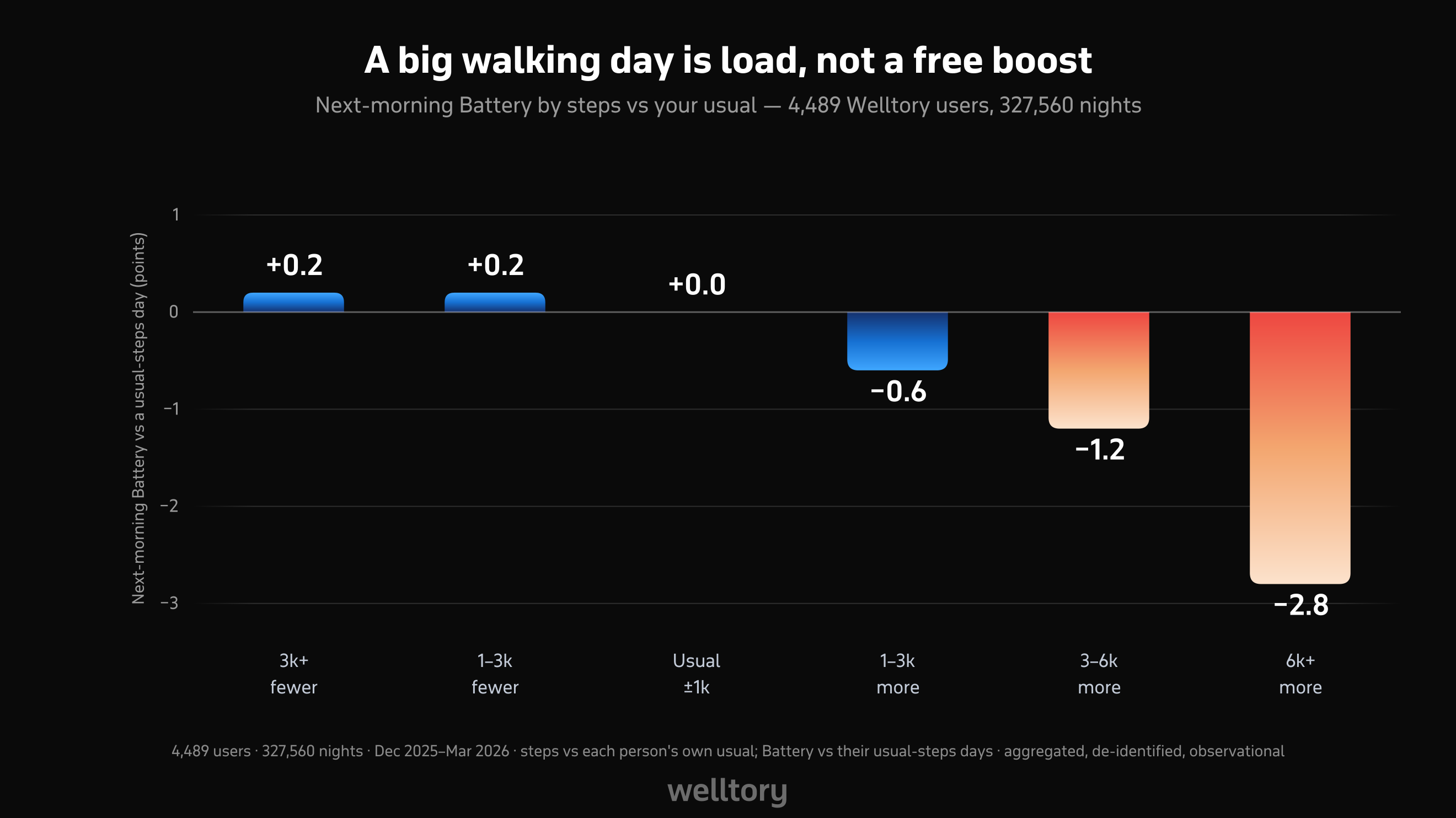
The morning after a much more active day dips a little, not a lot. After days with 1,000–3,000 more steps than usual, next-morning Battery was about 0.6 points lower than after a usual day. With 3,000–6,000 extra steps, it was about 1.2 points lower. Only on days with 6,000 or more extra steps did the dip reach about 2.8 points. Days with fewer steps than usual came with a Battery just 0.2 points higher — essentially flat.
Sleep followed the same gentle slope. Nights after the biggest step days were about 9 minutes shorter than after a usual day and had about 3.5 minutes less deep sleep. After 3,000–6,000 extra steps, the gap was about 6 minutes of sleep and 1.6 minutes of deep sleep. Quieter days went the other way: after 3,000 or more fewer steps than usual, people slept about 8 minutes longer with about 1.7 minutes more deep sleep.
How to read that. These are small differences. A couple of Battery points and a few minutes of sleep are the size of an ordinary day's variation, not a warning sign. What the pattern does show is that extra movement is load, and the body registers it the next morning — it isn't a free boost that makes you feel better straight away. That fits how training works: stress first, adaptation later.
A note on the data. This is observational, aggregated and de-identified data from Welltory users, who are not a random sample of the population. Days with many more steps than usual are often busy days — travel, errands, moving house, events — that also come with later bedtimes, so this is not a pure exercise effect, and we cannot tell a treadmill session from a day at an airport. A small next-morning dip after extra load is a normal response to training, not harm. And the long-term benefits of regular walking — fitness, blood pressure, blood sugar — are well established by other research and are not what this chart measures.
Wrecked the day after? Check what your body recorded first
A very common reaction to a first 12-3-30 goes something like: "It's just walking. If a walk flattens me, I must be really out of shape." Or worse: "Everyone online does this five days a week — something is wrong with me."
That conclusion skips a step. A 12% incline for 30 minutes more than doubles the cost of walking and puts heavy work through your calves and hips. For a lot of people it is the hardest thing their legs have done in months. Feeling it the next day is not weakness and not a character flaw — it is what load feels like before your body has adapted to it.
The body usually shows the cause. Look at the night after: was it shorter or more broken than usual? Was your morning resting heart rate a little higher, or your HRV a little lower than your own baseline? Was the session on top of an already heavy day — a long commute, a bad night before, a stressful week? Often the "I'm so unfit" feeling turns out to be the sum of a hard session, a short night and a busy day, all landing at once.
Then change one thing, and watch for two weeks. Pick one lever: lower the incline by a few points, drop to three sessions a week, or move the session earlier so it isn't right before bed. Keep everything else the same. Over the next one to two weeks, watch the trend rather than any single morning — your sleep after session days, how your mornings compare with your usual, how your legs feel. Most people find that what felt brutal in week one is ordinary by week three. That is fitness arriving, and it happens more reliably when the load is a size you can repeat.
How to bring this up with your doctor
Most healthy adults can start incline walking gradually without seeing anyone first. But if any of the situations in the "scale it down" list apply to you, a short conversation helps — and it goes better when you bring specifics.
What to track for a week or two:
the settings you used (incline, speed, minutes) and whether you held the rails
any symptoms during the walk — chest discomfort, breathlessness out of proportion to effort, dizziness, palpitations — and when they started
joint or tendon pain, where it is, and whether it is worse the next morning
your resting heart rate and blood pressure if you already measure them at home
What to say. Be concrete: "I've started walking on a treadmill at a 12% incline for 30 minutes, four days a week. In the second week I started getting heel pain the next morning," or "I get unusually breathless within five minutes even at a lower incline." Specific settings and timings are far more useful than "exercise makes me tired".
What to ask:
Is there any reason I should keep my heart rate or effort below a certain level?
Do any of my medications change how I should judge intensity?
Given my knees, Achilles or back, what incline and progression would you suggest?
Which symptoms mean I should stop straight away, and which can I watch?
Don't wait for an appointment if you have chest pain or pressure, fainting, or sudden severe breathlessness during exercise. Those need urgent care — call 911 in the US.
How Welltory helps — and what it cannot do
The limits first. Welltory is a general wellness product with no regulatory clearance. It does not diagnose anything, does not assess your joints or your heart for exercise safety, and cannot tell you whether a workout is right for you. It also doesn't control a treadmill or know your incline — it works with the data your phone and wearable already collect.
What it can show is the part that is hard to feel from the inside: how your body responds over the days after you add a new routine. That means your sleep and deep sleep after session days, your resting heart rate and heart rate variability against your own baseline, your step count, the minutes your body spends under stress, and your morning Battery compared with your usual.
Tags make it specific. You can tag the days you do 12-3-30 — and note the incline or how it felt. Over a few weeks, My Patterns can show which tagged situations tend to come before lower-Battery mornings or more stressful stretches. That is how you find out whether the session itself is the issue, or whether it is the late-evening timing, or the fact that you always stack it on your longest workday.
What to look for. In the first week or two, a slightly lower Battery or a shorter night after session days is expected. What you want to see over three to six weeks is those dips shrinking as your body adapts. If they are getting bigger instead — mornings flatter, resting heart rate creeping up, sleep getting worse — that is a sign to reduce the load or add rest, and a useful thing to show a clinician if you have concerns.
These signals are non-specific: a late meal, alcohol, a warm bedroom or a cold coming on move them just as a hard session does. Read the trend across a week, not a single morning.
How we made it
Made with AI tools, then edited and fact-checked by the Welltory team. See our Editorial & AI policy.
Data analysis by Jane Smorodnikova, co-founder of Welltory and the person who built the methodology behind how we read physiological data.
Written by Tatsiana Yashyna.


Discounts for blog readers: up to 36% off
See what affects your energy, stress, sleep, and daily state with Welltory
This article is for educational purposes only and is not medical advice. It does not replace an assessment by a clinician, especially if you have a heart or lung condition, take medication that affects heart rate or blood pressure, are pregnant, or have joint or tendon problems. Chest pain, fainting or sudden severe breathlessness during exercise need urgent care. Welltory is a general wellness product with no regulatory clearance and does not diagnose. Sources were retrieved on 29 September 2026.
Was this helpful?
Ask AI for a summary of page


Written by Jane Smorodnikova

The founder and CEO of Welltory. A recognized tech leader with two Master's degrees and experience at MIT, she has scaled Welltory to over 17 million users.
Written by Tatsiana Yashyna

Deputy COO at Welltory. With a background in medicine and years of working with health data, she translates research and real physiological signals — sleep, stress, heart rate, and hormones — into clear, evidence-based explanations that help people understand what their bodies are telling them.
References
- Wong MWH, Davis DW, Perez OR, Weyers B, Green DM, Garcia AV, Navalta JW. An exploratory study comparing the metabolic responses between the 12-3-30 treadmill workout and self-paced treadmill running. International Journal of Exercise Science 2025;18(6):56–64. https://doi.org/10.70252/UBIX5911
- Silder A, Besier T, Delp SL. Predicting the metabolic cost of incline walking from muscle activity and walking mechanics. Journal of Biomechanics 2012;45(10):1842–1849. https://doi.org/10.1016/j.jbiomech.2012.03.032
- Tudor-Locke C, Aguiar EJ, Han H, et al. Walking cadence (steps/min) and intensity in 21–40 year olds: CADENCE-adults. International Journal of Behavioral Nutrition and Physical Activity 2019;16:8. https://doi.org/10.1186/s12966-019-0769-6
- Berling J, Foster C, Gibson M, Doberstein S, Porcari J. The effect of handrail support on oxygen uptake during steady-state treadmill exercise. Journal of Cardiopulmonary Rehabilitation 2006;26(6):391–394. https://doi.org/10.1097/00008483-200611000-00009
- Haggerty M, Dickin DC, Popp J, Wang H. The influence of incline walking on joint mechanics. Gait & Posture 2014;39(4):1017–1021. https://doi.org/10.1016/j.gaitpost.2013.12.027
- Franz JR, Kram R. The effects of grade and speed on leg muscle activations during walking. Gait & Posture 2012;35(1):143–147. https://doi.org/10.1016/j.gaitpost.2011.08.025
- Piercy KL, Troiano RP, Ballard RM, et al. The Physical Activity Guidelines for Americans. JAMA 2018;320(19):2020–2028. https://doi.org/10.1001/jama.2018.14854
- Murtagh EM, Nichols L, Mohammed MA, et al. The effect of walking on risk factors for cardiovascular disease: an updated systematic review and meta-analysis of randomised control trials. Preventive Medicine 2015;72:34–43. https://doi.org/10.1016/j.ypmed.2014.12.041
- Paluch AE, Bajpai S, Bassett DR, et al. Daily steps and all-cause mortality: a meta-analysis of 15 international cohorts. The Lancet Public Health 2022;7(3):e219–e228. https://doi.org/10.1016/S2468-2667%2821%2900302-9
- Bratman GN, Hamilton JP, Hahn KS, Daily GC, Gross JJ. Nature experience reduces rumination and subgenual prefrontal cortex activation. Proceedings of the National Academy of Sciences 2015;112(28):8567–8572. https://doi.org/10.1073/pnas.1510459112


