

Short answer
The cortisol cocktail — orange juice, coconut water and a pinch of salt — has no evidence that it lowers cortisol or treats "adrenal fatigue", which is not a recognised diagnosis. It is a salty, potassium-rich juice. If you feel better after one, water, sugar and a pause are the likely reasons; if you regularly sleep under 6 hours, that is a far bigger lever than any drink.
If you reach for it because the afternoon slump makes you feel weak or lazy, that is not a character flaw, and it is not a sign your adrenal glands are failing. Before you blame yourself, check what your body already recorded: in our data, a night under 5 hours came with a morning Battery about 31 points below a person's own usual.
Note: this article explains a food trend and is not medical advice. If you have kidney disease, heart disease, high blood pressure, or take medicines that affect potassium, ask your doctor before adding salty or potassium-rich drinks. Persistent exhaustion deserves a proper check-up, not a recipe.
What is the cortisol cocktail?
A cold drink with three core ingredients, usually served mid-morning or mid-afternoon, and usually filmed.
The base recipe is orange juice, coconut water and a pinch of salt — often sea salt or a pink salt, sometimes with ice and sparkling water. Popular variations add cream of tartar, magnesium powder, a squeeze of lemon, or a spoon of collagen. It has circulated for years under the name adrenal cocktail, and on TikTok it picked up the newer, catchier name: the cortisol cocktail.
The pitch is the same across most videos. You are tired in a specific way — wired in the morning, crashing at three, craving salt or sugar — and the drink will "support your adrenals", "balance cortisol" and replace your afternoon coffee.
What is in it, in plain terms:
Vitamin C from the orange juice. The rationale usually offered is that the adrenal glands store a lot of vitamin C, so giving them more will help them work.
Potassium from the orange juice and coconut water, and a lot more if cream of tartar is added, since cream of tartar is potassium bitartrate. The NIH lists one cup of orange juice at 496 mg of potassium, about 11% of the Daily Value (NIH ODS).
Sodium from the salt.
Sugar and water — the part the videos talk about least, and probably the part that does the most.
Read it without the branding and it is a lightly salted juice with some electrolytes. That is not a criticism. Juice with salt is a perfectly reasonable thing to drink. The question is whether it does the specific thing it is sold for.
Does the cortisol cocktail actually lower cortisol?
There is no evidence that it does. We found no controlled study of the drink itself that measured cortisol, and nothing in its ingredients has a known mechanism for lowering it in a healthy person.
The vitamin C argument does not hold up the way it is told. It is true that the adrenal glands contain vitamin C. It does not follow that drinking orange juice tunes cortisol up or down. Your body regulates cortisol through a feedback loop between the brain and the adrenal glands — the HPA axis — and that loop is driven by time of day, sleep, light, stress and illness, not by how much citrus arrived an hour ago.
The salt argument confuses two hormones. The outer layer of the adrenal gland makes both cortisol and aldosterone. Aldosterone is the one that manages sodium and potassium. The "your adrenals are tired, so you crave salt" story borrows a symptom of real adrenal disease and attaches it to ordinary tiredness.
The "lower your cortisol" goal is itself a bit off. Cortisol is not a toxin to be minimised. It is supposed to be high in the morning and low at night. A healthy cortisol pattern is a rhythm, not a low number. A drink that flattened it — if one existed — would not be doing you a favour. If you want the basics, our guide to what cortisol is explains the daily curve and why a single reading tells you so little.
What the drink can plausibly do is small and ordinary: it rehydrates you a little, gives you some quick sugar, and adds sodium and potassium to your day. For most people, none of those will move cortisol in a measurable way.
Is adrenal fatigue real?
No — not as a medical diagnosis, and this is the idea the whole trend rests on.
"Adrenal fatigue" describes a theory that chronic stress wears out the adrenal glands, so they can no longer make enough cortisol, which then causes tiredness, brain fog, salt cravings and poor sleep. It sounds plausible. It has not held up when tested.
The largest review on the question was published by Flavio Cadegiani and Claudio Kater in BMC Endocrine Disorders in 2016. They screened 3,470 articles and included 58 studies that measured cortisol in people with fatigue. The results were described as "an almost systematic finding of conflicting results", and their conclusion was blunt: there is "no substantiation that 'adrenal fatigue' is an actual medical condition" (doi.org).
The Endocrine Society, the largest professional body of hormone specialists, takes the same position. Its patient guidance says "no scientific proof exists to support adrenal fatigue as a true medical condition" and that "there is no test that can detect adrenal fatigue". It also warns that supplements sold for adrenal health are not tested for safety and "could hurt you" (Endocrine Society).
What is real is adrenal insufficiency. In conditions like Addison's disease, the adrenal glands cannot make enough cortisol. It is uncommon, it is diagnosed with blood tests, and it can be dangerous if missed — which is exactly why the Endocrine Society urges people not to accept an adrenal fatigue label. The fatigue people describe can come from adrenal insufficiency, depression, obstructive sleep apnea or other conditions that a doctor can test for and treat.
None of this means the tiredness is imaginary. People who search for adrenal cocktails are usually tired in a way that is real and persistent. The problem with "adrenal fatigue" is not that it takes the exhaustion seriously. It is that it points to the wrong cause and then sells a fix for it, while the causes that can be found — short sleep, heavy stress, anaemia, thyroid problems, sleep apnea, low mood — go unexamined.
If you want to know what a cortisol test can and cannot tell you, our explainer on cortisol testing covers saliva, blood and urine tests and why timing matters so much.
Why do people feel better after drinking one?
Because they often do feel better — and that deserves an explanation rather than a dismissal. Several ordinary things happen at once, and none of them need the adrenal story.
You drank something. Many people arrive at mid-afternoon mildly dehydrated. In a controlled laboratory study, 25 young women were brought to a mild dehydration of about 1.36% of body mass. That small deficit was enough to lower their mood, raise fatigue, make tasks feel harder, reduce concentration and bring on headaches, even though most measures of thinking stayed intact (doi.org). A glass of anything wet at three o'clock can shift how you feel, and a salty one may be absorbed a little more readily.
You ate some sugar. Orange juice is fast sugar. If lunch was small or long ago, a sweet drink will lift energy for a while. That is a snack effect, not a hormonal one.
You stopped. The ritual matters. Making a drink, sitting down, drinking it slowly: that is a five-minute break in the middle of a busy afternoon. Breaks help on their own.
You replaced something. Many people use the drink to swap out a second or third coffee. If that means less caffeine late in the day, sleep that night may improve — and that is a real benefit, just not from the juice.
You expected it to work. Expectation changes how we feel, especially for vague symptoms like tiredness. This is not a trick and not gullibility; it is how human perception works, and it is why trials use placebos.
And for some people, the salt matters. A small group — people whose doctors have told them to increase salt and fluids, for example for some forms of low blood pressure or POTS — may notice a difference from extra sodium. That is a medical plan with medical supervision, not a trend, and our guide to POTS treatment explains how clinicians use fluids and salt.
The practical upshot: if the drink helps you, it is probably helping through water, a snack, a pause or less caffeine. You can keep the parts that work and drop the expectation that it is fixing your adrenal glands.
When a cortisol cocktail is not a good idea
For most healthy adults, an occasional salted juice is harmless. For some people, the combination of potassium, sodium and sugar is worth a second thought.
People with kidney disease. Healthy kidneys clear extra potassium easily. Kidneys that work less well do not. The NIH notes that in people with chronic kidney disease, "even dietary potassium intakes below the AI can cause hyperkalemia" — high blood potassium, which can affect heart rhythm (NIH ODS). Versions with cream of tartar add a great deal of potassium in a single spoon.
People on medicines that raise potassium. ACE inhibitors, angiotensin receptor blockers (ARBs) and potassium-sparing diuretics all reduce how much potassium your kidneys excrete, and the NIH flags each of them as a hyperkalemia risk. These are common blood pressure and heart medicines. If you take one, ask before making a potassium-rich drink a daily habit.
People with high blood pressure or heart failure. The CDC notes that Americans already eat more than 3,300 mg of sodium a day on average, against a recommended limit of less than 2,300 mg for adults, and that too much sodium raises blood pressure and the risk of heart disease and stroke (CDC). A daily salted drink adds to a total that is already high for most people.
People watching blood sugar. Orange juice is sugar without the fibre of the fruit. If you have diabetes or prediabetes, a daily glass of juice is a bigger deal than the salt.
People adding magnesium powders. Magnesium can interact with some antibiotics and osteoporosis medicines, and it builds up when kidneys are impaired. That is a conversation for your doctor or pharmacist, not a TikTok comment section.
Anyone using it instead of a check-up. The biggest risk of the adrenal story is not the drink. It is that a person with months of exhaustion spends those months adjusting a recipe instead of getting the blood tests that could find a cause.
What actually shapes your cortisol?
If the drink is not the lever, what is? The research is clearer here than on almost any trend, and the biggest driver is not glamorous.
Sleep. In a classic study published in Sleep in 1997, Rachel Leproult and colleagues measured cortisol around the clock in healthy young men under three conditions: normal sleep, a night cut to 4 hours, and no sleep at all. The next evening — not the next morning — cortisol was higher: by 37% after partial sleep loss and 45% after a full night awake. The point at which cortisol normally goes quiet for the night was also delayed by at least 1 hour (doi.org). One short night was enough to push cortisol up at the time of day it is supposed to be falling.
That is the opposite of what most people expect. The tiredness after a short night is not "low cortisol" that needs boosting. It is a stress system that did not get to reset.
The morning rise. Cortisol climbs sharply after you wake. In three studies with 152 participants, Jens Pruessner and colleagues found free cortisol rose by 50–75% within the first 30 minutes after waking (doi.org). This cortisol awakening response is normal and healthy. It is the body's way of getting you up, and it is why "high cortisol in the morning" in a video is not a diagnosis.
Light. Bright light in the early morning nudges cortisol up. In a study in the Journal of Clinical Endocrinology & Metabolism, a switch from dim to bright light between 5 and 8 a.m. produced an immediate rise in cortisol of more than 50%, while the same light in the afternoon had no effect (doi.org). Light timing matters for your body clock, and your body clock times your cortisol.
Stress load over days and weeks. Short, sharp stress produces a short cortisol response. Long stretches of pressure, poor sleep and no recovery are what distort the rhythm. That is why the useful unit is the week, not the afternoon.
Regular sleep of enough length. The American Academy of Sleep Medicine and the Sleep Research Society recommend that adults sleep 7 or more hours a night on a regular basis (doi.org). That is the least exciting sentence in this article and the most important one.
If you want the full picture of what helps, our guide on how to lower cortisol goes through sleep, movement, light, caffeine and stress in more detail.
Sleep versus any drink: what our data shows
We wanted to put the drink in proportion. So instead of asking what a cortisol cocktail does — something we cannot see — we asked how much the most basic lever, sleep length, moves morning energy.
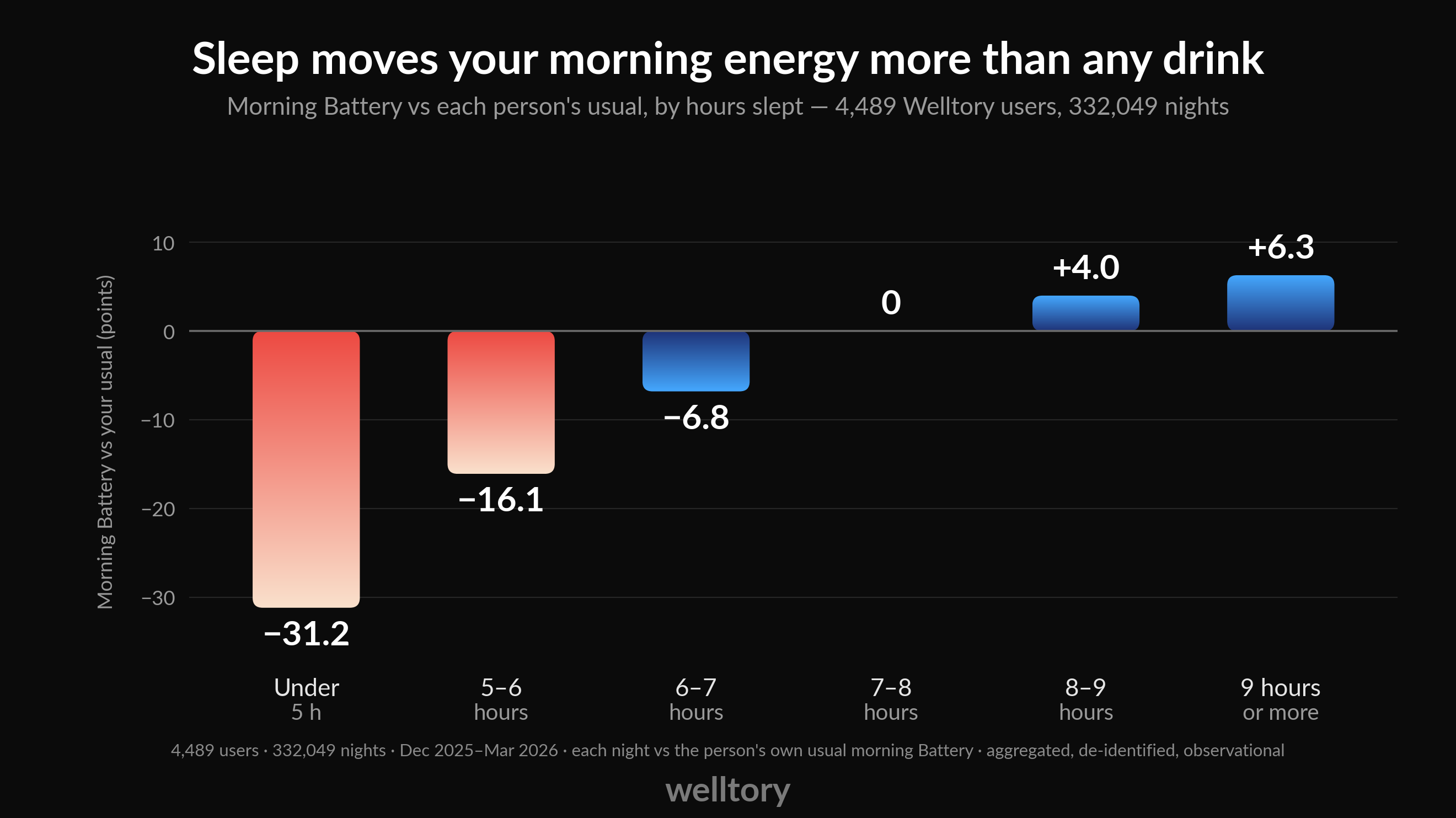
We looked at 4,489 Welltory users and 332,049 nights between December 2025 and March 2026. For each night, we compared the next morning's Battery score with that person's own usual morning Battery, so each person is measured against themselves. Then we grouped nights by how long people slept.
Nights of 7–8 hours were the reference point, sitting right at people's usual level.
Short nights cost a lot. After a night of 6–7 hours, morning Battery was about 6.8 points below a person's usual. After 5–6 hours, it was about 16.1 points below. After less than 5 hours, the gap was 31.2 points — close to a third of the scale. More than 22,000 nights in the dataset fell into that shortest group, so this is not a rare event.
Longer nights helped, but less. Sleeping 8–9 hours came with a morning about 4.0 points above usual, and 9 hours or more about 6.3 points above. The curve is steep on the short side and flattens on the long side: losing sleep costs far more than gaining extra sleep adds.
The comparison that matters. Nobody has shown that a glass of juice with salt can shift anything by tens of points. Sleep length does, every night, in our own users. If you are choosing where to put your effort, the evidence points at the hour before bed, not the glass at three o'clock.
A note on the data. This is observational, aggregated and de-identified data. Welltory users are not a random sample of the population; people who use a wellness app may sleep, work and live differently from others. Battery itself takes sleep into account, so part of this link is built into how the score is calculated — what matters is the size of the gap, tens of points, compared with what any drink could plausibly do. Very long sleep can also reflect recovery from illness, so the gain at 9 hours or more should not be read as "sleep as long as you can". We can see how long people slept, not why.
How to test it on yourself for two weeks
If you like the drink, there is no reason to stop. But if you want to know whether it does anything for you specifically, a small, fair test beats a hundred videos.
Week one: change nothing, just record. Note your sleep length, your afternoon energy on a 1–5 scale, and how much caffeine you had after noon. Do not drink the cocktail.
Week two: add the drink, keep everything else the same. Same bedtime, same caffeine, same lunch. Drink it at the same time each day and keep recording.
Compare the weeks, not the days. One good afternoon proves nothing. A week-level difference, with sleep held steady, is more meaningful.
Watch the confounders. If the week with the drink was also the week you slept better or skipped a third coffee, the credit is unclear. That is fine — it still tells you something useful about what helps you.
Try a plain version too. If you have a third week, swap the cocktail for a glass of water with a small snack at the same time. If that works just as well, you have learned the useful part, and it is cheaper.
Skip the test if you have kidney disease, take potassium-raising medicines, or have been told to limit salt. For you, the question is not whether it works but whether it is safe, and that is your doctor's call.
How to bring this up with your doctor
Persistent tiredness is one of the most common reasons people see a doctor, and one of the easiest to under-describe. A clear account helps.
What to track for two weeks before the appointment:
Sleep: bedtime, wake time and roughly how long you slept.
Energy at three points in the day on a simple 1–5 scale.
Caffeine, alcohol and what you ate at lunch.
Anything unusual: dizziness when standing, salt cravings, weight change, feeling cold, heavy periods, low mood.
What to say: "I have been tired most days for [how long]. It is worse in the afternoon. I sleep about [X] hours. I have been trying an adrenal cocktail because I read about adrenal fatigue." Mentioning the trend is useful — it tells your doctor what you are worried about, and they can address it directly.
What to ask:
"Could this be my thyroid, iron levels or blood sugar?"
"Is it worth checking for sleep apnea?" — especially if you snore, wake with headaches or someone has noticed pauses in your breathing.
"Is there any reason to test my adrenal function properly?" If there is, it will be a specific blood test ordered for a specific reason, not a saliva panel sold online.
"Is a salty, potassium-rich drink safe with my medicines and kidney function?"
Get checked promptly if tiredness comes with unexplained weight loss, dizziness or fainting when you stand, darkening of the skin, persistent vomiting, or a strong craving for salt. Those can be signs of real adrenal insufficiency, which needs medical care.
Before you blame yourself, check what your body already recorded
Most people who search for a cortisol cocktail are not chasing a trend for fun. They are tired, and they have started to believe something about themselves.
The feeling. "I can't get through an afternoon without a fix." "Other people manage, so something must be wrong with me." "Maybe my adrenals are burned out." It is easy for ordinary exhaustion to turn into a story about being weak, or broken, or not coping well enough.
What the body usually shows instead. When people look at their own data, the afternoon crash rarely appears out of nowhere. It tends to follow a run of short nights, a week of high stress load, late caffeine that shortened sleep, or a heavy day that left no room to recover. None of that is a flaw. It is arithmetic: less recovery in, less energy out. Our data makes the size of it clear — a night under 5 hours sat about 31 points below a person's usual morning Battery.
Permission, and one lever. You do not need to fix everything, and you do not need a special drink. Pick one thing that protects sleep — the same wake time every day, or bed 30 minutes earlier on work nights — and keep it for two weeks. Then look at the trend in your mornings, not at any single day. If the afternoons improve, you have found your lever. If nothing changes despite enough sleep, that is useful information to take to a doctor.
How Welltory helps — and what it cannot do
The limits first. Welltory is a general wellness product with no regulatory clearance. It does not diagnose anything, and it does not measure cortisol. It cannot tell you whether you have adrenal insufficiency, a thyroid problem or anything else — only a clinician with the right tests can.
What it can do is show you the patterns that sit around your tiredness, measured the same way every day:
Sleep — how long you slept and how regular your nights were.
Stress minutes — an estimate of physiological stress load through the day, from heart rate data.
Battery — a morning energy score that combines sleep and recovery signals. Our explainer on body battery covers what goes into scores like this and what they miss.
Resting heart rate and HRV — compared with your own baseline, so you see when you are running below your usual.
Tags and notes — you can tag a day "cortisol cocktail", "third coffee" or "late night", and My Patterns can show which tagged situations tend to come before stressful stretches or low mornings.
That last part is what makes a two-week test more than guesswork. If you tag the days you had the drink and the days you did not, you can see whether anything moved — and whether the bigger movement was in your sleep.
The caveat: these signals are non-specific. Alcohol, illness, a hot room and a stressful day move them the same way a short night does. Read the pattern across a week or two, not a single morning.
How we made it
Made with AI tools, then edited and fact-checked by the Welltory team. See our Editorial & AI policy.
Data analysis by Jane Smorodnikova, co-founder of Welltory and the person who built the methodology behind how we read physiological data.
Written by Tatsiana Yashyna.


Discounts for blog readers: up to 36% off
See what affects your energy, stress, sleep, and daily state with Welltory
This article is for educational purposes only and is not medical advice. Adrenal fatigue is not a recognised medical diagnosis; adrenal insufficiency is, and it needs medical assessment. People with kidney disease, heart disease or high blood pressure, or who take medicines that affect potassium, should ask a doctor before adding salty or potassium-rich drinks. Persistent exhaustion needs a clinical check-up. Welltory holds no regulatory clearance, is a general wellness product, does not measure cortisol and does not diagnose. Sources were retrieved on 29 September 2026.
Was this helpful?
Ask AI for a summary of page


Written by Jane Smorodnikova

The founder and CEO of Welltory. A recognized tech leader with two Master's degrees and experience at MIT, she has scaled Welltory to over 17 million users.
Written by Tatsiana Yashyna

Deputy COO at Welltory. With a background in medicine and years of working with health data, she translates research and real physiological signals — sleep, stress, heart rate, and hormones — into clear, evidence-based explanations that help people understand what their bodies are telling them.
References
- Cadegiani FA, Kater CE. Adrenal fatigue does not exist: a systematic review. BMC Endocrine Disorders 2016;16:48. https://doi.org/10.1186/s12902-016-0128-4
- Endocrine Society. Adrenal fatigue. Endocrine Library, patient resource, 2022. https://www.endocrine.org/patient-engagement/endocrine-library/adrenal-fatigue
- Leproult R, Copinschi G, Buxton O, Van Cauter E. Sleep loss results in an elevation of cortisol levels the next evening. Sleep 1997;20(10):865–870. https://doi.org/10.1093/sleep/20.10.865
- Pruessner JC, Wolf OT, Hellhammer DH, et al. Free cortisol levels after awakening: a reliable biological marker for the assessment of adrenocortical activity. Life Sciences 1997;61(26):2539–2549. https://doi.org/10.1016/S0024-3205%2897%2901008-4
- Leproult R, Colecchia EF, L'Hermite-Balériaux M, Van Cauter E. Transition from dim to bright light in the morning induces an immediate elevation of cortisol levels. Journal of Clinical Endocrinology & Metabolism 2001;86(1):151–157. https://doi.org/10.1210/jcem.86.1.7102
- Armstrong LE, Ganio MS, Casa DJ, et al. Mild dehydration affects mood in healthy young women. Journal of Nutrition 2012;142(2):382–388. https://doi.org/10.3945/jn.111.142000
- National Institutes of Health, Office of Dietary Supplements. Potassium: fact sheet for health professionals. https://ods.od.nih.gov/factsheets/Potassium-HealthProfessional/
- Centers for Disease Control and Prevention. About sodium and health. https://www.cdc.gov/salt/about/index.html
- Watson NF, Badr MS, Belenky G, et al. Recommended amount of sleep for a healthy adult: a joint consensus statement of the American Academy of Sleep Medicine and Sleep Research Society. Sleep 2015;38(6):843–844. https://doi.org/10.5665/sleep.4716


