

Short answer
Postpartum night sweats happen because the hormonal support system of pregnancy is dismantled in days rather than years. Estrogen and progesterone, high for months, fall steeply once the placenta is delivered, and the extra fluid your body built for pregnancy is unwound over the weeks that follow (7, 5). In the one prospective study that followed the same women through pregnancy and the year after birth, 29% reported sleep-disturbing hot flashes at some point after delivery, peaking in the second week and declining through the first year (1). Most women are past the worst of it within a few months, and a minority are still affected at twelve.
If you have been waking at 3 a.m. with your shirt stuck to you, wondering whether this is normal or whether something is wrong, you weren't imagining it and it is not your fault. This is one of the least-discussed parts of early recovery, and it has been measured. It is also the symptom where the ordinary and the dangerous explanations look identical at 3 a.m., which is why the warning signs here sit beside the advice rather than at the end.
Note: this article explains what is known about night sweating after birth and is not medical advice. Several serious postpartum conditions — infection, blood clots, thyroid disease — can present with sweating. New, severe or worsening symptoms need a clinician, and the emergency signs below need care the same day.
What causes postpartum night sweats?
Three things change at once after birth, and all three touch the body's temperature controls.
The hormonal cliff. The placenta is the main source of the estrogen and progesterone of pregnancy, so delivering it removes that source within minutes — rapid hormone withdrawal, against the years-long drift of the menopause transition (7). Why that produces sweating is best explained by hot flash physiology: a flash is "a rapid and exaggerated heat dissipation response, consisting of profuse sweating, peripheral vasodilation, and feelings of intense, internal heat", set off by very small rises in core body temperature inside a narrowed thermoneutral zone — the gap between the temperature at which you start to sweat and the one at which you start to shiver (4). Estrogen loss is part of what narrows that gap, though not the whole story.
The fluid. Pregnancy expands the volume of fluid you carry. A 2025 meta-analysis pooled 22 studies, 651 measurements and 560 women and found maternal plasma volume falls through the early weeks and is back to pre-pregnancy levels by about the second month (5). Urine and sweat are the main exits, which is the usual explanation for why the drenching clusters in the first fortnight. That fits the timing, but it has not been tested against the hormonal explanation. Nobody has run that study.
Sympathetic load. Raised central sympathetic activity also narrows the thermoneutral zone (4), and broken sleep, feeding on demand, pain and newborn vigilance all sit on that system. Not a cause — a reason the same hormonal change feels different in a calm week and a brutal one.
| What changes after birth | What it does to temperature | Keep in mind |
|---|---|---|
| Estrogen and progesterone fall steeply once the placenta is delivered (7) | Estrogen loss narrows the thermoneutral zone, so small temperature rises trigger sweating (4) | The thermoregulatory work was done in menopause; the mechanism has not been measured directly in postpartum women |
| Plasma volume returns to pre-pregnancy levels over roughly two months (5) | Fluid has to leave; urine and sweat are the routes | The timing fits, but the link to night sweating has not been tested |
| Prolactin stays high while breastfeeding, suppressing ovarian hormone production (6) | Keeps estrogen low for longer | In the prospective study, breastfeeding was not significantly associated with hot flashes (1) |
| Sympathetic activity raised by broken sleep, pain and vigilance (4) | Narrows the zone further | A contributor, not a cause. "Stress sweats" is not a diagnosis |
| Infection, thyroid disease and blood clots (3, 15) | Produce sweating by different routes | Why the warning signs below matter: night sweating is nonspecific |
A systematic review of night sweats across all of medicine found prevalence estimates from 10% in older primary care patients up to 60% among women on an obstetric inpatient unit, and concluded the symptom is nonspecific (3). That 60% is the highest figure in the review, and it comes from the setting you were in a few days ago.
How long do postpartum night sweats last?
For most women, weeks rather than months — but the tail runs longer than the usual advice suggests.
The best data come from a prospective study of 429 women assessed at weeks 20, 30 and 36 of pregnancy and again at weeks 2, 12, 26 and 52 after delivery, asking each time about sleep-disturbing hot flashes over the previous two weeks (1).
| Weeks after delivery | Reporting sleep-disturbing hot flashes | Adjusted odds vs week 2 | Keep in mind |
|---|---|---|---|
| 2 | 20% | reference | The peak. Overlaps with the fluid shift and the steepest hormone drop |
| 12 | 14% | 0.65 (95% CI 0.33–1.28) | Not a significant fall yet — this does not stop at the six-week check |
| 26 | 11% | 0.41 (95% CI 0.19–0.85) | First clearly significant decline |
| 52 | 10% | 0.30 (95% CI 0.13–0.68) | One in ten still affected a year out |
Across the year, 29% of women reported them at some point after delivery; 35% during pregnancy (1). A separate survey of 436 first-time mothers at 1, 3, 6, 9 and 12 months found increased sweating and hot flashes among the problems markedly more common at one month than later, and concluded that "recovery from childbirth often requires more than the 6 weeks traditionally allotted" (2).
Keep in mind what these numbers are not. The sample was recruited for studies of mood disorders in pregnancy, so women with a history of major depression or bipolar disorder were over-represented and psychotropic medication use was higher than in the general population; the authors name this and call for population-based sampling (1). The measure was a single question about hot flashes that disturbed sleep, so flashes that woke nobody were not counted. This is the best available shape of the curve, not a precise population rate.
And the part that does not wait for a trend. Watching how your nights change over weeks is useful, and the sections below describe how. It is useless when sweating is the opening symptom of something acute. If it arrives with a fever of 100.4°F (38°C) or higher, shaking chills, pain or swelling or redness in one calf, sudden breathlessness or chest pain, heavy bleeding, foul-smelling discharge, or a caesarean incision that is red, hot, leaking or coming apart — stop tracking and call your obstetric provider the same day, or 911 if you cannot breathe or your chest hurts. The CDC's urgent maternal warning signs apply "during pregnancy and in the year after delivery", not for six weeks (14).
When are night sweats after birth a sign of something urgent?
This section comes before the practical tips on purpose.
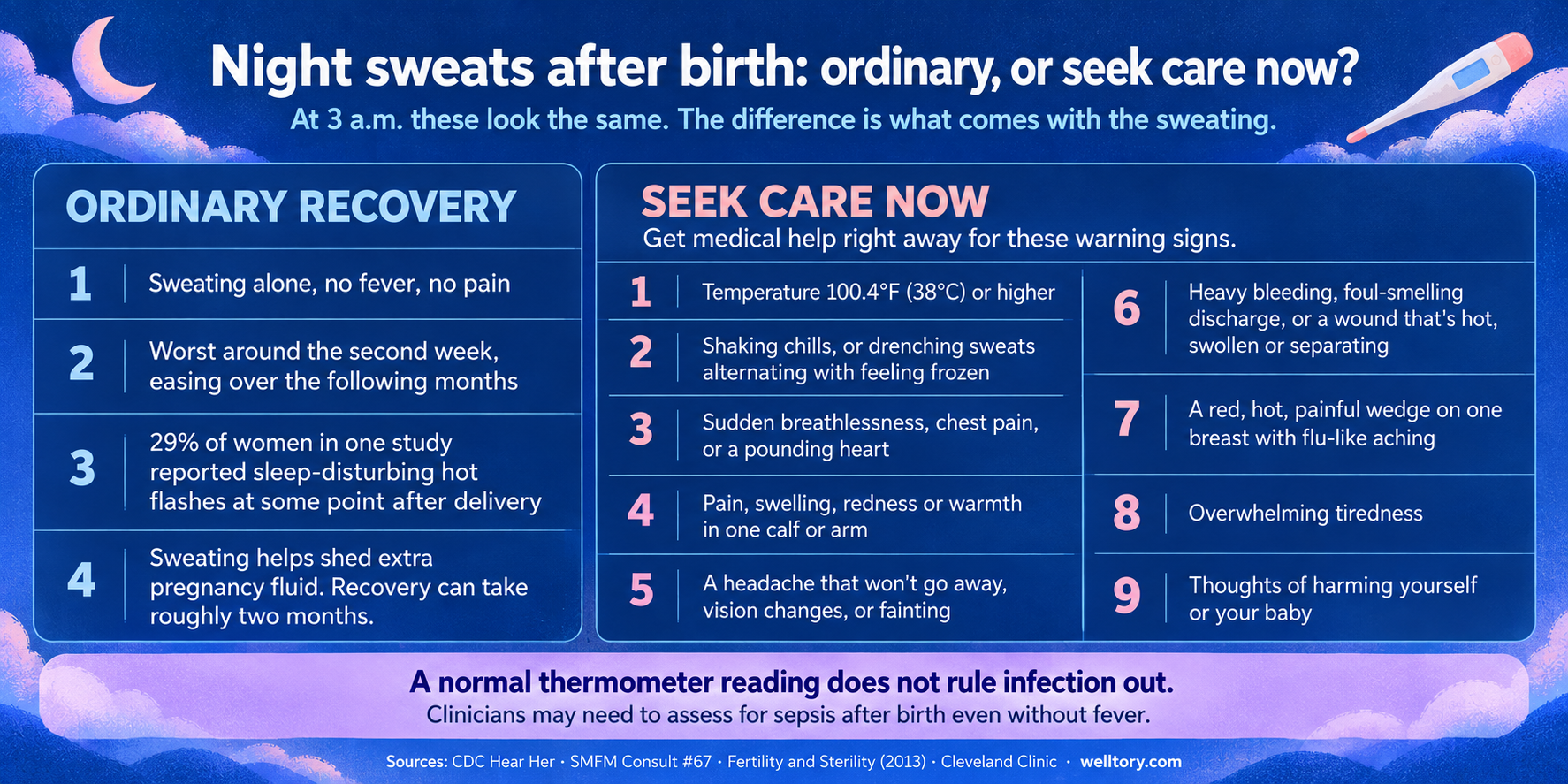
CDC analysis of pregnancy-related deaths for 2011–2015 found that 31.3% occurred during pregnancy, 16.9% on the day of delivery, 18.6% in the first six days after delivery, 21.4% between 7 and 42 days, and 11.7% between 43 and 365 days; leading causes included cardiovascular conditions, infection and haemorrhage, and about three in five were judged preventable (13). More than half happen after the baby is born, and a third of those after the six-week window has closed.
Both the ordinary and the dangerous explanations produce sweating, so the rule is not "watch the sweating". It is what the sweating comes with.
Call 911 or go to an emergency department now if you have:
Sudden shortness of breath, chest pain, or a fast or pounding heartbeat. In a study of 1,687,930 first deliveries, the odds of a first thrombotic event — stroke, heart attack or venous thromboembolism — were 10.8 times higher in the six weeks after delivery than in the same weeks a year later (95% CI 7.8–15.1), and about twice as high from 7 to 12 weeks (10). A pulmonary embolism can present with sweating, breathlessness and a racing heart and little else.
Pain, swelling, redness or warmth in one calf or one arm — on the CDC's urgent warning sign list, and the classic presentation of a deep vein clot (14).
A headache that will not go away or is getting worse, changes in vision, or fainting — also on that list, and signs of postpartum pre-eclampsia, which can start after you are home (14).
Heavy vaginal bleeding, soaking a pad in an hour or passing large clots, and thoughts of harming yourself or your baby (14).
Call your obstetric provider today — not at your next appointment — if you have:
A temperature of 100.4°F (38°C) or higher, with or without sweating. Fever is on the CDC list, and it is how endometritis — infection of the uterine lining — usually announces itself, often with a rapid pulse, uterine tenderness or discharge (14, 16).
Shaking chills, or drenching sweats alternating with feeling frozen. The Society for Maternal-Fetal Medicine recommends clinicians consider sepsis in postpartum patients with otherwise unexplained organ dysfunction and a suspected or confirmed infection regardless of the presence of fever, and treat sepsis in pregnancy as a medical emergency (11). A normal thermometer reading does not rule infection out.
Foul-smelling discharge, bleeding that gets heavier instead of lighter, or a caesarean incision or perineal repair that is red, hot, swollen, leaking or separating (14).
A red, hot, painful wedge on one breast with flu-like aching. Mastitis is common: a systematic review pooling three studies found 11.1 episodes per 1,000 breastfeeding weeks between birth and week 25, highest in the first four weeks (17).
Overwhelming tiredness, which the CDC lists as an urgent maternal warning sign in its own right (14).
One slower flag. Night sweats not obviously tied to the weeks after birth, carrying on for months with unexplained weight loss, persistent fever or lumps, deserve a proper look: nighttime sweating is linked to infections, autoimmune disease and malignancy as well as hormonal change (3). That is a reason to raise it, not to panic at month three.
If you are told it is just hormones and you do not believe it, say so and name what you want ruled out. Asking twice is reasonable.
Does breastfeeding cause postpartum night sweats?
The mechanism is real; the measured effect is smaller than you would expect.
Lactation is a state of sustained high prolactin. Suckling maintains it, high prolactin suppresses the hypothalamic neurons that drive pulsatile GnRH release, and without a proper LH pattern the ovaries do not run a normal cycle — which is why many women do not menstruate while breastfeeding and why estrogen stays low (6). Low estrogen for longer is a reasonable reason to expect night sweating for longer.
But the prospective study that measured it did not find breastfeeding significantly associated with reporting sleep-disturbing hot flashes after delivery; the factor that stayed associated in the adjusted model was depressive symptoms, not feeding method (1). Plausible mechanism, no demonstrated association in the one dataset built to look.
This is deliberately not a reason to change how you feed your baby. That decision belongs to you and your clinician, and nothing here is an argument in either direction.
Red flag, in this section too, because this is where it hides. Night sweating plus a red, hot, painful area on one breast plus flu-like aching is mastitis until proven otherwise, and mastitis is commonest in exactly these weeks (17). Night sweating plus a temperature of 100.4°F or higher is a call today, whatever you think the cause is (14).
Could postpartum night sweats be my thyroid?
This is the cause most often missed, because its timing does not match what people expect.
Postpartum thyroiditis is inflammation of the thyroid gland that, according to the US National Institute of Diabetes and Digestive and Kidney Diseases, "affects about 1 in 20 women during the first year after giving birth" (15). Inflammation first leaks stored thyroid hormone into the blood, producing an overactive phase that can last up to about three months; NIDDK notes it "often has no symptoms — or only mild ones", and lists irritability, trouble dealing with heat, tiredness, trouble sleeping and a fast heartbeat. Read that next to what a new parent expects to feel anyway and you can see why it gets filed under "newborn". An underactive phase may follow, lasting up to a year, with symptoms NIDDK says may be mistaken for the baby blues. Most women recover; in some, it does not resolve.
So: if your night sweating comes with heat intolerance, a higher resting pulse, tremor, unusual irritability or unexplained weight loss — especially if it started at two to four months rather than two weeks — that is a thyroid conversation. It is a blood test, not a mystery.
The flag that belongs here. A fast heartbeat is on the CDC's urgent maternal warning sign list (14) as well as being a symptom of the thyrotoxic phase, and the two are not distinguishable at home. If a racing heart comes with breathlessness, chest pain or faintness, treat it as the emergency category and get seen today.
Why do postpartum night sweats make broken sleep so much worse?
Because the sleep you lose to a soaked shirt comes out of a budget that is already overdrawn.
Hot flashes "are responsible for some, but not all" of the sleep disturbance that goes with them — a careful way of saying the sweating and the waking are tangled (4). The postpartum study measured flashes specifically as sleep-disturbing ones (1), so every figure here already refers to flashes that woke someone.
In a German panel study of 2,541 women and 2,118 men followed across childbirth, sleep satisfaction and duration fell sharply and bottomed out in the first three months after birth. Mothers lost an average of 62 minutes of sleep a night compared with before pregnancy; fathers lost 13. Neither had fully recovered up to six years after a first child (8).
The cost is not only tiredness. In a study tracking 70 first-time mothers with wrist actigraphy for 12 postpartum weeks, reaction-time performance kept worsening even as sleep itself improved — consistent with cumulative disruption rather than one bad night (9). The fog at week ten is not a sign you have stopped coping.
What can you actually do about postpartum night sweats at night?
Little of this has been studied in postpartum women, so treat it as damage limitation rather than treatment. What the physiology supports is cooling: flashes are triggered by small rises in core body temperature inside a narrowed thermoneutral zone, and peripheral cooling reduces them (4). Practical versions:
Make the room cooler than feels normal, and favour a fan over a heavier duvet — moving air helps heat leave the skin.
Layer the bed, not the body. A sheet plus a thin blanket beats one warm quilt, because you can shed heat in stages without getting up.
Keep a dry top and a towel within reach, and put a folded towel over the bottom sheet, so changing the bed at night means pulling one layer.
Combine the wake-ups. If you wake soaked and a feed is due anyway, one wake-up costs less than two.
What is not established: no diet, supplement or bedtime routine has been shown to reduce postpartum night sweats, and the systematic review of night sweats found treatment questions largely unanswered (3).
The flag belongs beside this list, in the same breath as the advice: none of it applies if the sweating is a symptom of something else. Cooling a room does not treat endometritis, and a dry shirt does not treat a pulmonary embolism. If your sweating comes with fever at or above 100.4°F, shaking chills, calf pain or swelling, breathlessness, chest pain, heavy bleeding, foul-smelling discharge, or a wound that is red or opening, stop optimising your bedding and call (14, 11). Only a clinician can tell you which version you have.
Are postpartum night sweats the same as menopause hot flashes?
They look the same and are not the same event. In the prospective study, the predictors of hot flashes in pregnancy and after birth — depressive symptoms, lower education, higher pre-pregnancy BMI — were the same ones that predict hot flashes in the menopause transition, which the authors read as a hint at shared physiology (1). The thermoregulatory model built for menopausal flashes is the best available explanation for what happens at 3 a.m. (4).
The difference is direction of travel. In menopause, estrogen goes down and stays down. After birth it falls from a very high level and is expected to come back as cycles return — which is why the course is weeks to months, not years (1), and why the treatment conversation is a different one.
On that conversation, so it is not left as a silence: The Menopause Society's 2022 position statement describes hormone therapy as "the most effective treatment for vasomotor symptoms (VMS) and the genitourinary syndrome of menopause", with risks that differ by type, dose, duration, route and timing of initiation, and lists contraindications including unexplained vaginal bleeding, liver disease, prior estrogen-sensitive cancer including breast cancer, prior coronary heart disease, stroke, myocardial infarction or venous thromboembolism, and a personal or inherited high risk of thromboembolic disease (18). That statement is about menopause, not the postpartum period — and the postpartum weeks are themselves a time of raised clot risk (10). Nothing here is a suggestion to ask for hormone therapy for night sweats after a baby. It is named so you know what exists and that the decision belongs to a clinician who knows your history.
If midlife flashes keep coming up in your searches, our guides to menopause and sleep and hormones in midlife cover that version, and our explainer on night sweats covers the non-hormonal causes.
Living with postpartum night sweats: the questions people ask next
Can I go back to work while I still have postpartum night sweats?
Yes, and the harder part is usually the sleep underneath them. Postpartum night sweats peak in the second week and decline through the first year (1), but maternal sleep duration stays below pre-pregnancy levels for years (8), and reaction-time performance kept worsening across the first 12 weeks in women tracked with actigraphy (9). Practical moves: a spare top in your bag, a cooler commute layer, honest expectations of your first hour. If overwhelming tiredness is the dominant symptom, the CDC lists that as an urgent maternal warning sign worth a call (14).
Will exercise make postpartum night sweats worse?
There is no good evidence either way for postpartum night sweats specifically. What is known is that raising core body temperature triggers a heat dissipation response inside a narrowed thermoneutral zone (4), so moving a hard session earlier in the day is worth trying. When and how much to exercise after birth — especially after a caesarean — is a question for the clinician who managed your delivery, not for an article. One thing is not negotiable: new breathlessness or chest pain on exertion in the postpartum months is not deconditioning until a doctor has said so, given how much higher clot risk is in this window (10).
Can I travel or go to an event while this is happening?
Nothing about ordinary postpartum night sweats rules out a flight, a wedding or a night away. The practical problem is bedding you do not control: pack a second set of nightclothes and a thin towel for the bottom sheet, and ask for a room you can cool. The medical caveat matters more — long immobile journeys and the postpartum period both raise clot risk, which was 10.8 times higher in the first six weeks after delivery than a year later (10). Ask your clinician before long-haul travel, move and drink water on the way, and treat calf pain or breathlessness as an emergency (14).
Does alcohol or caffeine make postpartum night sweats worse?
Nobody has studied this in postpartum women, so a confident answer would be a guess. The mechanism gives you something to work with: both affect sympathetic activity and sleep, and raised sympathetic activity narrows the thermoneutral zone (4). A practical approach is to treat it as a personal experiment rather than a rule — note what you had and how the night went, for a couple of weeks, then look at your own record. Your own notes can answer this better than the literature currently can. One limit on that experiment: a night with fever, chills, calf pain or breathlessness is not data to log, it is a call to your provider the same day (14).
How do I get back to sleep after waking up drenched?
Make the recovery short rather than trying to prevent the wake-up. Peripheral cooling is the one thing with a mechanism behind it (4), so a cooler room, a fan and layers you can throw off beat a single warm duvet. Keep a dry top within arm's reach and a folded towel over the bottom sheet, so a change takes seconds in the dark. If a feed is near, folding the two together costs less than two wake-ups. If you are left lying awake with your heart racing, raise that with your provider.
What if my mood is sliding, or nobody believes me?
Those two often arrive together. In the prospective study, higher depressive symptoms were the factor most consistently associated with reporting hot flashes, and the association held in the adjusted model (odds ratio 1.19 per unit of depression score, 95% CI 1.14–1.25) (1). The authors do not claim causation; reviews of perinatal hormones describe a subgroup of women especially sensitive to rapid hormone change (7). If you are told this is just hormones and you are not convinced, name what you want ruled out and ask for it in your notes. Thoughts of harming yourself or your baby are an emergency (14).
How do I explain postpartum night sweats to my partner or family?
Keep it short and physical: "When the placenta came out, the hormones that ran the show for nine months dropped within days, and my body is also shedding several litres of extra fluid. My temperature control is recalibrating, and that is why I am soaking the sheets." Numbers help with sceptics — 29% of women in a prospective study reported sleep-disturbing hot flashes at some point after delivery, peaking in the second week (1). The concrete ask usually lands better than the explanation: a second set of sheets, a fan, and someone else taking one wake-up.
Is this going to be permanent?
Almost certainly not. The prospective study shows a clear decline: 20% at two weeks, 14% at twelve, 11% at six months, 10% at a year (1), and the plasma volume expansion of pregnancy is gone by roughly two months (5). Two caveats: one in ten women still reported sleep-disturbing hot flashes at twelve months, and night sweating carrying on well past the first year with weight loss, fever or lumps needs looking into rather than waiting out (3). Our guide to postpartum recovery after 35 covers the wider timeline.
How to bring this up with your doctor
Night sweating gets dismissed quickly because it sounds minor and is invisible by the time you are in the room. A short, specific account changes that.
Say it in one sentence first: "I am waking soaked through most nights, it started at about week X, and here is what else has been happening." That gives the clinician the two things that sort the ordinary cause from the urgent one — the timing and the company the symptom keeps.
Bring four things, not a diary dump. When it started and whether it is improving. Your highest recorded temperature. Anything else new: breathlessness, calf pain, breast pain, bleeding, discharge, wound changes, heart racing, weight change. And how much sleep you are actually getting.
Ask what is being ruled out, by name. "Could this be an infection?" "Do we need to think about a clot?" "Should my thyroid be checked?" Postpartum thyroiditis affects about one in twenty women in the first year (15), and it is a blood test. Naming what you want excluded makes it harder for the visit to end at "that is normal after a baby".
Ask about follow-up timing. ACOG recommends contact with an obstetric care provider within the first three weeks after birth and a comprehensive visit no later than twelve weeks (12). A single appointment at six weeks is reasonable to push on.
Do not wait for an appointment for these. Fever of 100.4°F (38°C) or higher; shaking chills; pain, swelling or redness in one calf or arm; sudden breathlessness; chest pain or a racing heart; heavy bleeding or large clots; foul-smelling discharge; a wound that is red, hot, leaking or opening; a headache that will not go away; changes in vision; fainting; thoughts of harming yourself or your baby. These are the CDC's urgent maternal warning signs, and they apply for a full year after delivery (14). Breathlessness, chest pain, fainting or a seizure mean 911, not a callback. Clinicians are advised to consider sepsis in postpartum patients even without fever (11), so a normal temperature is not a reason to stay home if you feel very unwell.
If you are not taken seriously, ask for your symptoms and your request to be written in your notes, and go to an emergency department if things change. About three in five pregnancy-related deaths in the CDC's review were considered preventable (13).


Start understanding your body
Learn what affects your energy, stress, sleep, and daily state. Get the app.
How Welltory helps — and what it cannot do
The limits first. Welltory is a general wellness product, not a medical device. It does not diagnose, predict, monitor, prevent, treat or mitigate night sweats, postpartum infection, blood clots, thyroid disease or any other condition. It cannot find a hot flash, and nothing in the app can tell you whether a bad night was hormones or something that needs a doctor.
What it can do is narrower: it records your night-time heart rate, sleep and HRV the same way every day and shows those numbers against your own history, not a population norm. The formula is: you mark what happened, the app writes down the numbers, and together the two make a diary.
1. Mark the night. When Welltory flags a stress stretch and asks "What happened?", you can tap a suggested tag, type a few words, or just talk. Plain words work best: "woke up drenched", "changed the sheets", "three feeds", "chills", "sore breast". You can also add a note any time with the plus icon; it goes to your Journal.
In the same breath as that advice: tagging is for the ordinary version of this. If a night comes with a temperature of 100.4°F or higher, shaking chills, calf pain or swelling, breathlessness, chest pain, heavy bleeding, foul discharge, or a wound that is red or opening, that is not a tag — that is a call to your provider the same day, or 911 (14). An app is not a monitoring system and must never be the reason you waited.
2. Look at the one to three days before. Put sleep, stress minutes, Battery, resting heart rate and HRV next to the nights you marked. Stress minutes and sleep analysis need a supported wearable; with the phone camera alone you have your morning readings (how accurate those are). If the numbers look fine and you feel awful, believe your body (more on that gap).
3. My Patterns, after two to three weeks of tagging. My Patterns collects the tags you add on the Today screen, so it needs iOS with an Apple Watch or Oura. Patterns appear at around seven tagged events in the current month plus some history from the month before, and show which tagged situations tend to come alongside stressful stretches, which tags don't happen often but hit your body hard, day-of-week trends, and every time a tag occurred.
4. A record for the appointment. The Journal holds your measurements, tags and notes, and from the Welltory web app you can export your data as a CSV (Dashboard → choose a chart → Export). Six weeks of marked nights answers "how often is this happening?" better than memory.
Anything you find this way is an association to discuss with your doctor — not proof of a cause, not a diagnosis, not a warning system.
If you live with a condition that limits your energy — ME/CFS, long COVID, fibromyalgia, POTS, MCAS and similar — Welltory runs a paid, moderated community called Energy Lab for women aged 18 to 65. It runs alongside the app: you keep collecting your own data, and the Lab is where people learn to read it together, with a medical board answering the science. It is education and peer support, not medical care, and there is a 14-day money-back guarantee on a first purchase.
How we made it
Made with AI tools, then edited and fact-checked by the Welltory team. See our Editorial & AI policy.
Data analysis by Jane Smorodnikova, co-founder of Welltory and the person who built the methodology behind how we read physiological data.
Written by Tatsiana Yashyna.


Discounts for blog readers: up to 36% off
See what affects your energy, stress, sleep, and daily state with Welltory
This article is for educational purposes only and is not medical advice; your OB-GYN or midwife decides which vaccines fit you and when. Call 911 for hives, swelling of the face or throat, trouble breathing, a fast heartbeat, dizziness or a seizure after a shot. In pregnancy, a fever of 100.4°F or higher, a severe headache, vision changes, chest pain, bleeding or leaking fluid, or your baby moving less needs medical care right away. Welltory is a general wellness product and does not diagnose, detect or predict any condition and does not monitor pregnancy.
Was this helpful?
Ask AI for a summary of page


Written by Jane Smorodnikova

The founder and CEO of Welltory. A recognized tech leader with two Master's degrees and experience at MIT, she has scaled Welltory to over 17 million users.
Written by Tatsiana Yashyna

Deputy COO at Welltory. With a background in medicine and years of working with health data, she translates research and real physiological signals — sleep, stress, heart rate, and hormones — into clear, evidence-based explanations that help people understand what their bodies are telling them.
References
- Thurston RC, Luther JF, Wisniewski SR, Eng H, Wisner KL. Prospective evaluation of nighttime hot flashes during pregnancy and postpartum. Fertility and Sterility 2013;100(6):1667–1672. https://doi.org/10.1016/j.fertnstert.2013.08.020
- Gjerdingen DK, Froberg DG, Chaloner KM, McGovern PM. Changes in women's physical health during the first postpartum year. Archives of Family Medicine 1993;2(3):277–283. https://doi.org/10.1001/archfami.2.3.277
- Mold JW, Holtzclaw BJ, McCarthy L. Night sweats: a systematic review of the literature. Journal of the American Board of Family Medicine 2012;25(6):878–893. https://doi.org/10.3122/jabfm.2012.06.120033
- Freedman RR. Menopausal hot flashes: mechanisms, endocrinology, treatment. Journal of Steroid Biochemistry and Molecular Biology 2014;142:115–120. https://doi.org/10.1016/j.jsbmb.2013.08.010
- Deferm N, Dinh J, Pansari A, Jamei M, Abduljalil K. Postpartum changes in maternal physiology and milk composition: a comprehensive database for developing lactation physiologically-based pharmacokinetic models. Frontiers in Pharmacology 2025;16:1517069. https://doi.org/10.3389/fphar.2025.1517069
- Calik-Ksepka A, Stradczuk M, Czarnecka K, Grymowicz M, Smolarczyk R. Lactational amenorrhea: neuroendocrine pathways controlling fertility and bone turnover. International Journal of Molecular Sciences 2022;23(3):1633. https://doi.org/10.3390/ijms23031633
- Schiller CE, Meltzer-Brody S, Rubinow DR. The role of reproductive hormones in postpartum depression. CNS Spectrums 2015;20(1):48–59. https://doi.org/10.1017/S1092852914000480
- Richter D, Krämer MD, Tang NKY, Montgomery-Downs HE, Lemola S. Long-term effects of pregnancy and childbirth on sleep satisfaction and duration of first-time and experienced mothers and fathers. Sleep 2019;42(4):zsz015. https://doi.org/10.1093/sleep/zsz015
- Insana SP, Williams KB, Montgomery-Downs HE. Sleep disturbance and neurobehavioral performance among postpartum women. Sleep 2013;36(1):73–81. https://doi.org/10.5665/sleep.2304
- Kamel H, Navi BB, Sriram N, Hovsepian DA, Devereux RB, Elkind MSV. Risk of a thrombotic event after the 6-week postpartum period. New England Journal of Medicine 2014;370(14):1307–1315. https://doi.org/10.1056/NEJMoa1311485
- Shields AD, Plante LA, Pacheco LD, Louis JM; Society for Maternal-Fetal Medicine. Society for Maternal-Fetal Medicine Consult Series #67: Maternal sepsis. American Journal of Obstetrics and Gynecology 2023;229(3):B2–B19. https://doi.org/10.1016/j.ajog.2023.05.019
- American College of Obstetricians and Gynecologists. ACOG Committee Opinion No. 736: Optimizing postpartum care. Obstetrics & Gynecology 2018;131(5):e140–e150. https://doi.org/10.1097/AOG.0000000000002633
- Petersen EE, Davis NL, Goodman D, et al. Vital Signs: pregnancy-related deaths, United States, 2011–2015, and strategies for prevention, 13 states, 2013–2017. MMWR Morbidity and Mortality Weekly Report 2019;68(18):423–429. https://doi.org/10.15585/mmwr.mm6818e1
- Centers for Disease Control and Prevention. Urgent maternal warning signs. HEAR HER campaign. Last reviewed 15 December 2023. https://www.cdc.gov/hearher/maternal-warning-signs/index.html
- National Institute of Diabetes and Digestive and Kidney Diseases. Thyroid disease and pregnancy. Last reviewed December 2017. https://www.niddk.nih.gov/health-information/endocrine-diseases/pregnancy-thyroid-disease
- Paladine HL, Blenning CE, Strangas Y. Postpartum care: an approach to the fourth trimester. American Family Physician 2019;100(8):485–491. https://www.aafp.org/pubs/afp/issues/2019/1015/p485.html
- Wilson E, Woodd SL, Benova L. Incidence of and risk factors for lactational mastitis: a systematic review. Journal of Human Lactation 2020;36(4):673–686. https://doi.org/10.1177/0890334420907898
- The North American Menopause Society. The 2022 hormone therapy position statement of The North American Menopause Society. Menopause 2022;29(7):767–794. https://doi.org/10.1097/GME.0000000000002028