

Short answer
Dysautonomia is not one illness. It is the umbrella term for conditions in which the autonomic nervous system — the part that runs heart rate, blood pressure, digestion, temperature, sweating and bladder function without your involvement — stops regulating reliably. Because that one system runs all of those jobs, the symptoms land in every part of the body at once, which is exactly why they so rarely get connected.
The symptoms most consistently described are lightheadedness and fainting, especially on standing; a heart rate that races, pounds or runs too slow; blood pressure that will not hold steady; nausea, bloating, early fullness and constipation; trouble with temperature and sweating, in either direction; blurred vision; bladder problems; fatigue that is out of proportion to activity; disturbed sleep; and brain fog. Cleveland Clinic's own summary opens with the same observation — symptoms "can affect many body systems" — and leads with fainting and dizziness on standing.
You are not imagining it, and you are not unusually unlucky. Cleveland Clinic estimates that more than 70 million people worldwide have some form of autonomic dysfunction, and notes plainly that it is "often something that healthcare providers have limited experience with." Dysautonomia International puts the experience of getting diagnosed just as bluntly: most patients take years to get a diagnosis, and many are misdiagnosed along the way. If you have been told that each of your symptoms is separately minor, and left with the impression that the problem is you, that pattern is well documented and it is not a statement about your reliability as a narrator.
What this article does: groups the symptoms by the body system they come from, explains the single mechanism underneath them, and sets out what actually moves things forward — which is rarely another symptom list and usually a pattern you can hand to a clinician.
What are the symptoms of dysautonomia?
The list below is grouped by body system, because that is what makes it readable. The grouping is ours; the symptoms are the ones consistently described in clinical summaries of autonomic dysfunction.
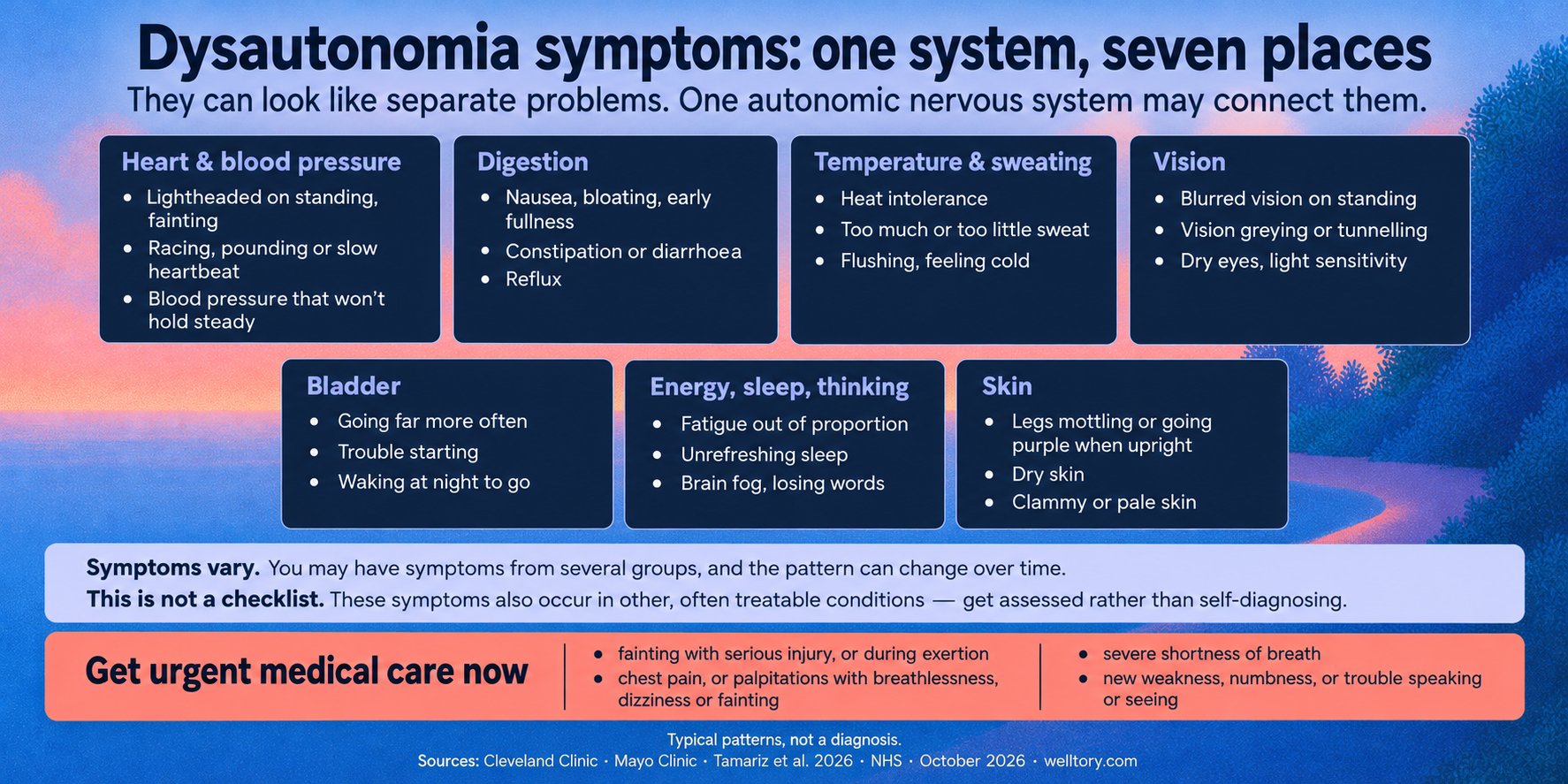
Heart rate and blood pressure. Lightheadedness, especially on standing. Fainting or near-fainting. A racing, pounding or forceful heartbeat. A resting heart rate that is unusually high or unusually low. Blood pressure that swings, drops on standing, or is unstable through the day. Chest discomfort. Exercise intolerance — a level of effort that used to be ordinary now costing far more than it should.
Digestion. Nausea. Bloating. Feeling full after a few bites. Constipation, diarrhoea, or alternating between them. Reflux. In its more severe form, delayed stomach emptying — gastroparesis — which Dysautonomia International lists among the recognised consequences of autonomic dysfunction.
Temperature and sweating. Heat intolerance. Sweating too much, too little, or in the wrong places — a drenched back with dry hands, for instance. Feeling cold when nobody else is. Flushing.
Vision and eyes. Blurred vision, particularly on standing. Vision that greys, dims or tunnels when you get up. Dry eyes. Light sensitivity.
Bladder. Needing to go far more often than seems reasonable. Difficulty starting. Incomplete emptying. Waking at night to urinate.
Energy, sleep and thinking. Fatigue that is out of proportion to what you did. Unrefreshing sleep. Difficulty falling or staying asleep. Brain fog — losing words, losing the thread, finding it hard to hold several things in mind at once.
Skin. Skin that mottles or goes blue-purple on the legs and feet when you stand for a while — blood pooling, which is visible and worth photographing if it happens to you. Dry skin, or the opposite. Changes in how your skin responds to pressure.
Two things are worth saying about this list. The first is that nobody has all of it. People usually have a cluster — some combination from three or four of these groups, stable over years, worse on some days than others. The second is that having several of these does not mean you have dysautonomia. Every item on this list appears in other conditions too, several of them common and treatable. That is a reason to get assessed, not a reason to decide.
Why do dysautonomia symptoms look so unrelated?
Because the thing they have in common is not an organ. It is a controller.
Your autonomic nervous system runs the functions you never think about: how fast your heart beats, how tight your blood vessels are, when your stomach empties, when you sweat, when your bladder signals. It does this continuously, adjusting second by second to posture, temperature, food, illness and stress. You notice none of it when it works.
When that regulation becomes unreliable, the failures appear wherever the system has a job. So the heart gets erratic, digestion slows, temperature control wanders, and the bladder misbehaves — all at once, and seemingly at random. To a person living it, this reads as a body falling apart in several directions. To a clinician looking at one complaint at a time, each piece looks minor and unrelated, which is how someone ends up with a reflux prescription, a referral for palpitations, and an unexplained-fatigue note in separate parts of the same file.
This is the single most useful idea in this article, and it is the one that changes appointments. The symptoms are not a list of separate problems. They are one system's output, and the pattern — not any individual symptom — is the thing worth presenting.
Which dysautonomia symptoms show up when you stand up?
A large share of them, and this is the most recognisable feature of the whole picture.
Standing is the hardest thing your autonomic nervous system does all day. Gravity pulls roughly half a litre of blood downward into your legs and abdomen the moment you get up, and your body has seconds to compensate — tightening blood vessels, nudging heart rate up — so that pressure at head level holds. When that compensation is unreliable, the consequences appear immediately: lightheadedness, visual greying, a heart that races to make up the difference, weakness, and in some people an ache across the neck and shoulders that builds the longer you stay upright (coat hanger pain).
The useful detail is that these symptoms are posture-dependent and reversible. They build when you are upright and ease when you lie down. That pattern is unusual — most causes of fatigue and dizziness do not behave that tidily — which is why clinicians pay attention to it, and why a structured stand test at home is often the most informative thing a person can bring to a first appointment. Do not do one alone if you have ever fainted.
Dysautonomia symptoms in women
Two separate facts get collapsed here, and separating them is useful.
The first is that the best-known form of dysautonomia, POTS, does affect women disproportionately, and typically younger women. Dysautonomia International describes POTS as primarily affecting young women and cites Mayo Clinic's estimate that roughly one teenager in a hundred develops POTS before adulthood. In the post-COVID research the female skew is just as visible: a cross-sectional study of 320 post-COVID clinic patients found 73% were women.
The second is that this does not describe dysautonomia as a whole. Cleveland Clinic puts the average age of onset for autonomic dysfunction between 50 and 60, which is nowhere near the picture most people form from the internet. The explanation is simple: POTS dominates online discussion because its patients are younger, more online, and more organised, while the larger share of autonomic dysfunction sits with older people and with diabetes.
Why this matters practically: if you are a woman in your fifties with unexplained dizziness, digestive trouble and heat intolerance, the fact that you do not resemble the twenty-four-year-old in the forum does not make your symptoms less likely to be autonomic. And symptoms that shift across the menstrual cycle or through perimenopause are a recognised pattern worth recording rather than discounting — see how your body changes across the menstrual cycle.
What does a dysautonomia flare feel like?
A flare is a stretch — hours to days — when the usual symptoms get markedly worse together, often without an obvious cause.
What people describe: a day when standing is suddenly much harder, the heart is less settled, the fog is thicker, the stomach is worse, and the margin for anything at all is smaller. Recognisable triggers are the ones that move blood volume or add load — heat, illness, dehydration, a large meal, a poor night's sleep, menstruation, a stressful week, or simply doing more than usual the day before.
Two things worth knowing. First, a flare's trigger is often a day or more back, which makes it hard to spot in the moment and easy to spot in a record. Second, the recovery tail can be longer than the flare — a pattern we published earlier from our own data in adrenaline dumps in POTS, where after a day the body spent above its own baseline, the following day was still elevated 88% of the time against 16% after a calm day.
Can an infection cause dysautonomia symptoms?
This is one of the better-evidenced parts of the picture, and it has changed a great deal since 2020.
A 2026 cross-sectional study of 100 long COVID patients found abnormal COMPASS-31 scores — the standard self-reported measure of autonomic symptom burden — in 82% of them (95% CI 72–89), abnormal heart rate variability in 60% (48–70), orthostatic hypotension in 12% and POTS in 10%. The authors concluded that dysautonomia is common in long COVID and may account for much of its symptom burden. The earlier post-COVID clinic study of 320 patients found a median COMPASS-31 score of 26.29.
Infection is not the only route — autonomic dysfunction also follows diabetes, Parkinson's disease, autoimmune conditions, vitamin B12 deficiency and others, and Cleveland Clinic lists long COVID alongside these as a recognised secondary cause. But if your symptoms started after a viral illness and never fully resolved, that sequence is now a well-described one, and saying it out loud at an appointment is more useful than it was five years ago.
Dysautonomia or POTS — what is the difference?
Dysautonomia is the category. POTS is one condition inside it.
POTS — postural orthostatic tachycardia syndrome — has specific criteria: a sustained heart rate rise of at least 30 beats per minute within ten minutes of standing (40 for ages 12–19), without a drop in blood pressure, with symptoms of orthostatic intolerance that ease on lying down, present for at least three months. Dysautonomia has no such criteria, because it is not a single diagnosis — it is a description of what the autonomic nervous system is doing.
So "do I have dysautonomia or POTS?" is usually the wrong shape of question: if you have POTS, you have a form of dysautonomia. The definitions, the named conditions and how they relate to each other are laid out in our piece on what dysautonomia is; the testing side is in how POTS is diagnosed.
One number worth correcting while we are here, because it circulates constantly. The widely repeated "70 million people worldwide" figure comes from Cleveland Clinic's page on dysautonomia. Dysautonomia International separately estimates that diabetic autonomic neuropathy alone affects approximately 69 million people worldwide, and multiple system atrophy about 350,000. Putting those two sources side by side is our comparison, not theirs — but it makes the point that the headline number is overwhelmingly a diabetes complication statistic. It is true, and it is routinely used to imply something it does not say.
Is it dysautonomia or something else?
Almost everything on the symptom list has common, treatable explanations that need excluding first. Cleveland Clinic describes diagnosis as "partly a process of elimination," and that is not a formality.
The conditions that produce overlapping pictures include thyroid disease, anaemia and iron deficiency, diabetes, heart rhythm disorders, inner-ear disorders, sleep apnoea, medication side effects — blood pressure drugs and antidepressants in particular — dehydration, and anxiety or panic disorder. Several of these are found with a blood test and fixed within weeks, which is the main argument for going through the boring part before pursuing a complicated answer.
What points toward an autonomic explanation rather than away from it: symptoms that are clearly tied to posture and ease on lying down; symptoms spanning several body systems at once rather than one; a pattern that has been stable for months rather than arriving suddenly; and ordinary investigations that have come back normal more than once.
What points away: a sudden onset over days, symptoms strictly on one side of the body, fever, unintended weight loss, or anything neurological that is new. Those need a different and faster assessment.
How to check the pattern at home
You cannot diagnose anything at home. What you can do is replace a list of complaints with a record, because a record is what makes an appointment productive.
Pick your three worst symptoms rather than tracking all of them. Trying to log twenty things is how a diary gets abandoned in a week.
Note what each one tracks with. Posture is the one to watch most carefully: does it come on when you are upright and ease when you lie down, and roughly how long does the easing take? Then heat, meals, time of day, sleep, and where you are in your cycle.
Record your resting heart rate the same way each morning, before getting up, so the numbers are comparable to each other rather than to a population range.
If standing is the trigger, do a structured stand test with someone present, and write down the numbers rather than the impression. The numbers are there for a clinician to interpret, not for you to score yourself against.
Give it two to four weeks. One dramatic day proves nothing; a pattern across a month is evidence.
When should you see a doctor?
Book an appointment if you have symptoms from several of the groups above that have persisted for months, especially if they are worse when you are upright and better when you lie down, and most especially if separate investigations have come back normal and nobody has looked at them together.
Seek care the same day for fainting without warning, fainting during exertion, a heartbeat that feels genuinely irregular, or chest pain.
Seek emergency care for fainting that causes injury, chest pain with breathlessness or sweating, severe shortness of breath, confusion, or new weakness, numbness, trouble speaking or trouble seeing.
And a practical note: if you are getting nowhere, the specialty matters. Autonomic disorders sit between cardiology and neurology, and many clinicians see them rarely — Cleveland Clinic says so directly. Asking for a referral to an autonomic specialist or a specialist clinic is a reasonable request, not an unreasonable one.
How to bring this up with your doctor — and what to ask for
Lead with the pattern, not the list. "I have symptoms in my heart, my digestion and my temperature control, they all got worse together after an infection two years ago, and they are worse when I am upright" is a different opening from naming six symptoms in a row.
Bring the record. Two to four weeks of three symptoms, with posture, heat, meals and sleep noted next to them. If you did a stand test, bring the numbers.
Say what has already been excluded. Normal thyroid results, normal bloods, a normal ECG — these are progress, not dead ends, and repeating them wastes an appointment.
Ask about orthostatic vital signs — blood pressure and heart rate lying and then standing at one, three and ten minutes. It is a simple office procedure and it is the obvious first step.
Ask what else should be ruled out, and whether a referral to an autonomic specialist is appropriate given what has already been tested.
Bring one photograph if your legs mottle or go purple on standing. It is one of the few parts of this that is visible, and it often does not happen in the clinic.
Living with dysautonomia: the questions people ask next
Can I keep working with this?
Many people do, and what helps is naming the specific limit rather than the diagnosis. If upright time is the problem, the useful requests are about upright time: a chair for tasks usually done standing, permission to sit in long meetings, a schedule that does not stack the hardest work into the worst hours. Fatigue that follows a day's exertion rather than arriving during it is also worth explaining explicitly, because it is invisible to colleagues.
Should I exercise, and will it make things worse?
Exercise is commonly included in conservative management for orthostatic intolerance, and recumbent or seated forms — a recumbent bike, rowing, swimming — let you build fitness without spending the session upright. The caution is real though: if your symptoms include a crash that arrives a day or two after exertion rather than during it, the usual advice to push through does not apply, and pacing is the better frame. Which of those two situations you are in is worth settling with a clinician before building a programme.
Why is summer so much worse?
Heat opens the blood vessels in your skin to shed warmth, which pools blood at the surface and leaves less returning to your heart — the same mechanism that makes standing hard, amplified. Hot showers, hot weather and hot rooms all belong in this group, and a hot shower taken standing combines two triggers at once.
Do symptoms change across my cycle?
Many people report that orthostatic symptoms are harder in the days before and during a period, and shifting fluid and blood volume across the cycle is the plausible reason. Research in POTS has reported lightheadedness varying across the cycle and peaking during menstruation; we cover that evidence in our piece on adrenaline dumps rather than restating it here. If you suspect a pattern, mark it on a calendar for two cycles rather than relying on memory.
Which specialist should I see?
Start with a GP or primary care physician, because the first job is orthostatic vital signs and excluding the common causes. Where it goes next depends on what that shows — cardiology, neurology, or a dedicated autonomic clinic. Gastroenterology may be involved if digestive symptoms dominate, but ideally alongside, not instead of, someone looking at the whole picture.
Is this permanent?
It depends entirely on the form and the cause, which is the argument for finding out rather than managing blind. Secondary autonomic dysfunction often follows its cause — treat the diabetes, the B12 deficiency, the thyroid problem, and the autonomic symptoms may follow. Post-viral forms improve for many people over months to years, though not for everyone. Progressive forms are a different situation. A general answer would be dishonest; the specific one requires a diagnosis.
How do I explain this to people who can't see anything wrong?
Pick the concrete over the medical. "If I stand for more than ten minutes my heart rate goes to 130 and I have to sit down" lands better than "I have autonomic dysfunction." The posture link is the easiest part for other people to understand, because they can watch it happen.


Start understanding your body
Learn what affects your energy, stress, sleep, and daily state. Get the app.
How Welltory helps — and what it cannot do
Welltory does not diagnose dysautonomia and cannot tell you whether you have it. It does not know your posture, cannot run an orthostatic test, and does not measure blood pressure. No app does these things, and a symptom checker that implies otherwise is doing you a disservice.
What the app provides is the boring, consistent context that makes a pattern visible. Resting heart rate and heart rate variability measured the same way each morning, against your own baseline rather than a population range, show when a stretch of days sits outside your usual range — after a bad night, during an illness, in a hot week. For a condition whose main diagnostic obstacle is that nobody has looked at the symptoms together, having the surrounding weeks recorded is worth more than it sounds.
It also gives the diary a shape. When the app detects a stress or recovery episode during the day, it asks what was happening, and your answer is stored as a tag; My Patterns collects those tags and shows which situations recur around your stress episodes and which recur around recovery. Tagging your worst days puts them in the same record as the measurements already being taken — which is the form a diary needs to be in to be useful at an appointment. Two limits: My Patterns is on iOS, and tags only count when attached to a detected episode, which needs heart-rate data through the day rather than one morning measurement.
What it will not do is replace orthostatic vital signs, a tilt table test, or a clinician who knows this territory.
How we made it
The symptom groupings draw on Cleveland Clinic's dysautonomia summary and Dysautonomia International's patient-facing material; the grouping by body system is ours, since both sources present flat lists. Prevalence figures are reported as the sources state them, including the breakdown showing that the widely quoted worldwide total is dominated by diabetic autonomic neuropathy. The post-viral section uses Tamariz and colleagues (2026), a cross-sectional study of 100 long COVID patients with COMPASS-31, heart rate variability, NASA Lean Test and cardiopulmonary exercise testing, and Eldokla and colleagues (2022), a 320-patient post-COVID clinic study, whose median score we report from the published record without interpreting it against a reference range. POTS criteria follow the Heart Rhythm Society expert consensus statement. The infographic's groupings and its caution that these symptoms occur in other conditions are additionally supported by Mayo Clinic's autonomic neuropathy page, for the heart, digestive, bladder, sweating and vision groups, and by the NHS PoTS page, for the purple-looking legs, the heat trigger, the fatigue, sleep and brain fog cluster, and its own statement that having these symptoms does not mean you definitely have the condition. Both were opened and checked in October 2026. The urgent-care list is standard clinical triage rather than a quotation from any one of these sources.


Discounts for blog readers: up to 36% off
See what affects your energy, stress, sleep, and daily state with Welltory
This article is for educational purposes only and is not a substitute for medical advice, diagnosis, or treatment from a qualified clinician.
Was this helpful?
Ask AI for a summary of page


Written by Jane Smorodnikova

The founder and CEO of Welltory. A recognized tech leader with two Master's degrees and experience at MIT, she has scaled Welltory to over 17 million users.
Written by Tatsiana Yashyna

Deputy COO at Welltory. With a background in medicine and years of working with health data, she translates research and real physiological signals — sleep, stress, heart rate, and hormones — into clear, evidence-based explanations that help people understand what their bodies are telling them.
References
- Cleveland Clinic. Dysautonomia: malfunctions in your body's automatic functions. https://my.clevelandclinic.org/health/diseases/6004-dysautonomia
- Dysautonomia International. What is dysautonomia? http://www.dysautonomiainternational.org/page.php?ID=34
- Tamariz L, Rozenfeld I, Iglesias R, et al. Dysautonomia in long COVID is prevalent and could explain the frequency of symptoms. Clinical Medicine & Research 2026;24(1):28-34. https://doi.org/10.3121/cmr.2025.2054
- Eldokla AM, Mohamed-Hussein AA, Fouad AM, et al. Prevalence and patterns of symptoms of dysautonomia in patients with long-COVID syndrome: a cross-sectional study. Annals of Clinical and Translational Neurology 2022;9(6):778-785. https://doi.org/10.1002/acn3.51557
- Sheldon RS, Grubb BP, Olshansky B, et al. 2015 Heart Rhythm Society expert consensus statement on the diagnosis and treatment of postural tachycardia syndrome, inappropriate sinus tachycardia, and vasovagal syncope. Heart Rhythm 2015;12(6):e41-e63. https://doi.org/10.1016/j.hrthm.2015.03.029
- Mayo Clinic. Autonomic neuropathy: symptoms and causes. https://www.mayoclinic.org/diseases-conditions/autonomic-neuropathy/symptoms-causes/syc-20369829
- NHS. Postural tachycardia syndrome (PoTS). Reviewed July 2026. https://www.nhs.uk/conditions/postural-tachycardia-syndrome/