

Short answer
Coat hanger pain is an aching, dragging pain across the back of the neck and the tops of the shoulders — the area a coat hanger would cover if you wore one under your skin. It is not a formal diagnosis. It is a descriptive name, and in the autonomic literature it describes a specific pattern: the pain appears when you are upright and eases when you lie down.
The leading explanation is that these muscles are starved of blood while you are standing. The neck and shoulder muscles that hold your head up sit above the level of your heart, they are working the whole time you are vertical, and they are supplied by vessels that need adequate pressure to push blood uphill. When blood pressure falls on standing, perfusion of those particular muscles falls with it, and muscle that is working without enough blood supply hurts.
That explanation is not a guess. In 2011, a team led by Andrea Humm recorded electrical properties of the trapezius muscle itself in eight people with multiple system atrophy, orthostatic hypotension and a history of coat hanger pain, alongside eight healthy controls. Lying down, the two groups were indistinguishable. During ten minutes of head-up tilt, the patients' muscle membranes depolarised progressively — early supernormality fell by 44% and the relative refractory period rose by 17% — while the controls' measurements did not budge. The authors concluded that the muscle was becoming ischaemic as perfusion pressure dropped, and that coat hanger ache is most likely the consequence.
You are not imagining it, and you are not uniquely bad at sitting up straight. This pain is common enough to have its own nickname in the autonomic world, it has been described in the medical literature since at least 1998, and in the groups that have been studied it is the rule rather than the exception — 25 of 27 people with pure autonomic failure in one survey, three quarters of people with orthostatic hypotension after spinal cord injury in another. If you have been told your shoulders hurt because you are tense, or stressed, or slouching, and none of the fixes for those things have worked, there may be a reason the fixes did not work.
The practical consequence for you is simple, and it is the thing most people have never been told. If this is coat hanger pain, the pain is tied to how long you have been upright, not to how you sit, how you sleep, or how tense you are. That is a pattern you can watch for over a few days without any equipment at all.
What does coat hanger pain feel like, and where exactly?
The distribution is the giveaway. Coat hanger pain sits across the back of the neck, the base of the skull, and outward along the upper trapezius toward the tips of the shoulders. Drawn on a body from behind, it traces the outline of a coat hanger, which is where the name comes from. It is usually bilateral — both sides at once — rather than a single sore spot on one side.
People describe it as an ache, a drag, a heaviness, or a feeling that their head is too heavy for their neck to carry. It is rarely sharp or stabbing. It does not usually shoot down an arm. Some people feel it creeping up into the base of the skull as a dull band rather than a headache with a clear edge.
The muscles in that region are worth knowing, because they explain the shape. The superficial one is the upper trapezius, and underneath it sit levator scapulae, splenius capitis, semispinalis capitis and the small suboccipital muscles. These are postural anti-gravity muscles: while you are upright they are never fully off, because something has to hold your head on top of your spine. They draw their blood supply largely from branches of the subclavian and vertebral arteries, and they sit above the heart, which is exactly the combination that makes them vulnerable when perfusion pressure falls.
What separates coat hanger pain from ordinary neck and shoulder tension is not how it feels but when it appears and what makes it stop. Ordinary muscular neck pain tends to track with what you have been doing with your body — a long drive, a bad pillow, hours at a laptop — and it does not care much about whether you are sitting or standing. Coat hanger pain tracks with vertical time. It builds through a long period upright, and it eases when you get horizontal.
Why is standing the trigger, and not my posture?
This is the part that tends to change how people think about their own symptoms, because almost everyone arrives at this pain with a posture explanation already in place.
Here is the mechanism as the literature describes it. Standing moves a large volume of blood downward into the legs and abdomen. Your body normally compensates within seconds: blood vessels tighten, heart rate rises a little, and pressure at head level stays roughly where it needs to be. When that compensation is inadequate — which is what orthostatic hypotension is — pressure at the top of the body falls. The muscles above heart level are the ones that feel it first, because they are furthest from the pump and working continuously against gravity.
Humm's 2011 trapezius recordings are the clearest direct evidence that this is what happens in the muscle. Membrane depolarisation progressing over ten minutes of tilt, absent when supine, absent in controls, is the electrical signature of a muscle running short of blood. A second, less-discussed route may add to it: if reduced perfusion lowers muscle tone and the head drifts into flexion, the richly innervated facet joints and ligaments of the neck get stretched, and they generate pain of their own.
There is also an argument about where exactly the pain is generated — muscle ischaemia, cerebrospinal fluid shifts, nociceptive input from cervical structures, or altered autonomic modulation of pain. We go into that honestly further down, because the uncertainty matters. But all the candidate mechanisms share the same trigger: being upright.
Which is why posture advice so often disappoints here. Correcting your desk height does not change the physics of blood returning from your legs. If your pain is driven by perfusion, a better chair will not touch it, and the repeated failure of ergonomic fixes is itself a clue worth paying attention to.
How long does coat hanger pain take to go away when I lie down?
In Khurana's 2012 case series, lying flat relieved the ache in most patients within 5 to 20 minutes. A small number took up to about two hours.
That window is the single most useful thing in this article, because it gives you something to observe. Ordinary muscular neck pain does not reliably switch off within twenty minutes of lying down. Pain driven by orthostatic physiology often does, because the moment you are horizontal, perfusion pressure at head and neck level is restored and the muscle is no longer working short of blood.
Two cautions on using this as a test. First, lying down also removes the mechanical load of holding your head up, so relief on lying down is suggestive, not conclusive. Second, relief that takes two hours is still consistent with the pattern, so a slow recovery does not rule it out. What you are looking for is not a stopwatch result but a repeated association: upright time builds it, horizontal time clears it, and this happens again and again regardless of what you were doing with your posture.
Does this mean my blood pressure is low?
Maybe — and this is where honest reading of the evidence matters, because the popular version of this topic skips straight past it.
The research linking coat hanger pain to blood pressure is strong, and it comes from populations with orthostatic hypotension, defined as a sustained fall of at least 20 mmHg systolic or 10 mmHg diastolic within three minutes of standing.
Bleasdale-Barr and Mathias surveyed people with autonomic failure in 1998 and found neck pain in the suboccipital and paracervical — coat hanger — distribution in 93% of 27 people with pure autonomic failure and 51% of 35 people with multiple system atrophy, and stated that the pain was related to the degree of orthostatic hypotension. Rest or lying flat relieved it for 95% of the pure autonomic failure group who had it. Cariga and colleagues looked at 28 people with spinal cord injury in 2002: orthostatic hypotension in 57.1% of them and coat hanger neck pain in 53.6% — and among those who had the hypotension, 75% reported the pain, against 25% of those who did not (P < 0.03). Khurana's 2012 series of 22 dysautonomic patients found the ache during daily life in 13 of them, 59%.
So the association is real and it is sizeable. But three things stop it being a simple test for low blood pressure.
The first is that Khurana's own data argue against a straightforward dose-response relationship. All 22 of his patients had abnormal blood pressure responses to tilt, with a mean systolic fall of 54.8 ± 25.0 mmHg. Yet only a handful developed the ache during the tilt itself, and the ones who did had enormous drops — 80 to 90 mmHg for neck discomfort, around 100 mmHg for head discomfort — while the patients who stayed comfortable on the table dropped less than 50 mmHg on average. Khurana concluded that his findings do not support a direct link and that the mechanism is probably multifactorial.
The second is that most of this research was done in people with frank autonomic failure, where blood pressure falls dramatically. Whether the same mechanism explains the same pain in someone whose blood pressure holds steady is not established.
The third is the one worth saying plainly, because nobody else writing about this says it. Most people searching for "coat hanger pain" today are not people with multiple system atrophy. They are people with POTS, or with suspected dysautonomia, where the defining feature is a heart rate rise on standing and blood pressure may not fall at all. The primary literature on coat hanger pain is almost entirely about orthostatic hypotension. We could not find it established as a characteristic POTS symptom in the research — a 2015 symptom survey of 39 POTS patients at an autonomic clinic asked about 37 symptoms and did not include it, although pain in general was reported by 69%, muscle cramping by 69%, joint pain by 62% and leg pain by 56%.
That does not mean people with POTS are imagining it. It means the honest sentence is: the pattern is well documented in orthostatic hypotension, it is widely reported by the POTS community, and the research connecting the two has not been done. Anyone who tells you more than that is going beyond the evidence.
What makes coat hanger pain worse?
The aggravating factors described in the autonomic literature follow directly from the mechanism — each one is a situation where there is less blood available to push uphill.
Mornings. Overnight you lose fluid through the kidneys, so blood volume is at its lowest when you first get up. This is why the ache is often worst in the first hours of the day and eases as you rehydrate.
After meals. Digestion sends blood to the gut — splanchnic vasodilation — which leaves less in circulation for everything else. Large meals and carbohydrate-heavy meals have the biggest effect, and the dip typically arrives twenty minutes to an hour after eating.
Heat. Warm environments open the vessels in your skin to shed heat, which pools blood at the surface and lowers what returns to the heart. Hot showers, hot weather and hot rooms all belong in this group, and a hot shower taken standing combines two triggers at once.
Standing still. Standing without moving is harder on circulation than walking, because the leg muscles that normally act as a pump are idle. Queues, kitchen counters and public transport are where people notice it.
Illness, dehydration and alcohol, all for the same reason: less circulating volume.
If your own pattern lines up with that list, you have a more informative observation than any single measurement could give you.
Is it coat hanger pain or something else?
The pattern below is what the autonomic literature uses to separate this from the much more common causes of neck and shoulder pain. It is a way of describing your own symptoms more precisely, not a way of diagnosing yourself.
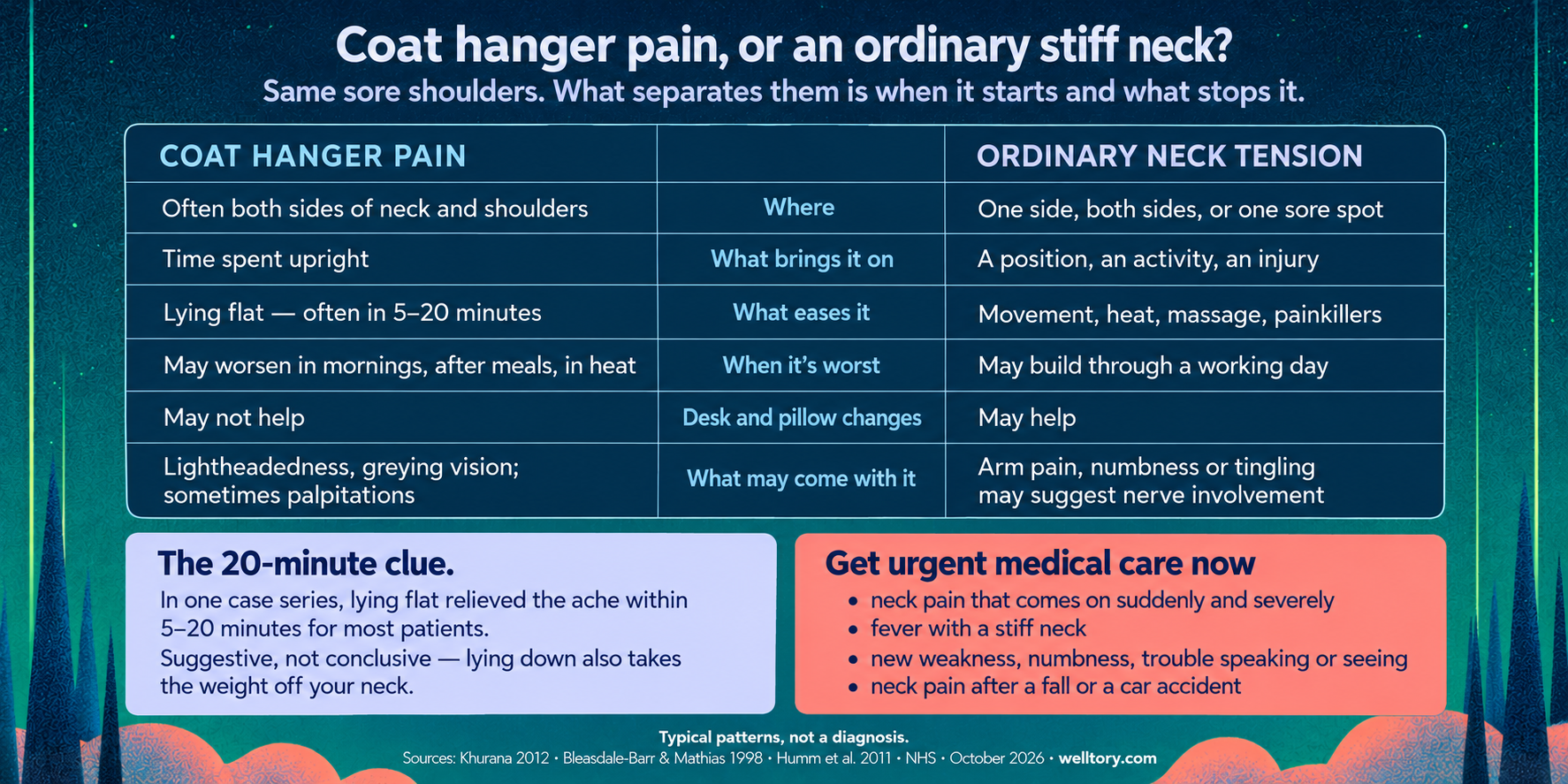
| | Fits coat hanger pain | Points somewhere else |
|---|---|---|
| Where it is | Across the back of the neck and both shoulders, symmetrical | One side only, or a single trigger point |
| What brings it on | Time spent upright — standing or sitting up | A specific activity, position or injury |
| What makes it stop | Lying flat, usually within 5–20 minutes | Movement, stretching, heat, massage, painkillers |
| Time of day | Worst in the morning, after meals, in heat | Worst at the end of a working day |
| Posture fixes | Chair, desk and pillow changes have not helped | Ergonomic changes do help |
| What comes with it | Lightheadedness, visual greying, palpitations, fatigue on standing | Arm pain, numbness, tingling, headache with aura |
Three near neighbours are worth naming. Ordinary muscular neck pain is by far the commonest explanation and should be the first assumption for most people. Fibromyalgia produces widespread pain that does not clear predictably on lying down. Orthostatic headache — head pain that worsens within fifteen minutes of sitting or standing and improves within fifteen minutes of lying down — shares the posture pattern but sits in the head rather than across the shoulders, and has its own list of causes, including low cerebrospinal fluid pressure, that need their own assessment.
How to check the pattern at home in three days
You cannot diagnose anything from home. What you can do is replace "my shoulders always hurt" with a description specific enough for a clinician to act on. Three days of notes is usually enough to see whether the posture story or the upright story fits better.
Each time the pain appears, write down three things: the time, roughly how long you had been upright before it started, and what you had been doing. Nothing more elaborate than a note on your phone.
Each time it eases, write down two: what you changed, and how many minutes passed before it let go. If lying flat is what helps, the number of minutes is the figure a clinician will find most informative.
Add the context that moves blood volume: whether you had eaten in the previous hour, whether the room was hot, whether you had slept badly, and — if you track it — what your morning resting heart rate looked like compared with your usual.
Then look for the shape rather than individual days. Does the pain follow upright time? Does lying down reliably end it, and roughly how fast? Does it cluster after meals, in the morning, or in heat? A pattern that holds across three days is worth more than any one dramatic afternoon.
If orthostatic physiology looks likely from those notes, the natural next step is a structured stand test at home, which records heart rate and blood pressure in a standardised way so a clinician can read it. Do not do one alone if you have ever fainted.
What helps
What helps here aims at the cause rather than at the pain. If the pain is driven by poor perfusion while you are upright, the things that help are the things that keep more blood in circulation and keep it moving — which is why these overlap with standard advice for orthostatic intolerance, and why none of it is a painkiller strategy.
Get horizontal early rather than pushing through. The literature's own observation — relief in 5 to 20 minutes lying flat — is also the most effective thing you can do in the moment. Sitting is not the same as lying; if sitting does not touch it, that is information.
Keep fluid and salt up, within what your clinician agrees. Fluid and salt intake are the first-line conservative measures for orthostatic intolerance, but salt loading is not safe for everyone — it is inappropriate in heart failure, kidney disease and some forms of hypertension — so this is a conversation to have rather than an experiment to run alone.
Ask about compression. Compression garments are used in orthostatic intolerance to limit blood pooling below the heart. Which type and what pressure is a question for the clinician managing you, not a shelf choice.
Move rather than stand still. Shifting weight, rising on your toes, crossing and tensing your legs — counter-manoeuvres that engage the leg muscle pump — buy circulation that standing motionless does not.
Change the shape of meals, not just the content. Smaller and more frequent beats large and carbohydrate-heavy if post-meal is your worst window.
Take heat seriously. Shower sitting down if hot showers set it off. The combination of heat and standing is the hardest one.
Treat the muscles as secondary, not primary. Massage, heat and gentle movement may ease the sore tissue, and there is no reason to avoid them. They simply are not addressing why the muscle is sore, which is why their relief tends to be short-lived if the underlying pattern is orthostatic.
What does the evidence not show?
Several things, and they are worth being clear about.
It does not show that coat hanger pain proves orthostatic hypotension. The association is strong in studied populations, but Khurana's data specifically argue against a simple link between the size of a blood pressure drop and the presence of the ache.
It does not show that this is a POTS symptom. The primary research is about orthostatic hypotension and autonomic failure. The POTS connection is reported by patients and repeated across the internet, but we could not find it established in the research literature, and the symptom surveys we found do not list it.
It does not establish one mechanism. Muscle ischaemia has the most direct supporting evidence, thanks to Humm's trapezius recordings. Cerebrospinal fluid shifts, nociceptive input from cervical structures and altered autonomic pain modulation remain live alternatives, and the honest position is that the pain is probably multifactorial.
The studies are small. Humm's work involved eight patients and eight controls. Khurana's series had 22 patients, mean age 62.4. Bleasdale-Barr and Mathias surveyed people with rare autonomic conditions. None of this is a population study of young people with suspected dysautonomia, which is who is mostly reading about it.
No wearable measures any of this. Not Welltory, not any other app. Devices can record heart rate, and some record blood pressure with their own accuracy limits, but none of them measure muscle perfusion in your trapezius or the pain you feel.
When should you see a doctor?
Book an appointment if neck and shoulder pain keeps returning and clears when you lie down, especially alongside lightheadedness, visual greying on standing, palpitations, or fatigue that is worse when upright. That cluster is worth assessing properly rather than managing with painkillers.
Seek care the same day for neck pain with fever and a stiff neck, or neck pain that came on suddenly and severely — described as the worst you have had, or peaking within a minute.
Seek emergency care for neck or shoulder pain with new weakness, numbness, trouble speaking, trouble seeing or loss of coordination; for pain following a fall, a car accident or any head or neck injury; or for fainting that causes injury.
And treat chest pain as chest pain, not as shoulder pain — if an ache across the shoulders arrives with chest tightness, breathlessness, sweating or nausea, that needs emergency assessment, not a stretching routine.
How to bring this up with your doctor — and what to ask for
What makes this conversation work is bringing the pattern rather than the symptom, because the pattern is what points toward an autonomic cause.
Lead with the posture relationship. "The pain comes on after I have been upright for about an hour and goes away within fifteen minutes of lying down" is a far more useful opening than "my shoulders hurt."
Bring your three days of notes. Times, upright duration, minutes to relief, and the meal, heat and sleep context.
Say what you have already tried. Ergonomic changes, physiotherapy, massage and painkillers that did not help are evidence, not failures.
Mention the other orthostatic symptoms explicitly, even if they seem unrelated: dizziness on standing, vision greying, palpitations, heat intolerance, fatigue that is worse upright.
Ask whether orthostatic blood pressure measurement is worth doing — lying and standing readings at one and three minutes, which is a simple office procedure.
Ask what else should be ruled out, since cervical spine problems, thyroid disease and inflammatory conditions can all produce neck and shoulder pain and are worth excluding.
If you have a diagnosis already, how POTS is diagnosed and what dysautonomia is cover the testing landscape in more detail, and the adrenaline dump article covers another pattern that is commonly dismissed.
Living with coat hanger pain: the questions people ask next
Can I keep working if the pain comes on every afternoon?
Most people do, and what helps is being specific about the trigger rather than the symptom. If upright time is what builds it, the useful requests are the ones that change upright time: a chair for tasks you currently do standing, permission to sit during a long meeting, a short lie-down in the middle of a long day rather than at the end of it. Those are easier to ask for when you can say "after about an hour upright" instead of "my shoulders hurt."
Should I exercise, and will strengthening my neck help?
Strengthening the muscles does not change their blood supply, so neck and shoulder exercises are unlikely to be the answer on their own if the pattern is orthostatic. That said, exercise is part of standard conservative management for orthostatic intolerance, and recumbent or seated forms — a recumbent bike, rowing, swimming — let you build fitness without spending the session upright. Build gradually, and treat a bad flare afterwards as information about pacing rather than as failure.
Is it worse in hot weather, and what do I do about summer?
Heat opens the vessels in your skin, which pools blood at the surface and leaves less returning to your heart, so yes — heat belongs on the list of things that make this worse. The practical versions are sitting down to shower, keeping the bedroom cool, planning errands for the cooler part of the day, and treating a hot day the way you would treat a day after a bad night: as one where you have less margin than usual.
Does it get worse around my period?
Many people report that orthostatic symptoms in general are harder in the days before and during a period, and the plausible reason is fluid and blood volume shifting across the cycle. There is no research we could find on coat hanger pain specifically across the menstrual cycle. If you suspect a pattern, the way to find out is to note the days rather than to assume — a cycle or two of marks on a calendar settles it better than any article can. Our piece on how your body changes across the menstrual cycle covers what does shift and what does not.
Which doctor should I see about this?
Start with a GP or primary care physician, because the first job is to measure lying and standing blood pressure and to rule out the commoner causes of neck pain. Where it goes next depends on what that shows: cardiology or a specialist autonomic service for orthostatic intolerance, neurology if the picture includes headache or neurological symptoms. Going straight to a physiotherapist or a massage therapist is a reasonable thing to have tried, but it is not the right place to end up if lying down is what reliably helps.
Could this be something serious that I am dismissing?
Neck and shoulder pain has serious causes, and the ones to take seriously are listed above: sudden severe onset, fever with a stiff neck, new neurological symptoms, pain after an injury, or pain that arrives with chest tightness and breathlessness. Pain that has been there for months, is symmetrical, and reliably clears when you lie flat is not the shape of an emergency — but it is the shape of something worth investigating properly rather than living with indefinitely.
Will I have this forever?
That depends entirely on what is driving it, which is the argument for finding out rather than managing it blind. Where an underlying cause of orthostatic intolerance is found and treated, the pain often follows the cause. Where no cause is found, the conservative measures above are the lever people have, and most find the pattern becomes more predictable once they know what it tracks with — which is itself a change worth having.


Start understanding your body
Learn what affects your energy, stress, sleep, and daily state. Get the app.
How Welltory helps — and what it cannot do
Welltory does not measure pain, does not know your posture, and cannot tell you whether you have orthostatic hypotension. No app can. We say that plainly because the gap between what a phone can measure and what this question needs is wide, and pretending otherwise would not help you.
What the app does provide is the ordinary context around the days you are trying to describe. Resting heart rate and heart rate variability measured the same way each morning, against your own baseline rather than a population range, make it visible when a stretch of days is harder than usual — after a bad night, during an illness, in a hot week. If your worst pain days line up with the days your body was already running above its normal, that is a connection worth showing a clinician, and it is one that is hard to reconstruct from memory.
It also gives you a place to keep the notes. When the app detects a stress or recovery episode during the day, it asks what was happening, and your answer is stored as a tag; My Patterns collects those tags and shows which situations come up most often around your stress episodes and which ones come up around recovery. Where the app asks on a day the pain was bad, your answer is stored alongside that day's measurements, which is the form a diary needs to be in to be useful at an appointment — dated days beat describing the pain from memory. Two limits worth knowing: My Patterns is on iOS, and tags only count when they are attached to a detected episode, which needs heart-rate data collected through the day rather than a single morning measurement.
What it will not do is diagnose anything, replace an orthostatic blood pressure measurement, or tell you why your shoulders hurt.
How we made it
The clinical content rests on the autonomic literature, with each figure checked against the paper it comes from rather than a secondary summary: Bleasdale-Barr and Mathias (1998) on neck pain in 27 people with pure autonomic failure and 35 with multiple system atrophy, Cariga and colleagues (2002) on prevalence in 28 people with spinal cord injury, Humm and colleagues (2011) on muscle velocity recovery cycles in the trapezius during head-up tilt, and Khurana (2012) on coat-hanger ache in orthostatic hypotension, including the duration-of-relief figures and the argument against a simple blood-pressure link. The absence of coat hanger pain from POTS symptom lists was checked against Deb and colleagues (2015), a 37-item symptom survey of 39 POTS patients at an autonomic clinic.


Discounts for blog readers: up to 36% off
See what affects your energy, stress, sleep, and daily state with Welltory
This article is for educational purposes only and is not a substitute for medical advice, diagnosis, or treatment from a qualified clinician.
Was this helpful?
Ask AI for a summary of page


Written by Jane Smorodnikova

The founder and CEO of Welltory. A recognized tech leader with two Master's degrees and experience at MIT, she has scaled Welltory to over 17 million users.
Written by Tatsiana Yashyna

Deputy COO at Welltory. With a background in medicine and years of working with health data, she translates research and real physiological signals — sleep, stress, heart rate, and hormones — into clear, evidence-based explanations that help people understand what their bodies are telling them.
References
- Bleasdale-Barr KM, Mathias CJ. Neck and other muscle pains in autonomic failure: their association with orthostatic hypotension. Journal of the Royal Society of Medicine 1998;91(7):355-359. https://doi.org/10.1177/014107689809100704
- Cariga P, Ahmed S, Mathias CJ, Gardner BP. The prevalence and association of neck (coat-hanger) pain and orthostatic (postural) hypotension in human spinal cord injury. Spinal Cord 2002;40(2):77-82. https://doi.org/10.1038/sj.sc.3101259
- Humm AM, Bostock H, Troller R, Z'Graggen WJ. Muscle ischaemia in patients with orthostatic hypotension assessed by velocity recovery cycles. Journal of Neurology, Neurosurgery & Psychiatry 2011;82(12):1394-1398. https://doi.org/10.1136/jnnp.2010.237982
- Khurana RK. Coat-hanger ache in orthostatic hypotension. Cephalalgia 2012;32(10):731-737. https://doi.org/10.1177/0333102412449932
- Deb A, Morgenshtern K, Culbertson CJ, Wang LB, Hohler AD. A survey-based analysis of symptoms in patients with postural orthostatic tachycardia syndrome. Proceedings (Baylor University Medical Center) 2015;28(2):157-159. https://doi.org/10.1080/08998280.2015.11929217
- Lei LY, Chew DS, Raj SR. Differential diagnosis of orthostatic hypotension. Autonomic Neuroscience 2020;228:102713. https://doi.org/10.1016/j.autneu.2020.102713

