
Can stress cause migraines? What the research shows, and how to track your own stress-migraine pattern
Stress is the trigger people with migraine name most often, but it does not create migraine — and the attack often comes after the stress, not during it. What the research shows, how to tell a stress migraine from a tension headache, and how to track your own pattern.
Short answer
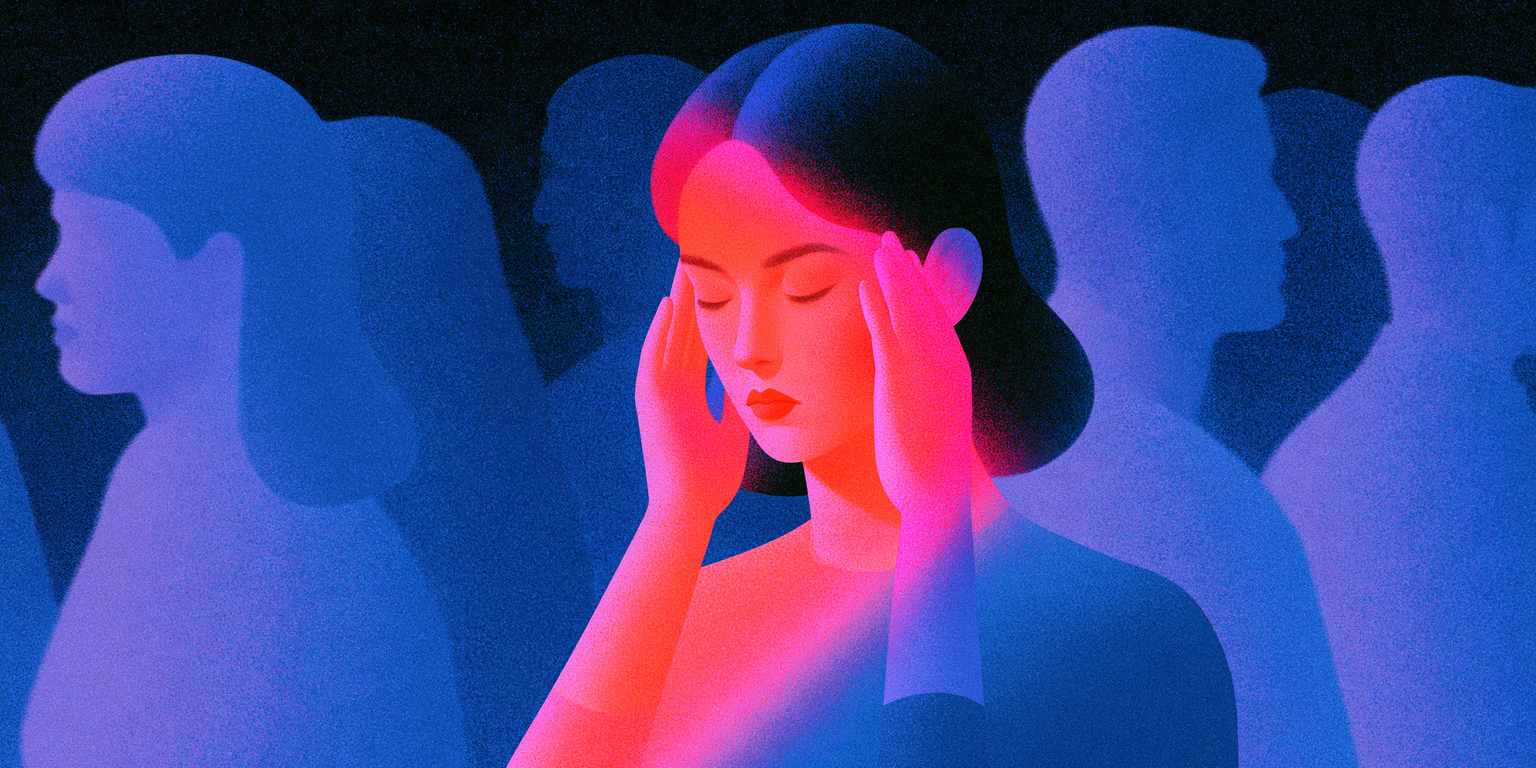
Stress is the migraine trigger people name most often, but stress alone does not cause migraine: migraine is a neurological condition, and stress is one of several things that can tip a susceptible brain into an attack. In a clinic study of 1,207 people, stress was the most commonly reported trigger, named by 79.7% of those who reported any trigger (Kelman 2007). The timing is often not what people expect: in a three-month diary study, the odds of an attack over the next 6 to 18 hours were 1.5 to 1.9 times higher after stress fell from one evening to the next (Lipton 2014). Welltory's Migraine Tracker on iPhone records each attack — when it started and ended, how severe it was, where it hurt, your symptoms and medications — and shows it next to your own stress, sleep and activity.
If your migraines seem to arrive at the worst possible moments — the deadline week, or the first day of a holiday — you are not imagining it, and it is not a failure to "manage stress". The pattern is real in the research, and it is not your fault.
The useful question is not "does stress cause my migraines?" but "which part of stress — the build-up, the peak or the come-down — lines up with my attacks?" That is something you can track.
Note: this article is for general education and is not medical advice. Migraine is diagnosed and treated by a clinician. A sudden, severe or new kind of headache needs urgent care.


Start understanding your body
Learn what affects your energy, stress, sleep, and daily state. Get the app.
Does stress cause migraines, or just trigger them?
A 2021 review in The Journal of Headache and Pain by Anker Stubberud and colleagues screened 2,223 records published between 1988 and August 2021 and split the question in two, because the answer differs (Stubberud 2021):
Can stress cause someone to develop migraine? The evidence does not show that. Migraine has a strong genetic and neurological basis.
Can stress make attacks more likely in someone who has migraine? Yes — stress is consistently linked with attacks, and major stressful life events can precede the move from episodic to chronic migraine. The main risk factors for that move, though, are frequent headache days, depression and overuse of acute medicines, and many of those are treatable.
So a fair short version is: stress does not create migraine, but it can trigger attacks and make them more frequent.
Two caveats keep this honest. People with migraine often live with high stress partly because of migraine, so cause and effect run both ways. And some of what feels like a stress trigger may be the attack already starting: in the hours before the pain, the brain's early phase can bring irritability, fatigue and trouble concentrating, which feel like stress (Karsan 2021). See your migraine trigger might be the migraine already starting.


Discounts for blog readers: up to 36% off
See what affects your energy, stress, sleep, and daily state with Welltory
Why the come-down matters: the let-down effect
The best-known test of stress timing is a 2014 study in Neurology led by Richard Lipton at the Montefiore Headache Center. People with migraine kept a daily electronic diary, including evening stress ratings, for about three months. When stress fell from one evening to the next, the odds of a migraine over the following 6, 12 and 18 hours were 1.5 to 1.9 times higher (Lipton 2014).
That is why some people get attacks on the first day of a holiday or at the weekend. It is not the whole story: in the larger PAMINA diary study of 327 people, days off were associated with a lower hazard of attacks overall, while tiredness, tension and the two days before menstruation raised it (Wöber 2007). Both patterns exist; which one is yours is exactly what a log can show. More in let-down migraine.
Stress migraine symptoms: is it a migraine or a tension headache?
Stress is linked to both migraine and tension-type headache, and they are treated differently, so the label matters.
| | Migraine | Tension-type headache |
|---|---|---|
| Where | Often one side, can switch | Both sides, like a band |
| Feel | Throbbing or pulsing | Pressing or tightening |
| Severity | Moderate to severe | Mild to moderate |
| Moving around | Makes it worse | Usually does not |
| Other symptoms | Nausea, sensitivity to light and sound | Usually none of these |
These features follow the international diagnostic criteria (ICHD-3). For a fuller walk-through see is it a headache or a migraine? and, for the tension-type side, stress headache.
Work out your early warning signs with women who get it
Welltory Migraine Lab is a paid, moderated online community for women 18 to 65 living with migraine. Opens December 1, 2026. Peer support and education, not medical care.
How to track stress as a migraine trigger
Feeling stressed and measuring stress are not the same thing, and memory is the weakest link: after a bad week, everything looks like a trigger. A useful log has three parts, kept the same way every day.
1. The attack, logged when it happens. Start and end time, severity, symptoms, medicine and whether it helped. An entry made at the time keeps its real timestamp; reconstructions do not. In a BMJ study, people with paper diaries actually made their entries on time on only 11% of occasions, while their cards suggested more than 90% (Stone 2002).
2. A daily stress line, including on good days. A simple 0–10 evening rating works, and so does a measured signal such as all-day stress from a wearable. Good days matter as much as bad ones: you cannot tell whether a stressful week came before an attack unless you know what an ordinary week looks like.
3. The direction of change, not just the level. Because of the let-down effect, write down — or look for — the day stress dropped: the deadline passed, the guests left, the exam was over.
Then wait. With episodic migraine, two to three months gives you a handful of attacks, which is the minimum for any pattern. At two weeks, anything you see is noise.
What to look for:
Attacks after high-stress days — the build-up pattern.
Attacks after a drop in stress — the let-down pattern.
Attacks after short or broken sleep in a stressful stretch — sleep is often the link between the two.
Attacks in the two days before your period that happen to coincide with stress — two risks stacking.
Stress, sleep and migraine: why the link often runs through the night
Stressful weeks rarely come alone. They tend to bring later nights, broken sleep, skipped meals and more caffeine — and several of those are migraine triggers in their own right. That is one reason stress is so hard to pin down from memory: it travels with other changes.
Sleep is the clearest example, and the research on it is less obvious than it sounds. Bertisch and colleagues followed 98 adults with episodic migraine for six weeks with twice-daily electronic diaries and wrist actigraphy — 4,406 days and 870 reported headaches. Sleep of 6.5 hours or less was not linked to migraine on the next day or the day after, and poor subjective sleep quality was not linked either. What was linked was low sleep efficiency — time awake in the night — with higher odds of a headache on the second day after (Bertisch 2020).
Two practical points follow. First, when you look back for a stress pattern, look two days back, not just at last night. Second, a stressful week that also fragments your sleep is a different exposure from a stressful week with good nights — and only a log that records both can tell them apart.
Stress, hormones and your cycle
For many women, the timing of the period matters more than any other factor. In the PAMINA diary study of 327 people, menstruation was the strongest factor linked to attacks, raising the hazard by up to 96%, and the two days before a period also added risk (Wöber 2007). A hard week that lands just before your period therefore stacks two known risks at once.
If your attacks cluster around your period, log cycle days alongside stress, and mention it to your doctor: menstrual migraine has its own prevention options. See menstrual migraine and hormonal migraine.
An example: reading two months of logs
Here is an illustration — not real data — of how the three parts of a log fit together.
Over eight weeks, someone logs five attacks. Two land on the Saturday after a deadline week, when the evening stress rating dropped from 8 to 3. One lands two days after a night of broken sleep in a busy week. Two come in the two days before her period, one of them in a calm week.
Read on its own, any single attack looks like "stress". Read together, the log suggests three separate things worth raising with a doctor: a possible let-down pattern after deadlines, a link with fragmented sleep two days earlier, and a menstrual pattern that has nothing to do with stress at all. Each of those leads to a different conversation — about winding down before weekends, about sleep, and about menstrual migraine prevention. None of them is proof of a cause, but all three are more useful than "stress gives me migraines".
Can an app measure stress for migraine?
Wearables estimate stress from heart rate and heart rate variability (HRV) — how much the time between heartbeats varies. Between attacks, people with migraine show, on average, weaker autonomic test responses than people without it (Pavelić 2024). That is a group-level finding: no wearable or app, from any company, has been shown to predict an individual attack from HRV or stress scores. What a measured stress line can do is replace guessing with a record — so you and your doctor can see whether your attacks really do follow your stressful days. See migraine and your nervous system.
What helps when stress sets off your migraines
Behavioural approaches with evidence. A 2025 systematic review of 50 trials with 6,024 adults found that cognitive behavioural therapy, relaxation training and mindfulness-based therapies may each reduce how often attacks happen, though the strength of evidence is low (Treadwell 2025). Relaxation training, CBT and biofeedback have long been recommended for prevention (Stubberud 2021).
A softer landing. If your log shows the let-down pattern, some people wind down over the last day or two of a big project and keep light structure on the first free day. No study has tested tapering directly, so treat it as an experiment.
Protect the basics in stressful weeks. Regular sleep and meal times are the parts of a stressful week you can most control.
Prevention, if attacks are frequent. If your migraine days are climbing during a long stressful period, that is a reason to ask your doctor about preventive treatment — not a sign that chronic migraine is inevitable.
Living with stress and migraine: the questions people ask next
Can anxiety cause migraines?
Anxiety and migraine often occur together, and anxiety can make attacks feel more frequent and harder to cope with. Like stress, anxiety does not create migraine, but it is worth treating in its own right — and treating it can make migraine easier to manage. Ask your doctor about both, not one at a time.
Can stress make my migraines chronic?
Major stressful life events can come before the move from episodic to chronic migraine — 15 or more headache days a month — but the main risk factors are frequent headache days, depression and overuse of acute medicines (Stubberud 2021). Many of those are treatable. If your headache days are creeping up during a long stressful period, that is the moment to ask about prevention.
Does exercise help or trigger stress migraines?
Both are possible. Regular, moderate exercise is often part of a migraine plan, but in Kelman's clinic study 22.1% of people who reported triggers named exercise (Kelman 2007). Warm up gradually, eat beforehand, drink water and avoid sudden bursts of hard effort when you are short on sleep. A new headache that starts with exertion needs a doctor's check before you carry on.
Is it my fault if stress sets off my migraines?
No. Migraine is a neurological condition, and stress is part of every life. The goal is not a stress-free life, which nobody has, but knowing your own pattern well enough to soften the peaks and the come-downs — and having a treatment plan that does not depend on willpower.
How to bring this up with your doctor
Lead with the count. "I had six migraine days last month; four came within a day of a big drop in stress."
Show the pattern, not the feeling. Bring your log with the stress line, and say which parts were measured and which were remembered.
Ask directly. Is this migraine, tension-type headache or both? Given my number of headache days, would preventive treatment help? Would CBT, relaxation training or biofeedback be worth trying, and is there a referral route?
Mention mood and sleep. Anxiety, depression and insomnia are common alongside migraine and are treatable in their own right.
Seek urgent care for a sudden, severe "worst ever" headache, a headache with weakness, confusion, loss of vision, fever and a stiff neck, or after a head injury (Do 2019). Call 911 in an emergency.
How Welltory helps — and what it cannot do
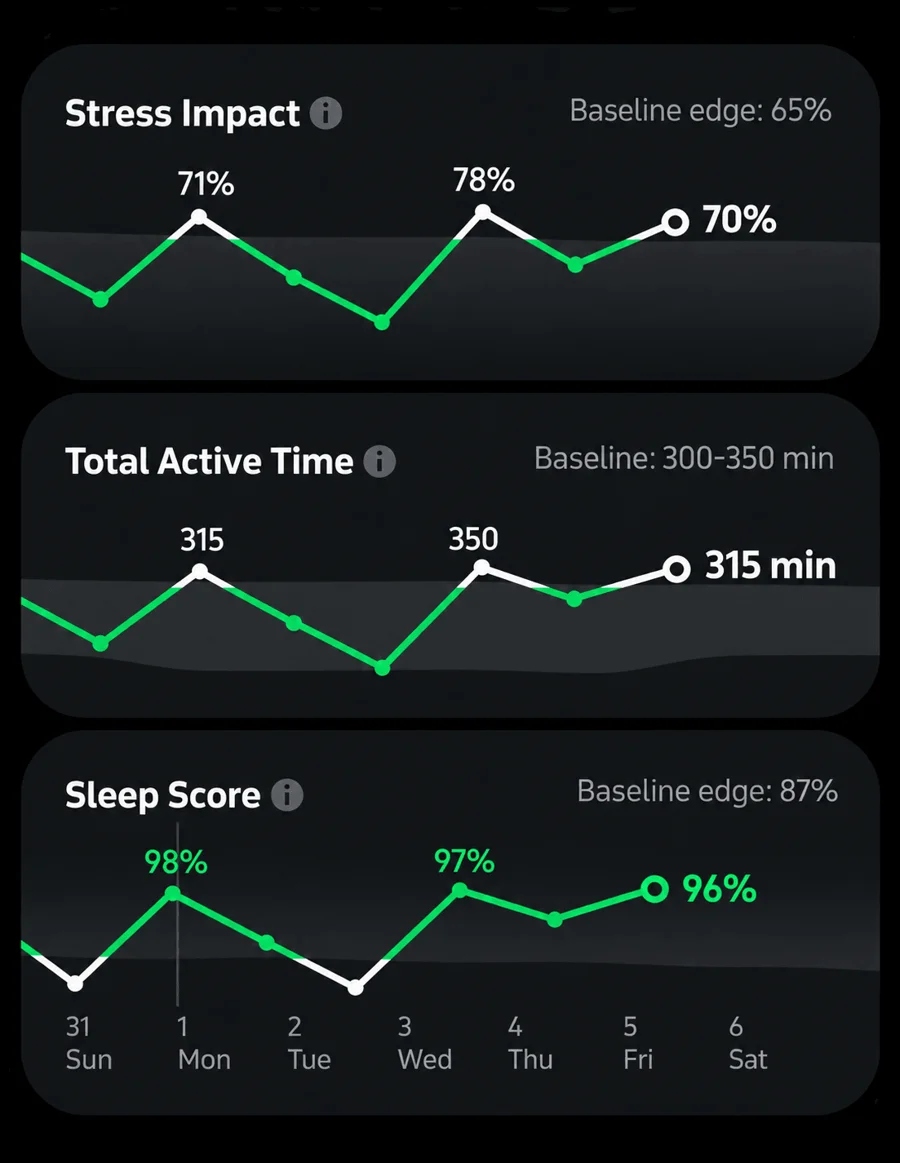
Log each attack in Migraine Tracker. On iPhone, Welltory's Migraine Tracker keeps the attack record itself: the day it began, start and end time, how severe it was, where it hurt, your symptoms, what you took and whether it helped, plus a note. Logging is free. With a subscription, each migraine day is shown against your own 30-day baseline for Stress Impact, Total Active Time and Sleep Score once there are at least 14 reliable days. It is available in English on iPhone and switches on when you tell the app you have migraine. The best experience is with an Apple Watch or Oura ring; Spanish and other languages are coming soon. A marked day is one you logged, not one Welltory detected, and a shifted day is not a prediction or proof of a cause.
See your stress as a line, not a feeling. Stress Impact is the stress accumulated over the day. In Changes from your baseline, a white dot marks a day above your usual range — so over a few months you can check whether your attacks follow high-stress days, or the days after them.
Tag what happened. On iPhone with an Apple Watch or Oura ring, the Today screen flags stress stretches and asks "What happened?" — "deadline", "argument", "first day off". After a few weeks, My Patterns shows which tagged situations tend to come before stressful stretches.
What it is, and what it is not. Welltory is a general wellness product, not a medical device. It does not diagnose, predict, monitor, prevent, treat or mitigate migraine or any other condition. Patterns are associations to discuss with your doctor, not proof of a trigger and not a warning system.
Working this out with other women. Welltory Migraine Lab is a paid, moderated online community for women aged 18 to 65 living with migraine; you do not need a formal diagnosis to join. It opens on December 1, 2026; you can book your place now, and your paid period starts on the opening day. Members get a personal strategy built on their own data, a community of women with similar symptoms, and a medical board that explains what is happening in the body. It is education and peer support, not medical care, and it does not replace your clinician. Join Migraine Lab or read what Migraine Lab is, who it is for and what it costs.
How we made it
Made with AI tools, then edited and fact-checked by the Welltory team. See our Editorial & AI policy.
Jane Smorodnikova, co-founder of Welltory, built the methodology behind how we read physiological data.
Written by Tatsiana Yashyna.
Discounts for blog readers: up to 36% off
See what affects your energy, stress, sleep, and daily state with Welltory
This article is for general education and is not medical advice. Research figures are reported as their sources state them. Welltory is a general wellness product, not a medical device: it does not diagnose, predict, monitor, prevent, treat or mitigate migraine or any other condition. Its Migraine Tracker (iPhone) records what you report and compares days with your own history; it does not detect or predict attacks or identify their cause. A sudden, severe or new kind of headache, or a headache with weakness, confusion, vision loss, fever and a stiff neck, or after a head injury, needs urgent care — call 911 in an emergency.
Was this helpful?
Ask AI for a summary of page


Written by Jane Smorodnikova

The founder and CEO of Welltory. A recognized tech leader with two Master's degrees and experience at MIT, she has scaled Welltory to over 17 million users.
Written by Tatsiana Yashyna

Deputy COO at Welltory. With a background in medicine and years of working with health data, she translates research and real physiological signals — sleep, stress, heart rate, and hormones — into clear, evidence-based explanations that help people understand what their bodies are telling them.
References
- Stubberud A, Buse DC, Kristoffersen ES, Linde M, Tronvik E. Is there a causal relationship between stress and migraine? Current evidence and implications for management. The Journal of Headache and Pain 2021;22:155. https://doi.org/10.1186/s10194-021-01369-6
- Kelman L. The triggers or precipitants of the acute migraine attack. Cephalalgia 2007;27(5):394–402. https://doi.org/10.1111/j.1468-2982.2007.01303.x
- Lipton RB, Buse DC, Hall CB, et al. Reduction in perceived stress as a migraine trigger: testing the "let-down headache" hypothesis. Neurology 2014;82(16):1395–1401. https://doi.org/10.1212/WNL.0000000000000332
- Wöber C, Brannath W, Schmidt K, et al.; PAMINA Study Group. Prospective analysis of factors related to migraine attacks: the PAMINA study. Cephalalgia 2007;27(4):304–314. https://doi.org/10.1111/j.1468-2982.2007.01279.x
- Karsan N, Bose P, Newman J, Goadsby PJ. Are some patient-perceived migraine triggers simply early manifestations of the attack? Journal of Neurology 2021;268(5):1885–1893. https://doi.org/10.1007/s00415-020-10344-1
- Headache Classification Committee of the International Headache Society. The International Classification of Headache Disorders, 3rd edition. Cephalalgia 2018;38(1):1–211. https://doi.org/10.1177/0333102417738202
- Stone AA, Shiffman S, Schwartz JE, Broderick JE, Hufford MR. Patient non-compliance with paper diaries. BMJ 2002;324(7347):1193–1194. https://doi.org/10.1136/bmj.324.7347.1193
- Pavelić AR, Zebenholzer K, Wöber C. Reconceptualizing autonomic function testing in migraine: a systematic review and meta-analysis. The Journal of Headache and Pain 2024;25:54. https://doi.org/10.1186/s10194-024-01758-7
- Treadwell JR, Tsou AY, Rouse B, et al. Behavioral interventions for migraine prevention: a systematic review and meta-analysis. Headache 2025;65(4):668–694. https://doi.org/10.1111/head.14914
- Do TP, Remmers A, Schytz HW, et al. Red and orange flags for secondary headaches in clinical practice: SNNOOP10 list. Neurology 2019;92(3):134–144. https://doi.org/10.1212/WNL.0000000000006697
- Welltory Help Center. Migraine Tracker (iOS). Updated 10 November 2026. https://help.welltory.com/en/articles/17603152-migraine-tracker-ios
- Bertisch SM, Li W, Buettner C, et al. Nightly sleep duration, fragmentation, and quality and daily risk of migraine. Neurology 2020;94(5):e489–e496. https://doi.org/10.1212/WNL.0000000000008740


