

Short answer
A stress headache is tension-type headache — the same thing under a different name. "Stress headache" is listed in the international headache classification as a previously used term for it, alongside "muscle contraction headache" and "psychogenic headache" (1). It typically feels like pressure or tightening on both sides of the head, mild to moderate, not throbbing, and it does not get worse when you walk up stairs (2).
It is also the most common headache there is: tension-type headache is the most prevalent primary headache disorder, with a global prevalence of around 26% (3). The classification itself notes that the infrequent kind "occurs in almost the entire population" (1).
So if you have been quietly wondering whether you are manufacturing this because work is hard — you are not imagining it, and it is not weakness. There is a measurable physical finding behind it: increased tenderness of the muscles around the skull is the most significant abnormal finding in people with any type of tension-type headache, present even between attacks and worse during them (1). The headache is real, it is physical, and it is extremely common.
Note: this article explains what guidelines and research say and is not medical advice; your doctor decides what fits you. Call 911 or go to an emergency department for a headache that comes on like a thunderclap and peaks within a minute, a headache with fever and a stiff neck, with weakness, numbness, confusion, trouble speaking or seeing, or one that follows a head injury.
What does a stress headache feel like?
The international criteria describe it precisely enough to recognise, which is useful because most people only know it as "a normal headache" (2):
Both sides, rather than one
Pressing or tightening, not pulsating — people describe a band, a vice, a weight
Mild to moderate — unpleasant and distracting rather than disabling
Not made worse by routine activity like walking or climbing stairs
No nausea or vomiting, and no more than one of light or sound sensitivity
Lasting anywhere from 30 minutes to seven days
The frequent episodic kind means at least ten such episodes on 1 to 14 days a month, on average, for more than three months (2). Beyond 15 days a month it is classified as chronic tension-type headache, which the classification calls "a serious disease, causing greatly decreased quality of life and high disability" (1) — that version needs a doctor rather than a strategy.
Stress headache vs migraine: how do you tell?
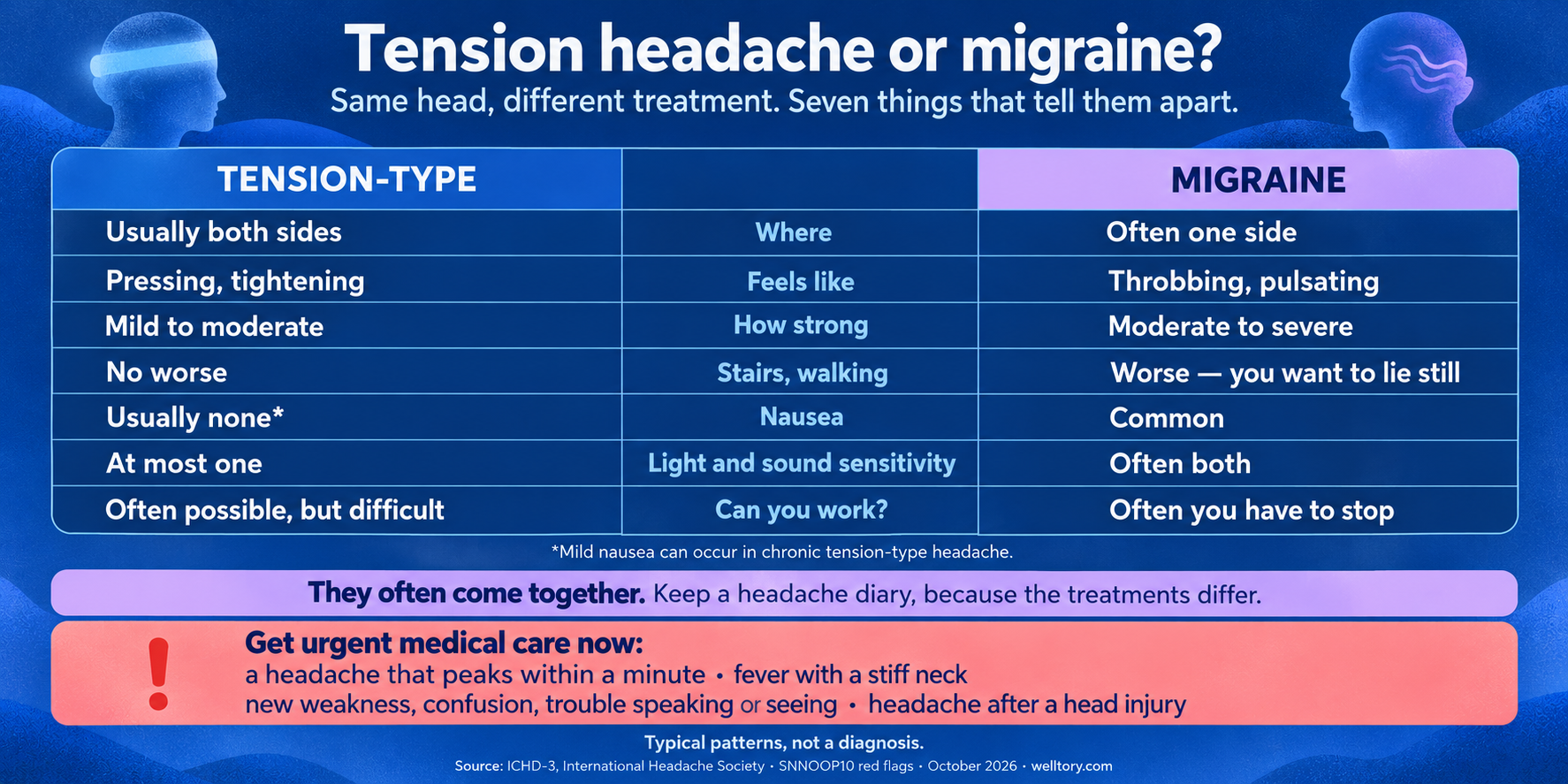
| | Tension-type (stress) headache | Migraine |
|---|---|---|
| Where | Usually both sides | Often one side |
| Quality | Pressing, tightening, band-like | Throbbing, pulsating |
| Intensity | Mild to moderate | Moderate to severe |
| Stairs, walking | No worse | Typically worse; people want to lie still |
| Nausea | None | Common |
| Light and sound | At most one of them | Often both |
| What you can do | Usually keep working, badly | Often need to stop |
The practical catch: these two coexist constantly. The classification states that frequent episodic tension-type headache often occurs alongside migraine without aura, that both need to be identified "preferably through use of a diagnostic headache diary", and that this matters because "the treatments of each differ considerably" (2).
That is the strongest argument for writing headaches down that exists in this article, and it comes from the people who wrote the diagnostic criteria rather than from us.
Why does stress trigger headaches?
Not because you are tensing your shoulders — or not only. The current picture has three layers (3).
The muscles around your head really are more tender. Increased pericranial tenderness is the most consistent physical finding, it is present between headaches, and it rises with their intensity and frequency (1). Myofascial trigger points and mechanical load on the neck and jaw feed into it (3).
Your pain system changes how it processes signals. Peripheral mechanisms dominate in the occasional kind, while central mechanisms — the nervous system turning up the gain on ordinary signals — matter more in the chronic kind (1). Imaging and neurophysiological studies show altered pain processing in people with tension-type headache (3).
Stress acts on that system directly. The locus coeruleus–norepinephrine system, which is the brain's stress-response machinery, is implicated here, and it correlates with how often and how severely tension-type headaches occur (3). Stress, anxiety and depression significantly influence the central mechanisms involved (3).
Which is why the headache so often arrives on the Saturday rather than during the week, and why "just relax" is useless advice: the system that produces it is the same one that has been running hot for days.
Is it my neck, my jaw or my posture?
Often some of each, and it is worth knowing because this is the layer you can act on. Sustained abnormal posture and mechanical load on the muscles around the head and neck are among the contributors, along with effects at the junction where neck nerves meet the trigeminal system (3).
Jaw clenching belongs here too. Frequent episodic tension-type headache with jaw-joint problems has been linked with awake bruxism and anxiety — but not with sleep bruxism (3). That distinction is more useful than it sounds: it points at daytime clenching during concentration, which you can notice and interrupt, rather than at something happening while you are unconscious.
Sleep sits underneath all of it. Tension-type headache is the headache disorder most commonly accompanied by sleep problems — insomnia, obstructive sleep apnoea, and poor sleep quality showing up as daytime sleepiness (3). Serotonin and noradrenaline systems may be what links disturbed sleep to increased pain perception here (3).
Why do tension headaches become more frequent over time?
This is the part worth understanding early, because it is the difference between a nuisance and a disorder.
In the occasional kind, the problem sits mostly in the periphery — tender muscles, mechanical load, trigger points. In the chronic kind, central mechanisms take over: the nervous system itself changes how it handles ordinary signals, and the classification is explicit that peripheral mechanisms dominate in infrequent and frequent episodic tension-type headache while central mechanisms matter more in the chronic form (1).
Two findings make that drift visible rather than theoretical. Pericranial tenderness increases with the intensity and frequency of headaches (1) — the more often it happens, the more tender the muscles become between episodes. And imaging studies show altered pain processing in cortical and subcortical regions in people with tension-type headache, changes the 2025 review describes as likely representing the brain's adaptation to chronic pain and as central to how pain is modulated here (3).
The practical conclusion is unglamorous. The window where this is easiest to influence is while the headaches are still occasional and still mostly about muscles, sleep and load — not after they have been part of life for two years. If yours are creeping up in frequency, that trend is the thing to take to a doctor, more than any single bad headache.
What actually helps a tension headache?
Management combines medication with non-drug approaches: neuromodulation, cognitive behavioural therapy, physical therapy, lifestyle changes and patient education (3). This article does not cover drugs or doses — that conversation belongs with a doctor or pharmacist who knows your history. What the evidence supports otherwise:
Muscle-targeted treatment. Because pericranial tenderness is the defining physical finding, physical therapy and other muscle-targeted interventions are a logical fit, and the presence or absence of that tenderness can help guide them (3).
CBT and relaxation training. Adding cognitive behavioural therapy to relaxation training showed incremental benefit in a small randomised trial, and CBT here includes sleep-hygiene education and cognitive restructuring (3). Small trial, so treat it as a direction rather than a guarantee.
Mindfulness-based stress reduction improved pain intensity significantly in another small randomised trial (3).
Treating the sleep problem as its own problem, given how tightly the two travel together (3).
One warning that matters more than any tip. Taking acute headache medication too often can itself produce headache. Medication-overuse headache is defined as headache on 15 or more days a month in someone with a pre-existing headache disorder, developing from regular overuse — on 10 or more, or 15 or more days a month depending on the medication — for more than three months. It usually, though not always, resolves once the overuse stops (4). If you are reaching for painkillers most weeks, count the days before you change anything, and take that count to a doctor.
Headache red flags: when is it not a tension headache?
Some headaches are symptoms of something else, and clinicians use a published checklist of warning features — the SNNOOP10 list — to decide when to look further (5). You are not diagnosing yourself with it; you are deciding whether to be seen.
Same day, or emergency:
A headache that explodes to maximum intensity within a minute
Headache with fever, a stiff neck, or a rash
Weakness, numbness, confusion, trouble speaking, or changes in vision
A headache that follows a head injury
A first severe headache after age 50
A headache that is clearly different from any you have had before
Make an appointment:
Headaches that are becoming more frequent or more severe over weeks
Headache that is consistently worse when you cough, strain or lie down
Headache with a new neurological symptom, or in pregnancy or after birth
Headache on 15 or more days a month, whatever it feels like
Do your headaches follow your stressful days?
This is answerable, and the answer is often surprising — which is the point of asking rather than assuming.
The classification recommends a diagnostic headache diary to separate tension-type headache from migraine, because the two coexist and are treated differently (2). A diary that also records the days around the headache answers a second question: whether your headaches cluster after short nights, after high-stress days, after skipped meals, or on the days when nothing happened at all.
The last pattern is common enough to have a name in the migraine literature — the let-down headache that arrives when the pressure stops — and if that is your pattern, "reduce stress" was never going to be the lever.
Living with tension headaches: the questions people ask next
Can stress cause headaches every day?
Stress is strongly associated with how often and how severely tension-type headaches occur (3), but daily headache is not something to absorb and manage at home. Headache on 15 or more days a month for more than three months is chronic tension-type headache, which the classification describes as a serious disease with high disability (1) — and it is also the threshold for medication-overuse headache if you have been treating it with painkillers (4). Both need a doctor.
Where is a tension headache usually located?
Typically both sides, often described as a band around the head, with pressure at the temples, the forehead, or the back of the head and into the neck. Bilateral location is one of the four defining characteristics in the criteria (2). A headache that is reliably one-sided and throbbing fits migraine better, and a diary is the standard way to tell them apart (2).
How long does a stress headache last?
From 30 minutes to seven days, by the criteria (2). Most people's are hours rather than days. One that persists beyond a few days, or that behaves differently from your usual pattern, is worth a call rather than another dose.
Why do I get a headache on my day off?
Because the nervous-system machinery involved in the stress response is tied to how often and how severely these headaches occur (3), and that machinery does not switch off cleanly at five o'clock on Friday. Headaches that arrive once the pressure lifts are a recognised pattern. If that is yours, the useful target is the recovery period — sleep, food, hydration on the first day off — rather than the working week itself.
Does my neck pillow matter?
Possibly, as part of the mechanical load story: sustained posture and load on the muscles around the head and neck are contributors (3). But pillows are a small lever compared with muscle-targeted physical therapy, which is the approach the evidence actually points to for people whose pericranial muscles are tender (3).
I clench my jaw. Is that the cause?
It may be part of it. Frequent episodic tension-type headache with jaw-joint problems has been associated with awake bruxism and anxiety, but not with sleep bruxism (3). So the lever is daytime awareness — noticing clenching during concentrated work — more than anything you do at night. A dentist or physiotherapist can assess the jaw properly.
Can a headache be both tension-type and migraine?
Yes, and it commonly is. The classification notes that frequent episodic tension-type headache often coexists with migraine without aura, and that both diagnoses need identifying because the treatments differ considerably (2). This is precisely why "it's just stress" can delay effective treatment for years.
How to bring this up with your doctor
Bring a count, not an adjective. "Headaches a lot lately" and "headaches on 11 of the last 30 days, 9 of them after nights under six hours, painkillers on 6 days" lead to different appointments.
What to bring. Days with headache in the last month; what each one felt like, in the terms above — both sides or one, pressing or throbbing, worse on stairs or not, nausea or not; how many days you took acute painkillers; and your sleep over the same period. The classification recommends a diagnostic headache diary for exactly this purpose (2).
What to ask for. Whether what you have is tension-type, migraine, or both — and if both, what the plan is for each. If painkiller days are high, ask directly about medication-overuse headache (4). If the muscles around your head and neck are tender, ask whether physical therapy is appropriate (3).
If you are brushed off. "It's just tension" is accurate and incomplete when headaches are taking days of your month. The number of headache days and the number of medication days are what move the conversation; bring them written down and ask what threshold would change the plan.
Sooner, not at the next appointment, for any of the red flags above, or for headaches on 15 or more days a month.


Start understanding your body
Learn what affects your energy, stress, sleep, and daily state. Get the app.
How Welltory helps — and what it cannot do
The limits first. Welltory is a general wellness product, not a medical device. It does not diagnose, detect, predict or treat headache, it cannot distinguish tension-type headache from migraine, and nothing in it replaces the diagnostic headache diary your clinician will want to see — though it can be where you keep one.
Tag the headache while it is happening. When the Today screen detects a stress or rest stretch, it asks what was happening — "What happened?" or "What helped you rest?" You answer by voice, by typing, or by tapping a suggested tag, and Welltory extracts the tags from your own words (6): headache, both sides, painkiller, deadline, skipped lunch, walk. Describing it in your own words at the time beats reconstructing it on Sunday.
Then look at the days around it. Sleep analysis, resting heart rate, HRV, stress minutes and Battery are recorded the same way every day, against your own history rather than a population range. The question worth asking your own record is narrow: do the headache days follow the short nights, the high-stress days, or the first day off. Battery and stress minutes need iOS with an Apple Watch or Oura; detailed sleep analysis needs an Apple Watch.
Over a month, My Patterns shows what your tags have in common. It collects the tags from those episodes and shows which recur before stress and which reliably help you recover (6). Patterns appear at around seven tagged events, so two to three weeks of tagging is a realistic minimum — one bad week will not produce one.
A record your doctor can use. The Journal (Premium) keeps measurements, tags and notes together, and the web app exports a CSV (Dashboard → choose a chart → Export). Arriving at the appointment with headache days, what each felt like, painkiller days and the sleep behind them is the diary the criteria ask for, and it is far more useful than memory.
One boundary, stated plainly: a pattern in your tags is an association to discuss, not a cause. And none of this applies to the red flags above — a thunderclap headache, a headache with fever and a stiff neck, or one with weakness or confusion needs care now, whatever your data says.
How we made it
Made with AI tools, then edited and fact-checked by the Welltory team. See our Editorial & AI policy.
Data analysis by Jane Smorodnikova, co-founder of Welltory and the person who built the methodology behind how we read physiological data.
Written by Tatsiana Yashyna.


Discounts for blog readers: up to 36% off
See what affects your energy, stress, sleep, and daily state with Welltory
This article is for educational purposes only and is not medical advice; your doctor decides what fits you. It does not cover medicines or doses. Call 911 or go to an emergency department for a headache that peaks within a minute, a headache with fever and a stiff neck, one with weakness, numbness, confusion or changes in speech or vision, or one that follows a head injury. Headache on 15 or more days a month needs a clinician. Welltory is a general wellness product and does not diagnose, detect or predict any condition.
Was this helpful?
Ask AI for a summary of page


Written by Jane Smorodnikova

The founder and CEO of Welltory. A recognized tech leader with two Master's degrees and experience at MIT, she has scaled Welltory to over 17 million users.
Written by Tatsiana Yashyna

Deputy COO at Welltory. With a background in medicine and years of working with health data, she translates research and real physiological signals — sleep, stress, heart rate, and hormones — into clear, evidence-based explanations that help people understand what their bodies are telling them.
References
- Headache Classification Committee of the International Headache Society. ICHD-3: 2. Tension-type headache. https://ichd-3.org/2-tension-type-headache/
- Headache Classification Committee of the International Headache Society. ICHD-3: 2.2 Frequent episodic tension-type headache — diagnostic criteria. https://ichd-3.org/2-tension-type-headache/2-2-frequent-episodic-tension-type-headache/
- Hallmarks of primary headache: part 2 — tension-type headache. The Journal of Headache and Pain 2025;26. https://doi.org/10.1186/s10194-025-02098-w
- Headache Classification Committee of the International Headache Society. ICHD-3: 8.2 Medication-overuse headache. https://ichd-3.org/8-headache-attributed-to-a-substance-or-its-withdrawal/8-2-medication-overuse-headache-moh/
- Do TP, Remmers A, Schytz HW, Schankin C, Nelson SE, Obermann M, et al. Red and orange flags for secondary headaches in clinical practice: SNNOOP10 list. Neurology 2019;92(3):134–144. https://doi.org/10.1212/WNL.0000000000006697
- Welltory. My patterns. https://welltory.com/blog/my-patterns/