

Short Answer
An "always-on" culture — where people feel they must monitor and answer work messages in the evening and on weekends — carries a measurable cost. The core mechanism is well documented: when employees can't mentally detach from work, their recovery suffers, and poor recovery predicts fatigue, burnout, and worse health over time. The most sobering hard number comes from the WHO and ILO: working 55+ hours a week is linked to a 35% higher risk of stroke and a 17% higher risk of dying from ischemic heart disease, and long working hours were tied to an estimated 745,000 deaths in 2016 (WHO, 2021). This is exactly where recovery data is useful: evening and weekend recovery is the clearest signal of whether people are actually switching off. Governments have started to respond with "right to disconnect" laws, but the most effective lever is a clear company rest-and-boundaries policy that leadership models — not just permits.
Always-on culture at a glance
| Question | Short answer | Why it matters |
|---|---|---|
| What is "always-on" culture? | An unwritten expectation to stay reachable and responsive after hours — the feeling researchers call "workplace telepressure." | The pressure, not just the hours, drives the harm. |
| What's the measurable cost? | Impaired recovery and detachment, higher burnout and turnover intention, and — at the extreme of long hours — real cardiovascular risk. | Turns a "culture" complaint into a business and health case. |
| How do you measure it? | Evening and weekend recovery: whether the nervous system actually downshifts when work should be off. | Recovery data shows the boundary that policies aim to protect. |
| Is there a "right to disconnect"? | Yes, in a growing number of countries (France, Australia, Portugal, Ireland, Ontario), with very different mechanisms. | Sets the legal backdrop; rules vary by jurisdiction. |
| What actually helps? | A clear rest-and-boundaries policy — quiet hours, async norms, a right not to reply — that leaders visibly follow. | Permission without modeling doesn't change behavior. |
What "always-on" culture actually is
An always-on culture is the unwritten expectation that employees stay reachable and responsive outside working hours — that a message sent at 9 p.m. or on a Sunday will be seen and answered. It is rarely a written rule. More often it's a norm that spreads through example: a manager who emails late, a team channel that never goes quiet, a quiet worry that being offline looks like being uncommitted.
Researchers have a name for the feeling this creates: workplace telepressure — the preoccupation with, and urge to quickly respond to, work messages, even off the clock (Barber & Santuzzi, 2015). Telepressure matters because it explains why the problem isn't only about hours worked. Two people can both stop working at 6 p.m., but the one who keeps checking, ruminating, and bracing for the next ping never really leaves work behind. The harm lives in that failure to disconnect, not just in the clock.
It's worth separating the culture from the tools. Remote and hybrid work, smartphones, and always-open chat apps make after-hours contact frictionless — but they don't require it. The expectation is a choice organizations make, consciously or not. That's good news: what a culture created, a culture (and a policy) can change.
The measurable cost — what the evidence shows
The case against always-on culture isn't a vibe; it's a fairly consistent body of research built on one idea: people need to recover from work, and recovery depends on psychological detachment — mentally switching off, not just physically clocking out.
The foundational work here is the stressor-detachment model. Across many studies, employees who fail to detach from work during off-hours report more fatigue, more emotional exhaustion, worse sleep, and lower wellbeing; detachment acts as a buffer that lets the stress of the day actually dissipate (Sonnentag & Fritz, 2015). After-hours connectivity attacks that buffer directly: when you're monitoring email at night, the "off" period stops being restorative.
That mechanism shows up in outcomes leaders care about. Studies of after-hours email expectations find that the mere anticipation of needing to be available — even without much actual work — is associated with emotional exhaustion and strain, and can spill over onto family life. And at the far end of chronic overwork, the health toll becomes measurable in the hardest currency there is: the WHO/ILO joint analysis attributed 745,000 deaths in 2016 to long working hours, with 55+ hour weeks carrying a 35% higher stroke risk and 17% higher risk of dying from ischemic heart disease versus a 35–40 hour week (WHO/ILO, Environment International, 2021).
The business costs travel alongside the health ones. Burnout — which the WHO classifies as an occupational phenomenon driven by chronic, unmanaged workplace stress — is consistently linked to lower engagement, more errors, and higher turnover intention; Gallup's workplace research has repeatedly tied burnout to a substantially higher likelihood that employees are actively looking for another job. In other words, the always-on team isn't even reliably more productive — it's more likely to be tired, disengaged, and halfway out the door.
What Our Data Shows About Evenings and Weekends
If detachment is the mechanism, recovery data is the measurement. Wearables and health apps estimate recovery from signals like heart rate variability (HRV), resting heart rate, and sleep — a practical readout of whether the nervous system is actually downshifting when work is supposed to be off. Evenings and weekends are the natural test: in a healthy pattern, recovery rises when the demand lifts. In an always-on culture, that rebound is muted — the "off" hours never fully become recovery.
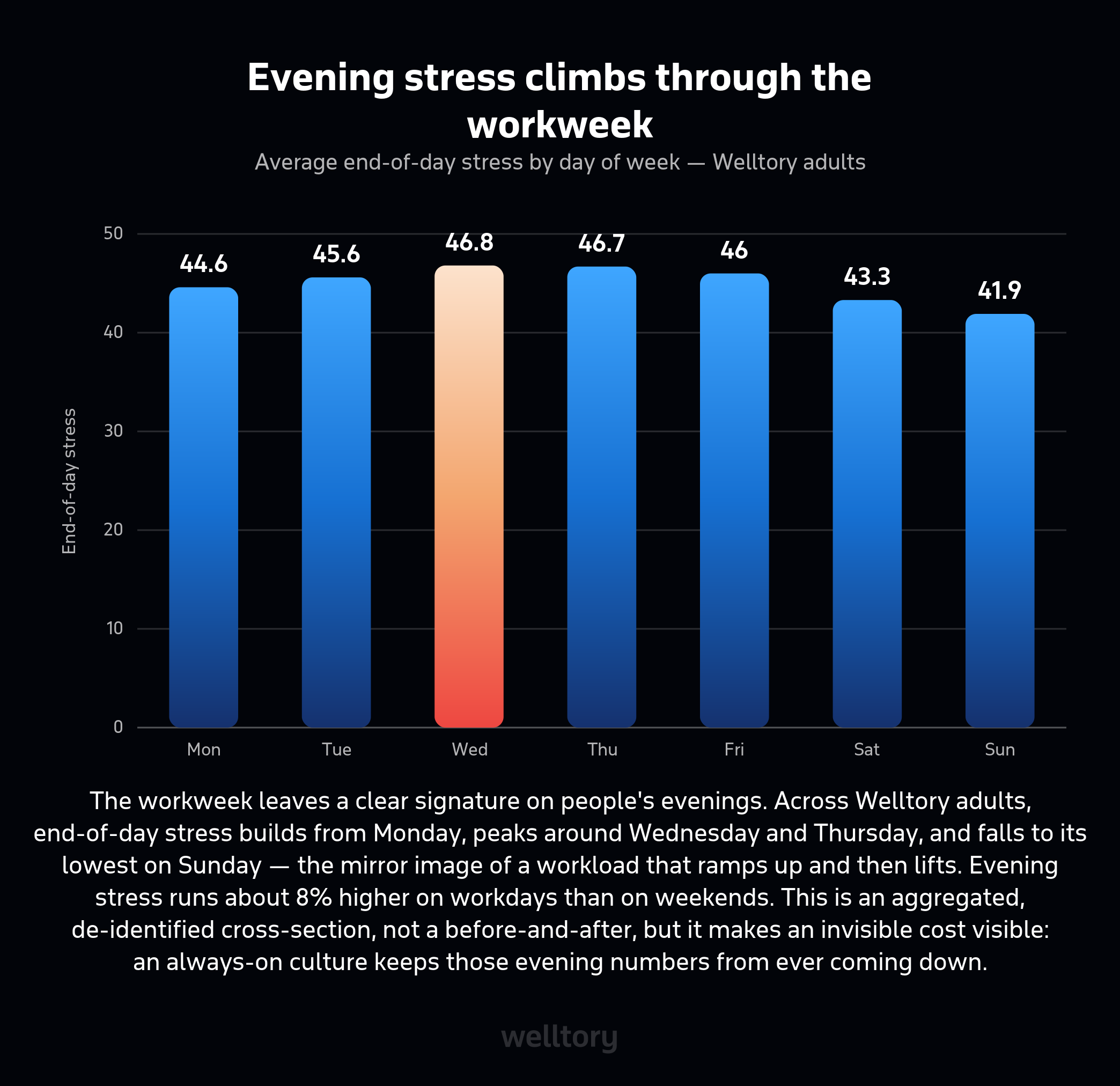
Welltory's own data makes this concrete. In an aggregated, de-identified analysis of roughly 448,000 user-days from about 5,000 people (December 2025–March 2026), the workweek leaves a clear stress signature on people's evenings. End-of-day stress runs about 7% higher on workdays than on weekends, and total daily stress load is about 10% higher on workdays. People also finish workdays with less in the tank: their end-of-day "energy battery" is roughly 13% higher on weekend days than on workdays. Evening stress climbs through the week, peaks around Wednesday and Thursday, and falls to its lowest on Sunday — the mirror image of a workload that builds and then lifts.
But here's the important, honest nuance: the body doesn't fully rebound just because it's the weekend. In the same data, physiological recovery is actually slightly lower on weekends than on workdays, and Sunday shows the weakest recovery of the entire week — even though Sunday is also the least stressful day. Removing workday stress is not the same as recovering: weekend routines (later nights, irregular schedules) and the quiet approach of Monday leave their own mark. The lesson for boundaries is twofold — the workweek genuinely elevates evening stress, and simply "having the weekend" doesn't guarantee recovery. Sustained, consistent rest does.
What "recovery doesn't rebound" means — and what to do about it. "Recovery" here is a physiological measure, not a mood: it's how well the body bounces back, read from signals like heart rate variability and resting heart rate. You'd expect it to climb on days off, when the demand lifts. When it doesn't — and especially when Sunday is the weekly low point — it usually reflects two things. First, weekend habits: later and more irregular bedtimes (what sleep researchers call "social jetlag"), alcohol, and a broken routine can cost the body more recovery than the workweek's stress does. Second, anticipatory stress — the quiet Sunday hum of Monday approaching. The key insight is that low stress and good recovery are not the same thing. Removing the workday stressor is necessary but not sufficient; the nervous system still needs consistent, restorative conditions to actually rebuild.
The practical response follows directly — and it's as much for individuals as for HR:
Protect consistent sleep and wake times across all seven days. Sleeping in dramatically on weekends disrupts recovery more than it helps; the nervous system rewards a stable rhythm, not a weekday–weekend whiplash.
Make weekends genuine downtime, not catch-up work. "Just one quick Sunday email" reintroduces the exact stressor the weekend was supposed to clear — and, at a team level, sets the after-hours norm for everyone.
Defuse the Monday approach. Set Monday's priorities on Friday, keep Sunday evenings work-free, and avoid Sunday-night messages to the team. The dread of Monday is part of the measurable cost, and it's largely a design choice.
Treat recovery as active, not just "not working." Sleep, daylight, gentle movement, and genuinely winding down are what restore the body; late nights and screens until 2 a.m. don't, even on a free day.
For the company: because the weekend alone doesn't reliably restore people, weekday boundaries matter more, not less. Protecting evenings during the working week — where our data shows stress actually concentrates — is where the durable gains are.
(Chart: evening stress by day of week — see `always_on_culture__boundaries__datachart.svg`.)
The point of this data is not to surveil anyone. It's to make an invisible cost visible at the level where a company can act: if a team's recovery stays flat from Friday into the weekend, or evening stress never eases, that's a measurable sign the boundary between work and rest has eroded — the very thing an always-on culture quietly does.
The right to disconnect — laws and how they work
Governments have started treating after-hours boundaries as a matter of policy, not just etiquette. The "right to disconnect" now exists in several countries, but the mechanisms differ a lot — which is why copying another country's headline is risky.
France was first: under the 2016 "El Khomri" labor law, a right to disconnect took effect on 1 January 2017 for companies with at least 50 employees. Notably, it doesn't ban after-hours contact or set penalties; it obliges employers to negotiate rules on disconnection with staff representatives (Herbert Smith Freehills, 2017).
Australia took a stronger, enforceable route: from 26 August 2024, employees at businesses with 15+ staff gained a right to refuse to monitor or respond to unreasonable contact outside working hours (extending to small business from 26 August 2025) (Fair Work Ombudsman).
Portugal framed it as an employer duty: a 2021 law generally bars employers from contacting workers outside working hours, with penalties for breaches. Ireland issued a Code of Practice on the right to disconnect (2021) that, while not a standalone statute, can be referenced in employment disputes. In Canada, Ontario's Working for Workers Act required employers with 25+ employees to have a written "disconnecting from work" policy. At the EU level, the European Parliament voted in 2021 to call for a right-to-disconnect directive, though a binding EU-wide law has not been adopted.
The practical takeaway for HR: "right to disconnect" is not one thing. It ranges from negotiate a policy (France) to an enforceable right to refuse (Australia) to an employer duty not to contact (Portugal). If you operate across borders, the rules — and the risks — differ by country.
What actually helps — a rest-and-boundaries policy
Laws set a floor; culture sets the reality. The organizations that actually protect recovery treat boundaries as a designed policy that leadership models, not a perk employees are nervously "allowed" to use. A practical checklist:
Set explicit quiet hours. Define a window (e.g., 7 p.m.–8 a.m. and weekends) when work contact is not expected. Name it, write it down, and make it the default.
Separate "send" from "expect a reply." If people work flexible hours, normalize scheduling messages for the morning, or add a simple line: "No need to reply outside your hours." Tools that delay-send help.
Make async the norm for non-urgent work. Most messages don't need an instant answer. Clarify what counts as truly urgent (and how those rare things are escalated) so everything else can wait.
Give an explicit right not to respond. State plainly that not answering after hours is acceptable and won't affect evaluations — and mean it.
Lead by example. Boundaries collapse when leaders text at midnight. The single strongest signal is senior people visibly logging off and respecting others' quiet hours.
Protect real recovery, not just "hours off." Encourage full weekends and genuine disconnection; discourage the humble-brag of always being available.
Measure it. Track boundary health with team-level, aggregated signals — after-hours message volume, and aggregated recovery trends across the week — and revisit the policy if the "off" hours aren't recovering.
Write the policy down and review it. A documented rest policy (with your legal basis where a right-to-disconnect law applies) turns good intentions into something durable. (Not legal advice — involve counsel for jurisdiction-specific rules.)
The Welltory angle
The hardest part of fixing an always-on culture is that the cost is invisible until it shows up as burnout or resignations. Welltory's approach is to make it visible safely — through aggregation. Individuals connect their own wearables and see their own recovery, sleep, and stress; when Welltory is used in a team context, the employer sees only aggregated, de-identified insights at the group level — for example, whether a team's recovery actually rises on weekends and in the evening, or stays flat — and never any single person's numbers.
That distinction matters here more than anywhere. The goal is to protect people's off-hours, so the measurement must never itself become after-hours surveillance. Aggregated recovery trends let a company answer the real question — is our culture letting people switch off? — and adjust the policy, without watching any individual's nights and weekends. It's the difference between caring whether the team is recovering and monitoring when a specific person went to bed.
How we made it
Made with AI tools, then edited and fact-checked by the Welltory team. This article draws on authoritative public sources and independent research; the summary of "right to disconnect" laws is informational and not legal advice. The Welltory recovery statistics are aggregated and de-identified.


Discounts for blog readers: up to 36% off
See what affects your energy, stress, sleep, and daily state with Welltory
This article is for informational purposes for HR, people-ops, and team leaders. It summarizes right-to-disconnect laws in several countries, but these rules differ by jurisdiction and change over time — it is not legal advice. Consult local employment counsel before writing a policy.
Was this helpful?
Ask AI for a summary of page


Written by Iuliia Belova

HR Business Partner, coach, and Compensation & Benefits (C&B) expert with 20 years of experience across IT and HR. She writes about workplace wellbeing, burnout, and building people programs that respect employees' data and trust.
Written by Kseniia Iaroslavtseva

She reviews scientific research and turns it into structured, readable insights.
Reviewed by Anna Elitzur
-2.jpg)
With her medical degree, Anna reviews Welltory's health content for medical accuracy and alignment with current clinical guidelines and research.
References
- WHO. Long working hours increasing deaths from heart disease and stroke: WHO, ILO. 2021. https://www.who.int/news/item/17-05-2021-long-working-hours-increasing-deaths-from-heart-disease-and-stroke-who-ilo
- Pega F. et al. Global, regional, and national burdens of ischemic heart disease and stroke attributable to long working hours, 2000–2016. Environment International, 2021. https://www.ncbi.nlm.nih.gov/pmc/articles/PMC8204267/
- Barber L., Santuzzi A. Please respond ASAP: Workplace telepressure and employee recovery. Journal of Occupational Health Psychology, 2015. https://pubmed.ncbi.nlm.nih.gov/25844908/
- Sonnentag S., Fritz C. Recovery from job stress: The stressor-detachment model. Journal of Organizational Behavior, 2015. https://onlinelibrary.wiley.com/doi/10.1002/job.1924
- France — right to disconnect in force from 1 January 2017 (El Khomri law, companies of 50+). Herbert Smith Freehills, 2017. https://www.hsfkramer.com/notes/employment/2017-01/france-employees-right-to-disconnect-from-it-devices-new-provisions-in-force-from-1-january-2017
- Australia — right to disconnect (from 26 August 2024). Fair Work Ombudsman. https://www.fairwork.gov.au/employment-conditions/hours-of-work-breaks-and-rosters/right-to-disconnect


