

TL;DR: Your heart can be working overtime even when you're sitting perfectly still. The physiological strain builds up throughout the day, leaving you exhausted and taking a toll on your cardiovascular system. But movement can work for you in two ways: helping counteract the stress you've accumulated today and building your body's resilience to future stress. We've translated the science behind both into a new Activity experience, complete with personalized daily goals, colorful gummies, a little bird, and real-time feedback that lets you see your movement making a difference.
Where did all your energy go?
You spend all day looking forward to the things you'll do when you're done with work.
You'll cook something nice. Go out with friends. Play with your kids. Pick up the project you've been neglecting for months.
But by evening, all you can do is lie on the couch and scroll through your phone.
The strange thing is, it was just a normal day — full of meetings, yes, but not marathons.
So why are you so exhausted?
In our previous article on stationary stress, we explored a physiological process that most people have never heard of: what happens inside your body when your heart rate is elevated but you're not moving.
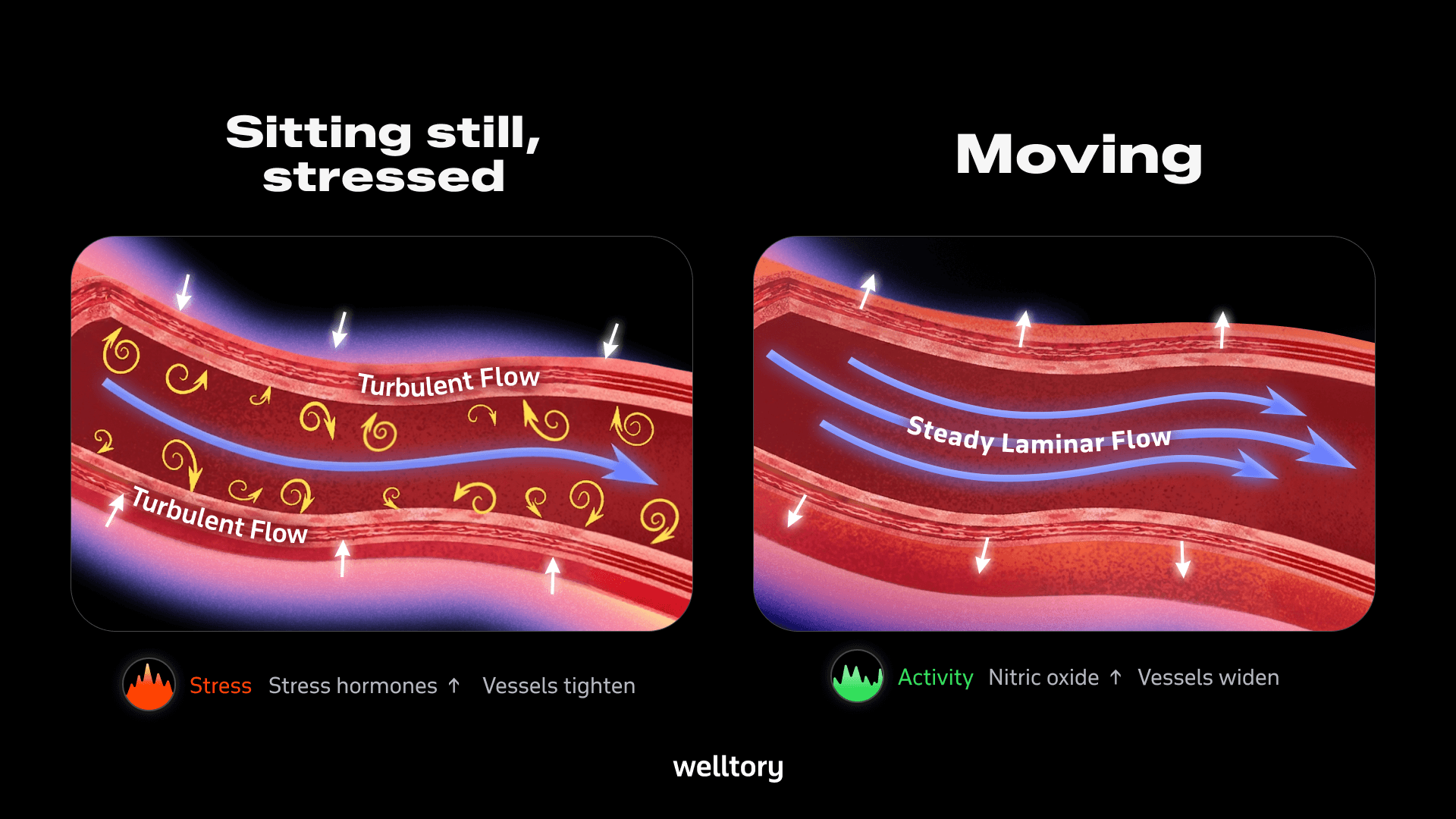
Your cardiovascular system is mobilizing for physical effort that never comes. Your blood vessels constrict, stress hormones circulate, and your body accumulates physiological strain while you're seemingly doing nothing.
At Welltory, we've learned how to make this invisible drain visible, distinguish it from beneficial physical activity, and let you know when it's happening.
But seeing the problem is only half the battle.
What can you actually do about the strain you've already accumulated? How much movement does your body need to counteract it? And can you make your body better equipped to handle it in the future?
That's what our new Activity experience is designed to help you do.
Why your blood vessels really want you to move
Your nervous system is trying to manage the physiological fallout of that passive-aggressive Zoom call, even if you haven't moved an inch.
When stress jacks up your heart rate while your body stays completely still, your body can engage its parasympathetic brakes to help regulate the cardiovascular response.
The problem is that the stressor hasn't gone anywhere. Your body can end up pressing the gas and the brakes at the same time. That physiological tug-of-war helps explain why a few hours of stationary stress can leave you feeling like you ran a marathon without ever leaving your chair.
Meanwhile, your blood vessels are caught in the crossfire.
When you're stressed, sympathetic activation and stress hormones can constrict your vessels. At the same time, sitting still slows blood flow, especially in your lower body, leaving the endothelium (the paper-thin cell layer lining your vessels that signals them to widen) with far less of the mechanical stimulation it needs to work well.
Stack those two together day after day, and endothelial dysfunction can start setting the stage for cardiovascular trouble.
Movement changes that scenario.
When your muscles start working, they help stimulate nitric oxide production and open up local blood flow. At the same time, that surge in blood flow creates stronger mechanical stimulation along vessel walls (called shear stress), which nudges your endothelium to ramp up its own nitric oxide production even further.
Together, these processes help your blood vessels relax, widen, and deliver blood where it's needed.
In other words, your blood vessels really like it when you give them something to do.
And the benefits of movement don't stop when you stop moving.
Over time, regular, appropriate physical activity can improve endothelial function and cardiovascular fitness, making your body better equipped to handle the physiological demands of everyday life.
This means movement can work for you twice:
Today: Help counteract the physiological strain you've accumulated throughout the day.
Tomorrow: Build a body that's more resilient to future stationary stress.
So how do you put that science to work in your everyday life?
Fight the invisible drain in real time
Imagine you've just spent three hours in back-to-back meetings. You open Welltory and see how much stationary stress your body has accumulated.
You decide to go for a walk.
But instead of just counting your steps or telling you how many calories you've burned, Welltory shows you how your movement is changing the picture.
With our new Activity experience, you'll be able to watch your accumulated physiological load decrease as you move.
For once, you can see what that walk around the block is doing for you beyond adding another thousand steps to your daily total.
It's a different kind of reward. You're not just working toward an abstract fitness goal or checking another task off your to-do list. You're doing something about the physiological strain of the day you've actually had.
And with our upcoming Live Activity experience, you'll be able to see your progress right on your iPhone lock screen, without interrupting what you're doing.
How much movement does your body actually need?
Here's where things get interesting.
Most activity goals are built around universal numbers. Walk 10,000 steps. Exercise for 30 minutes. Close your rings.
But what's beneficial for a marathon runner isn't necessarily beneficial for someone who hasn't exercised in years, or someone living with a chronic condition.
Your body has its own capabilities, and the intensity of movement that provides a useful cardiovascular stimulus depends on your individual physiology.
So instead of giving everyone the same activity target, we've created a personalized daily goal that adapts to you.
And because nobody wants to spend their afternoon calculating heart rate zones and active minutes, we've turned that goal into something a little more delightful.
A jar of colorful gummies.
Meet your daily jar
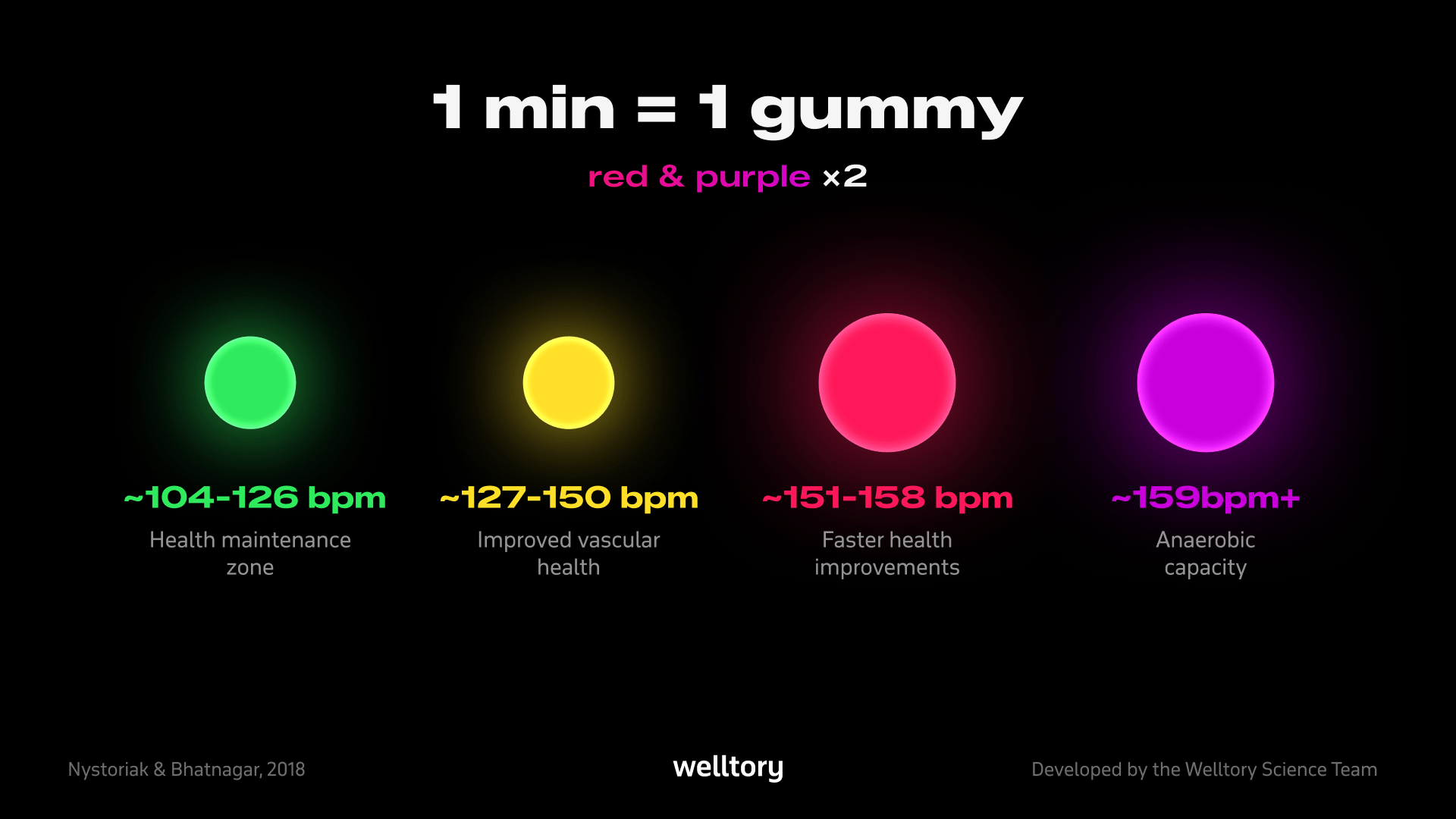
Every qualifying minute of beneficial activity earns you a gummy. Different colors represent different heart rate intensity zones, and not all minutes are created equal:
Green: You're giving your body an initial cardiovascular training stimulus.
Yellow: You're getting a stronger cardiovascular training stimulus.
Red: Higher-intensity effort. Each qualifying minute counts twice.
Purple: The highest-intensity zone. Each qualifying minute also counts twice.
As you move throughout the day, your jar fills up.
A brisk walk, dancing around your kitchen, cycling to the grocery store, or a more structured workout — different kinds of movement can contribute to your goal.
Your jar is personalized to your body's capabilities, so you're working toward a goal that makes sense for you rather than competing against someone else's physiology.
And you don't have to wait until the end of the day to see how you're doing. With Live Activity, you can watch those colorful gummies roll in as you move.
One important thing: more intense movement isn't always better. If you're living with a condition that limits your exercise capacity, particularly one involving post-exertional malaise, respecting your limits matters more than filling a jar. Rest and other ways of interrupting stationary stress are just as important.
Meet the body you're building for tomorrow
Counteracting today's stationary stress is one thing. Building a body that's better equipped to handle tomorrow's is another.
That's where our little Longevity Bird comes in.
While your jar represents your daily effort, your bird helps you see how that effort adds up over time.
Its flight path represents your longer-term activity progress, and the Flight Corridor helps you understand whether you're getting an appropriate amount of cardiovascular training stimulus.
Flying too low? You're not getting enough of the activity stimulus you're aiming for.
Flying too high? You may be pushing beyond your intended training range.
Flying within the corridor? You're working toward a more sustainable activity pattern.
The goal isn't to fly as high as humanly possible. It's to find a level of activity that helps you build cardiovascular resilience without constantly pushing your body beyond its capabilities.
Every gummy you collect is part of a bigger picture: the body you're building to carry you through the years ahead.
A different reason to move
We wanted to translate the science of stationary stress and cardiovascular adaptation into something you could actually experience in your everyday life.
Something that lets you:
See the invisible physiological strain you've accumulated.
Act on it with movement that's appropriate for your body.
Experience the benefits of your effort in real time.
Build greater cardiovascular resilience over time.
The jar makes your daily effort tangible. The gummies make movement immediately rewarding. The bird gives you a way to see the bigger picture. And the Flight Corridor helps you find a sustainable path toward it.
Behind all of it is a combination of published science and our own research.
But you don't need to understand endothelial function, nitric oxide production, or cardiovascular adaptation every time you decide to take a walk.
You just need to know that your movement can work for you twice — helping you counteract today's invisible drain and building a body that's better equipped to handle tomorrow's.
Because the point of being active isn't to become better at being active.
It's to have more of yourself left for the things that make life worth living.
Sources
Steptoe A, Kivimäki M. Stress and cardiovascular disease. Nature Reviews Cardiology. 2012;9(6):360–370. doi:10.1038/nrcardio.2012.45
Restaino RM, et al. Endothelial dysfunction following prolonged sitting is mediated by a reduction in shear stress. American Journal of Physiology – Heart and Circulatory Physiology. 2016;310(5):H648–H653. doi:10.1152/ajpheart.00943.2015
Nystoriak MA, Bhatnagar A. Cardiovascular effects and benefits of exercise. Frontiers in Cardiovascular Medicine. 2018;5:135. doi:10.3389/fcvm.2018.00135
World Health Organization. WHO Guidelines on Physical Activity and Sedentary Behaviour. Geneva: WHO; 2020. ncbi.nlm.nih.gov/books/NBK566048
Bull FC, et al. World Health Organization 2020 guidelines on physical activity and sedentary behaviour. British Journal of Sports Medicine. 2020;54(24):1451–1462. doi:10.1136/bjsports-2020-102955
Centers for Disease Control and Prevention. ME/CFS: Strategies to Prevent Worsening of Symptoms. cdc.gov
Arem H, et al. Leisure time physical activity and mortality: a detailed pooled analysis of the dose-response relationship. JAMA Internal Medicine. 2015;175(6):959–967. doi:10.1001/jamainternmed.2015.0533
This article is for educational purposes only and is not medical advice. If you have symptoms, a heart condition, or a chronic illness, talk to a qualified clinician before changing how you exercise or manage stress.
Was this helpful?
Ask AI for a summary of page


Written by Asya Paloni

Chief Product Officer at Welltory. She leads the product team and shapes what the app does next, from how your data is analyzed to the features you use every day.
Written by Irina Motovilova

Welltory’s brand and community lead. A hyperpolyglot specializing in UX writing and content strategy, she builds global communities and creates content people actually want to read.
Written by Vika Podleskih

Head of Design at Welltory. She shapes how the product looks and feels, turning complex health data into interfaces full of beauty and a little magic.
Written by Marina Kovaleva

Welltory's lead scientist and medical researcher. She turns messy heart-rate and activity data into health advice you can actually use, and designs personalized algorithms from your HRV.
