

Short answer
Exercise snacks are short bursts of movement — usually one to five minutes — spread through the day instead of done in one block. Think climbing three flights of stairs fast, 20 squats beside your desk or a brisk five-minute walk between meetings. Cleveland Clinic describes them as vigorous bouts of about two minutes or less, done a few times a day, ideally every day (1).
They do measurable things. In a 2025 meta-analysis of randomized trials in inactive adults, exercise snacks improved cardiorespiratory fitness — the evidence for that is rated moderate — while effects on blood pressure, cholesterol and body composition were not clear (2). In lab studies, breaking up sitting with five-minute walks kept leg arteries working normally and lowered blood pressure, blood sugar spikes and fatigue (4, 5).
Movement is also one of the best-studied ways to take the edge off stress. A single session of moderate-to-vigorous activity can reduce short-term anxiety the same day (7), and regular training can make your heart react less to stressful situations (8). If you end a day of meetings drained and can't explain why, it's not laziness. Hours of stress while sitting still are physically tiring, and short movement breaks are one of the few things that address both halves of that problem.
Note: this article is for general education and is not medical advice. If you have a heart condition, such as an arrhythmia or coronary artery disease, a joint or bone problem, or you haven't been active for a long time, talk to your doctor before adding vigorous bursts. Chest pain, fainting or severe shortness of breath during activity is an emergency: stop and call 911 or your local emergency number. This guide is published by Welltory, which makes one of the apps mentioned. Welltory is a general wellness product: it helps you track and understand your data and does not diagnose or treat any condition.
What are exercise snacks?
The name is a deliberate joke: instead of one big "meal" of exercise — an hour at the gym — you graze on small portions of movement through the day.
Researchers use slightly different definitions, and that's worth knowing because it changes what the studies can tell you:
Cleveland Clinic's practical version: about two minutes or less of vigorous movement, with an hour or more between snacks, three times a day, seven days a week. Vigorous means you're breathing hard enough that saying more than a few words is difficult (1).
The research definition in a 2025 *British Journal of Sports Medicine* review: structured bouts of five minutes or less, done at least twice a day, at least three days a week, for at least two weeks (2).
"VILPA" — vigorous intermittent lifestyle physical activity: not planned exercise at all, but the bursts already built into life, like running for a bus, carrying heavy shopping up the stairs or walking uphill fast (6).
Activity breaks from sitting: many sitting studies use light walking for one to five minutes every 30–60 minutes. These aren't vigorous, but they target a different problem — long, unbroken sitting (5).
The official US Physical Activity Guidelines back the whole idea. Older advice said activity only "counted" in bouts of at least 10 minutes. The 2018 guidelines dropped that requirement: bouts of any length add up, and even climbing a few flights of stairs counts (7).
Why sitting still is hard on your blood vessels
To see why a two-minute stair climb could matter, start with what happens in your legs when you don't move.
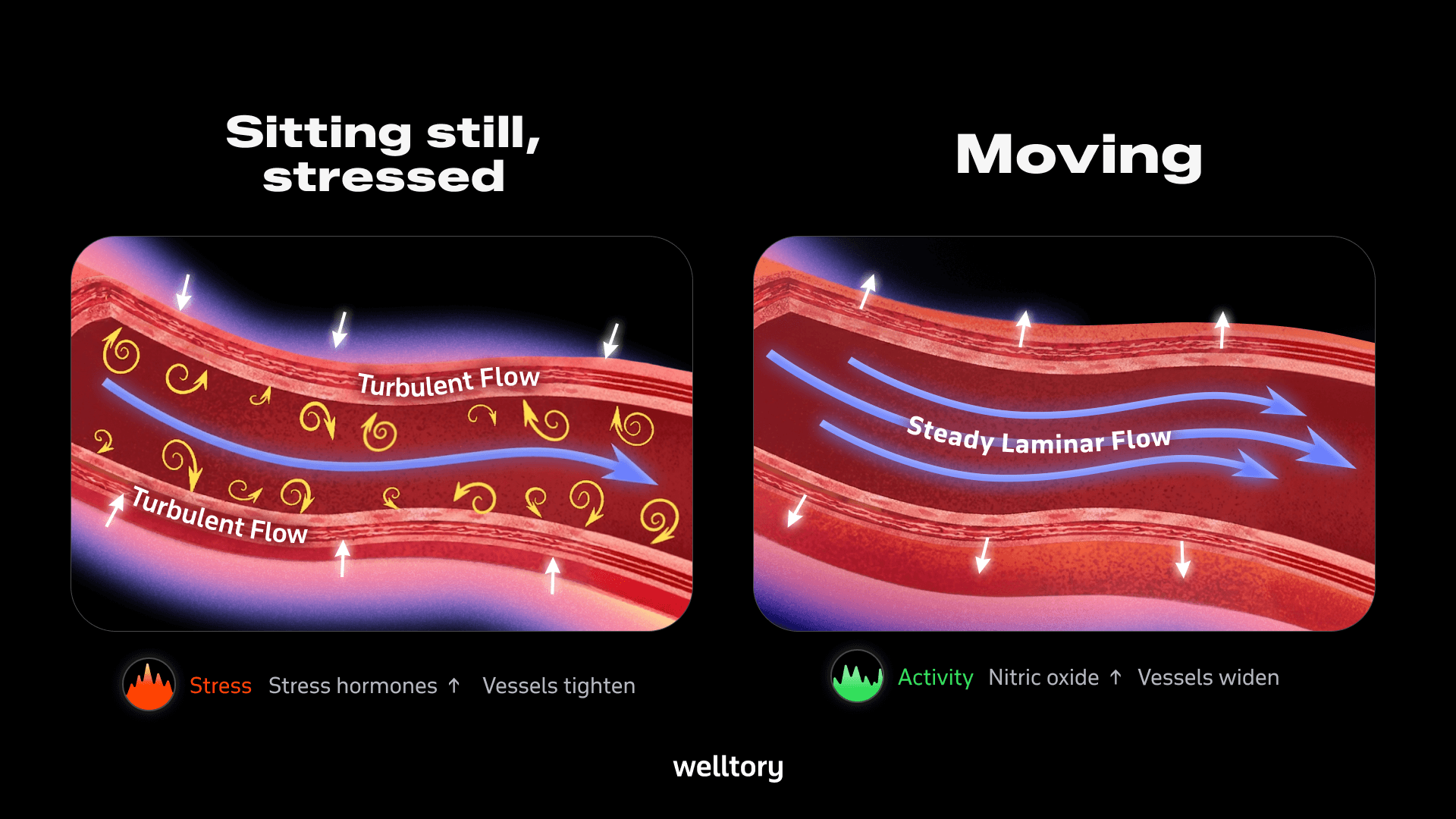
When you sit, your leg muscles are slack. They stop squeezing the veins and pushing blood back to the heart, so blood flow through the leg arteries slows down. The inner lining of your arteries — the endothelium — relies on the friction of flowing blood, called shear stress, as a signal to release nitric oxide and keep vessels relaxed and responsive (9). Less flow means less of that signal.
A 2015 study in Medicine & Science in Sports & Exercise measured this directly. Twelve healthy young men sat for three hours without moving their legs, and the function of the main artery in the thigh dropped. On another day they did the same, but walked on a treadmill for five minutes at an easy pace every hour — and their artery function stayed normal (4). The researchers noted the impairment was already significant after one hour of sitting (10).
That was a small study in a narrow group — 12 young men. But it fits a much larger body of work: repeated bursts of blood flow are the stimulus that keeps arteries healthy, which is why vascular researchers call exercise "vascular medicine" (9).
Now add stress. When you're tense — a hard call, a deadline, a difficult conversation — your heart rate rises, stress hormones circulate and vessels tighten, exactly as if you were about to sprint. If you're sitting, that effort has nowhere to go. We call this stationary stress: your body prepares for movement that never comes. A day of it can leave you as tired as a hard workout, without any of a workout's benefits.
What the research shows exercise snacks can do
Here's what the main studies found, and how much weight each result can carry.
| Study | What people did | What changed | How strong |
|---|---|---|---|
| BJSM meta-analysis, 2025: 11 trials, 414 inactive adults (2) | Bouts of ≤5 min, at least twice a day, for 4–12 weeks | Better cardiorespiratory fitness in adults; better muscular endurance in people over 65. No clear effect on blood pressure, cholesterol, leg strength or body composition | Moderate certainty for fitness; very low for endurance in older adults |
| Frontiers in Cardiovascular Medicine meta-analysis, 2025: 27 studies, 970 adults (3) | Short, intense bouts spread through the day, 8–15 weeks | Higher VO2 max, lower blood pressure, fasting glucose and LDL cholesterol, slightly lower body fat. No change in body weight | Mostly small, low-quality studies with very different methods |
| Stair-climbing trial, McMaster University, 2019 (11) | 3 fast climbs of a 3-flight stairwell (60 steps) a day, 1–4 hours apart, 3 days a week for 6 weeks | Peak oxygen uptake rose compared with a control group | Small trial in sedentary young adults; the gain was modest |
| Columbia University sitting study, 2023 (5) | 8 hours of sitting with different walking breaks | 5 min every 30 min cut post-meal blood sugar spikes by 58%; every regimen lowered blood pressure by 4–5 mmHg; most improved mood and fatigue | 11 adults, one day per condition |
| UK Biobank, Nature Medicine, 2022 (6) | Wrist trackers on 25,241 people who did no formal exercise | About 3 daily bursts of 1–2 min of vigorous everyday activity linked to 38–40% lower risk of death from any cause and 48–49% lower risk of cardiovascular death | Observational: shows a link, not cause |
Two honest takeaways. First, the most reliable result is better fitness — and cardiorespiratory fitness is one of the strongest markers of long-term heart health. Second, the two big reviews disagree on blood pressure and cholesterol because they included different trials. Treat those as "possible, still being tested," not as a promise.
How does exercise reduce stress?
This is the second half of the story, and it's where short bursts of movement may matter most on a busy day.
It finishes the stress response. Stress readies your body to move: faster heart, more glucose in the blood, tighter vessels. Mayo Clinic notes that exercise helps your body's systems practice working together through the fight-or-flight response, which may protect your heart, vessels, digestion and immune system from the effects of stress (12). Movement gives the mobilized energy a job.
It changes how you feel within minutes. Physical activity raises endorphins and other brain chemicals linked to better mood and less pain. Focusing on movement and breathing works a bit like "meditation in motion" — it pulls your attention off the thing that's worrying you (12). The US guidelines list reduced short-term anxiety and better sleep as benefits of a single session, on the same day (7). In the Columbia sitting study, people who took walking breaks reported better mood and less fatigue than on the day they sat still (5).
Over weeks, it may make your body react less to stress. In a randomized trial, 149 healthy men were assigned to 12 weeks of endurance training, relaxation training or a waiting list. The training group got fitter and showed smaller rises in heart rate and cortisol and a smaller drop in HRV during a standardized public-speaking stress test (8). Not every trial agrees: in a Swedish randomized study, training made people fitter but didn't change their hormonal or heart-rate response to the same stress test compared with a control group (13). The fairest summary: exercise reliably helps you feel and recover better, and it may also blunt your heart's reaction to stress, though the evidence on the stress response itself is mixed.
It improves sleep, and poor sleep makes everything feel more stressful the next day (12).
Two jobs for one habit: today's strain and tomorrow's buffer
Put the two halves together and short movement breaks do two different things.
Today: they interrupt sitting and give a stress response something to do. Five minutes of walking after a tense call restores blood flow in your legs and starts to bring your body back toward baseline (4, 12).
Tomorrow: repeated over weeks, the harder snacks build cardiorespiratory fitness (2), and fitter bodies tend to handle stress with a smaller heart-rate spike and a faster recovery (8).
We built Welltory's new Activity experience around exactly this idea. You can read how it works, from personalized daily goals to watching your accumulated load go down as you move, in Your body is keeping score. Here's how to change it.

20 exercise snack examples
No equipment, no changing clothes. Pick the ones that fit where you are.
At your desk or in the office
Climb two or three flights of stairs as fast as feels safe, then walk down.
Chair squats: stand up and sit down 15–20 times without using your hands.
Calf raises while you wait for the kettle or printer: 30 reps.
Wall push-ups: 15–20.
A brisk five-minute walk to a farther bathroom, water cooler or coffee place.
Walking calls: take one phone or audio call a day on your feet.
Desk-edge incline push-ups: 10–15.
Stand and march on the spot with high knees for one minute.
At home
Jumping jacks: one minute.
Bodyweight squats or lunges during an ad break or while the microwave runs.
Carry the laundry basket or shopping bags up the stairs in two fast trips.
Dance to one song, at full effort.
Mountain climbers: 30 seconds, rest, 30 seconds.
Play-chase with your kids or dog for a few minutes.
Out and about
Take the stairs instead of the elevator or escalator, walking fast.
Walk uphill briskly for one to two minutes.
Get off one stop early and walk the rest at a pace that makes talking hard.
Park at the far end of the lot and walk fast.
Cycle hard for one minute on a commute or errand.
Jog for a minute during an otherwise easy walk.
The Cleveland Clinic list includes stair climbing, jumping jacks, jump rope, chair squats, lunges, push-ups and mountain climbers (1); the rest are everyday versions of the same principle.
How to build an exercise snacks routine
A routine works better than good intentions. Consistency matters most — occasional snacks won't do much (1).
Anchor snacks to things you already do. After every meeting, after you finish a coffee, before lunch, when you get home. A trigger beats a timer you'll ignore.
Start with three a day. Morning, midday, mid-afternoon. That's the pattern most studies used (1, 11).
Add light breaks for long sitting. On heavy meeting days, aim for a few minutes of easy walking every 30–60 minutes on top of your vigorous snacks. In the Columbia study, five minutes every 30 minutes had the biggest effect (5).
Pair a snack with stressful moments. Right after a difficult call or before a presentation is a good time for two flights of stairs or a fast loop of the building.
Use the talk test to set intensity. For a vigorous snack, you should be able to say only a few words at a time by the end (1). For a sitting break, an easy pace is fine.
Keep a short log for two weeks. Write down when you did snacks and how you felt that evening. You're looking for your own pattern, not perfection.
Progress slowly. Add a fourth snack, another flight of stairs or a few more reps after a couple of weeks — not all at once.
How hard should an exercise snack be?
It depends on what you want from it.
For fitness: most of the trials that improved fitness used vigorous efforts — fast stair climbing or short intense intervals (2, 11).
For breaking up sitting: light walking was enough to protect leg artery function and lower blood pressure in lab studies (4, 5).
For stress: almost any form of movement can help, even if you're out of shape (12).
"Vigorous" is relative. Fast stair climbing may be easy for a runner and very hard for someone who hasn't exercised in years. What counts is your effort, not someone else's pace. If you live with a condition that limits your energy, such as ME/CFS or long COVID, the rules are different: pushing intensity can make you worse. Talk to your care team, and see our guide to the energy envelope.
Exercise snacks vs a regular workout
| | Exercise snacks | A 30–60 minute workout |
|---|---|---|
| Time | 1–5 minutes, a few times a day | One block |
| Equipment | None | Often a gym, class or gear |
| Best evidence for | Better fitness in inactive people; breaking up sitting | A wide range of health outcomes over decades of research |
| Fits | Desk jobs, parents, busy days, low motivation | People who can protect a block of time |
| Stress | Can be timed to the stressful moment itself | Helps overall mood and resilience |
It's not either-or. The US guidelines still recommend 150–300 minutes of moderate activity a week, plus strength work twice a week (7). Snacks are a way to get there, or to protect your body on the days when a workout won't happen. And a workout in the evening doesn't undo eight unbroken hours of sitting — breaking up sitting matters on its own (5).
Common mistakes with exercise snacks
Going all out from day one. Sore legs on day two end most new habits. Start at a level you could repeat tomorrow.
Doing them only "when I remember." Without an anchor, snacks vanish on exactly the busy days when you need them.
Counting only steps. Two thousand slow steps and two minutes of fast stairs do different things. Include some efforts that leave you breathing hard.
Snacking right after a big meal at full intensity. An easy walk after eating is great; a sprint up the stairs may feel unpleasant. Save the hard efforts for later.
Skipping them on stressful days. That's when they help most. One fast lap of the building after a difficult call is better than none.
Expecting weight loss. Neither big review found a clear change in body weight (2, 3). The point is your heart, vessels and mood.
Living with a desk job: the questions people ask next
Do exercise snacks really work?
For fitness, yes — that's the best-supported result, with moderate-certainty evidence in inactive adults (2). For blood pressure, cholesterol and blood sugar, results are promising but mixed between reviews (3).
How do I reduce the effects of sitting all day?
Break up long sitting every 30–60 minutes with a few minutes of walking, add two or three harder bursts a day, and take one walking call. In the lab, five minutes of walking every 30 minutes offset many of the measured effects of a full day of sitting (5). If your legs ache or swell at the end of the day, our guide to moving lymph when you sit all day has more ideas.
Why am I too tired after work to do anything?
There are many possible reasons, from sleep to stress to health conditions. One that people often miss is a day of stress while sitting still — your body works hard without moving. We go through the common causes in why am I so tired after work every day.
Is walking enough, or do snacks need to be hard?
Walking is enough to break up sitting and help mood. Harder bursts add the fitness benefit. A mix works best.
Can exercise snacks replace the gym?
For someone doing nothing, they're a real step up. For long-term health, they work best alongside the weekly guideline of 150–300 minutes of moderate activity (7).
Before you blame yourself
If you come home with no energy left for the things you were looking forward to, it's easy to call yourself lazy. Before you blame yourself, look at your data.
What you feel: exhausted after a day you spent mostly sitting.
What you can see: how many hours you sat without a break, how many of those hours your heart rate was raised by stress rather than movement, and how you felt on days with and without walking breaks.
One lever for 1–2 weeks: after every meeting longer than 30 minutes, take a two-to-five-minute walk or a fast stair climb. Note your evening energy each day, then compare the two weeks.
If nothing changes, that's useful too: it tells you to look at sleep, workload or your health with a doctor, rather than trying harder.
When to see a doctor
See a doctor before adding vigorous bursts if you:
Have a heart condition, such as an arrhythmia or coronary artery disease (1).
Have a joint, bone or back problem that makes squats, stairs or jumping painful (1).
Haven't been active for a long time or have other health concerns (12).
Feel unusually breathless, dizzy or have palpitations with light effort like one flight of stairs.
Feel much worse for a day or more after small amounts of activity.
Chest pain, fainting or severe shortness of breath during activity is an emergency: stop and call 911 or your local emergency number.
How to bring this up with your doctor
Say what you want to do: "I want to add two-minute bursts of stair climbing three times a day. Is that safe for me?"
Ask by name: "Is vigorous intensity OK with my heart condition or medication? Should I stay at a moderate level?" Some medicines, like beta-blockers, change how high your heart rate goes.
Bring a record: a week of notes on how you feel during and after stairs or brisk walks — breathlessness, dizziness, chest symptoms, energy the next day. If you track heart rate, bring that too.
If you feel brushed off: "I'm asking because I get breathless on one flight of stairs, and I'd like to understand why before I push harder."
How Welltory helps — and what it cannot do
The limits first. Welltory is a general wellness product, not a medical device. It does not diagnose heart conditions, tell you whether exercise is safe for you or replace your doctor's advice.
What it can do is show you how stress and movement play out in your own body over a day.
See stress that builds while you sit. On the Today screen, the Stress score tracks how well you're balancing activity and rest: stationary stress raises it, and activity and movement lower it. Today screen is available on iOS for people who use Apple Watch or Oura (Today screen, Welltory Premium).
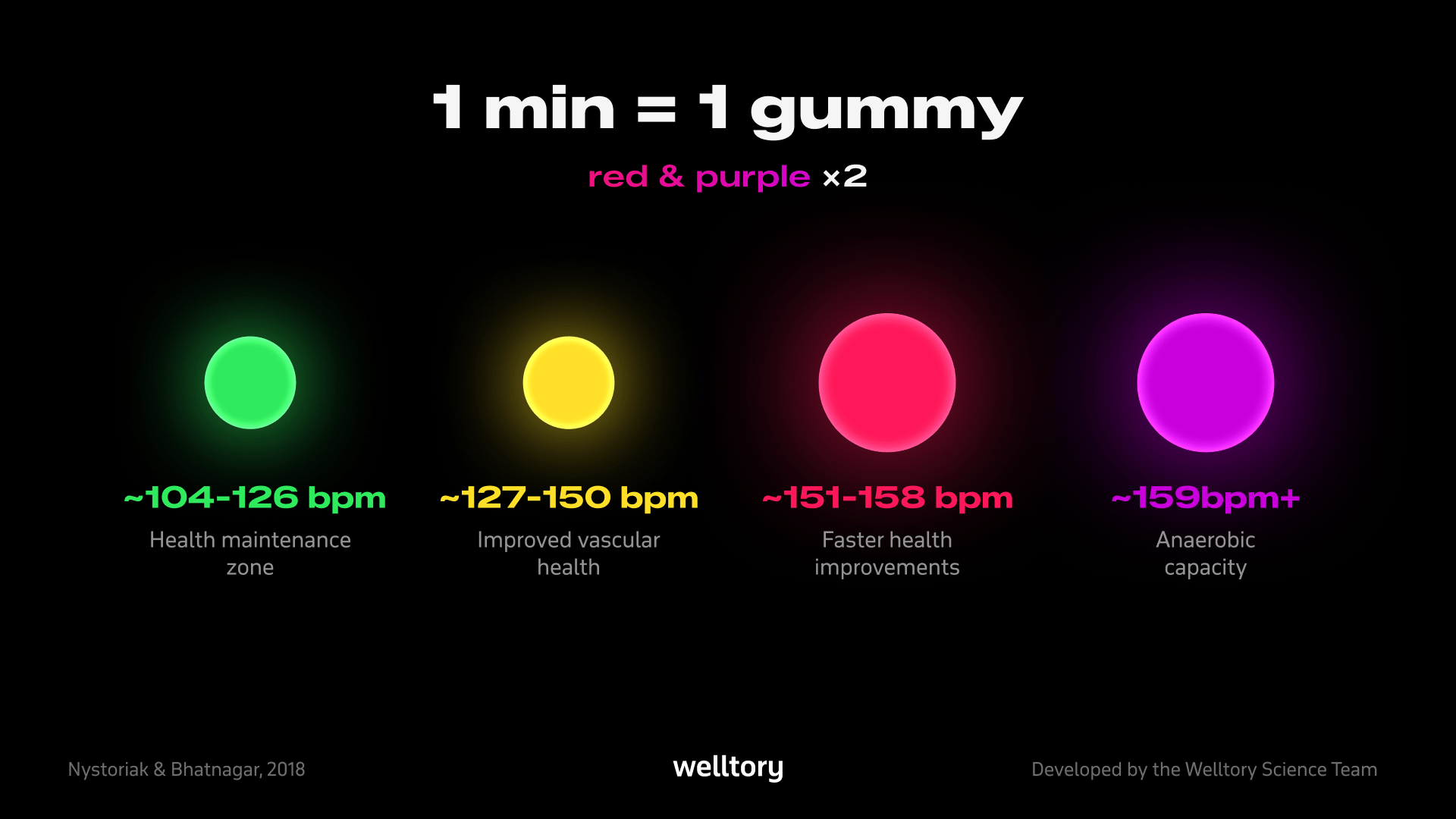
See which movement counts. In Welltory's scoring, activity in heart rate Zones 1 to 5 offsets the stationary stress built up over the past two hours; keep going after that, and you start building Buffers — a reserve in the app that offsets future stationary stress so it doesn't push your Stress score up. Light-zone activity doesn't change the Stress score, because your heart rate doesn't rise enough (Workout Report). Zone boundaries are personal and change daily, based on your morning resting heart rate (Today screen).
See every bit of movement add up. The Activity Report shows active time, sedentary time, time in elevated zones and stand hours. It's rolling out gradually to Apple Watch users (Activity Report).
Tag what you did. When Welltory detects a stress or recovery episode and asks "What happened?", you can tap a suggested tag, type or answer by voice — "back-to-back meetings", "stairs", "walk after lunch" (My Patterns). Over a couple of weeks, that shows you which breaks actually move your numbers.
Some of these features are part of Welltory Premium, a subscription that auto-renews until you cancel. Read more about the science behind it in your body is keeping score and stationary stress.
How we made it
We based this article on two 2025 meta-analyses of exercise snack trials (British Journal of Sports Medicine and Frontiers in Cardiovascular Medicine), the 2019 McMaster stair-climbing trial, the 2022 UK Biobank study of vigorous intermittent lifestyle activity in Nature Medicine, two laboratory studies of breaking up sitting (Indiana University, 2015; Columbia University, 2023), a review of exercise and vascular health in Physiological Reviews, two randomized trials of exercise training and stress reactivity, the 2018 Physical Activity Guidelines for Americans, and guidance from Cleveland Clinic and Mayo Clinic. The full text of the Frontiers meta-analysis on PubMed Central was behind a captcha for us, so we read it on the publisher's site. Search questions came from what people in the United States most often ask about exercise snacks and exercise for stress. For the product section, we checked every function against the Welltory Help Center on November 28, 2026. This article accompanies our story about Welltory's new Activity experience, your body is keeping score.
Made with AI tools, then edited and fact-checked by the Welltory team. See our Editorial & AI policy.
Jane Smorodnikova, co-founder of Welltory, built the methodology behind how we read physiological data.
Written by Asya Paloni and Vika Podleskih.
This article is for educational purposes only and is not medical advice. If you have a heart condition, a joint or bone problem, or haven't been active for a long time, talk to your doctor before adding vigorous bursts of exercise. Chest pain, fainting or severe shortness of breath during activity is an emergency. This guide is published by Welltory, which makes one of the apps mentioned. Welltory is a general wellness product: it helps you track and understand your data and does not diagnose or treat any condition. Sources were retrieved on November 28, 2026.
Was this helpful?
Ask AI for a summary of page


Written by Asya Paloni

Chief Product Officer at Welltory. She leads the product team and shapes what the app does next, from how your data is analyzed to the features you use every day.
Written by Vika Podleskih

Head of Design at Welltory. She shapes how the product looks and feels, turning complex health data into interfaces full of beauty and a little magic.
References
- Cleveland Clinic — How to work "exercise snacks" into your day. https://health.clevelandclinic.org/exercise-snacks
- Rodríguez MÁ, Quintana-Cepedal M, Cheval B, Thøgersen-Ntoumani C, Crespo I, Olmedillas H. Effect of exercise snacks on fitness and cardiometabolic health in physically inactive individuals: systematic review and meta-analysis. British Journal of Sports Medicine 2026;60(2):133–141 (online October 7, 2025). doi:10.1136/bjsports-2025-110027. https://research.birmingham.ac.uk/en/publications/effect-of-exercise-snacks-on-fitness-and-cardiometabolic-health-i/
- Chen J, Lu Y, Zhao H, Liu H, Yao J. The effectiveness of exercise snacks as a time-efficient treatment for improving cardiometabolic health in adults: a systematic review and meta-analysis. Frontiers in Cardiovascular Medicine 2025;12:1643153. doi:10.3389/fcvm.2025.1643153. https://www.frontiersin.org/articles/10.3389/fcvm.2025.1643153/full
- Thosar SS, Bielko SL, Mather KJ, Johnston JD, Wallace JP. Effect of prolonged sitting and breaks in sitting time on endothelial function. Medicine & Science in Sports & Exercise 2015;47(4):843–849. https://pubmed.ncbi.nlm.nih.gov/25137367/
- Columbia University Irving Medical Center — Rx for prolonged sitting: a five-minute stroll every half hour (on Duran AT, et al. Medicine & Science in Sports & Exercise 2023; doi:10.1249/MSS.0000000000003109). https://www.cuimc.columbia.edu/node/25711
- Stamatakis E, Ahmadi MN, Gill JMR, et al. Association of wearable device-measured vigorous intermittent lifestyle physical activity with mortality. Nature Medicine 2022;28:2521–2529. https://www.ukbiobank.ac.uk/publications/association-of-wearable-device-measured-vigorous-intermittent-lifestyle-physical-activity-with-mortality/
- US Department of Health and Human Services — Physical Activity Guidelines for Americans, 2nd edition (2018). https://odphp.health.gov/sites/default/files/2019-09/Physical_Activity_Guidelines_2nd_edition.pdf
- Klaperski S, von Dawans B, Heinrichs M, Fuchs R. Effects of a 12-week endurance training program on the physiological response to psychosocial stress in men: a randomized controlled trial. Journal of Behavioral Medicine 2014;37(6):1118–1133. https://acuresearchbank.acu.edu.au/item/8qwv9/effects-of-a-12-week-endurance-training-program-on-the-physiological-response-to-psychosocial-stress-in-men-a-randomized-controlled-trial
- Green DJ, Hopman MTE, Padilla J, Laughlin MH, Thijssen DHJ. Vascular adaptation to exercise in humans: role of hemodynamic stimuli. Physiological Reviews 2017;97(2):495–528. https://pmc.ncbi.nlm.nih.gov/articles/PMC5539408/
- Indiana University — Taking short walking breaks found to reverse negative effects of prolonged sitting (news release, 2014). https://www.eurekalert.org/news-releases/697782
- Jenkins EM, Nairn LN, Skelly LE, Little JP, Gibala MJ. Do stair climbing exercise "snacks" improve cardiorespiratory fitness? Applied Physiology, Nutrition, and Metabolism 2019;44(6):681–684. https://pubmed.ncbi.nlm.nih.gov/30649897/
- Mayo Clinic — Exercise and stress: get moving to manage stress. https://www.mayoclinic.org/healthy-lifestyle/stress-management/in-depth/exercise-and-stress/art-20044469
- Arvidson E, Sjörs Dahlman A, Börjesson M, Gullstrand L, Jonsdottir IH. The effects of exercise training on hypothalamic-pituitary-adrenal axis reactivity and autonomic response to acute stress — a randomized controlled study. Trials 2020. https://trialsjournal.biomedcentral.com/articles/10.1186/s13063-020-04803-3
- Welltory Help Center — Today Screen (iOS) (updated August 20, 2026). https://help.welltory.com/en/articles/8907642-today-screen-ios
- Welltory Help Center — New Workout Report for Apple Watch users. https://help.welltory.com/en/articles/10329671-new-workout-report-for-apple-watch-users
- Welltory Help Center — New Activity Report for Apple Watch users. https://help.welltory.com/en/articles/11610029-new-activity-report-for-apple-watch-users
- Welltory Help Center — Welltory Premium: personalized guidance, habit analytics and so much more. https://help.welltory.com/en/articles/4007331-welltory-premium-personalized-guidance-habit-analytics-and-so-much-more
- Welltory Help Center — My Patterns (iOS). https://help.welltory.com/en/articles/16012012-my-patterns-ios


