
Welltory Migraine Tracker: a free migraine tracker app on iPhone, and what it shows next to your attacks
Log each attack for free — start and end, severity, where it hurt, symptoms and medications — and, with a subscription, see every migraine day against your own stress, activity and sleep baseline. What it records, what it costs, and what no migraine app can do yet.

Short answer
Welltory's Migraine Tracker on iPhone records each attack — when it started and ended, how severe it was, where it hurt, your symptoms and medications — and shows it next to your own stress, sleep and activity. Logging is free. With a subscription, every migraine day is compared with your own previous 30 days for three measures — Stress Impact, Total Active Time and Sleep Score — so you can see what tended to look different around your attacks.
If you have tried to keep a headache diary and lost track after a few weeks, that is not a lack of discipline. Memory is bad at counting pain, and a diary that asks too much stops being filled in. The tracker is built to take a minute: pick the day, set the times, rate the pain, tap what you felt and what you took.
It is available in English on iPhone and switches on when you tell the app you have migraine. The best experience is with an Apple Watch or Oura ring; Spanish and other languages are coming soon. It records what you report; it does not detect, predict or diagnose migraine, and a day that looks unusual is not proof of what caused an attack.
Note: this article describes a consumer wellness app and is not medical advice. Features are as described in the Welltory Help Center on 24 November 2026. A sudden, severe or new kind of headache needs urgent care.


Discounts for blog readers: up to 36% off
See what affects your energy, stress, sleep, and daily state with Welltory
Welltory Migraine Tracker at a glance
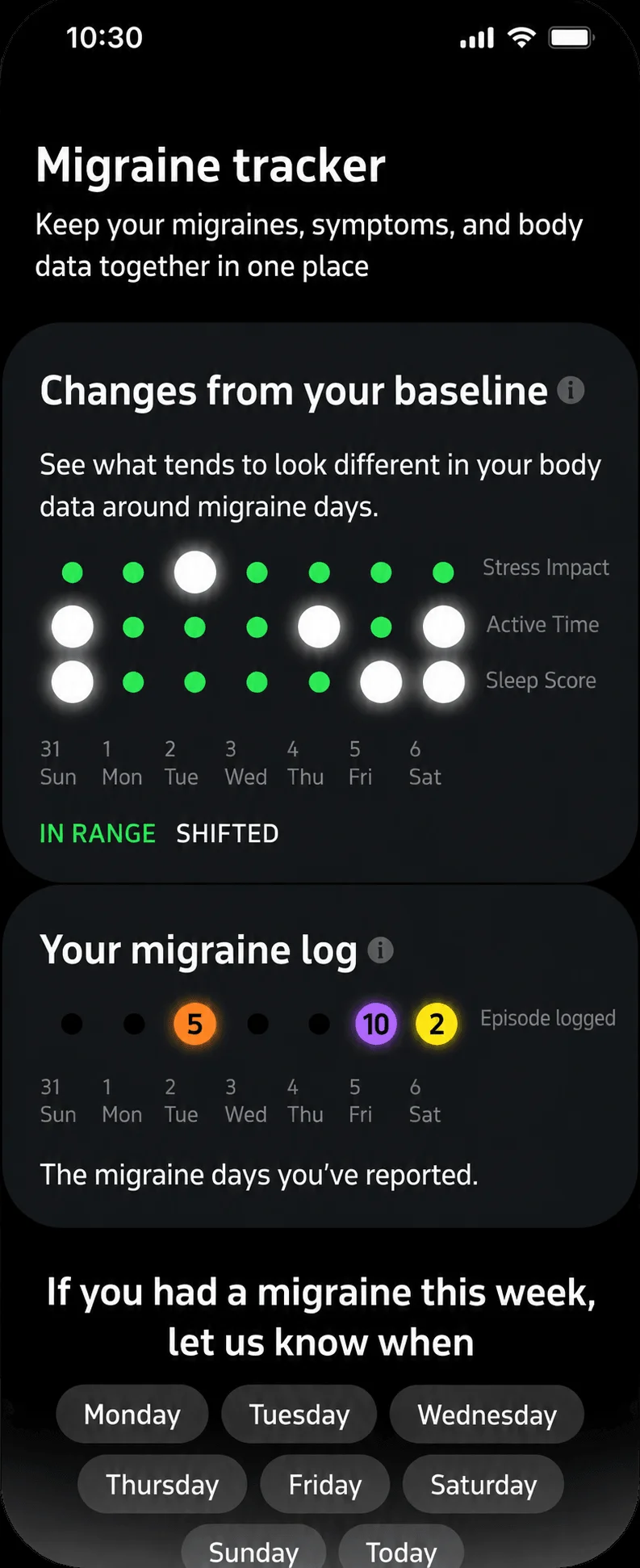
What you log — The day it began, start and end time or "still ongoing", severity, where it hurt, symptoms, medications, whether they helped, and a note
How far back — Any of the last 7 days from the Today screen
More than one attack a day — Yes — each is its own entry
What it shows — A 7-day migraine log, plus each day compared with your own 30-day baseline for Stress Impact, Total Active Time and Sleep Score
Free — Logging, symptom and medication tags, notes, reading and editing entries
Subscription — Objective measurements, "Changes from your baseline" and the detailed charts
Platform — iPhone, in English (Spanish and other languages coming soon); best with an Apple Watch or Oura ring
Predicts attacks? — No. The charts cannot predict a migraine or tell you what caused one
Quick answers about the Welltory Migraine Tracker
Is the Welltory Migraine Tracker free? Yes, logging is free. The baseline charts need a subscription.
Is it a migraine diary? Yes. It records each attack: start and end time, severity, where it hurt, symptoms, medications and whether they helped.
Does it work on iPhone? Yes, on iOS, in English. Spanish and other languages are coming soon.
Does it work on Android? Not yet. The help centre describes the Migraine Tracker for iOS only.
Do I need an Apple Watch? For the fullest and most accurate experience, yes — an Apple Watch or an Oura ring. With an iPhone alone you can still take phone-camera readings of heart rate and heart rate variability (HRV) and add notes and tags to them, but the Today screen, the tracker and the baseline charts come with a connected Apple Watch or Oura ring.
Can I log a migraine from yesterday? Yes, any of the last 7 days.
Can I log more than one migraine a day? Yes. Each attack is a separate entry.
Does it show stress before a migraine? With a subscription, yes: each migraine day is shown against your own baseline for Stress Impact, Total Active Time and Sleep Score.
Does it predict migraines? No. No app or wearable can yet predict an individual attack.
Does it diagnose migraine? No. It records what you report. Diagnosis is a doctor's job.
Is there a report for my doctor? Not a dedicated one. You can show your migraine log and Journal, and export measurements as a CSV from the web app.
What can you log in the Migraine Tracker?
You start from Migraine tracker on the Today screen and choose the day the migraine began. Then you add the start and end time, or switch on Still ongoing if it has not ended yet. A slider records how bad it felt, from mild to the worst pain imaginable. After that come tags: which side, where it hurt, your symptoms, what you took and whether it helped. Anything missing from the lists goes into Leave a note, so it stays attached to that attack.
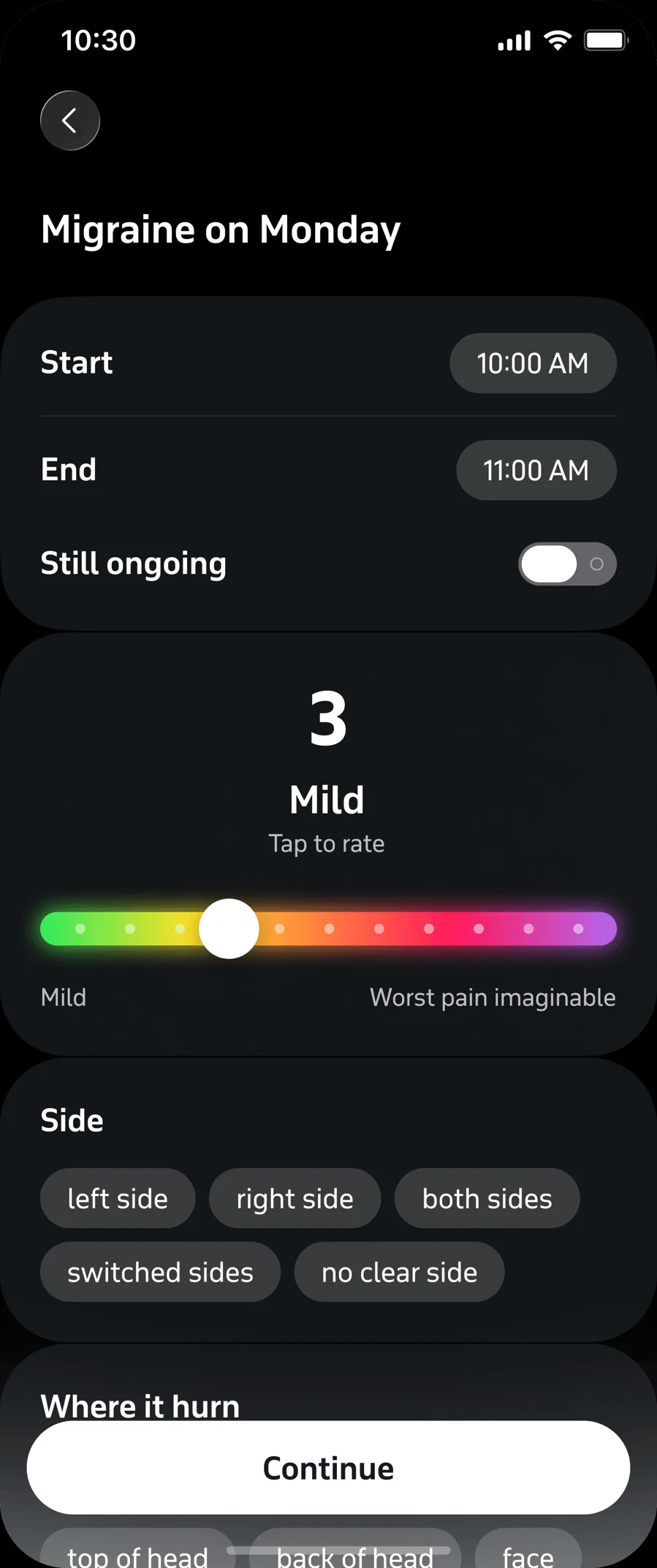
Each entry is saved to your Journal. You can open it again later from the Journal or from your migraine log and edit it, and you can record more than one migraine on the same day.
Three rules from the help centre are worth knowing before your first long attack:
One entry covers one day. The end time cannot go past midnight of the day the migraine began. If it carries on, log the next day as a new entry; a note such as "continued from yesterday" keeps them connected.
"Still ongoing" works only for an attack that started today. When it ends, open the entry and add the end time.
You can go back 7 days. If you log a past day without an end time, the entry ends at the end of that day.
If a symptom or a medicine is not in the catalogue, the note keeps it with the entry. You can also ask for a new tag from the episode details with Give feedback; writing it in a note does not add it to the tag list by itself.
Your migraine log: the last seven days at a glance
Your migraine log shows the last seven days, including today. A marked day is a day you recorded a migraine — not a day Welltory detected one on its own. The number on the day is the severity you gave it. If you logged several attacks that day, the log shows the highest one, and you can open the day to see each entry.
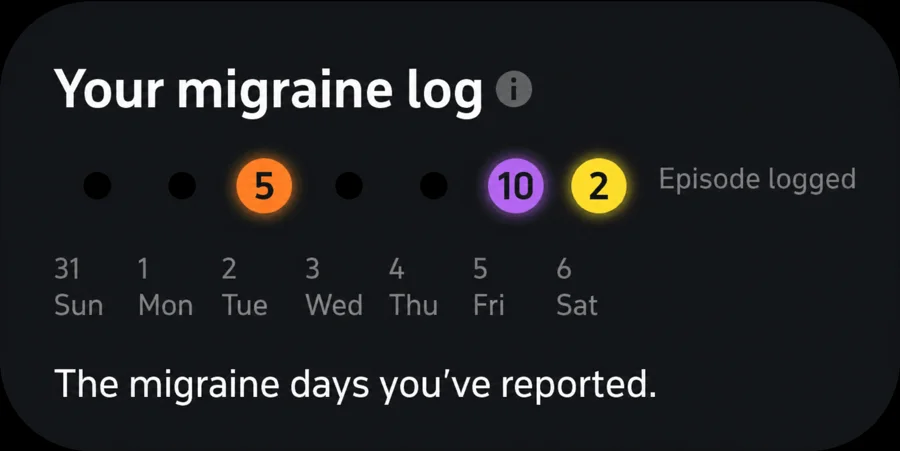
That is the whole point of a diary: a count you can trust. Neurologists ask how many migraine days you had last month and how many days you took acute medicine, because those two numbers decide whether prevention makes sense. A week view filled in at the time answers that better than a reconstruction in the waiting room.
Changes from your baseline: what stress, activity and sleep looked like around migraine days
This is the part a paper diary cannot do. The tracker compares each day with your own history, not with a population average.
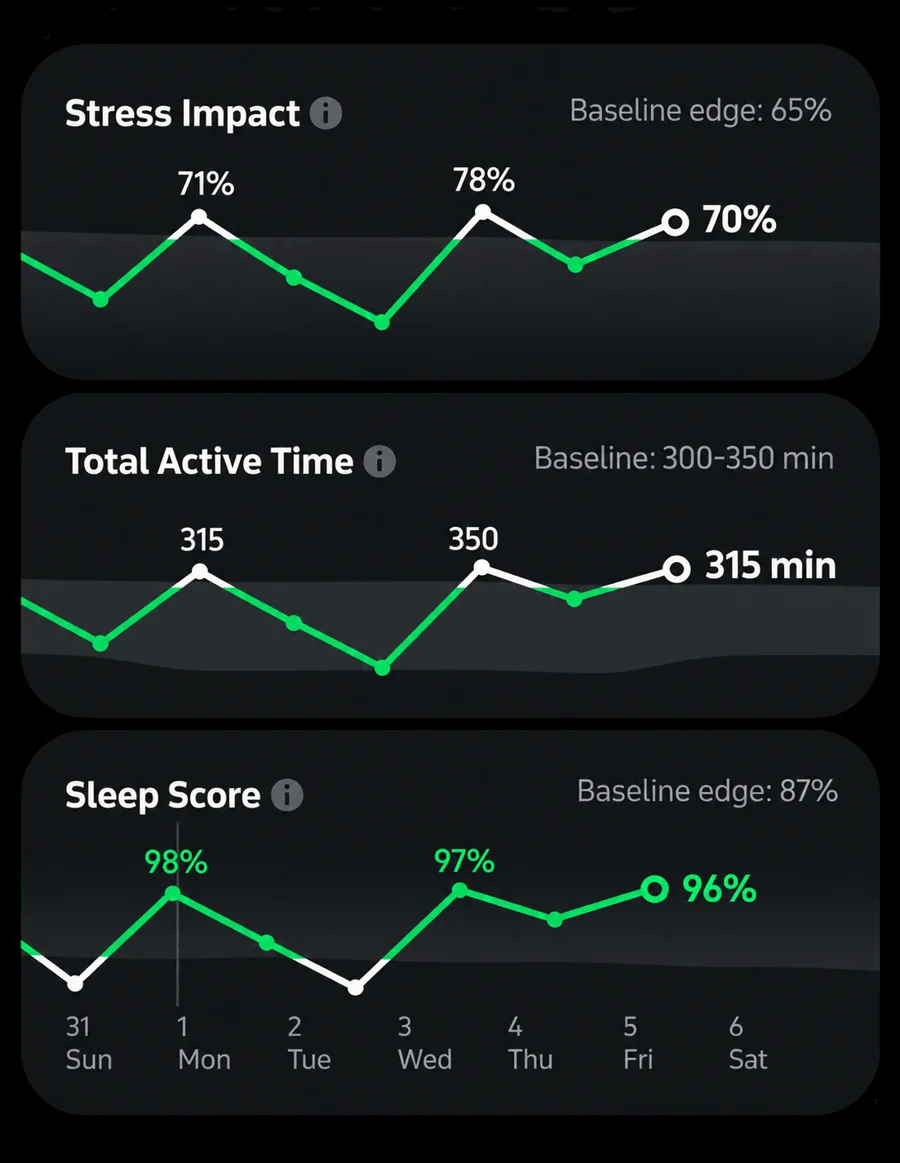
For every day, Welltory looks at the 30 calendar days before it; today's value never moves today's baseline. A day counts towards the baseline only if its sleep period is known and no more than two hours of data are missing while you were awake. With fewer than 14 reliable days, no baseline line is drawn yet.
Three measures are shown:
Stress Impact — stress accumulated over the day. A value above your upper boundary is marked as shifted.
Total Active Time — all active minutes, light movement and workouts included. Values below or above your usual range are marked as shifted.
Sleep Score — your sleep score for that day. A value below your lower boundary is marked as shifted.
In Changes from your baseline, a small green dot means the value was within your range, a larger white dot means it crossed a boundary, and a blank means there was not enough information to compare. A blank does not mean everything was fine. The detailed charts underneath show the daily values against your boundaries.
What this can show you over a few months is a pattern worth asking about: for example, that your attacks tend to come after nights with a low Sleep Score, or after a day when stress stayed above your usual range. What it cannot show is cause. A shifted day is not a migraine prediction, and it is not proof that the short night or the long week triggered the attack — some things people log as triggers turn out to be the attack already starting (your migraine trigger might be the migraine already starting).


Work out your early warning signs with women who get it
Welltory Migraine Lab is a paid, moderated online community for women 18 to 65 living with migraine. Opens December 1, 2026. Peer support and education, not medical care.
What is free, and what needs a subscription?
Free: logging migraines, choosing symptom and medication tags, adding notes, and reading or editing your entries. You can keep a full attack diary without paying.
Subscription: the objective measurements, Changes from your baseline and the detailed charts. Subscribing does not create values for days without measurements, and it does not draw a baseline before there are enough reliable days.
Welltory Care: members of a Care program, such as Migraine Lab, also see pacing charts below the main measures — Routine Shift, Overnight Reset, Autonomic Tone, Restless Night, Heart Rhythm Steadiness and Relative REM. They follow the same idea: your own history, not a population average, and context rather than predictions.
Who sees the tracker, and how do you turn it on?
The Migraine Tracker is available in English on iOS; the best experience is with an Apple Watch or Oura ring, and Spanish and other languages are coming soon. It is turned on for you if you told Welltory you have migraines — during onboarding, when you came back to the app, or in a question on Today.
If you also reported ME/CFS or chronic fatigue, long COVID or POTS, you will see the Crash Tracker by default; you can switch to the Migraine Tracker in the menu. Only one tracker can be on at a time. To turn it on or off: menu → Customization → Today screen → Migraine Tracker. You can switch it on this way yourself, even if you did not mention migraine at onboarding.
Your answers help tailor the app. Welltory does not use them to diagnose a condition.
Do you need an Apple Watch?
For the fullest and most accurate experience, yes: the Migraine Tracker works best with an Apple Watch or Oura ring connected to Welltory. With an iPhone alone you can still take phone-camera readings of heart rate and heart rate variability (HRV) and add notes and tags to them, but the Today screen, the tracker and the baseline charts come with a connected Apple Watch or Oura ring.
The baseline comparison needs days with a known sleep period and no more than two hours of missing data while you are awake, which in practice means measurements collected through the day and night by a device connected to Welltory. Welltory Care, the program built around this kind of data, lists an Apple Watch and an iPhone as the setup for the best experience. A phone-camera reading gives you a heart-rate and heart rate variability (HRV) snapshot, but one reading a day is not an all-day record. See how accurate HRV from a phone camera is.
What the Migraine Tracker cannot do
These limits are not special to Welltory; they apply to every migraine app and wearable on sale today.
It does not predict attacks. No consumer app or wearable has been shown to tell an individual that a migraine is coming. The strongest research models so far were built on clinical-trial data and still need independent validation. See can a smartwatch predict a migraine?
It does not find your triggers for you. It puts your attacks next to your own measurements. Whether a pattern is a trigger, an early symptom or a coincidence is a question to work through with your doctor.
It does not diagnose. A marked day is a day you logged. Telling migraine from other headaches is a clinical job; see is it a headache or a migraine?
It does not replace a clinician report. A dedicated report for your neurologist is not described in the help centre. You can show your log and export measurements as a CSV from the web app.
How does it compare with a paper diary and other migraine apps?
A paper diary costs nothing and every clinic can read it, but it has a known weakness: people fill it in later. In a study in the BMJ, light sensors in the binders showed that participants actually opened their paper diaries at the right time on only 11% of occasions, while the cards they handed in suggested more than 90% (Stone 2002). An entry made on the phone keeps its real timestamp.
Attack-diary apps such as Migraine Buddy, Migraine Monitor or N1-Headache record the attack in detail; some produce PDF reports for clinicians. Wearables such as Apple Watch, Garmin or Oura record your body all day but have no migraine form. Welltory's tracker puts the attack log and your own stress, activity and sleep baseline in one app on iPhone.
For the whole category side by side, see migraine tracker apps compared. If you already use Migraine Buddy, see Welltory vs Migraine Buddy for how to switch or run both.
Living with migraine tracking: the questions people ask next
How long before the charts tell me anything?
The baseline needs at least 14 reliable days before a line is drawn, and a pattern needs several attacks. With episodic migraine, that usually means two to three months of logging before you have something worth showing a doctor. NICE asks for a headache diary of at least 8 weeks for diagnosis (NICE CG150).
What should I log on a day without a migraine?
Nothing in the tracker — the measurements carry on in the background. Clear days matter as much as bad ones, because they are what your baseline is built from.
Should I log a headache if I am not sure it was a migraine?
Yes, and say so in the note. Your doctor can sort mixed days out later; a missing day cannot be recovered.
Can I track medication days?
Yes. Choose what you took and whether it helped in each entry. Acute medicine on 10 or more days a month (15 for simple painkillers) for more than three months is the threshold doctors watch for medication-overuse headache (ICHD-3), so that count is worth bringing to an appointment.
Start understanding your body
Learn what affects your energy, stress, sleep, and daily state. Get the app.
How Welltory helps — and what it cannot do
Log each attack in Migraine Tracker. On iPhone, Welltory's Migraine Tracker keeps the attack record itself: the day it began, start and end time, how severe it was, where it hurt, your symptoms, what you took and whether it helped, plus a note. Logging is free. With a subscription, each migraine day is shown against your own 30-day baseline for Stress Impact, Total Active Time and Sleep Score once there are at least 14 reliable days. A marked day is one you logged, not one Welltory detected, and a shifted day is not a prediction or proof of a cause.
Tag the context. On iPhone with an Apple Watch or Oura ring, the Today screen flags stress stretches and asks "What happened?" — a short night, a long call, day one of your period. After a few weeks, My Patterns shows which tagged situations tend to come before stressful stretches.
What it is, and what it is not. Welltory is a general wellness product, not a medical device. It does not diagnose, predict, monitor, prevent, treat or mitigate migraine or any other condition. Patterns are associations to discuss with your doctor, not proof of a trigger and not a warning system.
Working this out with other women. Welltory Migraine Lab is a paid, moderated online community for women aged 18 to 65 living with migraine; you do not need a formal diagnosis to join. It opens on December 1, 2026; you can book your place now, and your paid period starts on the opening day. Members get a personal strategy built on their own data, a community of women with similar symptoms, and a medical board that explains what is happening in the body. It is education and peer support, not medical care, and it does not replace your clinician. Join Migraine Lab or read what Migraine Lab is, who it is for and what it costs.
How we made it
Made with AI tools, then edited and fact-checked by the Welltory team. See our Editorial & AI policy.
Jane Smorodnikova, co-founder of Welltory, built the methodology behind how we read physiological data.
Written by Tatsiana Yashyna.
Discounts for blog readers: up to 36% off
See what affects your energy, stress, sleep, and daily state with Welltory
This article describes a consumer wellness product and is not medical advice. Welltory is a general wellness product, not a medical device: it does not diagnose, predict, monitor, prevent, treat or mitigate migraine or any other condition. The Migraine Tracker records what you report and compares days with your own history; it does not detect or predict attacks or identify their cause. Features and availability are as described in the Welltory Help Center on 24 November 2026 and may change. A sudden, severe or new kind of headache, or a headache with weakness, confusion, vision loss, fever and a stiff neck, or after a head injury, needs urgent care — call 911 in an emergency.
Was this helpful?
Ask AI for a summary of page


Written by Jane Smorodnikova

The founder and CEO of Welltory. A recognized tech leader with two Master's degrees and experience at MIT, she has scaled Welltory to over 17 million users.
Written by Tatsiana Yashyna

Deputy COO at Welltory. With a background in medicine and years of working with health data, she translates research and real physiological signals — sleep, stress, heart rate, and hormones — into clear, evidence-based explanations that help people understand what their bodies are telling them.
References
- Welltory Help Center. Migraine Tracker (iOS). Updated 10 November 2026. https://help.welltory.com/en/articles/17603152-migraine-tracker-ios
- Welltory Help Center. Welltory Care: support programs for ME/CFS, long COVID, POTS, and migraine. Updated 18 November 2026. https://help.welltory.com/en/articles/17744231-welltory-care-support-programs-for-me-cfs-long-covid-pots-and-migraine
- National Institute for Health and Care Excellence. Headaches in over 12s: diagnosis and management (CG150). 2012, updated 2021. https://www.nice.org.uk/guidance/cg150
- Headache Classification Committee of the International Headache Society. The International Classification of Headache Disorders, 3rd edition. Cephalalgia 2018;38(1):1–211. https://doi.org/10.1177/0333102417738202
- Stone AA, Shiffman S, Schwartz JE, Broderick JE, Hufford MR. Patient non-compliance with paper diaries. BMJ 2002;324(7347):1193–1194. https://doi.org/10.1136/bmj.324.7347.1193
- Karsan N, Bose P, Newman J, Goadsby PJ. Are some patient-perceived migraine triggers simply early manifestations of the attack? Journal of Neurology 2021;268(5):1885–1893. https://doi.org/10.1007/s00415-020-10344-1
- Faisal F, Poole AC, Danelakis A, et al. Forecasting migraine with time-series machine learning from mobile health data. The Journal of Headache and Pain 2026;27:91. https://doi.org/10.1186/s10194-026-02346-7
- Do TP, Remmers A, Schytz HW, et al. Red and orange flags for secondary headaches in clinical practice: SNNOOP10 list. Neurology 2019;92(3):134–144. https://doi.org/10.1212/WNL.0000000000006697


