


The body reacts to stake, not spectacle. We watched a whole country's heart rate rise for its own team — and stay flat for the biggest broadcast in its history.
For thirty-nine days this summer, the World Cup lived in North America. One hundred and four matches, played in front of a home crowd and broadcast into its evenings — the first men's World Cup on American soil in a generation. The country talked about it, argued about it, filled bars for it.
We wondered whether the body was keeping its own record. Not the opinions people posted or the tickets they bought, but the quieter thing underneath — the heart, beating a little faster or a little slower, logged passively all summer by a few tens of thousands of people wearing watches and pressing fingers to phone cameras. Does a nervous system notice a tournament? And if it does, what exactly is it reacting to?
This is the third story we've drawn from the continuous HRV record of our users. The first two traced America's hidden calendars — the Sunday Scaries the nervous system has never heard of, and the shape of an American summer written in heart rate. This one is about a spectacle, and, for the first time, it follows that spectacle past America’s borders.
You can see the World Cup in a nation's heartbeat
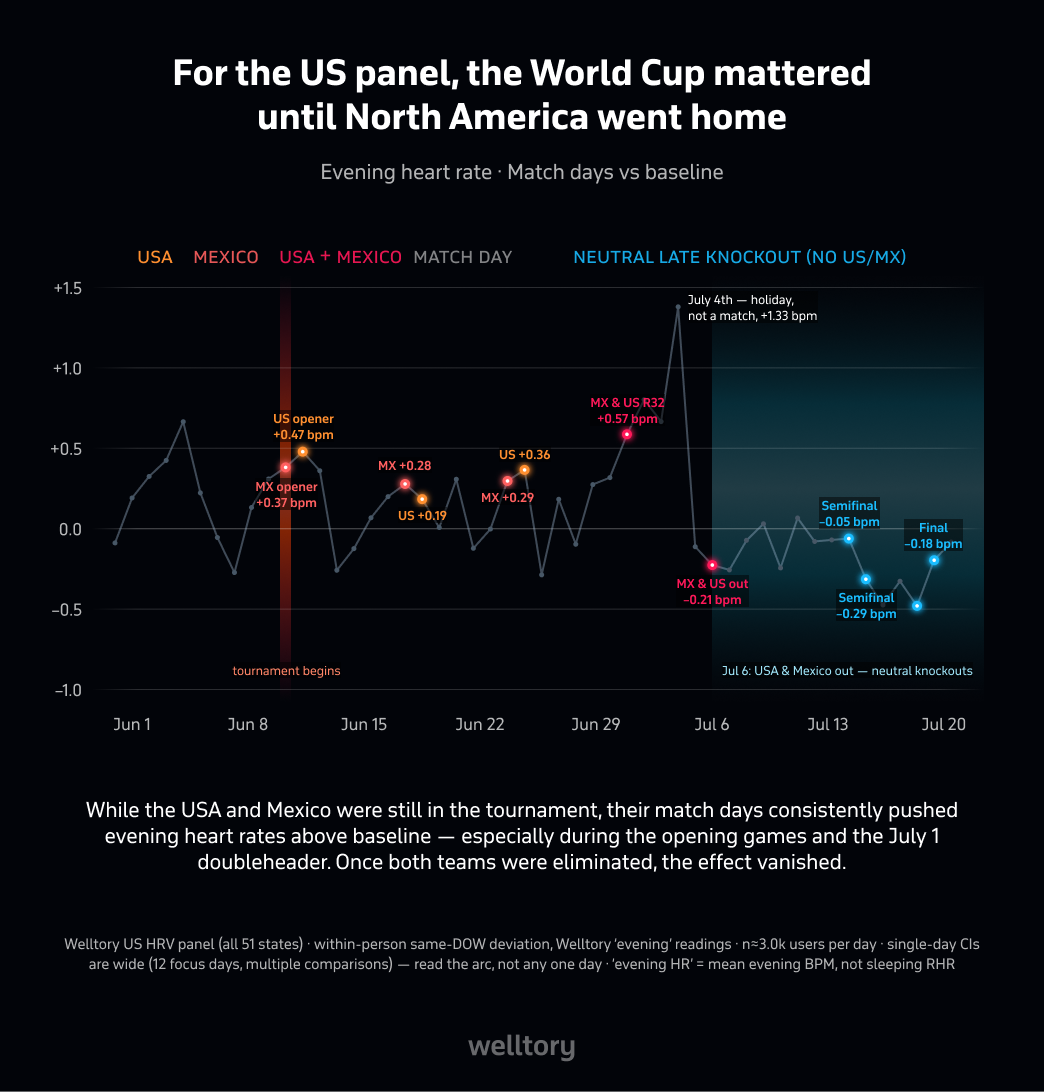
Across the US panel — hundreds of thousands of readings a night, from people in fifty states and on every schedule — the tournament left a mark you can actually measure. On the nights the USA and Mexico played, the country's evening heart rate rose above its own ordinary baseline. Not by a great deal in any single person — about a third of a beat — but in the same direction for tens of thousands of people at once, which is exactly what turns a private flicker into a national signal. A single sporting event, surfacing in the aggregate pulse of a whole country. That is the finding: the body of a nation registered a game.
So we looked for the obvious driver: the crowd. The bigger the audience, the bigger the mark on the panel — that was the assumption. And the final should have been the peak of the entire summer. Argentina against Spain drew sixty-six million American viewers, the largest audience for any soccer match in US history.
The panel stayed almost still.
Sixty-six million people watching, and the country's heart barely moved — because for Americans it was a magnificent, neutral match, with no team of their own in it. The lift had come somewhere else entirely: on the nights the USA and Mexico played, strongest while both were still alive in the draw, easing the moment they went out. The body wasn't counting viewers. It was counting who it had in the game.
It wasn't the spectacle. It was the stake.
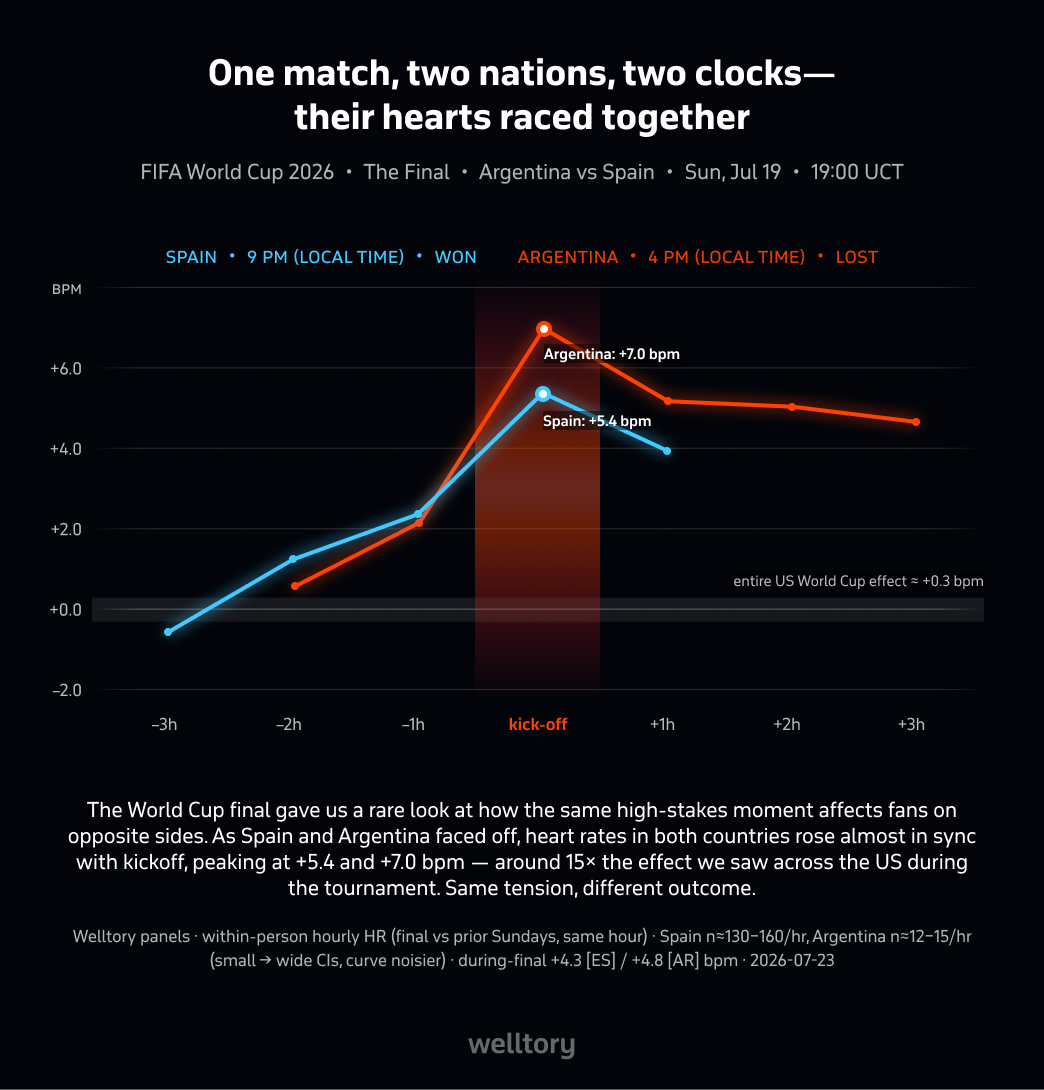
So we asked the obvious next question. If the reaction is about having a team, what happens in the two countries that had a team all the way to the end?
Aligned that way, the two curves do the same thing. They climb through the hour before the match and peak together, exactly at kickoff — four, five, seven beats a minute above an ordinary Sunday, holding there through a final that ran to extra time. Through the ninety minutes, and the thirty more, it made no difference which way it would end: the tension was shared.
The difference came after the whistle. Spain won — its second World Cup — and by Monday morning the Spanish panel had already settled back into an ordinary week. Victory, in the data, is a spike: sharp, and quickly spent. The defending champions, Argentina, took it harder. Hours after the final whistle, deep into the evening, their heart rate was still running about four beats a minute above a normal Sunday, and it was slower to come all the way down the next day. Winning is a spike; losing is a tail. (Argentina's panel is small — a few dozen people — so read that last part as a hint, not a verdict.)
It's the same thing the American data showed us — rooting interest, written into the pulse — carried to a country with everything on the line.
None of this would surprise a cardiologist. What we read as a fraction of a beat has a much heavier end of the scale.
In 2008, The New England Journal of Medicine reported on the 2006 World Cup in Germany: on days the German team played, acute cardiac emergencies in the Munich area ran more than two and a half times the normal rate — over three times among men — and the risk peaked in the two hours right after kickoff. The same rooting interest we watched lift a nation's evening by a third of a beat can, at its far edge, put a person in an ambulance. Watching your team, it turns out, is measurably hard on the heart. And this year a group at Bielefeld University put smartwatches on football supporters and watched their heart rates jump thirty-six percent during goals — while honestly noting that a few percent of it was simply the beer.
Our numbers are gentler than an emergency room's, and honest about their own edges: some of an elevated evening is a late night, a drink, a room full of people. But across the same event, in three different countries, the direction is the same. The heart keeps score.
The nervous system, it seems, reacts to stake, not to spectacle. It stayed still for the biggest broadcast of the American year and stirred for a third-round group match in June — because one had a team in it and the other did not. You can read a whole tournament in the pulse of a country, and you can read a single final in the pulse of the two nations playing it.
The oldest instrument we carry keeps a tally we never asked it to keep. It doesn't count the viewers. It counts what we have to lose.
Sources
- Wilbert-Lampen U, Leistner D, Greven S, et al. Cardiovascular Events during World Cup Soccer. New England Journal of Medicine 2008;358:475–483. https://doi.org/10.1056/NEJMoa0707427
- Fuchs C, Deutscher C, Langrock R, Adam T. Measuring football fever through wearable technology. Scientific Reports 2026. https://doi.org/10.1038/s41598-026-36182-1
Based on anonymized, passively collected heart-rate data from Welltory users across 2026. US figures are within-person evening heart-rate deviations (each user's match-night value against their own typical night), averaged across ~7,000 users per night. Spain and Argentina figures are within-person hourly heart rate on the final day against the same hour on prior Sundays (Spain n ≈ several hundred; Argentina n small — a few dozen during the match — so its numbers are real but imprecise). Effects are small in absolute terms and measured in aggregate; individuals vary enormously. Patterns are observed among Welltory users and are hypothesis-generating; they are not medical findings and have not been replicated in an independent dataset.
Was this helpful?
Ask AI for a summary of page


Written by Valeriia Avvakumova

AI strategist and systems builder specializing in AI personalization, RAG/LLM pipelines, agentic automation, localization, GEO, Harness Engineering, Edge AI, and zero-cost AI systems. Leads AI across product, infrastructure, content, support, and marketing.

