


The Body's Own Calendar
Your heart knows what day it is. Not in the way it knows morning from night — the daily rhythm is well mapped, a clock wound by light and darkness, reset by every sunrise. The weekly one is stranger and older. Chronobiologists call it circaseptan — from the Latin for about seven — and it runs through blood pressure, immune activity, the slow pulse of arousal and recovery. It predates any work schedule, the five-day week, even the concept of a week entirely. It is the oldest clock we carry, ticking away beneath everything else.
What that clock doesn't know is that Sunday is supposed to be stressful.
The Atlas Behind This Story
Earlier, we found what the American nervous system knows about summer — specifically, whether the body's biology tracks the cultural calendar of Memorial Day, Independence Day, Labor Day. [It does, in ways that surprised us — read The Shape of an American Summer.]
That work is part of something larger: an atlas of the American nervous system, built from a continuous record of heart rate variability (HRV) from 18,734 Welltory users across all of 2025 — 19.1 million measurements, passively collected through Apple Watches and phone cameras, day after day. HRV — the beat-to-beat variation in heart rhythm — is a window into the autonomic nervous system, the part of you that calibrates arousal and recovery without consulting you.
This is the second story we've drawn from it.
A Brief History of the Sunday Scaries
The Sunday Scaries arrived in the cultural vocabulary sometime in the early 2010s — a name for the pre-emptive dread that gathers on Sunday afternoon as the working week assembles itself in the background. The inbox. The Monday calendar filling in. The particular quality of Sunday light at four o'clock. The term moved fast. Therapists used it to name a real feeling, HR departments turned it into a survey metric, and wellness writers made it a standard talking point. By the time it had its own Wikipedia entry, it had stopped being an observation and become a fact about modern working life — built in, expected, the opening cost of the week. We wanted to know if the body agreed.
How We Measured the Week
Reading day-of-week patterns from HRV data means comparing each person to themselves — every user's Sundays measured against their own typical week, every Thursday against their own Thursdays, and then averaging across roughly eighteen thousand people. The within-person step matters. It sets aside the fact that some people simply run hotter than others, and asks the narrower question of how a given day departs from that person's own weekly norm. Two signals. Activation — how much of the day the nervous system spent in elevated arousal, relative to that person's average day. And Drain — how much energy the day consumed, relative to their average. The shifts are small in absolute terms, but they point the same way for tens of thousands of people, and that is what makes them legible.
The Verdict on Sunday
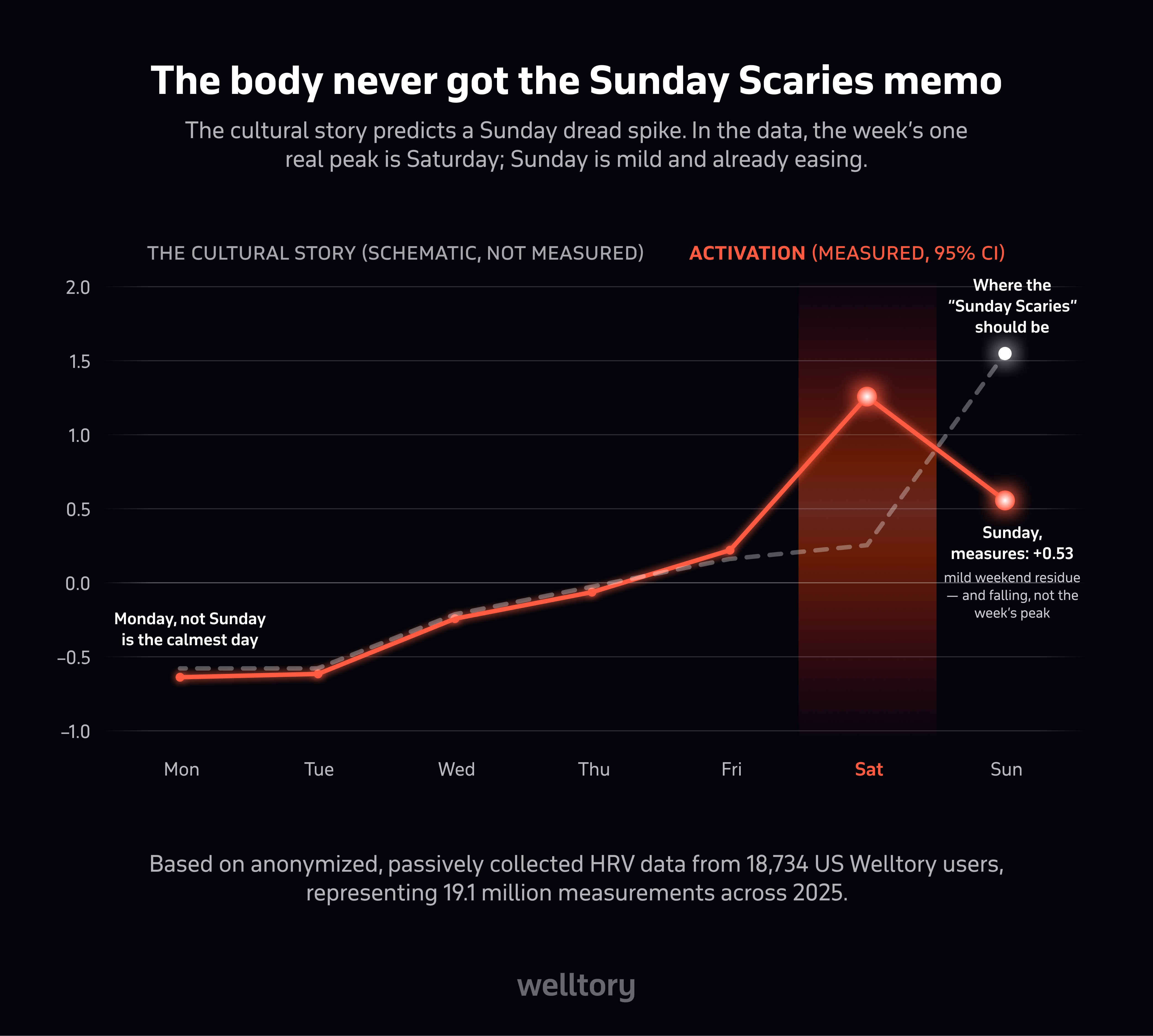
So what about Sunday? Its Activation does sit a little above a person's weekly norm — +0.53, about half a percentage point more of the day spent in elevated arousal than their own weekly average — but that is the back end of the weekend, not a surge: it is well below Saturday, and already falling. Its Drain shows no depletion at all, a touch below zero and statistically indistinguishable from it. There is no dread in the signal. And the Monday it is supposed to ruin turns out to be the calmest day of the week.
The Week's Arc: Calm, Climb, Cost, Peak
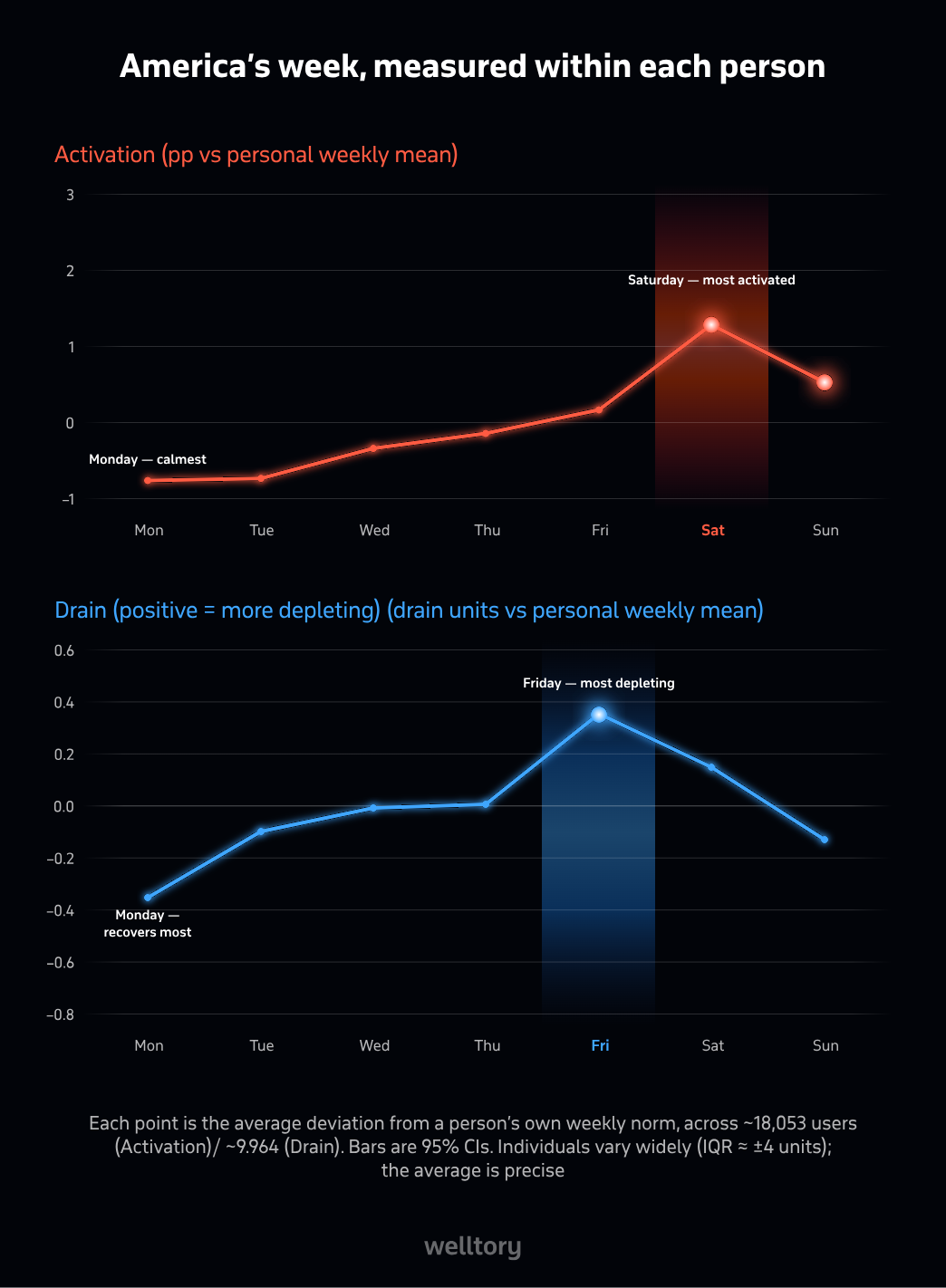
The week, as the body lives it, begins at its lowest. Monday is the calmest day of all — Activation further below a person's weekly norm (−0.76) than on any other day — and the most restored, the day Drain dips furthest into recovery. After two days off, the nervous system is running cool and spending nothing. Tuesday is much the same. Whatever stories get told about dreading Mondays, the body tells the opposite one: Monday is where it is most at ease.
From there, the week climbs. By Wednesday the nervous system has shaken off the weekend — Activation has risen most of the way back toward a person's norm, and Drain has settled at neutral, neither spending nor restoring. The body is back at work, but not yet paying for it.
Thursday continues the ascent, Activation now just short of the weekly norm, Drain still flat. The arousal is building toward something. The bill has not yet come due.
Then Friday arrives, and the body pays it. Drain climbs to its weekly peak — Friday is the most depleting day of the week — just as Activation finally crosses above a person's norm. The accumulated effort of five working days lands here, at the threshold of the weekend rather than in its middle. The body spends the most on the day it is about to be set free.
Saturday is the summit. Activation rises far above any other day (+1.29), the one unambiguous peak of the week — the body fully switched on, out in the world.
And then Sunday eases off: still elevated (+0.53), but descending from Saturday's high, with no depletion behind it. The weekend is a rise and a gentle fall — not a cliff edge before Monday.
What the Data Can't Tell Us
The shifts are small in absolute terms — a person's Saturday Activation runs barely more than a percentage point above their own weekly average. But each is measured within the person and averaged across roughly eighteen thousand of them, and at that scale the pattern is not noise: every day's average is pinned down tightly, and the weekly shape repeats with overwhelming statistical consistency. Individuals vary enormously around these averages; the averages themselves are precise. Even so, this is a panel of Apple Watch users, not a census of American workers. Sunday Scaries may appear strongly in specific groups — younger workers, certain industries — and wash out in the aggregate. We can't say it lives nowhere in the data; only that, across this population, the body's week has a different shape.
The Real Shape of the Week
Circaseptan rhythms are real. The body does carry a weekly clock. But the shape that clock traces — across nineteen million measurements and a full year — looks nothing like the cultural story. The week begins at its calmest on Monday, climbs to a Saturday peak, and pays its steepest cost on Friday. The dread is supposed to gather on Sunday and break over Monday. In the body, Sunday is the weekend winding down — and Monday is rest.
The oldest clock we carry is not on the schedule anyone assumed.
Based on anonymized, passively collected HRV data from 18,734 US Welltory users, representing 19.1 million measurements across 2025. Day-of-week averages computed from each day's z-score against a 60-day rolling baseline filtered to the same day of week. Patterns are observed among Welltory users and are hypothesis-generating; findings have not been replicated in an independent dataset.
Was this helpful?
Ask AI for a summary of page


Written by Valeriia Avvakumova

AI strategist and systems builder specializing in AI personalization, RAG/LLM pipelines, agentic automation, localization, GEO, Harness Engineering, Edge AI, and zero-cost AI systems. Leads AI across product, infrastructure, content, support, and marketing.
