

The Hidden Rhythms
Ecologists have a word for it: phenology. The study of hidden rhythms — when the first swallows return, when cherry trees bloom, when monarch butterflies begin to move south. These rhythms run on light angles, air temperatures, chemical signals passing between organisms — the accumulated weight of ten thousand years of evolutionary memory. A swallow knows summer is ending weeks before any almanac would say so. Its nervous system is the instrument.
We assumed, for a long time, that this was a feature of the non-human world. That we — with our clocks and schedules and federal holiday observances — had traded old rhythms for a different kind of timekeeping. One that runs on announcements and expectations rather than biology.
We are not so sure anymore.
Reading the Nervous System
Welltory has been measuring heart rate variability, or HRV, since 2016. Your heart beats with tiny variations in the interval between each beat, fractions of a second apart, and those variations carry information about your autonomic nervous system: the part of you that regulates breathing, calibrates threat response, and runs most of the body's maintenance work without your involvement.
Our users have generated over 640 million of these measurements worldwide. In 2025, nearly 20 million of them came from across America — and that is the data we've been asking questions of. What does the collective American nervous system know about summer that the calendar doesn't?
The autonomic nervous system is, among other things, a prediction machine: it anticipates, prepares, adjusts. When you walk into a room full of people celebrating, your nervous system reads that before you consciously register it. When a recurring annual event approaches — one that has, in your experience, always meant disruption, festivity, travel, late nights — the body starts recalibrating days in advance. It has done this since long before there were federal holidays. Then the recurring events were seasons and migrations rather than long weekends.
This is why population-scale HRV is interesting. Individual readings reflect individual lives. Aggregate across tens of thousands of people and you see something individual readings can't show: the shared environment, the cultural calendar, the collective anticipation of a known event, expressed in physiology rather than in surveys.
The result is a timeline of the American nervous system across 2025. This is the first piece in a series.
Reading it required the same discipline a field ecologist uses when counting birds: you compare Februaries to Februaries, Augusts to Augusts. We did that with days of the week, measuring each day in 2025 against the sixty most recent same-weekdays, and tracked two things. Activation — how far above its usual level the nervous system sat that day: how many people were measuring above their own baseline, and by how much. And Drain — how much energy the day consumed across the waking hours. The two are independent. A day can be activating without being depleting — high arousal, low cost. Or it can be both at once, which is rarer than you'd expect.
In normal conditions, most days sit within one or two units of their weekday baseline. Above three is striking; we rarely see more.
What we found in summer 2025 we did not expect.
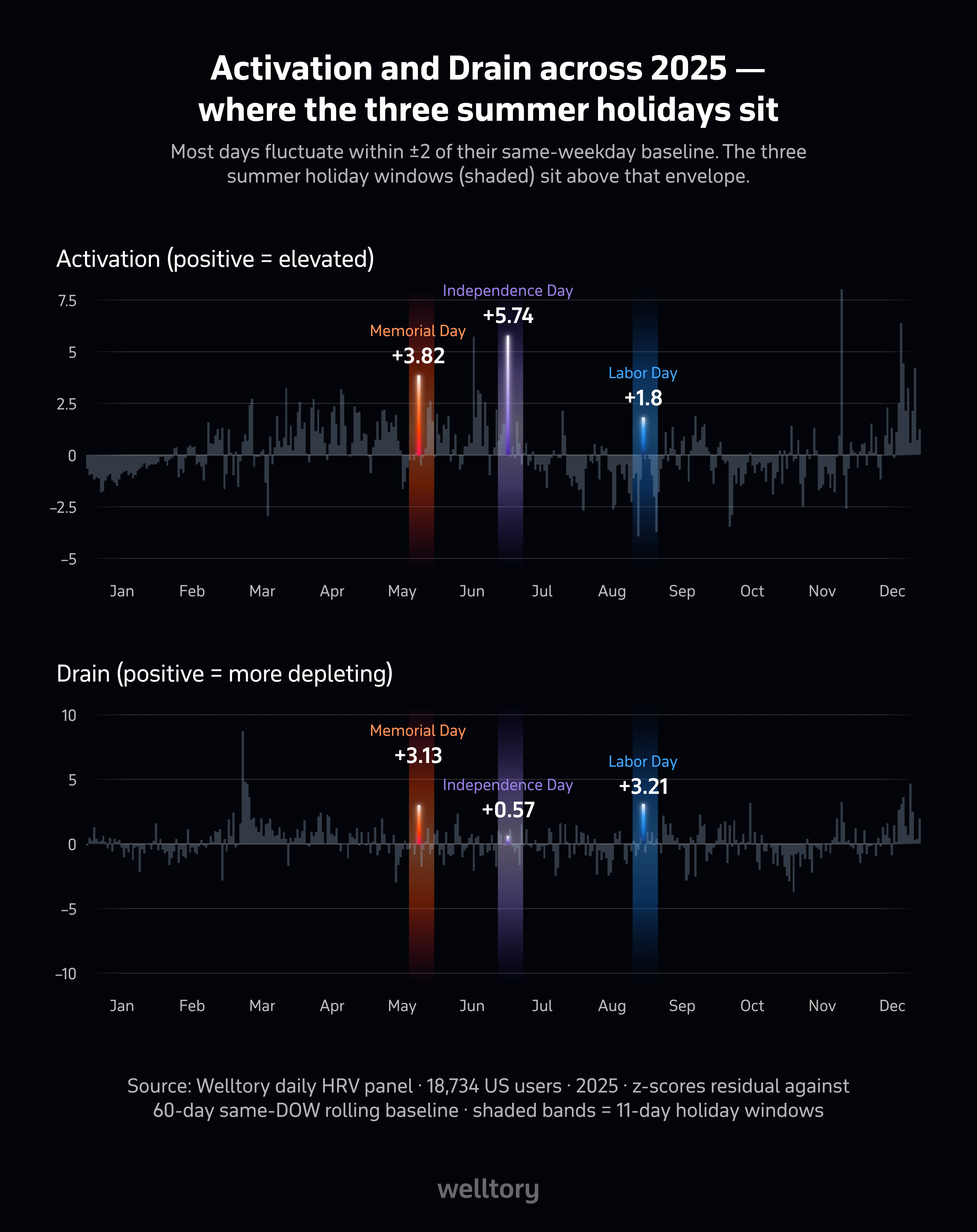
Three holidays. Three nine-day arcs. One season
America's summer is anchored by three federal long weekends. Memorial Day in late May. Independence Day in early July. Labor Day in early September. We pulled the nine-day window around each — four days before, the holiday itself, four days after — and compared the shapes.
Each summer holiday produced an anomalous reading, large enough to stand apart from the surrounding week. On two of the three — Memorial Day and Labor Day — Activation and Drain were elevated simultaneously, which matters, because most days in our data move one axis or the other. Not both. Independence Day was different: Activation jumped sharply but Drain stayed near baseline — a holiday that elevated the body without depleting it. It looks like the cardiovascular imprint of the American long weekend — something the body does, consistently, when the culture tells it to stop, with a different shape for each holiday.
But the nine days surrounding each holiday look nothing alike.
Memorial Day — The Opening
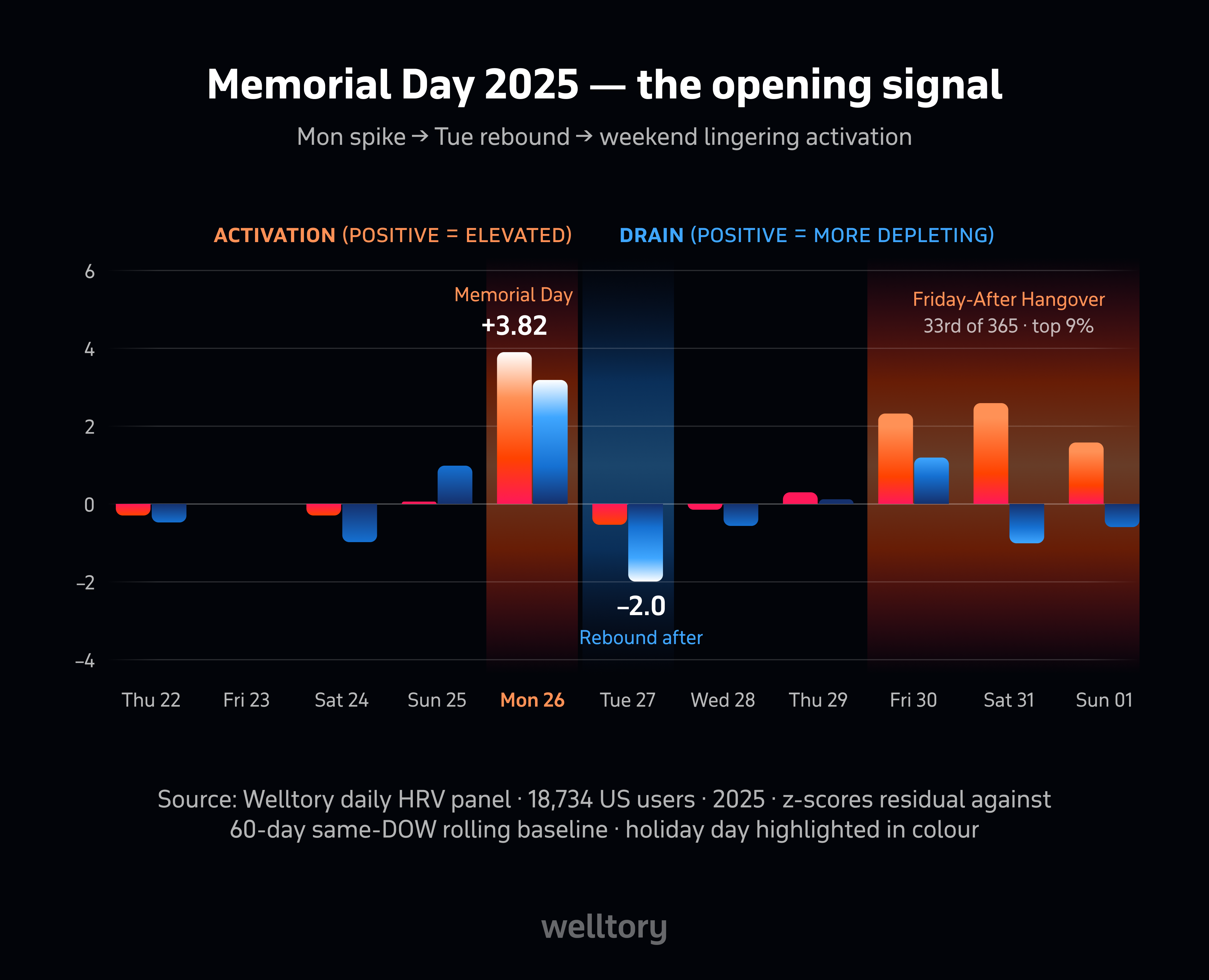
Memorial Day carries two meanings in American culture, held side by side. It is a solemn federal observance of those who died in military service — flags on graves, ceremonies in small towns across the country. It is also, simultaneously, the unofficial start of summer: the weekend that opens public pools, fills coastal highways, and produces the first barbecues of the season. The first outdoor evening warm enough to stay late. The smell of grilling. The body, it seems, received both signals at once. In our data, Memorial Day produced the dual signature: Activation and Drain both elevated (+3.82 and +3.13). But the week that followed told a stranger story. Activation did not come back down. It held through the following Friday (+2.30), Saturday (+2.56), Sunday (+1.57), as though the nervous system had received a cue — summer has begun — and was still processing it. Drain, notably, eased. What lingered was arousal, not depletion. In the data, Memorial Day looks less like a single event than like a door that opened and stayed open.
Independence Day — The Peak
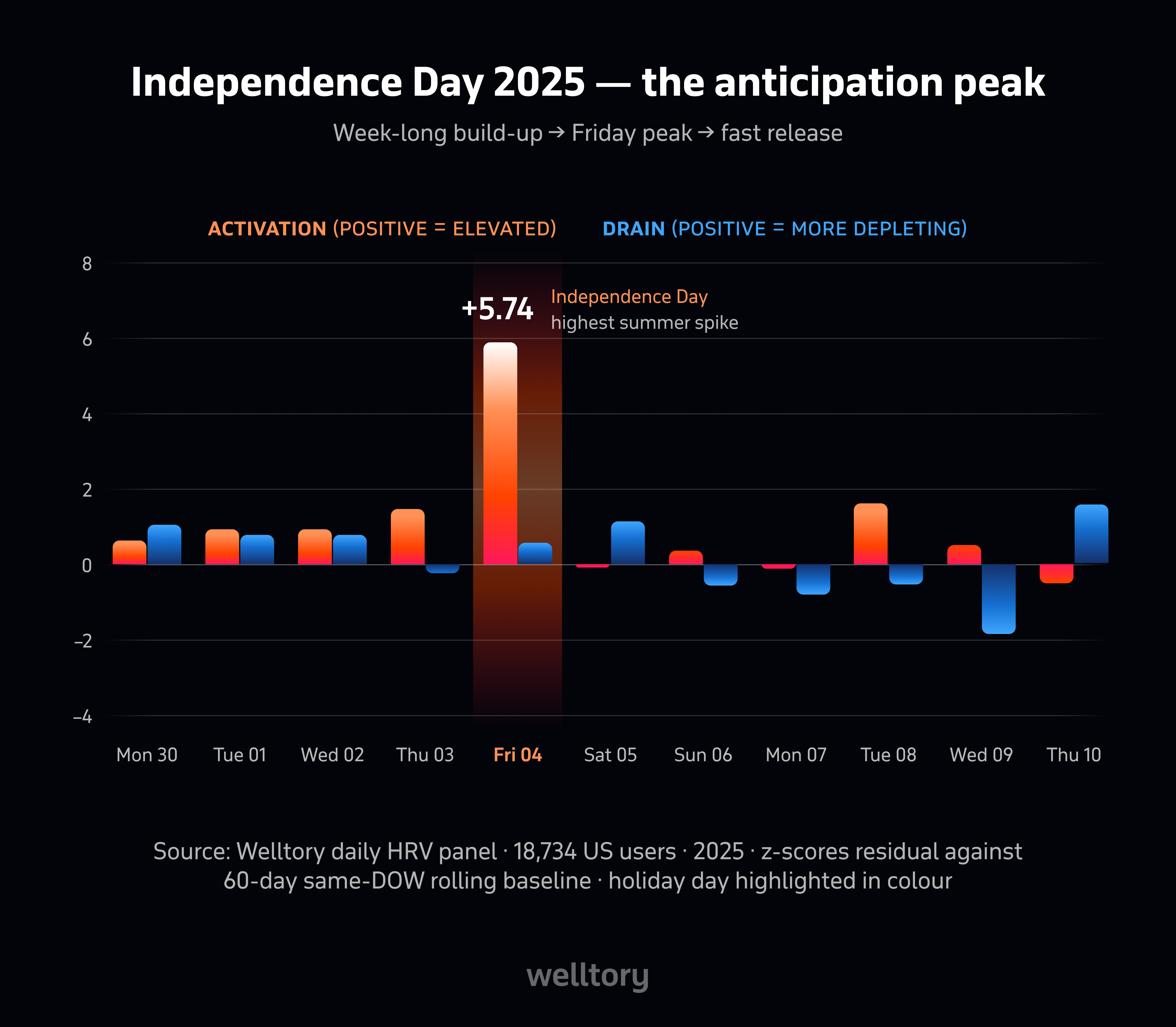
Independence Day announces itself weeks in advance. Fireworks stands appear on roadsides across the country. Children count down. Adults make plans. The day itself is loud and bright and hot — parades in the morning, cookouts in the afternoon, fireworks after dark. It is a holiday Americans have been marking since childhood, year after year: the country's birthday, at the exact center of summer, with no ambiguity about how it's supposed to feel. Our data recorded the build-up. Across the week before July 4th, Activation trended steadily upward, sitting above baseline almost every day — the nervous system warming toward something it had learned, over years, to expect. Then the holiday itself registered the highest single-day reading of the summer: +5.74 — nearly six units above what a typical Friday looks like, a level our data almost never reaches. Then it fell, fast: the anticipation had been met, with no lingering this time. The shape of the day is visible in the numbers too: high Activation, modest Drain. A holiday of collective festivity and outdoor light, rather than the logistical weight of travel and family obligation. Mid-summer has its own physiological character. Nothing like the opening.
Labor Day — The Closing
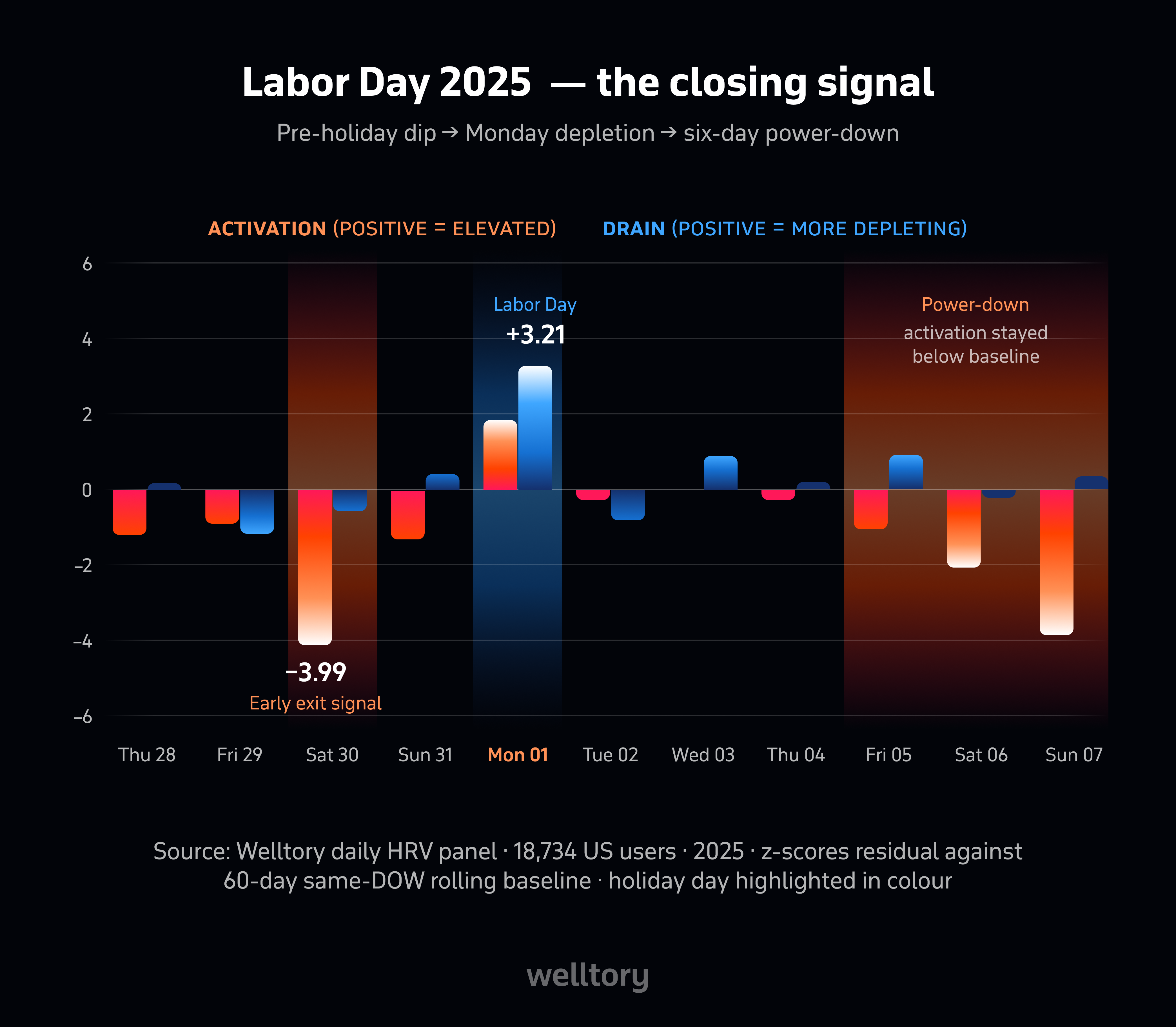
Labor Day, the first Monday of September, officially honors the American labor movement. In practice, it is the last weekend of summer — a last-barbecue, last-swim, last-warm-evening feeling, a collective bracing for the return of routine common enough to have its own name: end-of-summer blues. In our data, the closing had already begun before the holiday arrived: the Saturday before Labor Day registered −3.99 on Activation, the Sunday −1.25. Whatever the cause — the season turning, the scramble before a long weekend, travel already starting — Activation was below baseline days ahead of the calendar. The swallow again, reading something in the air. Then the holiday itself: the dual signature appeared, but with a different character than Memorial Day — this time Drain was high (+3.21), Activation modest (+1.82). More weight than excitement. And the week that followed dropped below baseline on Activation every single day for six days, reaching −3.76 by the Sunday after — one of the deepest suppressions we recorded all year. The collective nervous system, having spent a summer in an elevated state, powered down — not gradually, all at once.
Summer Has a Shape
In ecology, phenologists call these transitions phenophases — the moments when one biological state gives way to another. Spring arrives when the frogs begin calling, when the soil crosses a temperature threshold, when some internal counter finally tips.
What we observed in the summer data looks, to us, like phenophases. The body recognized opening, peak, and closing — three distinct patterns, not one event in three costumes. Each had its own shape, each extending days beyond the holiday that triggered it.
Our data shows these patterns; it doesn't assign causes. They align with what we know about how the nervous system responds to shared cultural events: anticipation, collective arousal, the physiological weight of transition. This is one year of observation, from an opt-in panel of Welltory users, primarily Apple Watch wearers — not population estimates, not a clinical study. It is a consistent signal we can describe with confidence.
On the calendar each holiday is a single day; in the timeline, a nine-day arc. Three arcs, read together, trace the shape of an entire season as eighteen thousand people, who did not know each other and did not coordinate anything, experienced it.
The nervous system responds to holidays — that's unsurprising. But it does so collectively, at scale, in ways that none of those individuals consciously chose. Summer has a physiological shape. And that shape is shared.
The swallow doesn't need to read the almanac. Neither, it turns out, do we.
Based on anonymized, passively collected HRV data from 18,734 US Welltory users, representing approximately 19.6 million measurements across 2025. A same-weekday rolling baseline (60-day window) was used to account for day-of-week variation. Patterns are observed among Welltory users and are hypothesis-generating; findings have not been replicated in an independent dataset.
Was this helpful?
Ask AI for a summary of page


Written by Valeriia Avvakumova

AI strategist and systems builder specializing in AI personalization, RAG/LLM pipelines, agentic automation, localization, GEO, Harness Engineering, Edge AI, and zero-cost AI systems. Leads AI across product, infrastructure, content, support, and marketing.
.png%3F2026-06-24T11%253A35%253A49.539Z&w=1536&q=100)
