
Migraine deep dive: your brain has a threshold, and everything in your life is filling the bucket.
The neuroscience in plain terms: what's happening in your brain, why the same trigger hits one day and not the next, and how your body warns you early.


Picture this: Friday night, friend's birthday, some Italian place. It's loud but whatever. You had 2 glasses of wine, which is fine, you've done that a million times. You slept okay last night. Not great, but okay. You skipped lunch because the day got away from you. The lights in there are those trendy Edison bulbs that flicker just enough to be annoying if you're paying attention, which you're not.
None of this is a problem. You've done all of this before and been fine.
And then about 45 minutes in, you feel it. That little hum behind your left eye. The neck starts tightening. A wave of nausea that has nothing to do with the food. And your whole body just goes: here we go.
The next 24 hours are gone. Dark room, cold pack on your face, everything canceled. You lie there cycling through what caused it: maybe the wine, maybe the lights, maybe that cheese plate, or the skipped lunch. You don't know. You never know. And you're furious at yourself for "letting this happen" even though you did absolutely nothing different from the last 10 times this didn't happen.
That's the thing about migraine triggers that makes people lose their minds. The same wine that wrecks you on Tuesday does nothing on Saturday. The same stress that triggers one migraine doesn't trigger the next. You track every variable like a scientist and the pattern still makes no sense.
There's a reason for that. The model most people use, "triggers cause migraines," is just wrong. And once you understand what's actually going on, a lot of things start to make sense.
A migraine is not a headache
Let's get this one out of the way first because misunderstanding this leads to everything else going wrong.
A headache is pain in your head. A migraine is a neurological event that sometimes includes a headache but is much, MUCH bigger than that.
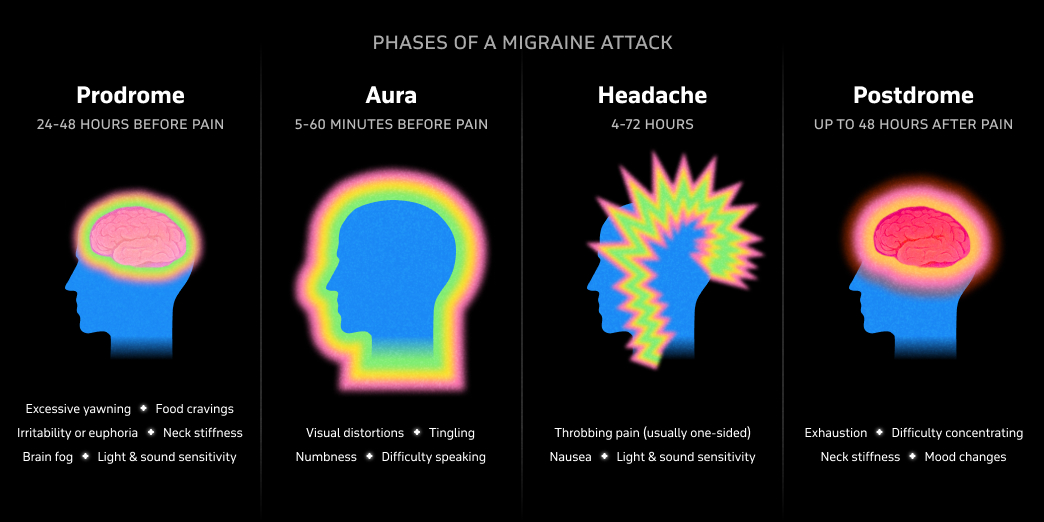
A migraine attack has up to four phases that can span 3-4 days:
Prodrome (up to 24-48h before pain): Your brain starts changing. You might yawn excessively, crave specific foods, feel unusually irritable or euphoric, get neck stiffness, feel foggy, or become sensitive to light and sound. Estimates range from about a third of people in population studies to 77-87% in clinical settings [1]. Most don't recognize these as part of the migraine because they seem so unrelated to a headache.
Aura (\~25% of people): Visual distortions (zigzag lines, blind spots, shimmering edges), tingling, numbness, or difficulty speaking. Each individual aura symptom typically lasts 5-60 minutes, though when multiple symptoms occur in sequence, the total aura phase can last longer. This is associated with a slow wave of electrical activity spreading across your cortex called cortical spreading depression (CSD). CSD is well established as the mechanism behind aura, though whether it directly triggers the headache phase (especially in migraine without aura) is still actively debated in the field.
Headache phase (4-72 hours): The part everyone knows about. Throbbing, usually one-sided, with nausea, light sensitivity, sound sensitivity, and sometimes the feeling that your skull is actively trying to escape your head. During this phase, the trigeminal nerve is activated, releasing inflammatory chemicals around the blood vessels in the meninges (the membranes surrounding your brain).
Postdrome (up to 48 hours after): The "migraine hangover." Exhaustion, difficulty concentrating, neck stiffness, mood changes. Your brain is recovering from what was essentially a neurological storm.
When you add it up, a single migraine attack can affect you for up to 5-6 days. Calling it a "bad headache" is like calling a hurricane "some wind."
Here's something people who don't get migraines never understand. When you're sick with a cold or the flu, you cancel your plans and spend a few days on the couch. You can eat, you can watch something, you can text people back.
When you have a migraine, there is no Netflix. There is a dark room with the curtains taped shut and a cold pack on your face and your eyes closed because even the standby light on the TV is too much. You can't watch anything. You can't read anything. You can't scroll your phone. You can't have a conversation. You lie there and wait for it to pass.
And if you're a parent or an adult with responsibilities, you don't even get to do that. The kids/pets still need to eat. School pickup still happens. So you drag yourself out of the dark room, do what has to be done with the room spinning and your skull pounding, and drag yourself back. That's what "just a headache" actually looks like.
The bucket model
The most important insight is that a migraine doesn't happen because of a trigger. It happens because your threshold was already low enough that the trigger was the thing that pushed you over.
Think of it as a bucket. Your brain has a bucket. Everything that stresses your nervous system fills it: poor sleep, hormonal shifts, dehydration, skipped meals, bright lights, alcohol, stress, weather changes, strong smells, intense exercise, even positive excitement.
When the bucket overflows, you get a migraine.
But (!) the bucket isn't the same size every day. Your threshold shifts based on your overall autonomic state, your sleep, where you are in your hormonal cycle, your allostatic load, and dozens of other factors. Some days the bucket is big and you can handle everything. Some days it's already 3/4 full when you wake up, and one cup of coffee puts you over.
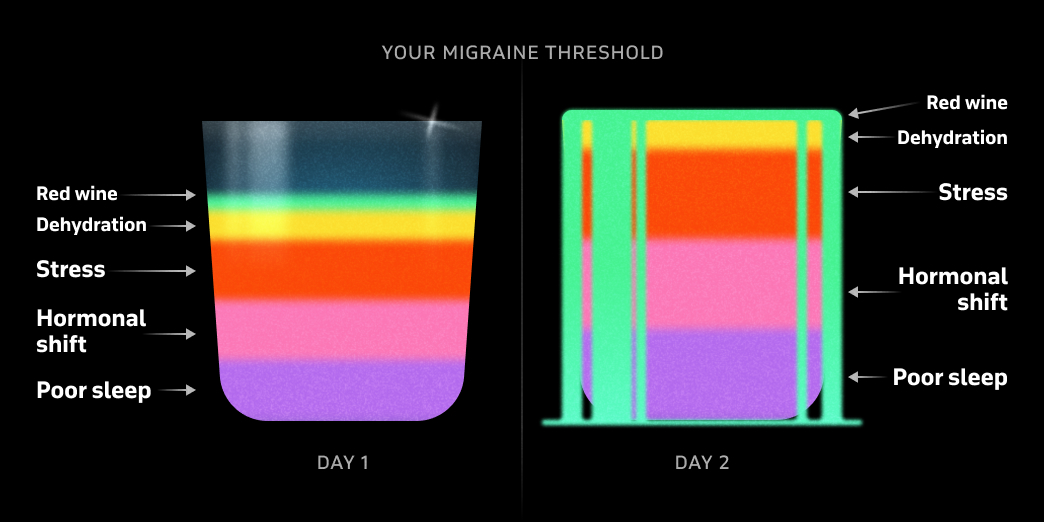
This is why trigger tracking as attribution ("wine causes my migraines") drives people crazy. Red wine doesn't cause your migraine. Red wine fills the bucket by a certain amount. On a day when the bucket is nearly empty, that amount is fine. On a day when the bucket is already full from bad sleep + stress + dehydration + hormonal shift, that same glass is the drop that overflows.
A 2024 paper in Cephalalgia explored how prodromal symptoms and triggers interact through a shifting biological threshold. The therapeutic implication (our framing, not the paper's exact language): the goal should be raising the threshold and reducing the fill level, rather than just avoiding individual triggers [2].
This does not mean stop keeping a migraine diary. A diary that tracks attack days, medication days, and cycle timing remains recommended by guidelines and is essential for detecting patterns like medication overuse (more on this below). What doesn't work well is obsessively attributing each attack to a single trigger, because the bucket model shows why that attribution is unreliable.
What's happening in your brain
The science of migraine has changed quite a bit in the last decade. We now understand that migraine is driven by a specific cascade centered on the trigeminovascular system, the network connecting the trigeminal nerve to the blood vessels around your brain.
Here's the sequence:
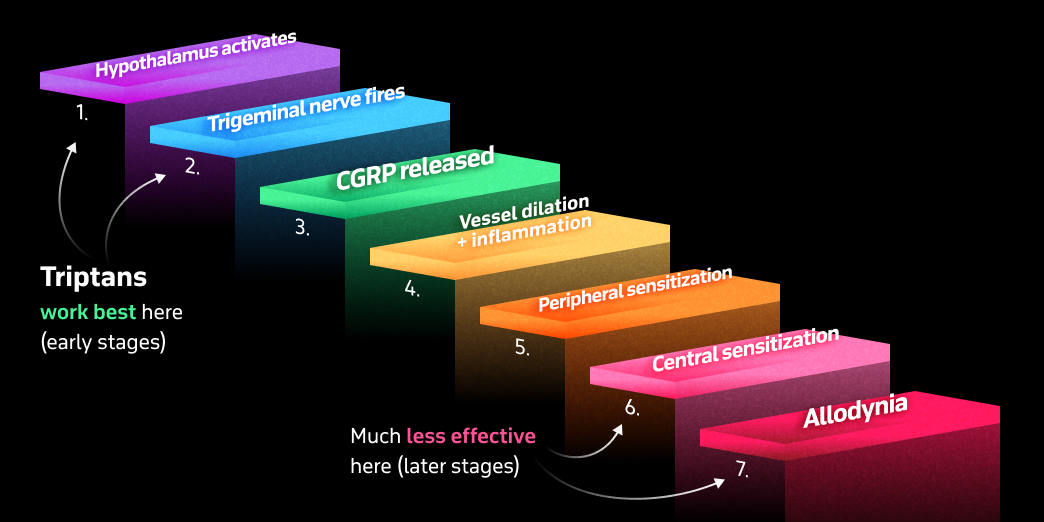
Step 1: The hypothalamus lights up. The hypothalamus, your brain's master regulator for sleep, hunger, mood, and autonomic function, becomes abnormally active in the hours to days before pain starts. Imaging research has confirmed hypothalamic activation beginning roughly 24 hours before the headache [3]. This is what produces the prodrome: the yawning, the food cravings, the mood changes. The migraine has already started. You just don't have a headache yet.
Step 2: The trigeminal nerve activates. The trigeminal nerve is the largest cranial nerve. Its fibers surround the blood vessels in your meninges. When it activates, it releases a flood of neuropeptides, the most important being CGRP (calcitonin gene-related peptide).
Step 3: CGRP drives neurogenic inflammation. CGRP is released around the meningeal blood vessels, where it sensitizes and activates trigeminal nerve endings and drives neurogenic inflammation. Blood vessels do widen at the same time, and for years that widening was assumed to be the source of the pain. It now looks like a parallel event rather than the cause. The pain comes from sensitized nerve endings and from how the brain amplifies their signal. We know this because some drugs relieve migraine pain without changing vessel size, and some substances that dilate vessels powerfully don't produce migraine pain at all [13].
Step 4: Sensitization cascades. First, the peripheral nerve endings around the blood vessels become sensitized (peripheral sensitization). Then, if the attack continues, the central neurons in the brainstem become sensitized too (central sensitization). Once central sensitization kicks in, normally non-painful stimuli become painful: brushing your hair, wearing glasses, resting your head on a pillow. This is called allodynia, and it's a sign the migraine has dug in [4].
Step 5: The brainstem's pain modulation fails. Your brain has built-in systems for dampening pain signals (descending pain modulation). During a migraine, these systems malfunction. Instead of turning down the volume on pain signals, they stop working or in some cases actually amplify the signals. The brain loses its ability to filter.
The best time to treat a migraine is when you're least sure it's one
Most people with migraine treat late for reasons that sound perfectly sensible.
You want to be sure it's a real migraine and not just a regular headache. You don't want to waste a tablet you might need more later in the week. Someone once implied you take too many. You only have a limited supply, and your insurance makes refills difficult. Or somewhere along the way you picked up the idea that reaching for something at the first twinge means you're not coping well enough.
The biology doesn't reward any of that.
Look back at the cascade: each step is harder to interrupt than the one before it. Acute treatments, whether simple painkillers (NSAIDs like ibuprofen, naproxen, aspirin) or migraine-specific drugs (triptans, gepants), act mostly on the early links: neuropeptide release and peripheral sensitization. By the time central sensitization is running and your hair hurts, the attack has moved into territory those drugs reach less well [5].
This applies to everything you might take, not just triptans. NSAIDs are first-line treatment for many people with migraine and they follow the same rule: early in the pain phase, they can interrupt the process. Hours later, they're fighting uphill.
For people with aura: take your medication at the start of the pain phase, not during the aura itself.
Practice recommendations from the International Headache Society state that treatment is most effective when initiated while pain intensity is still mild, preferably as early as possible in the headache phase. The trial evidence points the same way, though it's worth saying that it's not a slam dunk across every study.
There's also a longer-term cost to waiting. Research increasingly suggests that repeated, prolonged pain episodes contribute to chronification, the gradual progression from episodic to chronic migraine. In this context, the nervous system doesn't build tolerance to untreated pain. It builds sensitivity. Each uninterrupted attack is practice for the next one.
So the point here is not that pain is dangerous to feel, or that you should never sit with a headache. It's that sitting with it to prove the migraine is real, or to earn the right to treat it, tends to buy you a longer and worse attack.
The other side of "take it early"
So I just told you to treat early. That's true. But there's a limit that almost nobody talks about until it's too late.
If you use acute migraine medications (triptans, ergotamines, opioids, combination painkillers including caffeine-containing ones) on 10 or more days per month for 3 months, or simple painkillers (NSAIDs, acetaminophen, aspirin) on 15 or more days per month, you can develop medication overuse headache (MOH). Your brain adapts to the frequent medication, and when the medication wears off, it generates a rebound headache, which you then treat, which generates another rebound, and so on.
This is one of the most common reasons migraines get worse over time, and it's completely reversible.
A practical rule of thumb: acute medications no more than 2 days per week. If you're hitting that ceiling regularly, the conversation with your doctor needs to shift from "which acute medication works best" to "I need preventive treatment." The problem at that point is not that you need a better painkiller. The problem is that you don't have enough prevention.
This is not about toughing it out or feeling guilty for taking medication. It's the opposite. If you're using acute meds that often, you're suffering too much and you need more support upstream.
Things you need to know about safety
This section isn't fun to read but it could be the most important part of the post.
Migraine with aura and hormonal contraceptives. If you have migraine with aura and you're taking combined hormonal contraceptives (the pill, the patch, the ring that contains estrogen), this is a conversation to have with your doctor immediately. Migraine with aura approximately doubles the risk of ischemic stroke, and combined hormonal contraceptives on top of that push it further. This combination is classified as Category 4 (unacceptable risk) by both US and WHO medical eligibility criteria. Safe alternatives exist: progestin-only and non-hormonal methods. This is not optional guidance.
Triptan contraindications. Triptans should not be used by people with coronary artery disease, cerebrovascular disease, or uncontrolled hypertension because of their vasoconstrictive effects. Newer alternatives like lasmiditan (a 5-HT1F agonist) don't constrict blood vessels and may be an option. Discuss with your doctor.
When to go to the emergency room:
Thunderclap headache (maximum pain in under a minute)
First aura ever in your life
Aura lasting longer than 60 minutes
Weakness in your limbs during an attack
New neurological symptoms you haven't had before
First migraine after age 50
Your usual migraine pattern suddenly changes
Headache that gets worse when you cough, strain, or change position
A new or unusual headache during pregnancy or postpartum that doesn't resemble your typical migraine, especially if accompanied by high blood pressure, visual disturbances, swelling, or pain under the ribs (which can indicate preeclampsia), or a thunderclap headache in the postpartum period. Migraine treatment during pregnancy also needs to be discussed with your doctor, since many standard medications aren't safe to use.
These are red flags that can indicate something other than migraine. They need to be ruled out, not managed at home.
A note on one-sided aura: If your aura symptoms always occur on the same side without any variation, this isn't an emergency, but it's worth mentioning to your neurologist. They may want to do imaging to rule out other neurological causes.
The migraine-autonomic connection
If you have both migraines and some form of dysautonomia (btw, check out a deep dive on nervous system dysregulation here: https://welltory.com/blog/nervous-system-dysregulation/), like POTS, orthostatic intolerance, IBS, temperature dysregulation, etc, this isn't a coincidence. The connection is direct and goes both ways.
Migraine is fundamentally tied to autonomic function. The hypothalamus (which initiates the migraine cascade) is the central hub of autonomic regulation. The trigeminal nerve interfaces directly with autonomic pathways. The vagus nerve innervates many of the same structures involved in migraine.
During a migraine, autonomic symptoms are the norm: nausea, vomiting, light and sound sensitivity, nasal congestion, tearing, pallor, cold hands, and heart rate changes. Research using 24-hour Holter monitors found that HRV (specifically SDNN) drops substantially during migraine attacks compared to headache-free periods and compared to controls [6]. Important context: these values come from laboratory-grade 24-hour recordings and are not directly comparable to numbers you'd see in an app. The takeaway is that autonomic flexibility drops significantly during attacks.
The relationship runs both ways. Autonomic dysregulation fills the bucket. Poor vagal tone, chronic sympathetic activation, sleep disruption, blood pressure instability: all of these reduce your headroom, meaning smaller triggers can overflow it.
This is why people with POTS often have migraines. Why people with ME/CFS often have migraines. Why women in perimenopause (when autonomic instability increases) often see their migraines get worse. The bucket is getting smaller because the nervous system that controls the bucket is dysregulated.
Why migraines can get worse over time (and why that can reverse)
For some people, migraines start as occasional events and gradually become more frequent. This is not some kind of bad luck. There's a mechanism, and understanding it matters because it means the process can move in both directions.
Frequent migraine attacks involve repeated sensitization, both peripheral and central. Over time, this can lower the threshold for future attacks. A 2012 paper in Neuron described this as migraine-driven allostatic load: repeated attacks accumulate biological burden that can change brain function, making future attacks more likely [7].
This is chronification: the transition from episodic to chronic migraine (15+ headache days per month). The rate is roughly 2.5% per year.
But chronification is often reversible. A significant proportion of people with chronic migraine return to episodic patterns. The bucket can get bigger again.
The known modifiable risk factors for chronification include: medication overuse (the single biggest one), depression (which is treatable and often undertreated in migraine patients), weight changes (which can be addressed with support, and which some preventive medications actually help with), sleep apnea, high caffeine intake, and persistent allodynia. Addressing these can reverse the progression.
CGRP-targeting preventive therapies (monoclonal antibodies and gepants) reduce attack frequency, and in observational studies, patients report lower scores on allodynia and central sensitization questionnaires over time [8]. Whether this reflects a direct central effect or simply the downstream benefit of fewer attacks is still an open question (the antibodies themselves are large molecules that act peripherally). Either way, the practical result is the same: fewer attacks, less sensitization, higher threshold, fewer attacks. The cycle can run in reverse.
Your body warns you hours to days early. Here's how to see it.
Remember the prodrome? Your hypothalamus activates before pain. That's a usable warning window.
But prodrome symptoms are vague: yawning, neck stiffness, food cravings, irritability, fatigue. You could write those off as "just a weird day." Most people do. But if you track them alongside your physiological data, patterns can emerge.
Recent research using wearable sensors shows that HRV starts shifting before a migraine attack, during the prodrome phase. The pattern varies between people, but what researchers tend to see is autonomic instability: your sympathetic and parasympathetic systems fall out of their normal balance, and HRV drops in ways that don't match anything else happening in your day. This isn't the same thing as the long-term HRV changes you see with aging or general health. It's a short-term fluctuation specific to the pre-attack window, and it looks different from person to person [9].
A study published in Technology and Health Care (2026) using wearable biosensors found that nocturnal HRV features could predict migraine episodes, though with significant individual variability [10].
What to look for in your Welltory data:
- Watch for a 1-2 day drift, not a single bad reading. HRV dipping and resting heart rate creeping up over the same 24-48 hour window, with no obvious explanation (you didn't sleep badly, you weren't more stressed than usual, you're not getting sick), is the most consistent pre-migraine signal in the research.
- Check your sleep recovery. Shallower blue zones overnight, more fragmentation, less deep recovery. This can show up before the HRV shift does, sometimes 36-48 hours out. If your sleep data looks worse than your day justified, your hypothalamus may already be activating.
- Notice mismatches between your day and your data. This is the most practical signal. You had a normal, uneventful day, but your Nervous System Snapshot is red or yellow, or your stationary stress is heavy. When what you see in the app doesn't match what you experienced, that gap might be the prodrome making itself visible before you can feel it. That's the window to act: hydrate, eat, protect your sleep, reduce your sensory load, and have your acute medication ready.
- Be honest with yourself about the limits. Not everyone has a detectable pre-attack HRV shift. Research suggests 20-40% of people don't show a measurable change. If you menstruate, your cycle moves HRV more powerfully than prodrome does, which can bury the signal. And you need weeks of baseline data before any pattern becomes visible.
What to do with this practically: Tag your migraines in the app and leave notes when you notice data mismatches. When your Snapshot is red on a calm day, note it. When a migraine hits, tag it. Over 6-8 weeks, the pattern (if there is one for you) starts to emerge in your data. And every tag and note you add helps us too: it's what our research runs on.
What empties the bucket
If the bucket model is right, then migraine management is about keeping the bucket as empty as possible so that normal life doesn't overflow it. Here's what the evidence supports:
Sleep consistency
Not just "enough" sleep, but that boring consistent sleep I’m sure you know all about. Going to bed and waking up at the same time, even on weekends, stabilizes the hypothalamus, which is the master switch for migraine initiation [3]. The evidence for sleep-as-intervention is still developing (the studies are small), but the biological rationale is strong and the clinical consensus is clear. Sleeping in on Saturday and then waking early Monday is a big pour into the bucket.
Hydration and regular meals
Dehydration and blood sugar drops are common bucket-fillers. Not because they're "triggers" in some mysterious sense, but because they directly stress the hypothalamus and autonomic nervous system. Skipping lunch doesn't cause your migraine. It fills the bucket by a couple of inches, and if the bucket was already high, that's the overflow.
Stress management (not stress avoidance)
You can't avoid stress. But you can manage how your nervous system processes it. Vagal tone directly affects how quickly your body recovers from stressors and therefore how much each stressor fills the bucket.
Extended-exhale breathing, regular moderate exercise (within your limits), and adequate recovery time between demanding activities all support vagal tone. For people with dysautonomia, the strategies we covered in previous posts apply directly: compression, electrolytes, position changes, and cold exposure all reduce autonomic load (more here: https://welltory.com/blog/nervous-system-dysregulation/).
Exercise
This one gets buried in most migraine advice, usually a passing mention after supplements and lifestyle tips. But the evidence for regular exercise in migraine prevention is stronger than for most supplements that get entire paragraphs in posts like this one.
Pooling the migraine exercise trials, both strength training and aerobic training reduce monthly migraine days by roughly 2 to 3.5 [17]. And the type of exercise seems to matter less than doing it consistently. Walking, cycling, swimming, dancing, yoga. The trials that showed benefit weren't asking people to become athletes. The European Headache Federation review specifically names walking and cycling, 2-3 times a week [18]. Dose-response research puts the useful range around 70-135 minutes per week [19], which is actually less than the 150 minutes in standard national guidelines [20].
What exercise does for migraine isn't just "emptying the bucket" but building a bigger one. Regular physical activity raises pain thresholds, improves autonomic regulation, and modulates the same signaling pathways that preventive medications target. Over time, your system becomes more resilient to the things that fill the bucket.
Now for the part that explains why a lot of people gave up on this years ago: exercise triggers attacks for roughly 20-30% of people with migraine [18]. If you're in that group, you probably tried exercising, got a migraine, and concluded "exercise gives me migraines." That conclusion is understandable but incomplete.
What's actually happening is the bucket. A hard session is itself a pour: sudden exertion, fluid loss, often a skipped meal somewhere before it, maybe heat or dehydration on top. On an already-high day, that's enough to overflow. The lesson that sticks is "exercise is a trigger" when the real lesson is "exercise on a full bucket overflows it."
The European Headache Federation review addresses this directly [18]. It recommends a warm-up period, keeping intensity at a tolerable level rather than pushing through exercise-induced pain, and notes that tolerance to that pain-triggering effect does develop over time. This is why the first few weeks aren't the verdict. The trials that found benefit ran 8-10 weeks before measuring outcomes. The early sessions may be rough. That doesn't mean it's not working.
Starting low matters. If your bucket is chronically high (frequent migraines, poor sleep, high stress), start with gentle walks, not HIIT. Build gradually. Track your data alongside your exercise to find the intensity range that improves your baseline without triggering attacks. The sweet spot exists for most people. It just takes patience to find it.
And anyone managing a heart, lung, or joint condition, or who's been advised to be careful with exertion, has a different conversation to have first with their doctor.
The let-down effect (this one is quite surprising)
One of the most common and least intuitive bucket-fillers: a sudden drop in stress. Not stress itself, but the relief after stress. Friday evening after a brutal work week. The first morning of vacation. The day after a deadline. Your body held it together under pressure, and when it finally lets go, that rapid shift overflows the bucket.
This is called the let-down effect, and it's one of the most frequently reported migraine patterns. A sharp decrease in stress can destabilize the autonomic system just as much as a sharp increase. The hypothalamus responds to change, not just to load. Going from high tension to sudden relaxation is a big swing, and big swings fill the bucket.
This is why "weekend migraines" are so common, and why vacations so often start with an attack. Your body wasn't failing during the stressful week. It was holding. The migraine comes when it stops holding.
If this pattern sounds familiar, the practical takeaway is: don't go from 100 to 0. Ease the transition. A gradual wind-down on Friday evening instead of collapsing onto the couch. A gentle first day of vacation instead of immediately switching off everything. The goal is to let the stress drain from the bucket slowly, not dump it all at once.
Hormonal awareness
For folks who menstruate, the estrogen drop before menstruation is one of the biggest single pours into the bucket. The estrogen withdrawal hypothesis is the leading explanation for menstrual migraine, though the exact downstream mechanisms (CGRP modulation, serotonin pathways, TRP channel sensitivity) are still being worked out. What's well established clinically: menstrual migraines tend to be longer, more severe, and respond less well to triptans than non-menstrual attacks. Prostaglandins and progesterone withdrawal may also contribute.
Tracking your cycle alongside your HRV and migraine data can make this visible. If your migraines cluster in the 2-3 days before your period, the hormonal pour is likely the dominant factor, and managing everything else (sleep, hydration, stress) during that window becomes especially important.
Reducing sensory load
If your nervous system is already close to threshold, every additional sensory input is a small pour. Bright screens, noisy environments, strong perfumes, flickering lights. Individually harmless, collectively they add up. Noise-canceling headphones, blue-light filters, and structuring your environment during high-risk windows are not being precious. They're reducing the fill rate.
Caffeine: handle with care
Caffeine deserves its own mention because it cuts both ways. Small amounts early in an attack can help by enhancing pain medication absorption. But caffeine-containing combination analgesics are one of the most common drivers of medication overuse headache, and high habitual caffeine intake is a risk factor for chronification. The practical advice: keep your intake moderate and stable. Don't swing between heavy use and abstinence. If you're going to reduce caffeine, taper gradually.
Medication that raises the threshold
CGRP-targeting preventive medications (monoclonal antibodies or daily gepants) work by raising the threshold, making the bucket bigger. For people with frequent migraines, this can be transformative because normal life stops overflowing the bucket.
Beta-blockers, certain antidepressants (amitriptyline, venlafaxine), and anti-seizure medications (topiramate, valproate) also raise the threshold through various mechanisms. Botox, for chronic migraine, reduces sensitization in the trigeminal nerve endings.
Taking preventive medication is not giving up. It means the bucket is too small for your life right now, and making it bigger is the fix.
Supplements (with appropriate caveats)
Magnesium has the most evidence. People with migraines tend to have lower magnesium levels, and supplementation has shown benefit in reducing frequency. The form tested in the positive clinical trial was magnesium citrate at 600mg daily [16]. Many people anecdotally prefer magnesium glycinate for better absorption and fewer GI side effects, but glycinate specifically has not been tested in migraine trials, so that preference is based on bioavailability data rather than migraine outcome data. The upper limit for supplemental magnesium is 350mg per the IOM. Higher doses should be discussed with a doctor. Magnesium is contraindicated in kidney disease and can interact with certain antibiotics and bisphosphonates (space them 2+ hours apart). It takes 2-3 months of daily use before most people see a difference.
Riboflavin (Vitamin B2) at 400mg daily has shown benefit in one well-known trial, with subsequent results being mixed. The evidence level is moderate. One practical note: it turns your urine bright yellow. This is harmless and expected. Don't let it scare you into stopping.
CoQ10 has some supporting evidence. Discuss dosing with your doctor.
What people report helps during an attack
The science covers prevention, but when a migraine is already happening, these are the things that come up most consistently:
Cold on the head and neck. Frozen gel caps that cover the entire head are probably the most commonly mentioned item across migraine communities. Cold reduces nerve signal transmission and has a numbing effect on scalp nerves. One small trial tested a frozen neck wrap over the carotid arteries and found benefit, though the evidence base is limited. Either way, it's safe and most people find it helpful. Having two in the freezer so one is always ready is a common tip.
(One caveat: if you have rosacea or couperose, be careful with extreme cold directly on the face. It can trigger capillary dilation and flushing, which makes things worse. Applying the cold to the back of the neck or the top of the head rather than directly on facial skin is a safer option.)
Dark, cold, quiet room. This directly reduces sensory input to a system that's in a state of central sensitization. Every photon, every sound, every temperature fluctuation is amplified input. Removing it doesn't stop the migraine, but it stops making it worse.
Eating at the first prodrome signs. Multiple people report that eating something with protein at the very first hint of a migraine can sometimes reduce severity. This may relate to blood sugar stabilization or to the parasympathetic activation that comes with digestion.
Peppermint oil on temples and neck. Widely reported as helpful for reducing the pressure sensation. Some people use hot peppermint tea (caffeine-free) for nausea during attacks.
Acting fast with acute medication (within the limits discussed in the MOH section). Triptans are significantly more effective before central sensitization kicks in. But remember: no more than 2 days per week. If you're exceeding that, talk to your doctor about prevention.
The things most people get wrong
"It was the chocolate/cheese/wine"
Probably not. A massive misconception about migraine triggers comes from confusing the prodrome with the cause. During the prodrome, the hypothalamus activates and you crave specific foods, often chocolate, salty snacks, or carbs. You eat the chocolate. A day later, you get a migraine. Conclusion: chocolate caused it.
But the craving was the prodrome. The migraine had already started before you ate anything. The chocolate didn't fill the bucket. The bucket was already overflowing, and the craving was your brain's way of signaling it [11]. Eliminating these foods often makes no difference to migraine frequency, but it does make life more restrictive for no benefit.
"You should try harder to manage your stress"
People with chronic migraine aren't bad at managing stress. They have a lower threshold. The same amount of stress that a non-migraine brain handles fine overflows their bucket. Telling someone with chronic migraine to "manage stress better" is like telling someone with a smaller gas tank to "manage fuel better." The tank size is the problem.
And the cruelest thing: for many people, it's not even the stress itself that triggers the attack. It's the relief afterward (see: let-down effect above). So even when you do manage the stress perfectly, the moment you finally relax is when the migraine hits. Try explaining that to someone who just told you to "relax more."
"You should try yoga/cutting gluten/insertsomenewshinything"
People with migraines have tried everything. They've eliminated every food, every drink, every environmental factor. They've done the yoga, the meditation, the acupuncture and whatnot.
The reason nothing works consistently on its own is that none of these things are the problem by themselves. They're bucket-fillers of varying sizes. Eliminating one filler when the bucket is overflowing from six other sources doesn't fix the overflow. The people who see big results from magnesium or yoga were usually close to threshold already, and that one change was enough to create headroom. For people with chronic migraine, the bucket is overflowing from structural, hormonal, and neurological factors that one supplement can't address alone.
That doesn't mean supplements are useless. Magnesium genuinely helps a lot of people. But it helps as part of a strategy that addresses the whole bucket.
"At least it's just a headache"
Migraine is one of the leading causes of years lived with disability globally, and one of the top causes among women of reproductive age (GBD 2021). Chronic migraine can consume 15+ days per month. Each attack can span 5-6 days when you count prodrome and postdrome. People lose jobs, relationships, and years of their lives to this condition. This is definitely not “just a headache.”
"I read that migraines are caused by blood vessels/serotonin/neck problems"
Migraine science has changed dramatically. The "blood vessel theory" (migraines are caused by dilating blood vessels) was dominant for decades but is now understood to be incomplete: vessel dilation is a parallel event during the attack, not the cause. The "serotonin theory" is similarly incomplete in its original form. And while neck pain is extremely common in migraine (it's a prodrome symptom for many people), it's usually part of the migraine process rather than the cause. This is why treating neck problems alone rarely stops migraines.
The current understanding: migraine is a disorder of the brain's sensory processing and autonomic regulation, initiated in the hypothalamus, mediated through the trigeminovascular system, and amplified through central sensitization.
And my personal fav: "Have you tried drinking more water?"
Like, yeah. Every person with migraines has tried drinking more water. Hydration genuinely matters. Dehydration fills the bucket. But asking someone with chronic migraine if they've tried water is like asking someone with a broken leg if they've tried walking more carefully.
Final thoughts
If you made it this far, you now understand more about migraine neuroscience than most people who've had migraines their entire lives. That's not because this stuff is secret but because nobody sits you down and explains it.
The bucket model won't stop your next migraine. But it might stop you from blaming yourself for it. And over time, understanding what fills your bucket and what empties it gives you something that years of trigger-chasing never did: a framework that actually makes sense.


Discounts for blog readers: up to 36% off
See what affects your energy, stress, sleep, and daily state with Welltory
This post is for educational purposes and is not medical advice. If you experience migraines, please work with a healthcare professional for diagnosis and treatment.
Was this helpful?
Ask AI for a summary of page


Written by Irina Motovilova
Welltory’s brand and community lead. A hyperpolyglot specializing in UX writing and content strategy, she builds global communities and creates content people actually want to read.
Written by Fiona Ovcharenko
Product Designer at Welltory. She turns complex health science and data into clear, intuitive experiences — making health easier to understand and a little more delightful to explore.
References
- StatPearls: Migraine Headache (2024). https://www.ncbi.nlm.nih.gov/books/NBK560787/
- Sebastianelli, G. et al. (2024). Insights from triggers and prodromal symptoms on how migraine attacks start: The threshold hypothesis. Cephalalgia, 44(10). PMID 39380339. https://doi.org/10.1177/03331024241287224
- Schulte, L.H. & May, A. (2016). The migraine generator revisited: continuous scanning of the migraine cycle over 30 days and three spontaneous attacks. Brain, 139(7), 1987-1993. https://academic.oup.com/brain/article/139/7/1987/2464241
- Iyengar, S. et al. (2019). CGRP and the Trigeminal System in Migraine. Headache, 59(5), 659-681. https://headachejournal.onlinelibrary.wiley.com/doi/10.1111/head.13529
- Burstein, R., Collins, B. & Jakubowski, M. (2004). Defeating migraine pain with triptans: a race against the development of cutaneous allodynia. Annals of Neurology, 55(1), 19-26. https://pubmed.ncbi.nlm.nih.gov/14705108/
- Zhang, L. et al. (2021). Heart rate variability analysis in episodic migraine: a cross-sectional study. Frontiers in Neurology, 12:647092. https://www.frontiersin.org/journals/neurology/articles/10.3389/fneur.2021.647092/full
- Borsook, D. et al. (2012). Understanding Migraine through the Lens of Maladaptive Stress Responses: A Model Disease of Allostatic Load. Neuron, 73(2), 219-234. https://pubmed.ncbi.nlm.nih.gov/22284178/
- Danno, D. et al. (2024). Efficacy of galcanezumab in migraine central sensitization. Scientific Reports, 14, 21824. https://www.ncbi.nlm.nih.gov/pmc/articles/PMC11410828/
- Hervigo, Y. et al. (2023). Detecting Heart Rate Variability changes during different phases of migraines: a prospective study. https://iris.unil.ch/entities/publication/b3aa31cb-757f-4fd2-8331-7f9616fc2507
- Technology and Health Care (2026). Heart rate variability as a predictor of migraine: Sleep-time data analysis of pre-migraine nights. PMID 41607086. https://pubmed.ncbi.nlm.nih.gov/41607086/
- Association of Migraine Disorders (2024). S6:Ep6 — What to Know About The Migraine Prodrome. https://www.migrainedisorders.org/podcast/s6ep6-migraine-prodrome/
- Alebna, P. & Maleki, N. (2021). Allostatic Load in Perimenopausal Women With Migraine. https://pubmed.ncbi.nlm.nih.gov/33967942/
- Amin, F.M. et al. (2013). Magnetic resonance angiography of intracranial and extracranial arteries in patients with spontaneous migraine without aura. https://pubmed.ncbi.nlm.nih.gov/23578775/
- Calabrò, C. et al. (2024). Migraine chronification as an allostatic disorder: a proof-of-concept study. Neurological Sciences, 45(6), 2775-2782. https://pmc.ncbi.nlm.nih.gov/articles/PMC11081979/
- Chuang, C.H. et al. (2023). Abnormal heart rate variability and its application in predicting treatment efficacy in patients with chronic migraine. Cephalalgia, 43(10). PMID 37851663. https://journals.sagepub.com/doi/10.1177/03331024231206781
- Peikert, A. et al. (1996). Prophylaxis of migraine with oral magnesium: results from a prospective, multi-center, placebo-controlled and double-blind randomized study. Cephalalgia, 16(4), 257-263. https://pubmed.ncbi.nlm.nih.gov/8792038/
- What is the efficacy of aerobic exercise versus strength training in the treatment of migraine? A systematic review and network meta-analysis of clinical trials (2022). The Journal of Headache and Pain. https://pubmed.ncbi.nlm.nih.gov/36229774/
- The association between migraine and physical exercise (2018). The Journal of Headache and Pain. https://pubmed.ncbi.nlm.nih.gov/30203180/
- Efficacy and optimal dosage of various exercises for migraine: a multilevel network and dose-response meta-analysis (2025). PeerJ. https://pmc.ncbi.nlm.nih.gov/articles/PMC12548639/
- WHO 2020 guidelines on physical activity and sedentary behaviour (2020). British Journal of Sports Medicine. https://pubmed.ncbi.nlm.nih.gov/33239350/