

Short answer
Heat intolerance means feeling unwell in warmth that other people find comfortable — overheating fast, feeling drained, dizzy or nauseated, sweating too much or oddly too little, and needing to stop and cool down when nobody else does.
It is not a condition in itself. It is what happens when the body's temperature control is working against a handicap, and the handicap can sit in several places: in the thyroid, which sets your metabolic rate; in the hormonal shifts of perimenopause and menopause; in the autonomic nervous system, which controls blood vessels and sweat glands; in the nervous system itself, as in multiple sclerosis; in medication; in dehydration, fitness level or age; or in a condition that affects sweating directly.
You are not imagining it, and you have not simply become "soft" — this is not a tolerance problem and it is not your fault. Heat intolerance is a recognised symptom with a specific physiology behind it, and in some conditions it has been measured precisely — in multiple sclerosis, a rise in core body temperature of as little as 0.2 to 0.5°C is enough to bring symptoms on. That is a fraction of a degree. The fact that other people in the same room are comfortable tells you nothing about whether your experience is real.
The practical point: this is a symptom worth investigating rather than adapting around, because the shortlist of causes is short and several items on it are found with a blood test.
What does heat intolerance actually feel like?
People describe some combination of: overheating much faster than those around them; feeling wiped out, heavy or foggy in warm rooms; dizziness or lightheadedness in heat; nausea; a racing or pounding heart in conditions that do not justify it; sweating that is excessive, or strangely absent, or patchy — a drenched back with dry palms; flushing; and a need to lie down that arrives without much warning.
What distinguishes it from simply disliking hot weather is the mismatch and the cost. The temperature that floors you is one other people are coping with, and recovery takes longer than the exposure seems to warrant — an hour in a hot shop can cost the rest of the afternoon.
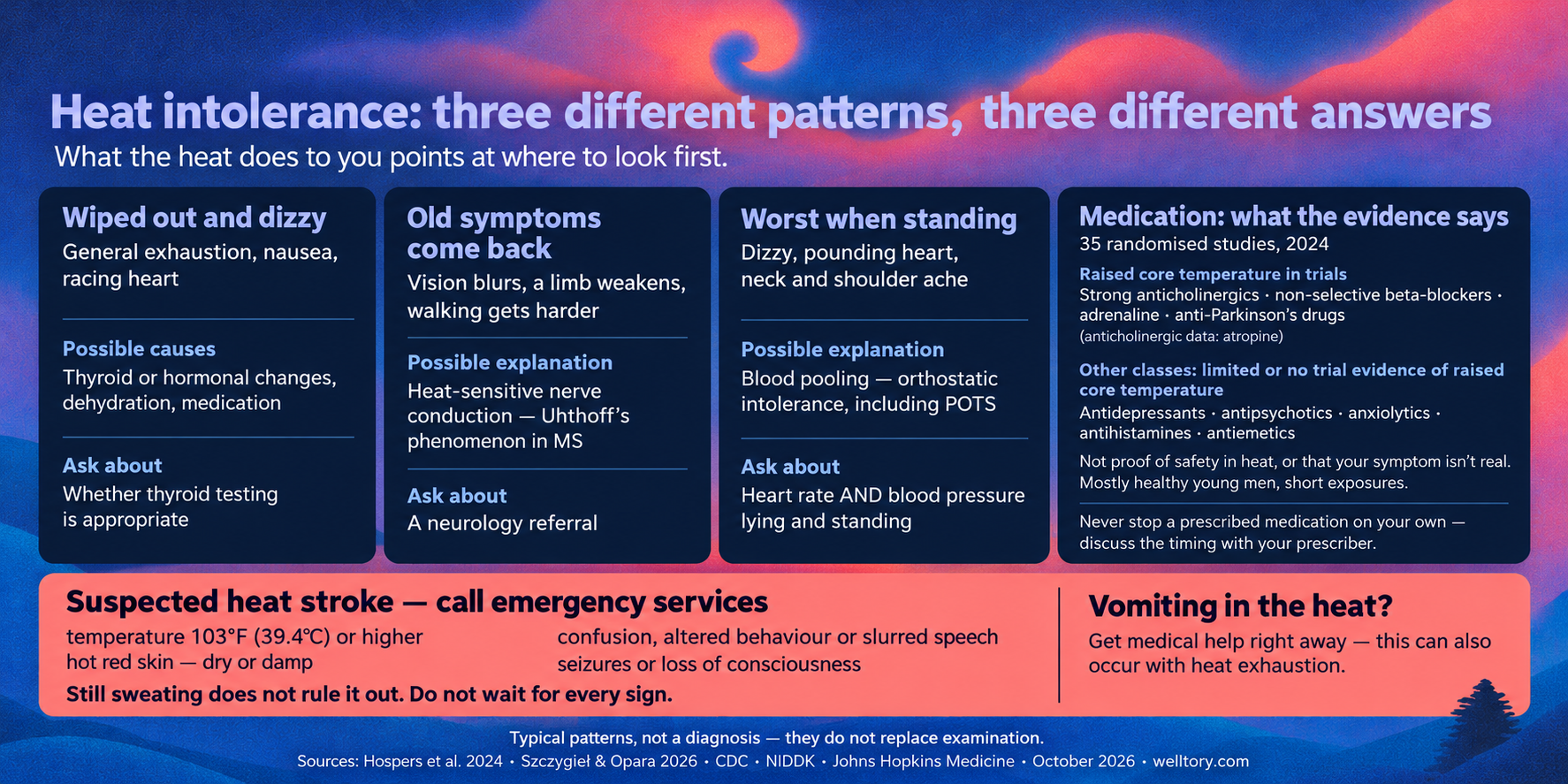
Two patterns are worth noticing because they point in different directions. If heat makes specific symptoms reappear — vision blurring, a limb going weak, an old symptom returning — that is a different phenomenon from general heat misery, and it belongs in the multiple sclerosis section below. If heat mainly makes standing harder, with dizziness and a racing heart, that points toward the circulatory and autonomic explanations.
What causes heat intolerance?
Thyroid. An overactive thyroid raises your metabolic rate, and a body running hotter has less margin. Heat intolerance is one of the classic features, usually alongside weight loss, a fast heart rate, tremor and anxiety. This is top of the list because it is common and because a blood test settles it. If that cluster sounds familiar, our piece on whether it is your thyroid or something else covers what to ask for.
Perimenopause and menopause. Changing oestrogen narrows the range of temperatures the body treats as comfortable, which is why warmth that used to be unremarkable becomes intolerable, and why flushes and night sweats arrive. This is distinct from hot flashes, though the two often travel together — see our guide to menopause.
The autonomic nervous system. Blood vessel tone and sweating are run autonomically, so when that regulation is unreliable, heat becomes much harder. In orthostatic intolerance and POTS the mechanism is specific: heat opens the blood vessels in the skin to shed warmth, which pools blood at the surface and leaves less returning to the heart — exactly the problem those conditions already have. More on the full picture in dysautonomia symptoms.
Multiple sclerosis and other neurological conditions. Here heat does something different: it temporarily worsens nerve conduction in already-damaged pathways, so existing symptoms resurface. Covered in detail below.
Medication. The most-asked cause and the most misreported one. Covered in detail below.
Dehydration, blood volume and fitness. Less fluid in circulation means less available for both cooling and blood pressure. Deconditioning after illness or a long sedentary stretch genuinely does reduce heat tolerance, which is why it often worsens after a period of inactivity.
Age. Sweating capacity and skin blood flow decline with age, and thirst becomes a less reliable signal, which is why older adults overheat at temperatures they used to manage.
Conditions affecting sweating directly. Where sweating is reduced or absent — some autonomic neuropathies, certain skin conditions, diabetes-related nerve damage — the body loses its main cooling route. The giveaway is heat distress with noticeably little sweat.
Fever and infection. An acute illness changes the set point entirely; that is a different situation from a long-standing pattern.
Lupus and other autoimmune conditions are often searched alongside heat intolerance, and heat or sun exposure can trigger flares in lupus specifically. That is an established part of the condition and a reason to raise it with the clinician managing you rather than a reason to self-diagnose from a symptom.
Is my medication causing heat intolerance?
This is where the internet and the evidence part ways, and it is worth knowing which is which before you worry about a prescription.
Search this question and you will find lists — "14 medications that cause heat intolerance" — naming antidepressants, antihistamines, blood pressure drugs, stimulants and more, usually without a study attached. Then in 2024 a systematic review and meta-analysis in eClinicalMedicine pooled 35 randomised studies of 353 participants to test what medications actually do to core body temperature during heat stress.
What it found raised core temperature:
Strong anticholinergic drugs, through suppressed sweating — though the evidence here rests on atropine specifically
Non-selective beta-blockers such as propranolol — notably, selective beta-blockers did not
Adrenaline, through increased internal heat production
Anti-Parkinson's agents such as bromocriptine and levodopa/carbidopa, by an unclear mechanism
What it found no evidence for: antidepressants, antipsychotics, anxiolytics, antihistamines, antiemetics and vasodilators. For diuretics no effect was found, on very low-certainty evidence. For antiepileptics, no studies existed at all.
So the single most-searched version of this question — whether SSRIs cause heat intolerance — does not have the research behind it that the listicles imply.
Now the honest caveats, because this cuts both ways. "No evidence of a rise in core temperature" is not the same as "your experience is imaginary." Antidepressants can change sweating, and feeling hot, clammy and wretched in warm weather is a real experience whether or not a thermometer in a laboratory agrees. What the review undermines is the specific mechanism people are told about, not the symptom. And the review's own limitations matter: most participants were healthy young men in short heat exposures, with few women, few older adults and few people with chronic illness — the exact groups most likely to be asking this question.
What to do with that: bring it up, do not act on it. If your heat intolerance started within weeks of a new medication, that timing is worth telling your prescriber, and strong anticholinergics and non-selective beta-blockers are the classes with the clearest evidence. Stopping a prescribed medication on your own because of a symptom is a worse risk than the symptom.
Heat and multiple sclerosis: what the research actually shows
If heat makes specific old symptoms come back — blurred vision, weakness in a particular limb, difficulty walking — rather than making you generally miserable, that pattern has a name: Uhthoff's phenomenon.
A 2026 narrative review puts the numbers on it. Thermal sensitivity affects roughly 60–80% of people with MS, with estimates across studies ranging from 29% to 80%; one longitudinal cohort found 52% showing clear Uhthoff's phenomenon over periods from one to twenty years. The temperature rise needed is tiny — typically 0.2 to 0.5°C of core body temperature, which a hot bath, a fever or a brisk walk in summer can produce.
The reassuring part is as important as the alarming part, and it often does not get said. Episodes last from several minutes to a few hours. Symptoms resolve once normal body temperature is restored, and the review describes lasting consequences attributable to Uhthoff's phenomenon as exceedingly rare. It is temporary worsening of existing damage, not new damage. The 24-hour boundary used to define it is an empirical convention rather than a biological threshold.
If this describes you and you do not have an MS diagnosis, that is a reason to see a neurologist rather than a reason to conclude anything. Plenty of other things cause heat-related symptom flares.
Heat, POTS and dysautonomia
For anyone with orthostatic intolerance, heat is one of the reliable aggravators, and the mechanism is worth understanding because it explains which situations are worst.
Cooling works mainly by opening the blood vessels in your skin so warmth can escape. That pulls blood toward the surface and toward the lower body, which leaves less returning to the heart. If your circulation already struggles to keep enough blood moving upward when you stand, heat takes away the margin you had. This is why a hot shower taken standing is one of the hardest things in the day, why queues in summer are worse than walks, and why a hot room can produce the full cluster — dizziness, racing heart, weakness, and the ache across the neck and shoulders that comes from being upright.
Practically, this means the most useful adjustments are the ones that remove heat and upright time at once: showering seated, planning errands for cooler hours, and treating a hot day as one with less margin, in the same way you would treat a day after a bad night.
Heat intolerance or heat exhaustion — where is the line?
This distinction matters more than anything else in this article, because one of them is a long-term question and the other is an emergency.
Heat intolerance is a pattern: you are less able to cope with warmth than other people, over weeks and months, and you recover when you cool down.
Heat exhaustion is an event: heavy sweating, cold clammy pale skin, a fast weak pulse, nausea or vomiting, muscle cramps, tiredness and weakness, dizziness, headache, fainting. It needs immediate cooling — move somewhere cool, loosen clothing, apply cool wet cloths, sip water — and medical attention if symptoms worsen, last longer than an hour, or include vomiting.
Heat stroke is a medical emergency. Call emergency services for a body temperature of 103°F (39.4°C) or higher, hot red skin that may be dry or damp, a fast strong pulse, confusion or altered behaviour, slurred speech, seizures, or loss of consciousness. Move the person somewhere cool and cool them with whatever is available while you wait. Do not give the person anything to drink.
The reason to hold both in mind: cooling that already works against a handicap leaves less margin on a hot day, and "I'm always bad in heat" is exactly the belief that can delay someone calling for help on the day it is something else.
How to check the pattern at home
You cannot diagnose anything at home. What you can do is turn "I can't handle heat" into something a clinician can work with.
Write down what temperature and what situation. "Above about 24°C," "any hot shower," "the supermarket but not the garden" — specificity is what separates a usable history from a complaint.
Note what the heat actually does. General exhaustion and dizziness point one way; specific old symptoms returning point another; mainly trouble when upright points to a third. These three patterns send a clinician down different paths.
Note what your sweating does. Too much, too little, or uneven. Reduced sweating in someone who is distressed by heat is a specific and important observation.
Record your resting heart rate the same way each morning so that hot stretches can be compared with ordinary ones against your own baseline rather than a population range.
Mark the start. Did this begin after an illness, a new medication, a pregnancy, a change in your cycle, or a period of inactivity? The timeline is often the most informative single thing you will bring.
Give it a few weeks. One bad day in a heatwave proves nothing.
What helps while you are sorting out the cause
None of this treats an underlying condition, and none of it replaces finding out what is going on.
Take heat out of the hardest moments. Shower seated and cooler, move errands to the cooler part of the day, and plan for a hot day the way you would plan for a bad night — less margin, fewer stacked demands.
Cool the places that work. Wrists, neck, face and feet shed heat efficiently; a cool damp cloth or a hand in cold water does more than it sounds like it should.
Keep fluids up, and if you also have orthostatic symptoms, discuss salt with your clinician rather than deciding alone — it is not appropriate for everyone, particularly with heart or kidney conditions or some forms of high blood pressure.
Watch exertion in heat specifically. The combination raises core temperature faster than either alone. Recumbent or seated exercise in a cool room keeps the fitness without the exposure.
Keep a cooler room to retreat to, particularly for sleep, since a hot bedroom costs you the recovery you need most.
When should you see a doctor?
Book an appointment if heat intolerance is new, has worsened noticeably, or has lasted more than a few weeks — and especially if it came with weight loss, a persistently fast heart rate, tremor, unusual anxiety, changes in your periods, or new fatigue. That cluster deserves thyroid testing at minimum.
Book sooner if heat brings back specific neurological symptoms, if you have noticed you have largely stopped sweating, or if you faint in the heat.
Seek emergency care for confusion, fainting, a temperature of 103°F (39.4°C) or higher, hot red skin that may be dry or damp, seizures, or vomiting during heat exposure. Skin that is still sweating does not rule heat stroke out.
How to bring this up with your doctor — and what to ask for
Lead with the mismatch and the timeline. "Since last spring I've been unable to tolerate temperatures everyone else is fine with, and it started after I had a virus" is a history. "I hate the heat" is not.
Say which of the three patterns it is — general exhaustion, specific symptoms returning, or trouble when upright.
Bring the medication list, with start dates. The timing relative to a new prescription is the thing your prescriber can act on.
Ask about thyroid function testing if it has not been done recently — it is the cheapest item on the differential.
Ask what else is worth excluding given your history: anaemia, diabetes, autoimmune conditions, and, if you have autonomic symptoms, whether orthostatic vital signs are worth measuring.
Do not ask to stop a medication in the appointment. Ask whether the timing is consistent and what the alternatives would be if it were.
Living with heat intolerance: the questions people ask next
Can I still exercise in summer?
Usually yes, with the exposure managed rather than the exercise dropped. Train in the cooler hours or indoors with air conditioning, pre-cool before you start, and keep fluids up. If exertion in heat reliably produces a crash the next day rather than ordinary tiredness, that is a different situation and worth discussing — pacing is the better frame there.
Will I get used to it if I push through?
Healthy people do acclimatise to heat over one to two weeks of regular exposure. But if your heat intolerance has a medical cause, pushing through does not train it away — it just raises your risk of heat illness. Which situation you are in is the whole question, and it is the argument for finding the cause first.
Why is it so much worse after an illness?
Two reasons usually stack. Deconditioning reduces heat tolerance genuinely and reversibly. And some infections are followed by autonomic symptoms that include heat intolerance, which is well described after COVID. If it has not improved over months, that is worth raising rather than waiting out.
Does it get worse around my period?
Body temperature is higher in the luteal phase, after ovulation, so the second half of the cycle starts from a warmer baseline and can leave less margin in hot weather. If you suspect a pattern, mark it across two cycles rather than relying on memory — how your body changes across the cycle covers what shifts.
Is heat intolerance the same as hot flashes?
No. A hot flash is a sudden, time-limited wave of heat with flushing and sweating, typically lasting minutes and arriving without an external trigger. Heat intolerance is a reduced ability to cope with warm environments. They can occur together, particularly in perimenopause, and are often confused with each other.
Should I buy a cooling vest?
They are genuinely useful for some people, particularly in MS, where the goal is keeping core temperature from rising at all. They are not a substitute for working out why you overheat. If you are considering one for a specific condition, ask the clinician managing it which approach fits.


Start understanding your body
Learn what affects your energy, stress, sleep, and daily state. Get the app.
How Welltory helps — and what it cannot do
Welltory does not measure body temperature. It cannot tell you why you overheat, and it does not diagnose thyroid disease, dysautonomia, MS or anything else. For a symptom that is fundamentally about temperature, that limitation is worth stating plainly rather than burying.
What the app does provide is the context around your hot days. Resting heart rate and heart rate variability measured the same way each morning, against your own baseline, make it visible when a stretch of days costs more than usual. Heat is one of the loads that can show up there, alongside poor sleep and illness — though the app does not pull in the weather, so lining your hardest weeks up against the hottest ones is something you do yourself. If they match, that is a connection worth putting in front of a clinician rather than reconstructing from memory.
It also gives the record a shape. When the app detects a stress or recovery episode during the day, it asks what was happening, and your answer is stored as a tag; My Patterns collects those tags and shows which situations recur around your stress episodes and which recur around recovery. Where the app asks on a day the heat floored you, your answer is stored alongside that day's measurements — which is the form a diary needs to be in to be useful at an appointment. Two limits: My Patterns is on iOS, and tags only count when attached to a detected episode, which needs heart-rate data through the day rather than one morning measurement.
What it will not do is measure your temperature, replace thyroid testing, or tell you which of the causes above applies to you.
How we made it
The medication section rests on Hospers and colleagues (2024), a systematic review and meta-analysis in eClinicalMedicine of 35 randomised studies and 353 participants testing drugs listed by the WHO as impairing thermoregulation; we report both its positive findings and its null findings, along with the authors' own caution that most participants were healthy young men. The multiple sclerosis section uses Szczygieł and Opara (2026), a narrative review of Uhthoff's phenomenon, for the prevalence range, the 0.2–0.5°C threshold, episode duration and reversibility. Heat exhaustion and heat stroke warning signs — the 103°F threshold, the description of the skin, the one-hour rule and the instruction not to give someone with heat stroke anything to drink — come from the CDC's current heat-related illness guidance, which we opened and checked in October 2026 rather than quoting from memory. The sections on checking the pattern at home, what helps and when to book an appointment are not drawn from a single source: the thresholds in them restate the causes and the CDC triage above, and the rest is practical framing rather than an evidence claim. Thyroid, menopause and dysautonomia causes are summarised here and covered properly in the linked articles rather than restated. The infographic's three columns are additionally supported by NIDDK's hyperthyroidism page, which lists trouble tolerating heat among the symptoms and points to thyroid blood tests, and by Johns Hopkins Medicine's POTS page, for blood pooling below the heart when upright, the worsening in warm environments such as a hot bath, and the standing test that records heart rate and blood pressure lying and standing. Both were opened and checked in October 2026.


Discounts for blog readers: up to 36% off
See what affects your energy, stress, sleep, and daily state with Welltory
This article is for educational purposes only and is not a substitute for medical advice, diagnosis, or treatment from a qualified clinician.
Was this helpful?
Ask AI for a summary of page


Written by Jane Smorodnikova

The founder and CEO of Welltory. A recognized tech leader with two Master's degrees and experience at MIT, she has scaled Welltory to over 17 million users.
Written by Tatsiana Yashyna

Deputy COO at Welltory. With a background in medicine and years of working with health data, she translates research and real physiological signals — sleep, stress, heart rate, and hormones — into clear, evidence-based explanations that help people understand what their bodies are telling them.
References
- Hospers L, Dillon GA, McLachlan AJ, et al. The effect of prescription and over-the-counter medications on core temperature in adults during heat stress: a systematic review and meta-analysis. eClinicalMedicine 2024;77:102886. https://doi.org/10.1016/j.eclinm.2024.102886
- Szczygieł JW, Opara JA. Uhthoff's phenomenon — a scare or real threat to multiple sclerosis patients? A narrative review. Clinical and Translational Neuroscience 2026;10(3):24. https://doi.org/10.3390/ctn10030024
- Centers for Disease Control and Prevention. Heat-related illness: warning signs and what to do. September 2026. https://www.cdc.gov/natural-disasters/media/pdfs/2026/09/Heat_Related_Illness-NEWLOGO.pdf
- National Institute for Occupational Safety and Health, CDC. Heat-related illnesses. https://www.cdc.gov/niosh/heat-stress/about/illnesses.html
- Cleveland Clinic. Dysautonomia: malfunctions in your body's automatic functions. https://my.clevelandclinic.org/health/diseases/6004-dysautonomia
- Dysautonomia International. What is dysautonomia? http://www.dysautonomiainternational.org/page.php?ID=34
- National Institute of Diabetes and Digestive and Kidney Diseases. Hyperthyroidism (overactive thyroid). https://www.niddk.nih.gov/health-information/endocrine-diseases/hyperthyroidism
- Johns Hopkins Medicine. Postural orthostatic tachycardia syndrome (POTS). https://www.hopkinsmedicine.org/health/conditions-and-diseases/postural-orthostatic-tachycardia-syndrome-pots