
Doomscrolling before bed: what your phone really does to your sleep — light, a wired brain, and stolen hours
Scrolling in bed is a triple hit: screen light delays melatonin, alarming content wires your brain, and 'five more minutes' steals sleep you can't get back. Here's the mechanism and how to see it in your data.
Short answer
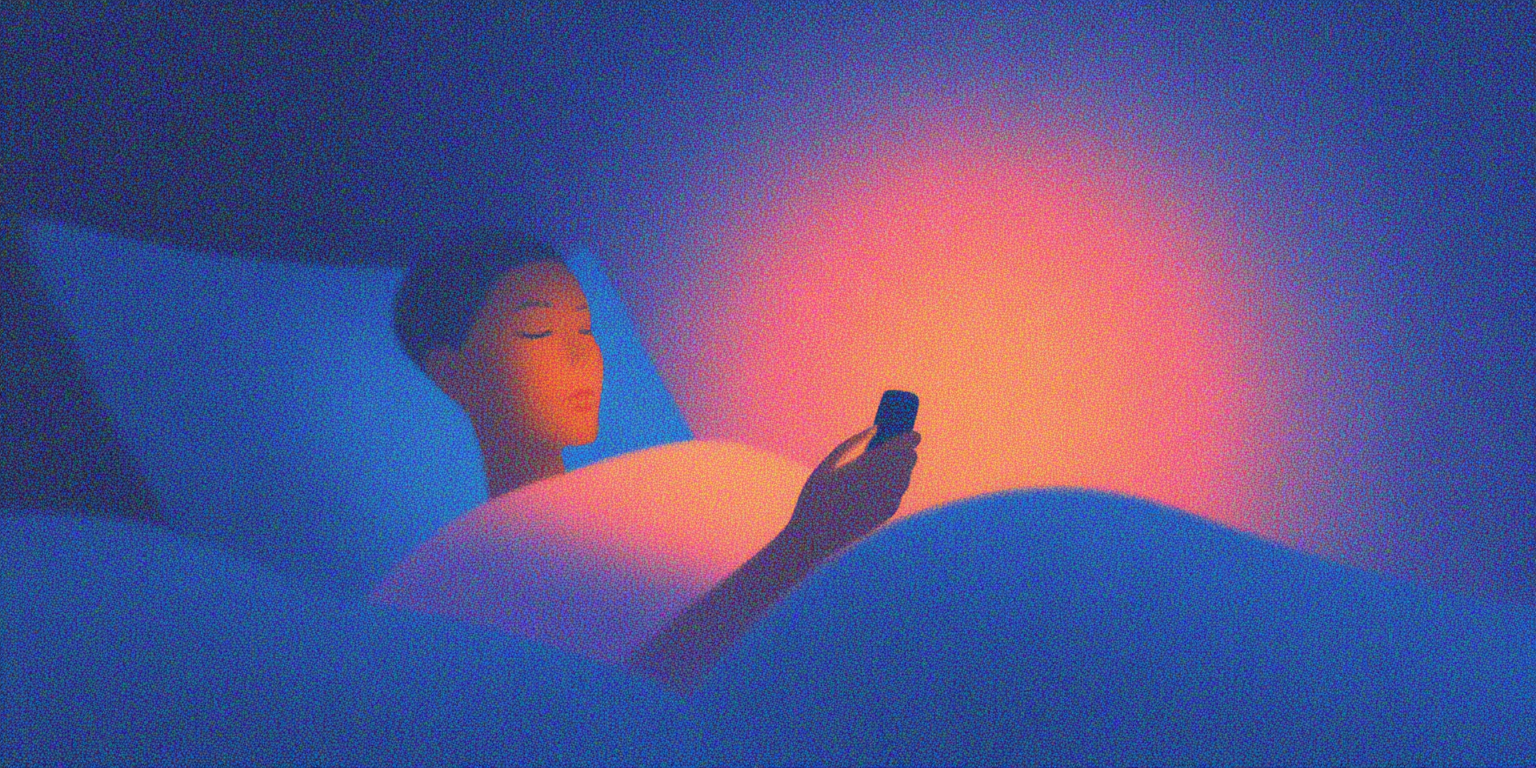
Scrolling in bed costs you sleep three separate ways. The light suppresses melatonin and pushes your body clock later. The content triggers your alert system, so you stay wired after the screen is off. And the time disappears — five more minutes becomes an hour you cannot get back.
If you have put the phone down and still lain there awake, feeling like your brain refused to cooperate, that was not your fault and not a failure of willpower. Two of the three mechanisms are still working after the screen goes dark, and one of them is chemical.
Note: this article explains how screens affect sleep and is not medical advice. A tracker cannot diagnose insomnia. Persistent trouble sleeping, or exhaustion despite adequate hours, needs a clinician rather than a better bedtime routine.
The longer version. The result of those three hits is a longer time to fall asleep, fewer hours, lighter and less restorative sleep — less deep and less REM — and a mind still buzzing when the lights are off. The good news is that this is among the most fixable sleep problems there is, because all three mechanisms respond to the same small set of changes.
A note on the data: Welltory doesn't track phone use, so this isn't a Welltory cohort finding. It's the well-established science of screens and sleep, plus how the cost shows up in exactly what a tracker measures — when you fall asleep, how long you sleep, your deep and REM sleep, and your next-day energy and HRV.
Hit one: light delays your body clock
Your brain decides it's bedtime largely based on light, and screens send the wrong signal. The blue-enriched light from a phone held close to your face suppresses melatonin and delays your circadian clock, so your body doesn't get the "it's night" cue on time. Research on evening display light shows it measurably lengthens sleep latency (how long it takes to fall asleep), suppresses melatonin, and raises alertness. (ncbi.nlm.nih.gov) And blue light doesn't just delay sleep — it can reduce time in slow-wave and REM sleep, the stages that do the most restoration. (sleepfoundation.org) Night mode and dimming help a little, but they don't remove the other two hits.
Hit two: doomscrolling wires your brain
Even if you filtered out every photon, the content would still be a problem — and doomscrolling is uniquely bad. Sleep needs your brain to shift into rest mode; a feed of alarming news, outrage, social comparison, and rapid video does the reverse, triggering the alert system and cranking up anxiety and stress just as you're trying to wind down. (ncbi.nlm.nih.gov) That emotional arousal keeps your nervous system in a mild fight-or-flight state, which is exactly the wrong gear for falling and staying asleep. It's why you can put the phone down and still lie there wired, mind racing — the scroll left your brain switched on. Evening smartphone use is linked not just to worse sleep but to poorer overnight memory consolidation, a downstream cost of that disrupted, shortened sleep.
Why the feed is harder to leave than a book
Worth naming, because "just stop" ignores that these products are built by people whose job is to prevent you stopping.
There is no end. A chapter ends, an episode ends, a feed does not. The design decision that removed the bottom of the page removed the natural moment at which you would have put it down.
Autoplay removes the next decision. The cost of continuing is zero and the cost of stopping is an action. Reverse those and most people stop within minutes.
Variable rewards keep attention. Most of what you scroll past is nothing; occasionally something lands. That pattern — unpredictable payoff — holds attention far more effectively than reliable payoff, which is why a feed is stickier than a book you are enjoying.
Notifications create re-entry points. Every one is an invitation to start again, and a phone by the bed makes re-entry frictionless at three in the morning.
None of this means the pull is not real or that you are weak for feeling it. It means willpower is the wrong tool, and the effective interventions are all about friction — distance, a charger in another room, grayscale, timers. You are not trying to want it less. You are trying to make it slightly annoying.
Hit three: the hours you don't get back
The third hit is the simplest and often the biggest: scrolling eats time you'd otherwise spend asleep. "Just a few more minutes" stretches into an hour, and because falling into a feed is frictionless, bedtime slips later and later. Psychologists call this revenge bedtime procrastination — staying up to reclaim leisure or autonomy that the day didn't allow, even at a known cost to sleep. A 2021 study linked it to high job demands, smartphone habits, and poorer self-regulation. (studentaffairs.stanford.edu) It's an understandable impulse — that late-night window can feel like the only time that's yours — but the sleep you trade away is exactly what makes the next day feel like it needs reclaiming, keeping the loop going.
Is it worse for teenagers?
The evidence points that way, and for reasons that are structural rather than moral.
Adolescent body clocks run late anyway. The natural shift towards later sleep timing in the teenage years is biological, not defiance — and a delayed clock plus a bright screen plus a fixed school start compresses sleep from both ends.
Sleep need is higher and being met less often. Teenagers need more sleep than adults and routinely get less, so the same hour lost costs proportionally more.
The social stakes are higher. For an adult a feed is entertainment; for a teenager it is often where the social world is happening, and stepping away at ten has a cost adults do not feel. Advice that ignores this gets ignored.
What tends to work is the same friction, applied as a household arrangement rather than a rule for one person: phones charging outside bedrooms overnight, for everyone including the adults. A rule that applies to one member of the family reads as punishment; one that applies to all of them reads as how the house works.
What does not work is confiscation as a response to bad marks or a late night, which reliably turns the phone into contested territory and the bedroom into somewhere to hide one.
How long before bed should you stop looking at screens?
The advice you will see everywhere is an hour. It is a reasonable default and it is worth understanding where it comes from, because the three mechanisms have very different timescales.
The light needs the most lead time. Melatonin suppression and the delay to your body clock depend on how bright the light is, how long you are exposed and how close it is to your face — and a phone held thirty centimetres away is a much stronger signal than a television across the room. An hour of dim light before bed is the version of this advice with the most behind it.
The arousal needs less, but not none. After genuinely activating content — an argument, distressing news, work email — the nervous system takes time to come down. This is why a calm fifteen minutes does more than an hour of scrolling followed by an abrupt lights-out.
The time loss needs a decision, not a countdown. No cutoff helps if the cutoff is negotiable. The hour only works if something replaces it.
A realistic version for people who will not do an hour: thirty minutes, phone out of the bedroom, something with a physical end — a chapter, a shower, a stretch. Thirty minutes kept every night beats sixty minutes kept twice a week.
And one useful reframe. The point is not that screens are forbidden. It is that the last stretch before sleep should be boring, and a feed is engineered to be the opposite. What you are protecting is not darkness — it is the absence of anything demanding.
Does night mode or a blue light filter actually help?
Partly, and less than the marketing implies — which matters, because a lot of people install a filter, change nothing else, and conclude the whole idea is nonsense.
What filters do address. They reduce the blue-enriched component of the light, which is the part melatonin suppression is most sensitive to. Turning brightness down does at least as much as the colour shift, and both together are better than neither.
What they do not touch. The content and the time. A filter does not make an outrage thread less activating or a feed less absorbing, and those are two of the three mechanisms. A dimmed, warm-toned screen showing you something upsetting at midnight is still costing you the night.
Why the evidence looks mixed. Studies on filters show modest effects, and the honest reading is that the light is real but is not the whole story, and it is probably not even the biggest part for most people. Anyone promising that a setting solves this is selling something.
Practical version: use night mode and low brightness because they are free and directionally right, and do not count them as your solution. If you want one change that works, it is moving the phone out of reach, not changing its colour temperature.
What if you genuinely cannot fall asleep without your phone?
This is the situation most advice skips, and it deserves a straight answer rather than more discipline.
For many people the phone is doing a job. It is distraction from an anxious mind, company in a quiet flat, or the only unstructured time in the day. Remove it without replacing the function and you get a person lying in the dark with their thoughts, sleeping worse, and reaching for the phone again by Thursday.
So replace rather than subtract. Audio works well for a lot of people — an audiobook, a podcast you have heard before, something dull. It occupies the anxious channel without light and without a feed that renews itself indefinitely. A paper book does the same if reading is your thing. The criterion is that it should end, or become boring, on its own.
If the pull is anxiety, the phone is a symptom. Lying awake with a racing mind is worth addressing directly rather than through screen rules, and it is one of the places where cognitive behavioural therapy for insomnia genuinely outperforms sleep hygiene advice.
And do not get into bed to fight it. If you have been lying awake for what feels like twenty minutes or more, getting up and doing something quiet in dim light is better than staying put — for the same reason that the bed should not become a place associated with being awake and frustrated.
One honest caution about tracking. If checking your sleep data has itself become a source of anxiety, that is a real phenomenon and the answer is to check less. A tracker is meant to make a pattern visible, not to grade your nights.
How to break the habit
You don't need monk-like discipline — you need to add friction and address the "why." Get the phone out of the bedroom, or at least out of arm's reach, and charge it across the room so checking it takes effort. Set a cutoff roughly an hour before bed and put a genuine wind-down in its place (reading on paper, a shower, stretching, dim light). Use night mode and lower brightness as a small help, but don't rely on them — the content and the time loss matter more than the light. And gently tackle revenge bedtime procrastination by building small pockets of "your time" into the actual day, so nighttime doesn't have to carry all of it. If the pull is strong, app timers and grayscale mode reduce the feed's grip.
Two things worth reading alongside this: why you wake in the night and what it costs the next morning, and how much movement has quietly disappeared from an ordinary day.
How to bring this up with your doctor
Screen habits rarely need a doctor. Persistent bad sleep does, and the distinction is worth getting right before you spend another six months adjusting your evening.
Try the obvious thing first, properly. Two weeks with the phone out of the bedroom is a real experiment. If your sleep improves, you have your answer for free.
If it does not, that is the useful information. Sleep that stays broken after the screens are gone is not a screen problem, and that is the sentence to open with.
Bring two weeks of notes: what time you got into bed, roughly how long until sleep, how often you woke, and how you felt the next day. Duration and fragmentation are what a clinician can use; sleep-stage percentages from a wearable are much softer.
Ask about CBT-I by name. Cognitive behavioural therapy for insomnia is the first-line treatment for chronic insomnia in adults and consistently outperforms sleep hygiene advice, which is what most people are handed instead. It is reasonable to ask whether it is available to you.
Flag these specifically, because they point away from habits entirely: loud snoring with pauses or waking gasping, which suggests sleep apnoea; exhaustion despite adequate hours; an irresistible urge to move your legs in the evening; or low mood alongside the sleep trouble, since depression and insomnia feed each other and treating one without the other tends to fail.
And mention what you take. Caffeine timing, alcohol, and several common medications affect sleep architecture more than an hour of scrolling does.
What actually changes when you stop, and how fast
Useful to know before you start, because the timeline shapes whether you stick with it.
The first two or three nights may be worse. Lying down without the usual distraction is uncomfortable, and people frequently report taking longer to fall asleep at first. This is the most common point at which the experiment gets abandoned, and it is the wrong conclusion drawn from the right observation.
Within about a week, most of what changes is timing: you get into bed earlier because nothing is holding you, and you fall asleep sooner because the arousal is lower. Those two together often add more sleep than anything else you could do.
Total sleep time is the honest headline. If the change works for you, it mostly shows up as more hours, not as some transformation in sleep quality. That is not a disappointing result — for most people short sleep is the actual problem, and stages are a distraction from it.
Deep and REM usually follow duration. More total sleep generally means more of both, since they scale with time asleep. A device reporting a large jump in deep sleep percentage is more likely to be noise than a real structural change.
Give it two weeks before judging. One night proves nothing in either direction, and the first few are unrepresentative for the reason above.
And expect it to slip. Almost everyone reverts during a stressful week. The habit that survives is the one with the charger in another room, not the one held together by intention.
How Welltory helps you catch it in your own data
Because the effect is large and immediate, this is an ideal thing to test on yourself. Compare nights you scrolled in bed to nights you stopped an hour before and did something calmer, and watch your bedtime and sleep onset (later and slower after scrolling), your total sleep, deep and REM, your awakenings, and your next-day energy, HRV, and resting heart rate. Many people are startled to see how a late scroll pushes their whole night back and thins out their restorative sleep — and how much better their morning numbers look after a phone-free wind-down. Use it to find what actually works for you, and to make the trade-off concrete: seeing the lost deep sleep and the sluggish next-day recovery is often more motivating than any "put your phone away" advice. Two honest caveats: sleep-stage estimates and HRV are noisy night to night, so read the pattern across a week rather than one night, and a tracker can't diagnose insomnia — persistent trouble sleeping deserves a doctor. But for turning a hazy "my phone probably wrecks my sleep" into a personal, visible fact, this is exactly what a tracker is for.
How we made it
Made with AI tools, then edited, fact-checked and medically reviewed by the Welltory team. See our Editorial & AI policy.
Data analysis by Jane Smorodnikova, co-founder of Welltory and the person who built the methodology behind how we read physiological data.
Written by Tatsiana Yashyna.
Reviewed by Anna Elitzur — Medical Advisor & Mental Health Expert.


Discounts for blog readers: up to 36% off
See what affects your energy, stress, sleep, and daily state with Welltory
This article is for educational purposes only and is not medical advice. If you have ongoing insomnia or sleep problems, talk to a doctor. Welltory measures physiological signals like heart rate, HRV, sleep, activity, and stress; it does not diagnose anything.
Was this helpful?
Ask AI for a summary of page


Written by Jane Smorodnikova

The founder and CEO of Welltory. A recognized tech leader with two Master's degrees and experience at MIT, she has scaled Welltory to over 17 million users.
Written by Tatsiana Yashyna

Deputy COO at Welltory. With a background in medicine and years of working with health data, she translates research and real physiological signals — sleep, stress, heart rate, and hormones — into clear, evidence-based explanations that help people understand what their bodies are telling them.
Reviewed by Anna Elitzur
-2.jpg)
With her medical degree, Anna reviews Welltory's health content for medical accuracy and alignment with current clinical guidelines and research.
References
- Melanopic irradiance defines the impact of evening display light on sleep latency, melatonin and alertness. PMC. 2023. https://www.ncbi.nlm.nih.gov/pmc/articles/PMC9974389/
- Effects of evening smartphone use on sleep and declarative memory consolidation in adolescents and young adults. PMC. 2024. https://www.ncbi.nlm.nih.gov/pmc/articles/PMC11154150/
- How blue light from electronic devices affects sleep (melatonin suppression, reduced slow-wave and REM sleep). Sleep Foundation. https://www.sleepfoundation.org/how-sleep-works/how-electronics-affect-sleep
- Revenge bedtime procrastination (concept and 2021 associations with job demands, smartphone use, self-regulation). Stanford Student Affairs. https://studentaffairs.stanford.edu/sleep-revenge-bedtime-procrastination