

Short answer
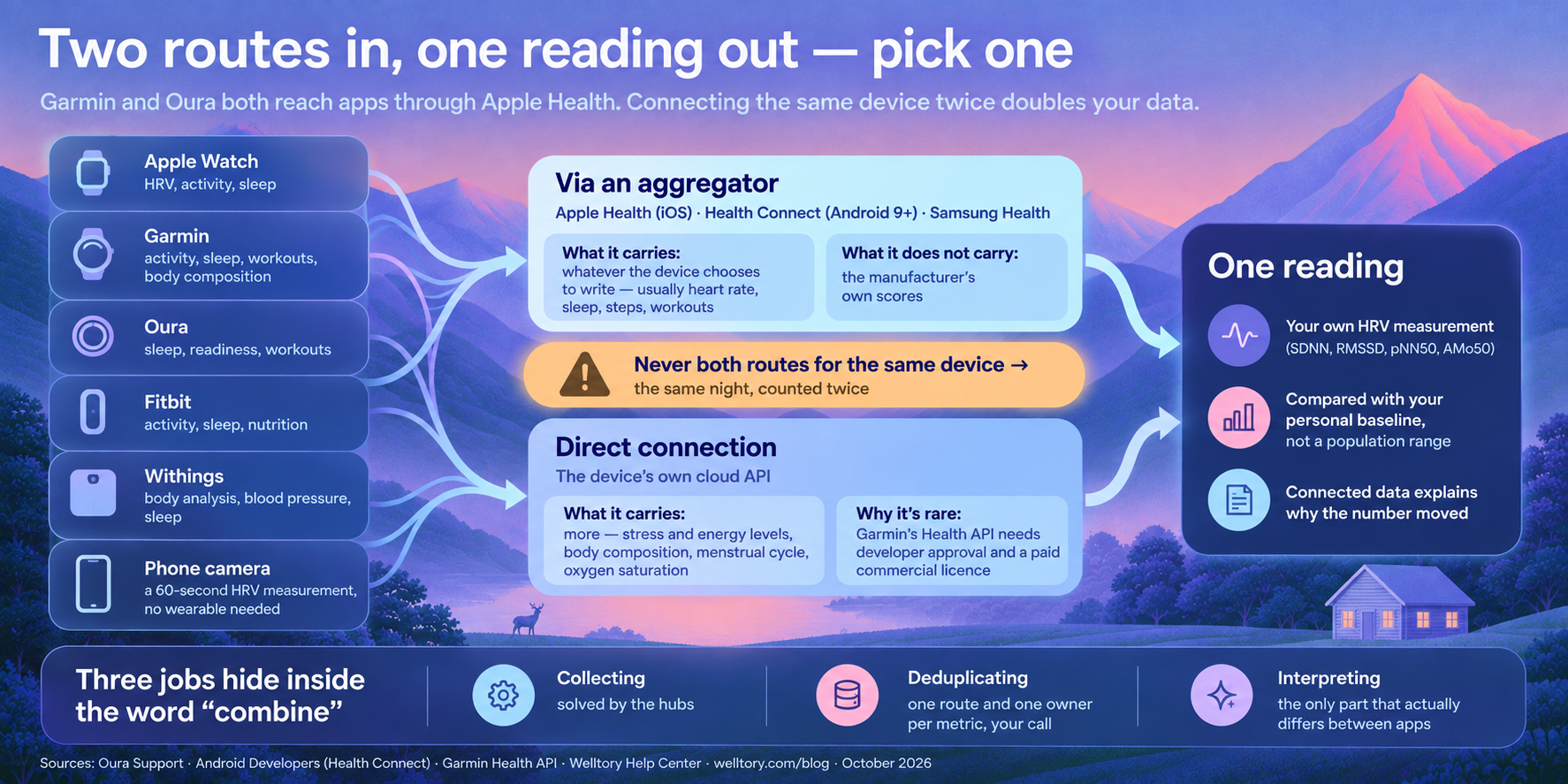
Any app that reads from Apple Health or Health Connect can combine data from most wearables, because Garmin, Oura, Fitbit and Apple Watch all write into those hubs. The harder part is not collecting the data — it is reconciling it. The same night can produce two different sleep scores, and connecting a device twice can double-count your steps.
Why does my health data end up in three apps that don't agree?
Because each company built a closed loop on purpose. Your ring measures sleep and shows it in its own app. Your watch measures steps and shows them in its own app. Your phone counts steps too, whether or not you asked it to. Nobody designed these to be read together, and nobody is responsible for making the totals match.
There is a shared layer underneath — Apple Health on iOS, Health Connect on Android — and most devices do write to it. But a hub is a filing cabinet, not an analyst. It stores a step count from Garmin and a step count from your iPhone side by side without deciding which one is true. It stores a sleep session from Oura and a sleep session from your Apple Watch without reconciling them. What you see when you open the Health app is the pile, not the answer.
So the real question behind "which app combines my data" is usually not "which app can read all of it." Several can. It is "which app does something sensible with it once it has it."
What "combining" actually means — three different jobs
The word hides three separate pieces of work, and most apps only do the first.
Collecting. Reading data from multiple sources into one place. This is the easy part, and it is largely solved by the platform hubs. On iPhone, Apple Health is the hub; on Android, Health Connect, which Google states is compatible with Android 9 (API level 28) and higher and is the successor to Google Fit. If an app asks for Health permissions, it can usually see whatever your devices have written there.
Deduplicating. Deciding what to do when two sources describe the same event. Your phone and your watch both counted this morning's walk. Your ring and your watch both logged last night. Without a rule, the app adds them together and tells you that you walked 19,000 steps, which you did not.
Interpreting. Turning a pile of numbers into one statement about your day. This is where apps actually differ, and it is the part that cannot be solved by adding another integration.
An app can be excellent at the first and useless at the third. That is why "it syncs with everything" is a weak answer to the question you are really asking.
How do aggregators work on iPhone and Android?
Think of an aggregator as a shared notebook that any app can read from and write to, with your permission, one data type at a time.
Apple Health (iOS) is the default hub for iPhone. Garmin Connect, the Oura app, Fitbit, Withings, Strava and most other health apps can write to it, and other apps can read from it. You control each permission separately: an app can be allowed to read your heart rate but not your weight.
Health Connect (Android) does the same job on Android, and Google is retiring the Google Fit APIs in favour of it — Google's developer documentation states Fit APIs will be supported until the end of 2026. Health Connect also now carries data types that older hubs did not, including skin temperature, exercise routes and mindfulness.
Samsung Health plays the hub role for Samsung devices and can pass data onward.
The important limitation is that a hub only contains what a device chooses to write. Oura's own support documentation lists what it exports to Apple Health — active energy, heart rate, height, mindful minutes, respiratory rate, sleep with stages, steps, weight, workout routes and workouts — and separately lists what it imports. Readiness and the ring's own scores are not in the export list. The same asymmetry applies to other devices: the hub gets the raw-ish measurements, not the manufacturer's proprietary interpretation of them.
That is why some apps also build direct connections to a device's own cloud API, bypassing the hub. A direct connection can pull things the hub never sees. It is also much more work: Garmin's Health API, for example, requires developer approval before you get access to even an evaluation environment, and Garmin states that commercial use requires a licence fee. That approval process and licence fee are a real barrier for a small developer, which is one reason direct integrations are less common than hub integrations.
Which apps can actually pull Garmin, Oura and Apple Health together?
Practically: most health apps that request Health permissions can read Garmin and Oura data, because both write to the hub. The distinctions worth caring about are narrower than the marketing suggests.
Does it read from the hub, or only from its own hardware? Some apps are built only around their manufacturer's own device and show you nothing else. The app's own support documentation will say which data sources it accepts, and if you own two brands that is the first thing to check.
Does it have direct connections as well as hub access? Direct connections surface data the hub does not carry. Welltory, for example, connects directly to Garmin, Oura, Fitbit, Withings, Strava and a few non-fitness sources such as RescueTime and Netatmo, in addition to reading Apple Health, Health Connect and Samsung Health. The practical difference with Garmin is large: through a direct connection, Welltory receives workouts, stress level, energy level, body composition, sleep, menstrual cycle, oxygen saturation, breathing, heart rate, steps, distance and calories.
Does it measure anything itself, or only re-display other people's numbers? This matters more than it sounds. An app with no sensor of its own inherits every gap in your devices' coverage: take the ring off to charge it and the night is gone. Welltory measures heart rate variability directly through the phone camera, so there is one signal that does not depend on whether you wore anything.
Does it tell you what the combination means? The honest test is to connect a second source and see whether the app's conclusion changes. If nothing changes except the number of charts, it is collecting, not combining.
Why does the same night get two different sleep scores?
This is the question that sends people looking for one app in the first place, and the answer is not that one device is lying.
Consumer sleep trackers estimate sleep stages from movement and heart rate, because the thing that actually defines a sleep stage — brain activity — is not something a wrist or a finger can see. Researchers test these estimates against polysomnography, the overnight lab recording that is the reference standard, and the results are consistent across studies.
In a 2025 validation in Sleep Advances, 62 adults slept one night with polysomnography while wearing two to four of six consumer devices (Fitbit Charge 5, Fitbit Sense, Withings ScanWatch, Garmin Vivosmart 4, Whoop 4.0, Apple Watch Series 8). Every device detected more than 90% of sleep epochs — they are good at knowing you are asleep. But specificity ranged from 29% to 52%, meaning they are much weaker at recognising the moments you were awake, and agreement with the lab on which stage you were in gave Cohen's kappa values from 0.21 to 0.53 — fair to moderate.
A 2024 study in Sensors found something more useful for everyday life: the errors are not random, they are directional. Across five devices, all of them overestimated nights with short wake times and underestimated nights with long wake times. Each device also had its own signature — the Oura Ring underestimated light sleep of any duration in that sample, while the Withings sleep mat and the Garmin Vivosmart were accurate on deep sleep but compressed the range of light sleep. These are findings about specific models tested on one night in a lab, and they do not automatically carry across to other models from the same brands.
Two devices with different proportional biases, measuring the same night, will disagree. Neither is broken. No app can resolve that disagreement, because the information needed to resolve it does not exist in the data. What a good app can do is stop pretending the disagreement is a problem to be averaged away, and compare each source against its own history instead.
The duplication trap: when connecting more makes your data worse
The counter-intuitive part of aggregation is that adding a source can make your picture less accurate.
The classic case is a device that can reach the app by two routes at once. Oura can send data to an app through Apple Health and through a direct connection; connect both and the same workout, or the same night, can arrive twice. Welltory's own help centre says this plainly: we do not recommend using both connection types at the same time, because it leads to duplicate data. The same applies anywhere else you have a choice of routes.
The second case is step double-counting, which happens inside the hub rather than inside any one app. Your phone counts steps whenever it is in your pocket. Your ring or watch counts the same steps. Oura's support documentation tells users to set Oura as the priority step source in Apple Health, or to turn off Oura's step writing altogether — which is a vendor acknowledging that the hub will otherwise add two records of one walk.
Three rules that prevent most of this:
One route per device. Direct connection or aggregator, not both.
One owner per metric. Decide which device is the authority for steps, which for sleep, which for heart rate. Turn the others off for that metric rather than trusting an average.
Check the total, not the chart. A step count that jumped the day you connected something new is the signature of a duplicate, not of a sudden habit change.
What Welltory actually measures here
Aggregated data is context. The measurement Welltory contributes is its own, and it is worth being specific about what it is, because "HRV" on three devices can mean three different numbers.
Where it comes from. A short measurement with your phone camera and flash, or from an Apple Watch, Samsung Watch, Google Pixel Watch (series 2, 3 and later), or a heart rate monitor that transmits raw RR intervals over Bluetooth 4.0. Garmin watches, Oura rings and Fitbit trackers send activity and sleep to Welltory, but Welltory's HRV measurements do not come from them: they do not pass on the unsmoothed beat-to-beat intervals these metrics are computed from. Garmin's HRM-Dual and HRM-Pro chest straps do, and can be used for measurements. Our device compatibility table lists this device by device.
What it produces. Open Measurement details after any reading and you get the standard HRV metrics, not a proprietary score:
SDNN — the standard deviation of normal intervals between beats; the broadest single indicator of whether your variability sits in the usual range.
RMSSD — the root mean square of successive differences; the metric most closely tied to parasympathetic activity, which is the branch responsible for recovery.
pNN50 — the proportion of adjacent intervals differing by more than 50 ms; high when the body is relaxed, low when you are tired or over-stressed.
AMo50 — mode amplitude; the counterpart that reflects sympathetic activity, the mobilising side.
Mean RR and MxDMn — average interval length and the spread between the longest and shortest.
Frequency-domain values — Total Power, VLF, LF, HF and the LF/HF ratio. These need a longer reading: switch on 300-beat mode in Menu → Settings.
Every measurement also carries an accuracy score, so a reading taken while you were moving or talking is marked as such instead of quietly entering your trend.
How we interpret it. This is where connected sources earn their place. The published reference ranges for these metrics are extremely wide — for RMSSD, pooling the studies gives something like 13–107 ms, which is too broad to tell anyone anything. We narrowed it with an internal analysis of artefact-free RR intervals from over 600 Welltory users who had measured for at least 90 days, which gives our working RMSSD range of 20–89 ms. That analysis is ours and has not been externally peer-reviewed; the method is described in our help centre. Even that is a population range, not your range. The comparison that actually means something is against your own baseline, and your baseline is built from your own history.
That is the job aggregated data does here. Your sleep from a ring, your steps and workouts from a watch, your caffeine and alcohol from tags, your air quality from a sensor if you have one — none of those are the measurement. They are the explanation for why the measurement moved.
Before you blame yourself for inconsistent numbers
Most people arrive at this question slightly irritated with themselves. The ring says one thing, the watch says another, and the quiet conclusion is I must be doing this wrong.
You are not. You are looking at three instruments with different sensors, different measurement windows and different proprietary models, each reporting honestly from where it sits. Disagreement between them is the expected result, and the research above says so in numbers.
What changes the picture is giving yourself one signal you take deliberately, under consistent conditions, and then watching it against your own history rather than against anyone else's number. A hard week shows up. Three short nights in a row show up. So does the evening you thought you had got away with. Two weeks of that is usually enough to see a pattern you could not see while comparing apps.
Before you conclude that you are inconsistent, check what your body already recorded.


Start understanding your body
Learn what affects your energy, stress, sleep, and daily state. Get the app.
How Welltory helps — and what it cannot do
What it does. Reads from Apple Health, Health Connect and Samsung Health, and connects directly to Garmin, Oura, Fitbit, Withings, Strava and others, so sleep, activity, workouts and body composition arrive in one place. Adds its own HRV measurement from the phone camera, which does not depend on wearing anything. Builds a personal baseline from your own history and reads each new measurement against it. Shows you the standard metrics underneath, not only a score.
What it cannot do. It cannot make two devices agree about last night, and it will not pretend to. It cannot take an HRV measurement from a Garmin watch, an Oura ring or a Fitbit, because they do not pass on the raw beat-to-beat intervals it needs. It is not a medical app and not a medical device: it does not diagnose, treat or monitor any condition, and an HRV measurement is not an ECG. It holds health data — our privacy policy classifies that as special category personal data requiring your explicit consent — but it holds no clinical record: no diagnosis, no condition, no treatment history, because we never ask for any. It also cannot help much in a week: the interpretation depends on having a baseline, and a baseline takes repeated measurements over weeks to form.
If something about your health worries you, that belongs with a clinician, not with a better dashboard.


Discounts for blog readers: up to 36% off
See what affects your energy, stress, sleep, and daily state with Welltory
This article is for educational purposes only and is not a substitute for medical advice, diagnosis, or treatment from a qualified clinician. Welltory is not a medical device.
Was this helpful?
Ask AI for a summary of page


Written by Jane Smorodnikova

The founder and CEO of Welltory. A recognized tech leader with two Master's degrees and experience at MIT, she has scaled Welltory to over 17 million users.
Written by Tatsiana Yashyna

Deputy COO at Welltory. With a background in medicine and years of working with health data, she translates research and real physiological signals — sleep, stress, heart rate, and hormones — into clear, evidence-based explanations that help people understand what their bodies are telling them.
Written by Veranika Zdanovich

Veranika leads Welltory’s commercial strategy, growth initiatives, and global partnerships. Working at the intersection of health technology, consumer behavior, and product-led growth, she helps build personalized wellness experiences used by millions worldwide.
References
- Oura Support. Apple Health integration — data exported from Oura to Apple Health, imported data types, and step priority settings. https://support.ouraring.com/hc/en-us/articles/360025438734
- Google. Health Connect — Android developer documentation: supported Android versions, data types, and migration from the Google Fit APIs. https://developer.android.com/health-and-fitness/guides/health-connect
- Garmin. Health API — Garmin Connect Developer Program: available data types, approval process, and commercial licensing. https://developer.garmin.com/gc-developer-program/health-api/
- Schyvens AM, Peters B, Van Oost NC, Aerts JM, Masci F, Neven A, Dirix H, Wets G, Ross V, Verbraecken J. A performance validation of six commercial wrist-worn wearable sleep-tracking devices for sleep stage scoring compared to polysomnography — Sleep Advances, 2025;6(2):zpaf021. https://doi.org/10.1093/sleepadvances/zpaf021
- Kainec KA, Caccavaro J, Barnes M, Hoff C, Berlin A, Spencer RMC. Evaluating accuracy in five commercial sleep-tracking devices compared to research-grade actigraphy and polysomnography — Sensors, 2024;24(2):635. https://doi.org/10.3390/s24020635
- Data sources and how to connect them — Welltory Help Center. https://help.welltory.com/en/articles/11130907-data-sources-and-how-to-connect-them
- Is my device compatible with Welltory for HRV measurements and activity tracking? — Welltory Help Center. https://help.welltory.com/en/articles/4998580-is-my-device-compatible-with-welltory-for-hrv-measurements-and-activity-tracking
- About your heart rate variability metrics — Welltory Help Center. https://help.welltory.com/en/articles/3878830-about-your-heart-rate-variability-metrics
- What normal ranges and measurement standards we use to interpret your heart rate variability — Welltory Help Center. https://help.welltory.com/en/articles/4413231-what-normal-ranges-and-measurement-standards-we-use-to-interpret-your-heart-rate-variability